Non Surgical Aesthetic Device Market
Non Surgical Aesthetic Device Market Summary
As per Market Research Future analysis, the Non-Surgical Aesthetic Device Market was estimated at 16.15 USD Billion in 2024. The Non-Surgical Aesthetic Device industry is projected to grow from USD 17.0 Billion in 2025 to USD 28.38 Billion by 2035, exhibiting a compound annual growth rate (CAGR) of 5.26% during the forecast period 2025 - 2035
Key Market Trends & Highlights
The Non-Surgical Aesthetic Device Market is experiencing robust growth driven by technological advancements and increasing consumer acceptance.
- The market is witnessing a rise in personalized treatments tailored to individual needs and preferences.
- Integration of advanced technologies is enhancing the efficacy and safety of non-surgical aesthetic procedures.
- North America remains the largest market, while Asia-Pacific is emerging as the fastest-growing region in this sector.
- The growing demand for minimally invasive procedures and rising disposable incomes are key drivers propelling market expansion.
Market Size & Forecast
| 2024 Market Size | 16.15 (USD Billion) |
| 2035 Market Size | 28.38 (USD Billion) |
| CAGR (2025 - 2035) | 5.26% |
Major Players
Allergan (US), Galderma (CH), Revance Therapeutics (US), Medytox (KR), Hugel (KR), Ipsen (FR), Sientra (US), Hugel (KR)
Non Surgical Aesthetic Device Market Trends
The Non-Surgical Aesthetic Device Market is currently experiencing a notable transformation, driven by evolving consumer preferences and advancements in technology. As individuals increasingly seek less invasive options for enhancing their appearance, the demand for non-surgical procedures is on the rise. This shift is largely influenced by a growing awareness of the benefits associated with these devices, including minimal downtime and reduced risk compared to traditional surgical methods. Furthermore, the market is characterized by a diverse range of products, from injectables to laser treatments, catering to various aesthetic needs. In addition, the Non-Surgical Aesthetic Device Market is witnessing a surge in innovation, with manufacturers continuously developing new technologies to improve efficacy and safety. This trend is complemented by an increase in the number of trained professionals offering these services, which further enhances accessibility for consumers. As the market evolves, it appears poised for sustained growth, driven by a combination of consumer demand, technological advancements, and a broader acceptance of aesthetic procedures. The future landscape of this market may be shaped by ongoing research and development, as well as changing societal attitudes towards beauty and self-care.
Rise of Personalized Treatments
The Non-Surgical Aesthetic Device Market is increasingly leaning towards personalized treatment options. Consumers are seeking tailored solutions that address their unique aesthetic concerns, leading to a demand for devices that can be customized to individual needs. This trend suggests a shift from one-size-fits-all approaches to more individualized care, enhancing patient satisfaction and outcomes.
Integration of Advanced Technologies
The integration of advanced technologies, such as artificial intelligence and machine learning, is becoming more prevalent in the Non-Surgical Aesthetic Device Market. These innovations are enhancing the precision and effectiveness of treatments, allowing practitioners to deliver better results. This trend indicates a move towards more sophisticated devices that can analyze patient data and optimize treatment plans.
Increased Focus on Safety and Regulation
There is a growing emphasis on safety and regulatory compliance within the Non-Surgical Aesthetic Device Market. As consumers become more informed about potential risks, manufacturers are prioritizing the development of safer devices and adhering to stricter regulations. This trend highlights the importance of consumer trust and the need for transparency in the aesthetic industry.
Non Surgical Aesthetic Device Market Drivers
Rising Disposable Incomes and Consumer Spending
Economic factors, particularly rising disposable incomes, are contributing to the growth of the Non-Surgical Aesthetic Device Market. As individuals experience increased financial stability, they are more willing to invest in personal appearance and wellness. This trend is particularly evident in emerging markets, where a burgeoning middle class is seeking aesthetic enhancements. Market analysis indicates that consumer spending on non-surgical aesthetic procedures has seen a marked increase, with many individuals prioritizing self-care and beauty treatments. This shift in spending habits is likely to continue, as more consumers view aesthetic procedures as an integral part of their lifestyle. Consequently, the Non-Surgical Aesthetic Device Market is poised for expansion, driven by a demographic that values aesthetics and is willing to allocate resources towards achieving their desired appearance.
Technological Advancements in Aesthetic Devices
Technological innovation plays a pivotal role in shaping the Non-Surgical Aesthetic Device Market. The introduction of advanced technologies, such as artificial intelligence and machine learning, enhances the precision and effectiveness of aesthetic treatments. Devices equipped with these technologies can provide personalized treatment plans, improving patient satisfaction and outcomes. Furthermore, the integration of non-invasive imaging techniques allows practitioners to assess skin conditions more accurately, leading to tailored solutions. The market is witnessing a shift towards devices that combine multiple modalities, such as ultrasound and laser, to address various aesthetic concerns simultaneously. This trend not only broadens the treatment options available but also attracts a wider clientele. As technology continues to evolve, the Non-Surgical Aesthetic Device Market is expected to expand, driven by the demand for innovative and effective solutions.
Growing Demand for Minimally Invasive Procedures
The Non-Surgical Aesthetic Device Market is experiencing a notable surge in demand for minimally invasive procedures. Patients increasingly prefer treatments that offer effective results with reduced recovery times and lower risks compared to traditional surgical options. This trend is reflected in the rising popularity of devices such as injectables, laser treatments, and radiofrequency devices. According to recent data, the market for non-surgical aesthetic procedures is projected to grow at a compound annual growth rate of approximately 10% over the next five years. This growth is driven by a combination of factors, including an aging population seeking rejuvenation and younger individuals desiring preventive treatments. As awareness of these options expands, the Non-Surgical Aesthetic Device Market is likely to see continued growth, catering to a diverse demographic seeking aesthetic enhancements.
Expansion of Aesthetic Clinics and Service Providers
The proliferation of aesthetic clinics and service providers is a key driver of the Non-Surgical Aesthetic Device Market. As the demand for non-surgical treatments rises, more practitioners are entering the market, offering a diverse range of services. This expansion is not limited to urban areas; even smaller towns are witnessing the establishment of aesthetic clinics, making treatments more accessible to a broader audience. The increase in competition among service providers is likely to lead to improved service quality and innovative treatment offerings. Additionally, many clinics are adopting advanced marketing strategies to attract clients, further fueling market growth. As the number of aesthetic service providers continues to rise, the Non-Surgical Aesthetic Device Market is expected to thrive, catering to an increasingly diverse clientele seeking aesthetic solutions.
Increasing Awareness and Acceptance of Aesthetic Treatments
The Non-Surgical Aesthetic Device Market benefits from a growing awareness and acceptance of aesthetic treatments among consumers. Social media platforms and celebrity endorsements have played a significant role in normalizing these procedures, making them more accessible and desirable. As individuals share their experiences and results online, potential clients are increasingly motivated to explore non-surgical options. This cultural shift is further supported by educational campaigns that emphasize the safety and efficacy of non-invasive treatments. Market data indicates that the number of aesthetic procedures performed has risen significantly, with non-surgical options accounting for a substantial portion of the total. This trend suggests that as societal perceptions continue to evolve, the Non-Surgical Aesthetic Device Market will likely experience sustained growth, driven by an expanding customer base.
Market Segment Insights
By Device Type: Laser Devices (Largest) vs. Energy-Based Devices (Fastest-Growing)
In the Non-Surgical Aesthetic Device Market, Laser Devices hold the largest market share due to their wide range of applications including hair removal, skin resurfacing, and tattoo removal. Energy-Based Devices are rapidly capturing market attention, leveraging advancements in technology to enhance treatment effectiveness and patient outcomes. The distribution of market share reveals a clear hierarchy, with Laser Devices at the forefront, while Energy-Based Devices are gaining traction among both practitioners and consumers. The growth trends within this segment are significantly influenced by consumer demand for minimally invasive procedures and increased awareness of aesthetic treatments. Furthermore, the technological advancements in laser and energy-based technologies have made these devices more effective and user-friendly. The combined effects of rising disposable incomes and social media influence are encouraging a broader acceptance of aesthetic procedures, which benefits both Laser and Energy-Based Devices as leading choices in the market.
Laser Devices (Dominant) vs. Ultrasound Devices (Emerging)
Laser Devices, representing the dominant segment in the Non-Surgical Aesthetic Device Market, are renowned for their versatility and effectiveness in cosmetic procedures. They cater to a diverse clientele looking for effective solutions for skin rejuvenation, hair removal, and pigment correction. In contrast, Ultrasound Devices are emerging as promising alternatives, noted for their non-invasive nature and minimal downtime. While they are currently less utilized compared to Laser Devices, their appeal is growing due to minimal invasiveness and effective results. The continuing innovation in ultrasound technology has the potential to expand its market share and attract a new demographic interested in safe but effective aesthetic treatments.
By Application: Skin Rejuvenation (Largest) vs. Body Contouring (Fastest-Growing)
In the Non-Surgical Aesthetic Device Market, the skin rejuvenation segment holds the largest share, driven by growing consumer demand for youthful skin and the effectiveness of non-invasive techniques. Following closely, body contouring is emerging as the fastest-growing segment, reflecting a shift in consumer preferences towards body aesthetics and the increasing availability of advanced technologies that offer personalized solutions. The demand for skin rejuvenation is fueled by factors such as aging demographics and rising disposable incomes, while body contouring benefits from advancements in laser technologies and a focus on minimally invasive procedures.
Skin Rejuvenation (Dominant) vs. Body Contouring (Emerging)
Skin rejuvenation remains a dominant force in the Non-Surgical Aesthetic Device Market, characterized by a wide range of treatments aimed at improving skin appearance and texture. This segment includes popular procedures such as laser therapy, chemical peels, and microneedling, catering to an audience seeking anti-aging solutions. On the other hand, body contouring is rapidly emerging, gaining traction due to advancements that provide safer and more effective outcomes with minimal downtime. This segment focuses on technologies designed to eliminate unwanted fat and shape the body, appealing particularly to individuals looking for quick and efficient aesthetic improvements. As both segments evolve, they continue to influence market dynamics significantly.
By End User: Dermatology Clinics (Largest) vs. Beauty Clinics (Fastest-Growing)
The Non-Surgical Aesthetic Device Market is predominantly driven by Dermatology Clinics, which capture a significant share of the overall segment due to their specialized services and trained professionals. These clinics typically offer a range of non-surgical treatments utilizing advanced technologies, making them the preferred choice for consumers looking for effective aesthetic solutions. In contrast, Beauty Clinics are rapidly gaining traction, appealing to a wider demographic that prioritizes aesthetic enhancements and wellness treatments, leading to their emergence as a key player in this market.
Dermatology Clinics (Dominant) vs. Homecare Settings (Emerging)
Dermatology Clinics hold a dominant position in the Non-Surgical Aesthetic Device Market due to their established reputation and comprehensive range of treatments, which include laser therapies, skin rejuvenation, and injectable procedures, employing cutting-edge technologies tailored for individual patient needs. On the other hand, Homecare Settings are emerging as a significant trend within the sector, as consumers increasingly seek convenience and personalized care. The rise in at-home aesthetic devices is fueled by technological advancements, affordability, and a growing desire for self-administered treatments, catering to a broad audience eager for accessible and effective aesthetic options.
By Technology: Cryolipolysis (Largest) vs. Intense Pulsed Light (Fastest-Growing)
The non-surgical aesthetic device market showcases a diverse range of technologies, with cryolipolysis holding the largest market share. This technology is particularly favored for its effectiveness in body contouring without invasive procedures. Following it closely is intense pulsed light (IPL), which has gained popularity in recent years for treating skin disorders and enhancing skin appearance. Microdermabrasion and chemical peels are also notable players, contributing to the overall growth of the market, though they hold comparatively smaller shares. In terms of growth trends, intense pulsed light technology is regarded as the fastest-growing segment, attributed to its versatility in various skin treatments and increasing consumer demand for non-invasive aesthetic solutions. As awareness surrounding skin care continues to rise, these technologies are expected to evolve further, driven by advancements in device precision and efficacy. Notably, the rising inclination towards self-care and aesthetic enhancement plays a crucial role in propelling these trends forward.
Cryolipolysis (Dominant) vs. Chemical Peels (Emerging)
Cryolipolysis remains a dominant force in the non-surgical aesthetic device market due to its non-invasive approach and effectiveness in localized fat reduction. Its ability to provide significant results without recovery time makes it a preferred choice for both clinics and patients. In contrast, chemical peels are emerging as an increasingly popular option, offering skin rejuvenation and texture improvement, which are vital in today's aesthetic market. While chemical peels have been available for some time, innovations in formulation and application techniques are enhancing their safety and effectiveness. Patients are becoming more educated about their options, leading to a growing acceptance of chemical peels as a viable non-surgical treatment for various skin concerns. The ongoing development of both technologies indicates a balanced progression in the aesthetic landscape.
Regional Insights
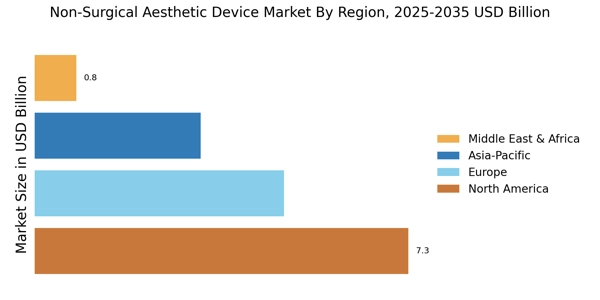
The Non-Surgical Aesthetic Device Market exhibits robust growth across various regional segments, with a notable overall valuation of 16.15 USD Billion in 2024, projected to rise to 28.4 USD Billion by 2035. Among the regions, North America commands a majority holding with a market value of 6.0 USD Billion in 2024, expanding to 10.5 USD Billion by 2035, driven by high consumer demand and advanced healthcare infrastructure.
Europe follows with significant revenue at 4.5 USD Billion in 2024, growing to 8.0 USD Billion, largely attributed to increasing awareness regarding aesthetic procedures and an aging population.The APAC region, valued at 3.5 USD Billion in 2024 and expected to reach 6.5 USD Billion, benefits from rising disposable incomes and changing beauty standards, which contribute to its growing importance in the market. South America and MEA, although comparatively smaller, also show potential with values of 1.5 USD Billion and 0.7 USD Billion in 2024, respectively, reflecting emerging trends and growing acceptance of non-surgical aesthetic procedures.
These regions collectively shape the market dynamics, with each presenting unique opportunities and challenges, making the Non-Surgical Aesthetic Device Market an evolving sector with diverse growth drivers.
Key Players and Competitive Insights
Key Companies in the Non Surgical Aesthetic Device Market include
Industry Developments
- Q2 2024: Cynosure Launches Potenza™ RF Microneedling Device in the U.S. Cynosure announced the U.S. launch of its Potenza™ radiofrequency microneedling device, expanding its portfolio of non-surgical aesthetic solutions for skin revitalization and tightening.
- Q2 2024: Lumenis Announces FDA Clearance for NuEra Tight with FocalRF Technology Lumenis received FDA clearance for its NuEra Tight device, which uses FocalRF technology for non-invasive skin tightening and wrinkle reduction, marking a significant regulatory milestone for the company.
- Q2 2024: Sofwave Medical Receives FDA Clearance for New Synchronous Ultrasound Parallel Beam Technology Sofwave Medical announced FDA clearance for its next-generation synchronous ultrasound parallel beam technology, designed for non-invasive treatment of facial lines and wrinkles.
- Q2 2024: Venus Concept Announces Launch of Venus BlissMAX™ in North America Venus Concept launched Venus BlissMAX™, a new non-invasive device for fat reduction, muscle toning, and skin tightening, expanding its aesthetic device offerings in North America.
- Q3 2024: Cutera Appoints David Mowry as Chief Executive Officer Cutera, a provider of energy-based aesthetic systems, announced the appointment of David Mowry as its new Chief Executive Officer, effective immediately.
- Q3 2024: Alma Lasers Launches Alma PrimeX in Europe for Non-Invasive Body Contouring Alma Lasers announced the European launch of Alma PrimeX, a non-invasive device for body contouring and skin tightening, targeting the growing demand for non-surgical aesthetic treatments.
- Q3 2024: InMode Receives Health Canada Approval for Morpheus8 Body InMode received Health Canada approval for its Morpheus8 Body device, enabling the company to market its non-surgical fractional radiofrequency technology for body remodeling in Canada.
- Q3 2024: Soliton Announces Partnership with Aesthetic Solutions for U.S. Distribution Soliton entered into a partnership with Aesthetic Solutions to distribute its Rapid Acoustic Pulse (RAP) device for non-invasive cellulite reduction across the United States.
- Q4 2024: Bausch Health Launches Thermage FLX in Japan Bausch Health announced the launch of Thermage FLX, a non-invasive radiofrequency device for skin tightening, in the Japanese market.
- Q4 2024: Cynosure Receives CE Mark for PicoSure Pro Device Cynosure received CE Mark approval for its PicoSure Pro device, allowing the company to market its advanced picosecond laser technology for skin revitalization in the European Union.
- Q1 2025: Lumenis Announces Strategic Partnership with MedSkin Solutions Lumenis entered a strategic partnership with MedSkin Solutions to co-develop advanced non-surgical aesthetic devices, aiming to accelerate innovation in skin rejuvenation technologies.
- Q1 2025: Venus Concept Raises $30 Million in Private Placement Financing Venus Concept completed a $30 million private placement financing round to support the commercialization and development of its non-surgical aesthetic device portfolio.
Future Outlook
Non Surgical Aesthetic Device Market Future Outlook
The Non-Surgical Aesthetic Device Market is projected to grow at a 5.26% CAGR from 2025 to 2035, driven by technological advancements, increasing consumer demand, and expanding treatment options.
New opportunities lie in:
- Development of AI-driven personalized treatment plans
- Expansion into emerging markets with tailored marketing strategies
- Integration of telemedicine for remote consultations and follow-ups
By 2035, the market is expected to achieve robust growth, solidifying its position as a leader in aesthetic solutions.
Market Segmentation
Non Surgical Aesthetic Device Market End User Outlook
- Dermatology Clinics
- Beauty Clinics
- Hospitals
- Homecare Settings
Non Surgical Aesthetic Device Market Technology Outlook
- Cryolipolysis
- Intense Pulsed Light
- Microdermabrasion
- Chemical Peels
Non Surgical Aesthetic Device Market Application Outlook
- Skin Rejuvenation
- Body Contouring
- Hair Removal
- Cellulite Treatment
Non Surgical Aesthetic Device Market Device Type Outlook
- Laser Devices
- Energy-Based Devices
- Radiofrequency Devices
- Ultrasound Devices
Report Scope
| MARKET SIZE 2024 | 16.15(USD Billion) |
| MARKET SIZE 2025 | 17.0(USD Billion) |
| MARKET SIZE 2035 | 28.38(USD Billion) |
| COMPOUND ANNUAL GROWTH RATE (CAGR) | 5.26% (2025 - 2035) |
| REPORT COVERAGE | Revenue Forecast, Competitive Landscape, Growth Factors, and Trends |
| BASE YEAR | 2024 |
| Market Forecast Period | 2025 - 2035 |
| Historical Data | 2019 - 2024 |
| Market Forecast Units | USD Billion |
| Key Companies Profiled | Allergan (US), Galderma (CH), Revance Therapeutics (US), Medytox (KR), Hugel (KR), Ipsen (FR), Sientra (US), Hugel (KR) |
| Segments Covered | Device Type, Application, End User, Technology, Regional |
| Key Market Opportunities | Integration of advanced technologies enhances personalization in the Non-Surgical Aesthetic Device Market. |
| Key Market Dynamics | Rising consumer demand for minimally invasive procedures drives innovation and competition in the Non-Surgical Aesthetic Device Market. |
| Countries Covered | North America, Europe, APAC, South America, MEA |
FAQs
What is the projected market valuation for the Non-Surgical Aesthetic Device Market in 2035?
The projected market valuation for the Non-Surgical Aesthetic Device Market in 2035 is 28.38 USD Billion.
What was the market valuation for the Non-Surgical Aesthetic Device Market in 2024?
The market valuation for the Non-Surgical Aesthetic Device Market in 2024 was 16.15 USD Billion.
What is the expected CAGR for the Non-Surgical Aesthetic Device Market from 2025 to 2035?
The expected CAGR for the Non-Surgical Aesthetic Device Market during the forecast period 2025 - 2035 is 5.26%.
Which companies are considered key players in the Non-Surgical Aesthetic Device Market?
Key players in the Non-Surgical Aesthetic Device Market include Allergan, Galderma, Revance Therapeutics, Medytox, Hugel, Ipsen, and Sientra.
What are the main segments of the Non-Surgical Aesthetic Device Market?
The main segments of the Non-Surgical Aesthetic Device Market include Device Type, Application, End User, and Technology.
How much is the Laser Devices segment projected to grow by 2035?
The Laser Devices segment is projected to grow from 4.85 USD Billion in 2024 to 8.25 USD Billion by 2035.
What is the projected valuation for the Body Contouring application by 2035?
The projected valuation for the Body Contouring application is expected to rise from 4.0 USD Billion in 2024 to 6.5 USD Billion by 2035.
Which end user segment is anticipated to have the highest growth by 2035?
The Beauty Clinics end user segment is anticipated to grow from 5.0 USD Billion in 2024 to 8.5 USD Billion by 2035.
What is the expected growth for Chemical Peels technology by 2035?
The Chemical Peels technology segment is expected to grow from 5.65 USD Billion in 2024 to 10.88 USD Billion by 2035.
How does the market for Ultrasound Devices compare to other device types by 2035?
The Ultrasound Devices segment is projected to increase from 4.05 USD Billion in 2024 to 9.63 USD Billion by 2035, indicating substantial growth.
What is the expected market size of the Global Non-Surgical Aesthetic Device Market in 2024?
What is the forecasted value of the Global Non-Surgical Aesthetic Device Market by 2035?
What is the expected compound annual growth rate (CAGR) of the Global Non-Surgical Aesthetic Device Market from 2025 to 2035?
Which region is expected to hold the largest market share in 2024?
What will the market value of Europe be in 2035 for the Global Non-Surgical Aesthetic Device Market?
What are the projected market sizes for Laser Devices by 2035?
Who are the key players in the Global Non-Surgical Aesthetic Device Market?
What is the estimated market value for Radiofrequency Devices in 2024?
How much is the market for Ultrasound Devices expected to grow by 2035?
What challenges might impact the Global Non-Surgical Aesthetic Device Market growth?
Kindly complete the form below to receive a free sample of this Report
Customer Stories
“This is really good guys. Excellent work on a tight deadline. I will continue to use you going forward and recommend you to others. Nice job”
“Thanks. It’s been a pleasure working with you, please use me as reference with any other Intel employees.”
“Thanks for sending the report it gives us a good global view of the Betaïne market.”
“Thank you, this will be very helpful for OQS.”
“We found the report very insightful! we found your research firm very helpful. I'm sending this email to secure our future business.”
“I am very pleased with how market segments have been defined in a relevant way for my purposes (such as "Portable Freezers & refrigerators" and "last-mile"). In general the report is well structured. Thanks very much for your efforts.”
“I have been reading the first document or the study, ,the Global HVAC and FP market report 2021 till 2026. Must say, good info! I have not gone in depth at all parts, but got a good indication of the data inside!”
“We got the report in time, we really thank you for your support in this process. I also thank to all of your team as they did a great job.”