×
Request Free Sample ×

Kindly complete the form below to receive a free sample of this Report

* Please use a valid business email

Leading companies partner with us for data-driven Insights

clients tt-cursor
Hero Background

North America Conversational Computing Platform Market

ID: MRFR/ICT/60914-HCR
200 Pages
Aarti Dhapte
October 2025

North America Conversational Computing Platform Market Research Report By Application (Customer Support, Virtual Assistants, Chatbots, Voice Interfaces, Speech Recognition), By Deployment Type (Cloud-Based, On-Premise, Hybrid), By End User (Retail, Healthcare, Education, Telecommunications, Banking and Financial Services), By Technology (Natural Language Processing, Machine Learning, Speech Synthesis, Text-to-Speech, Voice Recognition) and By Regional (US, Canada) - Forecast to 2035

Share:
Download PDF ×

We do not share your information with anyone. However, we may send you emails based on your report interest from time to time. You may contact us at any time to opt-out.

North America Conversational Computing Platform Market Infographic
Purchase Options

North America Conversational Computing Platform Market Summary

As per MRFR analysis, the North America Conversational Computing-Platform Market Size was estimated at 2800.0 USD Million in 2024. The North America conversational computing-platform market is projected to grow from 3212.44 USD Million in 2025 to 12700.0 USD Million by 2035, exhibiting a compound annual growth rate (CAGR) of 14.73% during the forecast period 2025 - 2035.

Key Market Trends & Highlights

The North America conversational computing-platform market is experiencing robust growth driven by technological advancements and evolving consumer preferences.

  • The US remains the largest market for conversational computing platforms, while Canada is emerging as the fastest-growing region.
  • There is a notable increase in the adoption of AI technologies, enhancing the capabilities of conversational platforms.
  • A strong emphasis on data privacy and security is shaping consumer trust and engagement in these technologies.
  • Rising demand for enhanced customer engagement and integration of voice-activated technologies are key drivers propelling market growth.

Market Size & Forecast

2024 Market Size 2800.0 (USD Million)
2035 Market Size 12700.0 (USD Million)
CAGR (2025 - 2035) 14.73%

Major Players

Google (US), Amazon (US), Microsoft (US), IBM (US), Apple (US), Salesforce (US), Nuance Communications (US), SAP (DE), Baidu (CN)

North America Conversational Computing Platform Market Trends

the conversational computing-platform market is evolving rapidly., driven by advancements in artificial intelligence and natural language processing technologies. As organizations increasingly adopt these platforms, they are enhancing customer engagement and streamlining operations. The integration of voice recognition and chatbots into various sectors, including retail, healthcare, and finance, appears to be reshaping how businesses interact with consumers. This shift not only improves efficiency but also fosters a more personalized experience for users, which is becoming a critical factor in maintaining competitive advantage. Moreover, the rise of remote work and digital communication tools has further accelerated the demand for conversational computing solutions. Companies are recognizing the necessity of providing seamless interactions across multiple channels, which may lead to increased investments in these technologies. As the market continues to mature, it is likely that new entrants will emerge, offering innovative solutions tailored to specific industry needs. The ongoing development of regulatory frameworks surrounding data privacy and security will also play a crucial role in shaping the future landscape of the conversational computing-platform market.

Increased Adoption of AI Technologies

The integration of artificial intelligence in conversational computing platforms is becoming more prevalent. Businesses are leveraging AI to enhance user interactions, leading to improved customer satisfaction and operational efficiency.

Focus on Multimodal Interfaces

There is a growing trend towards multimodal interfaces that combine voice, text, and visual elements. This approach allows users to engage with platforms in a more intuitive manner, catering to diverse preferences and enhancing accessibility.

Emphasis on Data Privacy and Security

As the use of conversational computing platforms expands, concerns regarding data privacy and security are intensifying. Companies are prioritizing compliance with regulations and implementing robust security measures to protect user information.

North America Conversational Computing Platform Market Drivers

Growing Focus on Automation and Efficiency

A growing focus on automation and efficiency is reshaping the conversational computing-platform market in North America. Companies are increasingly adopting automated solutions to streamline operations and reduce costs. Recent findings suggest that organizations implementing conversational AI can achieve up to a 30% reduction in operational expenses. This trend highlights the potential for conversational platforms to enhance productivity by automating routine tasks and improving response times. As businesses seek to optimize their processes, the industry is likely to see a rise in demand for innovative solutions that leverage automation to deliver efficient customer interactions.

Integration of Voice-Activated Technologies

The integration of voice-activated technologies significantly influences the conversational computing-platform market in North America. With the proliferation of smart speakers and voice assistants, businesses are increasingly adopting these technologies to streamline operations and enhance user experiences. Recent statistics suggest that over 50% of households in North America own a smart speaker, creating a fertile ground for conversational platforms. This trend indicates a growing reliance on voice interactions, prompting companies to develop solutions that cater to this demand. Consequently, the industry is evolving to incorporate voice recognition capabilities, enabling seamless communication between users and devices.

Rising Demand for Enhanced Customer Engagement

the conversational computing-platform market in North America is seeing a significant increase in demand for enhanced customer engagement.. Businesses increasingly recognize the value of real-time interactions with customers, leading to the integration of advanced conversational platforms. According to recent data, approximately 70% of organizations in North America are investing in AI-driven chatbots and virtual assistants to improve customer service. This trend indicates a shift towards personalized experiences, where companies leverage conversational computing to address customer inquiries promptly. As a result, the industry is witnessing a transformation in customer relationship management, with platforms evolving to meet the expectations of a tech-savvy consumer base.

Increased Investment in Conversational AI Startups

The conversational computing-platform market in North America is experiencing increased investment in conversational AI startups. Venture capital funding for AI-driven companies has surged, with investments reaching over $10 billion in the past year alone. This influx of capital indicates a strong belief in the potential of conversational technologies to transform industries. As startups innovate and develop cutting-edge solutions, the market is likely to witness rapid advancements in capabilities and functionalities. This trend not only fosters competition but also encourages established players to enhance their offerings, ultimately benefiting consumers and businesses alike.

Shift Towards Omnichannel Communication Strategies

the conversational computing-platform market in North America is shifting towards omnichannel communication strategies.. Organizations are increasingly recognizing the importance of providing a consistent experience across various channels, including social media, websites, and messaging apps. Data indicates that businesses employing omnichannel strategies achieve a 91% higher customer retention rate compared to those that do not. This trend drives the development of conversational platforms that can integrate seamlessly with multiple communication channels, allowing for a unified customer experience. As a result, the industry is adapting to meet the demands of consumers who expect fluid interactions regardless of the platform.

Market Segment Insights

By Application: Customer Support (Largest) vs. Chatbots (Fastest-Growing)

In the customer support application segment, businesses are increasingly leveraging conversational computing platforms to enhance customer experience and streamline service delivery. This segment holds a significant market share as organizations prioritize efficient interaction methods. Meanwhile, chatbots are emerging rapidly, gaining traction for their ability to handle inquiries autonomously and reduce operational costs, indicating a shift in consumer preferences towards automated solutions. The growth of the application segment is primarily driven by evolving consumer expectations for instant services and support. With advancements in AI, voice interfaces and speech recognition technology are gaining popularity, making interactions seamless and intuitive. Additionally, investments in virtual assistants are surging, fueled by their ability to personalize customer interactions, making them a preferred choice for many firms looking to improve engagement and customer satisfaction.

Customer Support: Customer Support (Dominant) vs. Chatbots (Emerging)

Customer support remains the dominant application in the conversational computing landscape due to its critical role in enhancing customer satisfaction and loyalty. Organizations leverage conversational platforms to provide efficient, real-time assistance, leading to improved customer experiences. In contrast, chatbots are an emerging segment that is quickly gaining ground, recognized for their ability to automate repetitive tasks and provide quick responses to user inquiries. They represent the future of customer interaction, employing AI-driven technologies to learn and adapt over time, thereby increasing their efficacy. While traditional customer support focuses on personalized service through human agents, chatbots offer an innovative approach that balances efficiency with user convenience, positioning them as a valuable addition to customer support strategies.

By Deployment Type: Cloud-Based (Largest) vs. On-Premise (Fastest-Growing)

The deployment type segment in the conversational computing-platform market reveals a significant preference for cloud-based solutions, which dominate the market landscape due to their scalability and flexibility. On-premise solutions, while less prevalent, are witnessing a resurgence among enterprises seeking enhanced control over their data and infrastructure. The hybrid model serves as a bridge, catering to businesses that require a combination of cloud and on-premise capabilities, thus aiding in a balanced deployment strategy. Growth trends indicate robust expansion in the cloud-based segment, propelled by advancements in technology and increasing adoption of AI-driven solutions. On-premise deployment is gaining traction as organizations prioritize data security and compliance. The hybrid deployment model is emerging as a popular choice, particularly for businesses seeking to leverage both models' advantages, thus dynamically shaping investment and strategic planning in this sector.

Cloud-Based (Dominant) vs. On-Premise (Emerging)

Cloud-based deployment leads the market, characterized by its ability to offer on-demand resources, ease of integration, and lower operational costs. This model supports a range of applications and is increasingly favored for its adaptability in evolving technological landscapes. On-premise solutions are positioning themselves as an emerging choice for organizations with stringent data governance needs and those that prefer maintaining physical control over their infrastructure. These deployments are typically tailored for specific enterprise requirements, offering more stability and reliability for sensitive operations. As businesses navigate digital transformation, the hybrid model provides a valuable option, allowing for flexibility in deployment that satisfies diverse operational necessities.

By End User: Retail (Largest) vs. Healthcare (Fastest-Growing)

The market share distribution among the end user segments reveals that the retail sector holds the largest share within the North America conversational computing-platform market, driven by the increasing adoption of chatbots and virtual assistants for enhancing customer experience and streamlining operations. Meanwhile, healthcare is emerging as the fastest-growing sector, fueled by the demand for improved patient engagement and the need for efficient communication tools in healthcare settings. Growth trends indicate that retail will continue to thrive as more businesses adopt conversational platforms to engage customers at various touchpoints, enhancing satisfaction and driving sales. Conversely, the healthcare segment is experiencing rapid expansion due to advancements in telemedicine and the rising importance of personalized patient interactions. This shift is driven by technological innovations and the growing trend of digital health solutions that prioritize patient accessibility and care efficiency.

Retail: Dominant vs. Healthcare: Emerging

The retail sector is categorized as the dominant player in the conversational computing-platform market due to its significant investment in AI-driven solutions aimed at improving customer service and operational efficiency. Retailers are increasingly utilizing chatbots and voice assistants to handle customer inquiries and facilitate sales. In contrast, the healthcare segment showcases emerging potential, capitalizing on new technologies to provide patients with enhanced communication avenues. Innovations such as virtual health assistants and automated appointment scheduling are reshaping the way healthcare providers interact with patients, making healthcare services more accessible and efficient. As demand for personalized care rises, both sectors are expected to innovate and adapt, but the retail sector currently leads in market significance.

By Technology: Voice Recognition (Largest) vs. Natural Language Processing (Fastest-Growing)

In the North America conversational computing-platform market, Voice Recognition currently holds the largest market share, dominating the landscape due to its widespread adoption in various applications, including personal assistants and customer service automation. Natural Language Processing is emerging robustly and is witnessing significant traction as organizations increasingly seek to automate and enhance user interactions through advanced language understanding capabilities. The growth trends for these technologies are driven by the rising demand for seamless user experiences and improved interaction efficiencies. Voice Recognition is propelled by improvements in accuracy and the proliferation of smart devices, while Natural Language Processing is growing rapidly as companies leverage improved algorithms to facilitate more natural interactions. Sectors such as healthcare and retail are adopting these technologies to enhance customer engagement and operational efficiencies.

Technology: Voice Recognition (Dominant) vs. Natural Language Processing (Emerging)

Voice Recognition leads as a dominant force in the North America conversational computing-platform market, driven by its integration into various consumer and enterprise applications, bolstered by advances in machine learning technologies. This segment is characterized by continued improvements in accuracy and responsiveness, enabling more fluid and natural user interactions. On the other hand, Natural Language Processing is emerging as a critical component in transforming how users communicate with machines. It focuses on understanding, interpreting, and generating human language, making it instrumental for future conversational AI applications. As businesses prioritize automating communication processes, both of these technologies are essential for developing advanced, user-friendly conversational interfaces.

Get more detailed insights about North America Conversational Computing Platform Market

Regional Insights

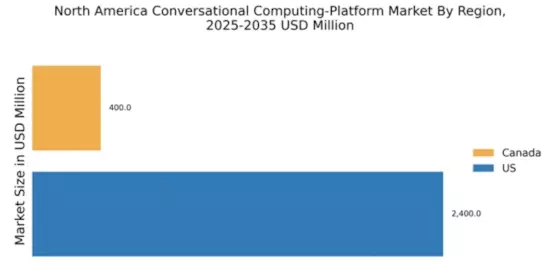
The North America Conversational Computing Platform Market is experiencing notable growth, driven by advancements in artificial intelligence and natural language processing technologies. This regional segment is characterized by a high adoption rate in various sectors including customer service, healthcare, and financial services, placing emphasis on enhancing user engagement and improving operational efficiency. The US stands out as a leader in this market due to its robust technological infrastructure and significant investments in Research and Development.

Canada, on the other hand, is witnessing rising demand for conversational platforms as businesses look to enhance customer interactions and streamline processes. The integration of chatbots and voice assistants in enterprise operations is a key trend in this region, fostering innovation and providing lucrative opportunities for market players. 

Additionally, both countries are focused on enhancing data privacy and security measures due to growing consumer concerns, creating a complex yet promising landscape in the North America Conversational Computing Platform Market.The region's collaborative efforts between government and private sectors further drive the growth potential, highlighting the opportunity for businesses to innovate and expand within the market.

North America Conversational Computing Platform Market Regional Image

Key Players and Competitive Insights

The conversational computing-platform market in North America is characterized by intense competition and rapid innovation, driven by advancements in artificial intelligence (AI) and increasing demand for seamless user experiences. Major players such as Google (US), Amazon (US), and Microsoft (US) are at the forefront, each adopting distinct strategies to enhance their market positioning. Google (US) focuses on integrating AI capabilities into its platforms, aiming to provide more personalized and efficient user interactions. Amazon (US), on the other hand, emphasizes its cloud services and voice recognition technology, leveraging its extensive ecosystem to enhance customer engagement. Microsoft (US) is strategically investing in partnerships and acquisitions to bolster its AI offerings, particularly in enterprise solutions, thereby expanding its reach in the business sector. Collectively, these strategies contribute to a competitive landscape that is both dynamic and multifaceted, with each player striving to differentiate itself through innovation and customer-centric solutions.

Key business tactics within this market include localized development and supply chain optimization, which are essential for meeting diverse consumer needs across North America. The competitive structure appears moderately fragmented, with several key players holding substantial market shares while also facing competition from emerging startups. This fragmentation allows for a variety of innovative solutions to flourish, as companies seek to carve out their niches in a rapidly evolving environment.

In September 2025, Google (US) announced the launch of its latest AI-driven conversational platform, which integrates advanced natural language processing capabilities. This strategic move is significant as it positions Google (US) to capture a larger share of the market by enhancing user engagement through more intuitive interactions. The platform's ability to understand context and nuance in conversations could potentially redefine user expectations and set new standards in the industry.

In October 2025, Amazon (US) unveiled a new suite of tools designed for developers to create customized voice applications. This initiative reflects Amazon's commitment to expanding its Alexa ecosystem and fostering innovation among third-party developers. By providing these tools, Amazon (US) not only strengthens its market position but also encourages a broader adoption of voice technology across various sectors, thereby enhancing its competitive edge.

In August 2025, Microsoft (US) entered into a strategic partnership with a leading AI research firm to enhance its conversational AI capabilities. This collaboration is likely to accelerate the development of more sophisticated AI models, enabling Microsoft (US) to offer cutting-edge solutions to its enterprise clients. Such partnerships are indicative of a broader trend where companies are increasingly recognizing the value of collaboration in driving innovation and maintaining competitive advantage.

As of November 2025, the competitive trends in the conversational computing-platform market are heavily influenced by digitalization, sustainability, and the integration of AI technologies. Strategic alliances are becoming more prevalent, as companies seek to leverage each other's strengths to enhance their offerings. Looking ahead, it appears that competitive differentiation will increasingly hinge on innovation and technological advancements rather than solely on price. The emphasis on supply chain reliability and the ability to deliver unique, high-quality solutions will likely define the future landscape of this market.

Key Companies in the North America Conversational Computing Platform Market market include

Industry Developments

The North America Conversational Computing Platform Market has witnessed several notable developments in recent months. Twilio has expanded its capabilities by integrating new AI features to enhance its communication solutions, which is expected to drive customer engagement and retention. In October 2023, Google announced improvements to Dialogflow, refining natural language understanding which is crucial for developing more sophisticated chatbots. 

Verint Systems also reported a strategic partnership aimed at enhancing their analytics capabilities within conversational platforms. In terms of mergers and acquisitions, in September 2023, Nuance Communications was acquired by Microsoft, significantly strengthening Microsoft's Azure cloud services with advanced conversational AI technologies. 

Such acquisitions are indicative of a broader trend in the market focused on enhancing AI capabilities. The market valuation for companies like Amazon and IBM continues to grow, as increased investments in AI and cloud technologies pave the way for advancements in conversational applications. 

Additionally, Apple and Cisco Systems are prioritizing R&D in voice technologies and machine learning to refine user interactions and business applications, positioning themselves competitively within this soaring market. The evolution of these platforms is reflective of changing consumer preferences towards more interactive and personalized communication experiences.

Future Outlook

North America Conversational Computing Platform Market Future Outlook

The Conversational Computing Platform Market is projected to grow at a 14.73% CAGR from 2024 to 2035, driven by advancements in AI, increased demand for automation, and enhanced user experiences.

New opportunities lie in:

  • Development of AI-driven customer support chatbots for e-commerce platforms.
  • Integration of voice recognition technology in smart home devices.
  • Creation of personalized virtual assistants for enterprise applications.

By 2035, the market is expected to achieve substantial growth, driven by innovative applications and increasing adoption.

Market Segmentation

North America Conversational Computing Platform Market End User Outlook

  • Retail
  • Healthcare
  • Education
  • Telecommunications
  • Banking and Financial Services

North America Conversational Computing Platform Market Technology Outlook

  • Natural Language Processing
  • Machine Learning
  • Speech Synthesis
  • Text-to-Speech
  • Voice Recognition

North America Conversational Computing Platform Market Application Outlook

  • Customer Support
  • Virtual Assistants
  • Chatbots
  • Voice Interfaces
  • Speech Recognition

North America Conversational Computing Platform Market Deployment Type Outlook

  • Cloud-Based
  • On-Premise
  • Hybrid

Report Scope

MARKET SIZE 20242800.0(USD Million)
MARKET SIZE 20253212.44(USD Million)
MARKET SIZE 203512700.0(USD Million)
COMPOUND ANNUAL GROWTH RATE (CAGR)14.73% (2024 - 2035)
REPORT COVERAGERevenue Forecast, Competitive Landscape, Growth Factors, and Trends
BASE YEAR2024
Market Forecast Period2025 - 2035
Historical Data2019 - 2024
Market Forecast UnitsUSD Million
Key Companies Profiled["Google (US)", "Amazon (US)", "Microsoft (US)", "IBM (US)", "Apple (US)", "Salesforce (US)", "Nuance Communications (US)", "SAP (DE)", "Baidu (CN)"]
Segments CoveredApplication, Deployment Type, End User, Technology
Key Market OpportunitiesIntegration of artificial intelligence enhances user engagement in the conversational computing-platform market.
Key Market DynamicsRising demand for AI-driven customer support solutions reshapes the competitive landscape of the conversational computing-platform market.
Countries CoveredUS, Canada

Leave a Comment

FAQs

What is the expected market size of the North America Conversational Computing Platform Market by 2024?

The North America Conversational Computing Platform Market is expected to be valued at 2.4 USD Billion by 2024.

What will be the projected market value of the North America Conversational Computing Platform Market in 2035?

By 2035, the North America Conversational Computing Platform Market is projected to reach 10.9 USD Billion.

What is the expected CAGR for the North America Conversational Computing Platform Market from 2025 to 2035?

The market is anticipated to witness a CAGR of 14.748 % during the forecast period from 2025 to 2035.

Which segment of the North America Conversational Computing Platform Market is valued highest for customer support by 2024?

The customer support segment is valued at 0.8 USD Billion in the North America Conversational Computing Platform Market for the year 2024.

What are the projected values for virtual assistants in the market by 2035?

The virtual assistants segment is expected to reach a value of 2.8 USD Billion in 2035.

Which regions make up the major share of the North America Conversational Computing Platform Market?

The North America Conversational Computing Platform Market is primarily divided into the United States and Canada.

What is the market size for the US segment of the North America Conversational Computing Platform Market in 2024?

The US segment is anticipated to be valued at 1.44 USD Billion in 2024.

What is the expected market size for Canada in the North America Conversational Computing Platform Market by 2035?

The Canadian market size is projected to be 4.33 USD Billion by 2035.

Who are the key players in the North America Conversational Computing Platform Market?

Major players in the market include Twilio, Verint Systems, Google, IBM, and Microsoft among others.

What is the projected value of the chatbots segment in the North America Conversational Computing Platform Market by 2035?

The chatbots segment is projected to reach a value of 2.3 USD Billion by 2035.

Download Free Sample

Kindly complete the form below to receive a free sample of this Report

Compare Licence

×
Features License Type
Single User Multiuser License Enterprise User
Price $4,950 $5,950 $7,250
Maximum User Access Limit 1 User Upto 10 Users Unrestricted Access Throughout the Organization
Free Customization
Direct Access to Analyst
Deliverable Format
Platform Access
Discount on Next Purchase 10% 15% 15%
Printable Versions