×
Request Free Sample ×

Kindly complete the form below to receive a free sample of this Report

* Please use a valid business email

Leading companies partner with us for data-driven Insights

clients tt-cursor
Hero Background

Europe Conversational Computing Platform Market

ID: MRFR/ICT/60916-HCR
200 Pages
Aarti Dhapte
October 2025

Europe Conversational Computing Platform Market Research Report By Application (Customer Support, Virtual Assistants, Chatbots, Voice Interfaces, Speech Recognition), By Deployment Type (Cloud-Based, On-Premise, Hybrid), By End User (Retail, Healthcare, Education, Telecommunications, Banking and Financial Services), By Technology (Natural Language Processing, Machine Learning, Speech Synthesis, Text-to-Speech, Voice Recognition) and By Regional (Germany, UK, France, Russia, Italy, Spain, Rest of Europe)- Forecast to 2035

Share:
Download PDF ×

We do not share your information with anyone. However, we may send you emails based on your report interest from time to time. You may contact us at any time to opt-out.

Europe Conversational Computing Platform Market Infographic
Purchase Options

Europe Conversational Computing Platform Market Summary

As per MRFR analysis, the Europe conversational computing platform market size was estimated at 1752.45 USD Million in 2024. The Europe conversational computing-platform market is projected to grow from 2011.82 USD Million in 2025 to 8000.0 USD Million by 2035, exhibiting a compound annual growth rate (CAGR) of 14.8% during the forecast period 2025 - 2035.

Key Market Trends & Highlights

The Europe conversational computing-platform market is experiencing robust growth driven by technological advancements and evolving consumer expectations.

  • The market is witnessing a rise of AI-driven solutions, particularly in Germany, which is the largest market in Europe.
  • There is a growing emphasis on data privacy, reflecting consumer concerns across the UK, the fastest-growing region.
  • Multilingual and cultural adaptation is becoming increasingly vital as businesses expand their reach across diverse European markets.
  • Key market drivers include increased demand for automation and advancements in natural language processing, which are shaping the future of conversational platforms.

Market Size & Forecast

2024 Market Size 1752.45 (USD Million)
2035 Market Size 8000.0 (USD Million)
CAGR (2025 - 2035) 14.8%

Major Players

Google (US), Amazon (US), Microsoft (US), IBM (US), Apple (US), Salesforce (US), Nuance (US), SAP (DE), Baidu (CN)

Europe Conversational Computing Platform Market Trends

The conversational computing-platform market is currently experiencing notable growth, driven by advancements in artificial intelligence and natural language processing technologies. As businesses increasingly adopt these platforms to enhance customer engagement, the demand for sophisticated solutions continues to rise. This trend is particularly evident in sectors such as retail, finance, and healthcare, where organizations seek to streamline operations and improve user experiences. Furthermore, the integration of voice recognition and chatbots into various applications is reshaping how consumers interact with brands, leading to a more personalized approach in service delivery. In addition, regulatory frameworks in Europe are evolving to address data privacy and security concerns, which may influence the development and deployment of conversational computing solutions. Companies are likely to invest in compliance measures to ensure adherence to these regulations, thereby fostering trust among users. As the market matures, the focus on multilingual capabilities and cultural nuances is expected to grow, allowing businesses to cater to diverse audiences effectively. Overall, the conversational computing-platform market is poised for continued expansion, with innovations and regulatory considerations shaping its trajectory.

Rise of AI-Driven Solutions

The conversational computing-platform market is witnessing a surge in AI-driven solutions, which enhance user interactions through improved understanding and responsiveness. This trend reflects a broader shift towards automation and efficiency in customer service.

Emphasis on Data Privacy

With increasing concerns over data privacy, the conversational computing-platform market is adapting to stringent regulations. Companies are prioritizing secure data handling practices to build consumer trust and ensure compliance with local laws.

Multilingual and Cultural Adaptation

As businesses expand their reach, the need for multilingual capabilities in conversational computing platforms is becoming more pronounced. This adaptation allows organizations to engage effectively with diverse customer bases across different regions.

Europe Conversational Computing Platform Market Drivers

Expansion of E-commerce

The rapid expansion of e-commerce in Europe is significantly influencing the conversational computing-platform market. With online shopping becoming increasingly prevalent, businesses are turning to conversational platforms to enhance customer engagement and improve the shopping experience. Data suggests that e-commerce sales in Europe are expected to surpass €700 billion by 2025, creating a substantial opportunity for conversational computing solutions. These platforms enable personalized interactions, allowing retailers to provide tailored recommendations and support to customers. As e-commerce continues to thrive, the demand for conversational computing technologies is likely to rise, positioning them as essential tools for businesses aiming to remain competitive in the digital marketplace.

Integration with IoT Devices

The integration of conversational computing platforms with Internet of Things (IoT) devices is emerging as a key driver in Europe. As smart home technologies and connected devices proliferate, the demand for intuitive interfaces that facilitate user interaction is increasing. Conversational platforms enable users to control IoT devices through natural language commands, enhancing the overall user experience. The European IoT market is anticipated to reach €1 trillion by 2025, suggesting a substantial opportunity for conversational computing solutions that cater to this growing ecosystem. As consumers seek seamless interactions with their devices, the conversational computing-platform market is likely to benefit from this trend, positioning itself as a vital component of the smart home landscape.

Increased Demand for Automation

The growing need for automation in various sectors is driving the conversational computing-platform market in Europe. Businesses are increasingly adopting automated solutions to enhance operational efficiency and reduce costs. According to recent data, the automation market in Europe is projected to reach €50 billion by 2026, indicating a robust demand for technologies that facilitate seamless interactions between humans and machines. This trend is particularly evident in customer service, where companies are leveraging conversational platforms to handle inquiries and support requests. As organizations seek to streamline processes, the conversational computing-platform market is likely to experience significant growth, as these platforms provide the necessary tools for effective automation.

Regulatory Compliance and Standards

The emphasis on regulatory compliance and standards is a significant driver for the conversational computing-platform market in Europe. With stringent regulations surrounding data protection and privacy, businesses are compelled to adopt solutions that ensure compliance while maintaining user trust. The General Data Protection Regulation (GDPR) has set a high standard for data handling practices, influencing how conversational platforms are developed and implemented. Companies that prioritize compliance are likely to gain a competitive edge, as consumers increasingly favor brands that demonstrate a commitment to data security. This regulatory landscape is expected to propel the growth of the conversational computing-platform market, as organizations seek compliant solutions that align with legal requirements.

Advancements in Natural Language Processing

Advancements in natural language processing (NLP) are playing a crucial role in shaping the conversational computing-platform market in Europe. As NLP technologies evolve, they enable more sophisticated and human-like interactions between users and machines. This evolution is reflected in the increasing accuracy and efficiency of conversational agents, which are now capable of understanding context and intent with greater precision. The European NLP market is projected to grow at a CAGR of 20% over the next five years, indicating a strong demand for enhanced conversational capabilities. Consequently, businesses are increasingly investing in conversational computing platforms that leverage these advancements to improve customer interactions and satisfaction.

Market Segment Insights

By Application: Customer Support (Largest) vs. Chatbots (Fastest-Growing)

The market share in the Application segment reveals that Customer Support remains the largest contributor, driven by the increasing demand for efficient service solutions. Virtual Assistants and Voice Interfaces also hold significant shares, focusing on enhancing user experiences across various platforms. Chatbots, while smaller in share, are quickly gaining traction due to their versatility and cost-effectiveness, positioning them as key players in the market. Growth trends in the Application segment are heavily influenced by technological advancements and shifting consumer preferences. The rise in AI capabilities, coupled with the need for automated customer interaction, fuels the expansion of Chatbots and Speech Recognition technologies. As businesses prioritize digital transformation and customer engagement through seamless interaction methods, the Application segment is poised for robust growth, reflecting the shift towards conversational computing solutions.

Customer Support: Dominant vs. Chatbots: Emerging

Customer Support applications dominate the market due to their critical role in enhancing client interactions and satisfaction. Organizations are increasingly adopting these solutions to streamline operations and provide 24/7 assistance. In contrast, Chatbots represent an emerging segment, characterized by their rapid adoption across industries for tasks such as handling inquiries and providing information. Chatbots are known for their scalability and cost efficiency, enabling businesses to maintain high levels of service without significant investment. As AI technology continues to evolve, both segments are expected to leverage advancements to improve functionality and user experience, with Chatbots offering innovative solutions that complement traditional Customer Support methods.

By Deployment Type: Cloud-Based (Largest) vs. Hybrid (Fastest-Growing)

In the Europe conversational computing-platform market, the deployment type segment is primarily dominated by cloud-based solutions, capturing a significant share of the overall market. This widespread adoption is driven by the flexibility and scalability offered by cloud services, making them the preferred choice for many organizations. On-premise solutions, while still relevant, have seen a decline due to the increasing preference for cloud technology, although they still hold a niche segment of loyal customers who value data security and control. In contrast, hybrid deployment models are emerging rapidly, fueled by businesses seeking a balanced approach that combines the benefits of both cloud and on-premise solutions. This trend is propelled by organizations looking to integrate legacy systems with modern cloud capabilities, allowing for enhanced operational efficiency. The evolution toward hybrid solutions signifies a shift in market dynamics, highlighting the need for customization and versatility in deployments to meet diverse business needs.

Cloud-Based (Dominant) vs. On-Premise (Emerging)

Cloud-based deployment models have established themselves as the dominant force within the deployment types, characterized by their ability to provide seamless integration and accessibility over the internet. They offer outstanding scalability and cost-effectiveness, appealing particularly to startups and SMEs aiming to minimize upfront costs. Conversely, on-premise solutions are regarded as an emerging choice among larger enterprises requiring stringent data security and compliance measures. While traditionally favored for handling sensitive data internally, their growth is slowing as more companies recognize the advantages of hybrid and cloud-based options. The presence of both models highlights the diverse requirements within the industry, with businesses seeking tailored solutions that align with their unique operational requirements.

By End User: Retail (Largest) vs. Healthcare (Fastest-Growing)

The distribution of market share among the end user segments showcases retail as the largest contributor, driven by the increasing adoption of conversational agents for customer interaction and service enhancement. Meanwhile, healthcare is witnessing a surge in demand due to the need for efficient patient engagement systems, with organizations increasingly implementing AI-driven solutions for telehealth services and administrative tasks. Growth trends indicate that while retail establishes a solid foundation, healthcare's rapid expansion is fueled by technological advancements such as natural language processing and machine learning capabilities. These drivers are enhancing the precision and responsiveness of conversational platforms, enabling sectors like telecommunications and banking to also leverage these tools, albeit at a slower growth pace compared to healthcare.

Retail: Dominant vs. Healthcare: Emerging

The retail segment stands out as a dominant force in the conversational computing landscape, characterized by robust implementations of chatbots and virtual assistants that streamline customer service, improve user experience, and ultimately drive sales. These solutions cater to a wide consumer base, leveraging conversational interfaces to facilitate shopping experiences and provide personalized recommendations. In contrast, the healthcare sector is emerging rapidly, propelled by a focus on telemedicine and remote patient monitoring solutions. Healthcare platforms emphasize data privacy and security while utilizing conversational technology to speed up diagnosis, streamline administrative tasks, and enhance patient management, making it a critical player in the evolving digital health landscape.

By Technology: Natural Language Processing (Largest) vs. Voice Recognition (Fastest-Growing)

The market share distribution within the technology segment reveals that Natural Language Processing (NLP) holds the largest share, dominating the landscape of conversational computing platforms. Following NLP, Voice Recognition is gaining traction rapidly and is poised to become a significant player as it captures more customer interest and investment. Other segments, such as Machine Learning, Speech Synthesis, and Text-to-Speech, also contribute notably but trail behind NLP and Voice Recognition in market share distribution. Current growth trends emphasize technological advancements, particularly in Voice Recognition and Machine Learning, driven by increased user demand for seamless interaction experiences. The rise in automation and AI integration in various applications is propelling these technologies as key drivers of market growth. As businesses focus on enhancing customer interactions, the technology segment is expected to see continued innovation and investment over the coming years.

Technology: Natural Language Processing (Dominant) vs. Voice Recognition (Emerging)

Natural Language Processing (NLP) is characterized by its ability to analyze, understand, and generate human language, making it a cornerstone of conversational applications. With extensive applications in chatbots and virtual assistants, NLP continues to thrive as a dominant technology in this market. In contrast, Voice Recognition, an emerging force, uses advanced algorithms to understand and process spoken language, enhancing user interfaces across devices. This segment is witnessing rapid development, with companies focusing on improving accuracy and contextual understanding. The competitive landscape is increasingly favoring integration capabilities, with NLP and Voice Recognition working synergistically to deliver more interactive and efficient user experiences.

Get more detailed insights about Europe Conversational Computing Platform Market

Regional Insights

Germany : Strong Growth Driven by Innovation

Germany holds a commanding market share of 36.5% in the European conversational computing-platform market, valued at €450.0 million. Key growth drivers include a robust tech ecosystem, increasing demand for AI-driven customer service solutions, and supportive government initiatives promoting digital transformation. Regulatory frameworks are evolving to ensure data privacy and security, fostering consumer trust and adoption. Infrastructure investments in broadband and 5G are enhancing connectivity, crucial for real-time applications.

UK : Innovation Fuels Conversational Growth

Key markets include London, Manchester, and Birmingham, where tech hubs are thriving. Major players like Google and Amazon have established significant operations, intensifying competition. The local market is characterized by a collaborative environment, with many startups partnering with established firms. Industries such as e-commerce, finance, and healthcare are rapidly adopting conversational platforms to enhance customer engagement.

France : Strong Focus on Innovation and Regulation

Key markets include Paris and Lyon, where tech startups and established firms collaborate. Major players like IBM and Microsoft are investing heavily in local operations, creating a competitive landscape. The business environment is favorable, with a focus on innovation and sustainability. Sectors such as tourism, retail, and public services are increasingly leveraging conversational platforms to improve user experiences.

Russia : Diverse Needs Drive Local Solutions

Key cities like Moscow and St. Petersburg are central to market activities, with local players like Yandex gaining traction. The competitive landscape includes both international giants and local startups, creating a dynamic environment. The business climate is evolving, with a focus on adapting global technologies to meet local needs. Industries such as retail, telecommunications, and finance are key adopters of conversational computing.

Italy : Focus on Customer Engagement Solutions

Key markets include Milan and Rome, where many tech startups are emerging. Major players like SAP and Nuance are establishing a presence, intensifying competition. The local market dynamics favor collaboration between startups and established firms, fostering innovation. Industries such as fashion, automotive, and tourism are increasingly adopting conversational technologies to enhance customer interactions.

Spain : AI Adoption on the Rise

Key markets include Madrid and Barcelona, where tech innovation is thriving. Major players like Amazon and Google are expanding their operations, creating a competitive landscape. The local business environment is favorable, with many startups emerging in the AI space. Industries such as tourism, retail, and telecommunications are key adopters of conversational platforms, enhancing customer experiences.

Rest of Europe : Varied Adoption Across Regions

Key markets include smaller countries like Belgium and the Netherlands, where local players are emerging. The competitive landscape is fragmented, with both international and regional players vying for market share. The business environment varies, with some countries fostering innovation while others face regulatory challenges. Industries such as retail, healthcare, and education are exploring conversational technologies to improve service delivery.
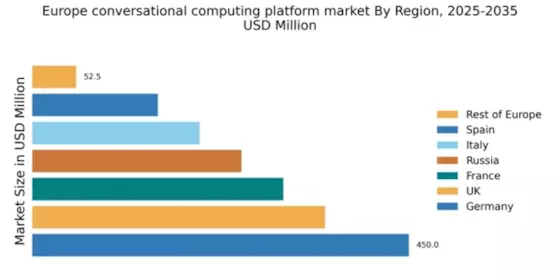

Europe Conversational Computing Platform Market Regional Image

Key Players and Competitive Insights

The conversational computing-platform market is currently characterized by intense competition and rapid innovation, driven by advancements in artificial intelligence (AI) and increasing demand for seamless user experiences. Major players such as Google (US), Amazon (US), and Microsoft (US) are at the forefront, each adopting distinct strategies to enhance their market positioning. Google (US) focuses on integrating AI capabilities into its platforms, aiming to improve natural language processing and user interaction. Amazon (US), on the other hand, emphasizes its cloud services and voice recognition technologies, leveraging its extensive ecosystem to capture a larger share of the market. Microsoft (US) is strategically investing in partnerships and acquisitions to bolster its AI offerings, while IBM (US) is concentrating on enterprise solutions, catering to businesses seeking advanced conversational interfaces.

The market structure appears moderately fragmented, with a mix of established giants and emerging players. Key tactics employed by these companies include localizing their services to meet regional demands and optimizing supply chains to enhance efficiency. This competitive landscape is shaped by the collective influence of these major players, who are continuously innovating and adapting to consumer preferences, thereby driving growth in the sector.

In October 2025, Google (US) announced a significant upgrade to its AI-driven conversational platform, enhancing its capabilities in multilingual support. This strategic move is likely to broaden its user base across Europe, where multilingualism is prevalent, thus positioning Google (US) as a leader in catering to diverse linguistic needs. The upgrade not only strengthens its competitive edge but also aligns with the growing trend of personalization in user interactions.

In September 2025, Amazon (US) launched a new suite of tools aimed at small and medium-sized enterprises (SMEs) to facilitate the integration of conversational AI into their customer service operations. This initiative reflects Amazon's commitment to democratizing access to advanced technologies, potentially increasing its market penetration among SMEs. By providing tailored solutions, Amazon (US) enhances its value proposition and fosters customer loyalty, which is crucial in a competitive environment.

In August 2025, Microsoft (US) entered into a strategic partnership with a leading European telecommunications provider to enhance its conversational AI capabilities. This collaboration is expected to leverage the telecommunications provider's infrastructure, allowing Microsoft (US) to deliver more robust and reliable services. Such partnerships are indicative of a broader trend where companies are seeking synergies to enhance their technological offerings and market reach.

As of November 2025, the competitive trends in the conversational computing-platform market are increasingly defined by digitalization, sustainability, and AI integration. Strategic alliances are becoming more prevalent, as companies recognize the need to collaborate to stay ahead in a rapidly evolving landscape. The shift from price-based competition to a focus on innovation, technology, and supply chain reliability is evident, suggesting that future differentiation will hinge on the ability to deliver cutting-edge solutions that meet the dynamic needs of consumers.

Key Companies in the Europe Conversational Computing Platform Market market include

Industry Developments

The Europe Conversational Computing Platform Market has recently seen significant developments, particularly in the area of mergers and acquisitions. For instance, in September 2023, Twilio announced its acquisition of a Europe-based company to enhance its capabilities in customer engagement solutions. This move aims to strengthen Twilio's position in the competitive landscape dominated by major players like Cisco and SAP. 

Additionally, in August 2023, IBM launched a new suite of AI-driven solutions tailored for European businesses, further broadening its market reach. Similarly, Verint Systems has updated its customer engagement platform, catering specifically to European regulatory and compliance standards, thus addressing the unique needs of the region. The market is experiencing a consistent valuation growth, driven by increasing demand for personalized customer interactions, with companies like Haptik and Freshworks leading the charge. 

Over the last two to three years, governmental initiatives promoting digital transformation across Europe have also played a crucial role, with numerous local governments implementing AI-centric policies to foster innovation within the sector. This growing market activity reflects the critical importance of conversational computing as organizations strive to enhance customer experience and operational efficiency in the European landscape.

Future Outlook

Europe Conversational Computing Platform Market Future Outlook

The conversational computing-platform market is projected to grow at a 14.8% CAGR from 2024 to 2035, driven by advancements in AI, increased demand for automation, and enhanced user experiences.

New opportunities lie in:

  • Development of AI-driven customer support chatbots for e-commerce platforms.
  • Integration of voice recognition technology in smart home devices.
  • Creation of multilingual conversational interfaces for diverse markets.

By 2035, the market is expected to achieve substantial growth, driven by innovation and strategic investments.

Market Segmentation

Europe Conversational Computing Platform Market End User Outlook

  • Retail
  • Healthcare
  • Education
  • Telecommunications
  • Banking and Financial Services

Europe Conversational Computing Platform Market Technology Outlook

  • Natural Language Processing
  • Machine Learning
  • Speech Synthesis
  • Text-to-Speech
  • Voice Recognition

Europe Conversational Computing Platform Market Application Outlook

  • Customer Support
  • Virtual Assistants
  • Chatbots
  • Voice Interfaces
  • Speech Recognition

Europe Conversational Computing Platform Market Deployment Type Outlook

  • Cloud-Based
  • On-Premise
  • Hybrid

Report Scope

MARKET SIZE 2024 1752.45(USD Million)
MARKET SIZE 2025 2011.82(USD Million)
MARKET SIZE 2035 8000.0(USD Million)
COMPOUND ANNUAL GROWTH RATE (CAGR) 14.8% (2024 - 2035)
REPORT COVERAGE Revenue Forecast, Competitive Landscape, Growth Factors, and Trends
BASE YEAR 2024
Market Forecast Period 2025 - 2035
Historical Data 2019 - 2024
Market Forecast Units USD Million
Key Companies Profiled ["Google (US)", "Amazon (US)", "Microsoft (US)", "IBM (US)", "Apple (US)", "Salesforce (US)", "Nuance (US)", "SAP (DE)", "Baidu (CN)"]
Segments Covered Application, Deployment Type, End User, Technology
Key Market Opportunities Integration of artificial intelligence in conversational computing-platforms enhances user engagement and personalization.
Key Market Dynamics Rising demand for AI-driven customer support solutions reshapes competitive landscape in the conversational computing-platform market.
Countries Covered Germany, UK, France, Russia, Italy, Spain, Rest of Europe

Leave a Comment

FAQs

What is the projected market size of the Europe Conversational Computing Platform Market in 2024?

The Europe Conversational Computing Platform Market is expected to be valued at 1.59 USD billion in 2024.

What is the estimated market size of the Europe Conversational Computing Platform Market by 2035?

By 2035, the market is projected to reach approximately 7.26 USD billion.

What is the expected CAGR for the Europe Conversational Computing Platform Market from 2025 to 2035?

The expected CAGR for the market during this period is 14.804 percent.

Which application segment is anticipated to have the highest market value in 2035?

The Customer Support application segment is expected to reach 1.81 USD billion by 2035.

Which regional market is projected to dominate the Europe Conversational Computing Platform Market by 2035?

Germany is anticipated to dominate the market with a valuation of 1.74 USD billion by 2035.

What is the projected market value for the Virtual Assistants application in 2024?

The Virtual Assistants application segment is projected to be valued at 0.3 USD billion in 2024.

Who are some of the key players in the Europe Conversational Computing Platform Market?

Major players in the market include Haptik, Twilio, Verint Systems, Google, and Microsoft.

What is the forecast market size for the Chatbots application by 2035?

The Chatbots application segment is projected to reach a market size of 1.3 USD billion by 2035.

What is the estimated growth rate for the Voice Interfaces application from 2024 to 2035?

The Voice Interfaces application is expected to grow significantly, with a market size of 1.44 USD billion by 2035.

How much is the Speech Recognition application expected to be valued in 2024?

The Speech Recognition application is expected to be valued at 0.31 USD billion in 2024.

Download Free Sample

Kindly complete the form below to receive a free sample of this Report

Compare Licence

×
Features License Type
Single User Multiuser License Enterprise User
Price $4,950 $5,950 $7,250
Maximum User Access Limit 1 User Upto 10 Users Unrestricted Access Throughout the Organization
Free Customization
Direct Access to Analyst
Deliverable Format
Platform Access
Discount on Next Purchase 10% 15% 15%
Printable Versions