×
Request Free Sample ×

Kindly complete the form below to receive a free sample of this Report

* Please use a valid business email

Leading companies partner with us for data-driven Insights

clients tt-cursor
Hero Background

South America Conversational Computing Platform Market

ID: MRFR/ICT/60915-HCR
200 Pages
Aarti Dhapte
October 2025

South America Conversational Computing Platform Market Research Report By Application (Customer Support, Virtual Assistants, Chatbots, Voice Interfaces, Speech Recognition), By Deployment Type (Cloud-Based, On-Premise, Hybrid), By End User (Retail, Healthcare, Education, Telecommunications, Banking and Financial Services), By Technology (Natural Language Processing, Machine Learning, Speech Synthesis, Text-to-Speech, Voice Recognition) and By Regional (Brazil, Mexico, Argentina, Rest of South America)- Forecast to 2035

Share:
Download PDF ×

We do not share your information with anyone. However, we may send you emails based on your report interest from time to time. You may contact us at any time to opt-out.

South America Conversational Computing Platform Market Infographic
Purchase Options

South America Conversational Computing Platform Market Summary

As per MRFR analysis, the South America conversational computing-platform market size was estimated at 637.26 USD Million in 2024. The South America conversational computing-platform market is projected to grow from 715.77 USD Million in 2025 to 2286.98 USD Million by 2035, exhibiting a compound annual growth rate (CAGR) of 12.32% during the forecast period 2025 - 2035.

Key Market Trends & Highlights

The South America conversational computing-platform market is experiencing robust growth driven by technological advancements and evolving consumer needs.

  • The demand for AI-driven solutions is rising sharply across South America, particularly in Brazil.
  • Integration with e-commerce platforms is becoming increasingly prevalent, enhancing user engagement and sales.
  • There is a notable focus on multilingual capabilities to cater to diverse consumer bases in the region.
  • Key market drivers include growing internet penetration and rising consumer expectations, particularly in Brazil and Mexico.

Market Size & Forecast

2024 Market Size 637.26 (USD Million)
2035 Market Size 2286.98 (USD Million)
CAGR (2025 - 2035) 12.32%

Major Players

Google (US), Amazon (US), Microsoft (US), IBM (US), Apple (US), Facebook (US), Salesforce (US), Nuance Communications (US), Baidu (CN), Alibaba (CN)

South America Conversational Computing Platform Market Trends

the conversational computing-platform market in South America is experiencing notable growth, driven by increasing adoption of artificial intelligence and natural language processing technologies. Businesses across various sectors are recognizing the potential of these platforms to enhance customer engagement and streamline operations. As organizations seek to improve user experiences, the demand for chatbots and virtual assistants is on the rise. This trend is particularly evident in industries such as retail, banking, and telecommunications, where personalized interactions are becoming essential for maintaining competitive advantage. Moreover, the region's expanding internet penetration and mobile device usage are facilitating the integration of conversational computing solutions. Governments and private entities are investing in digital transformation initiatives, which further propels the market forward. The emphasis on improving customer service and operational efficiency is likely to drive innovation in this space. As companies continue to explore the capabilities of conversational computing, the market is poised for sustained growth, with new entrants and established players alike striving to capture share. The future appears promising, with advancements in technology and increasing consumer expectations shaping the landscape of the conversational computing-platform market.

Rising Demand for AI-Driven Solutions

There is a growing interest in AI-driven solutions within the conversational computing-platform market. Businesses are increasingly leveraging these technologies to automate customer interactions, thereby enhancing efficiency and reducing operational costs. This trend is particularly pronounced in sectors such as e-commerce and finance, where timely responses are crucial for customer satisfaction.

Integration with E-commerce Platforms

The integration of conversational computing platforms with e-commerce systems is becoming more prevalent. This trend allows businesses to provide seamless shopping experiences through chatbots and virtual assistants, facilitating transactions and customer support. As online shopping continues to expand, this integration is likely to play a vital role in enhancing user engagement.

Focus on Multilingual Capabilities

Given the linguistic diversity in South America, there is an increasing emphasis on multilingual capabilities within the conversational computing-platform market. Companies are recognizing the importance of catering to various languages to reach broader audiences. This focus on language inclusivity is expected to drive the development of more sophisticated language processing technologies.

South America Conversational Computing Platform Market Drivers

Expansion of E-commerce

expansion of e-commerce in South America is significantly influencing the conversational computing-platform market. With online retail sales projected to grow by 20% annually, businesses are increasingly adopting conversational platforms to facilitate customer interactions and streamline the purchasing process. These platforms enable real-time communication, allowing customers to receive instant support and guidance while shopping online. As more consumers turn to digital channels for their shopping needs, the demand for effective conversational solutions is likely to rise. Companies that integrate these platforms into their e-commerce strategies can enhance user experience, reduce cart abandonment rates, and ultimately drive sales growth. This trend underscores the importance of conversational computing in the evolving retail landscape of South America.

Growing Internet Penetration

increasing internet penetration in South America is a pivotal driver for the conversational computing-platform market. As of 2025, approximately 75% of the population has access to the internet, which facilitates the adoption of digital solutions. This connectivity enables businesses to leverage conversational platforms to enhance customer engagement and streamline operations. The rise in smartphone usage, which stands at around 80% in urban areas, further supports this trend. Companies are increasingly investing in conversational computing technologies to meet the demands of a digitally savvy consumer base. This shift is likely to result in a more competitive landscape, as businesses that adopt these platforms can provide superior customer service and personalized experiences, thereby gaining a significant edge in the market.

Rising Consumer Expectations

Consumer expectations in South America are evolving rapidly, driving demand for more interactive and responsive customer service solutions. As consumers increasingly seek immediate assistance and personalized experiences, businesses are turning to conversational computing platforms to meet these demands. Surveys indicate that over 60% of consumers prefer interacting with chatbots for quick inquiries, highlighting a shift in customer service preferences. This trend is pushing companies to invest in sophisticated conversational technologies that can provide timely and relevant responses. the market is thus positioned to thrive as businesses strive to enhance customer satisfaction and loyalty. By adopting these platforms, companies can not only meet but potentially exceed consumer expectations, leading to increased market share and profitability.

Focus on Data Privacy and Security

As the conversational computing-platform market expands in South America, concerns regarding data privacy and security are becoming increasingly prominent. With regulations such as the General Data Protection Regulation (GDPR) influencing local policies, businesses are compelled to prioritize the protection of customer data. This focus on security is likely to drive the adoption of conversational platforms that incorporate robust data protection measures. Companies that can demonstrate compliance with privacy regulations and ensure secure interactions are more likely to gain consumer trust. As a result, the conversational computing-platform market may see a shift towards solutions that not only enhance user experience but also prioritize data security. This trend indicates a growing awareness of the importance of safeguarding personal information in the digital age.

Increased Investment in Technology

Investment in technology across South America is surging, which is likely to bolster the conversational computing-platform market. In 2025, technology investments in the region are projected to reach $50 billion, with a substantial portion directed towards AI and machine learning solutions. This influx of capital enables companies to develop and implement advanced conversational platforms that can handle complex customer interactions. Furthermore, government initiatives aimed at promoting digital transformation are encouraging businesses to adopt innovative technologies. As organizations recognize the potential of conversational computing to enhance operational efficiency and customer satisfaction, the market is expected to experience robust growth. This trend indicates a shift towards more automated and intelligent customer service solutions, positioning the conversational computing-platform market as a key player in the broader technology landscape.

Market Segment Insights

By Application: Chatbots (Largest) vs. Virtual Assistants (Fastest-Growing)

The application segment within the market is characterized by a diverse portfolio, with chatbots holding the largest share due to their widespread adoption across various industries for customer engagement. Customer support applications are also significant contributors, leveraging AI to enhance service efficiency. Voice interfaces and speech recognition technologies follow, with their roles becoming increasingly important in making interactions seamless and more accessible. Growth trends within this segment indicate a robust demand for virtual assistants, driven by the consumer preference for personalized interactions and automation in daily tasks. Emerging technologies such as Artificial Intelligence and Natural Language Processing are key factors propelling the adoption of voice interfaces and chatbots, demonstrating a clear trend towards automation and efficiency in customer service and support applications.

Chatbots (Dominant) vs. Virtual Assistants (Emerging)

Chatbots dominate the application segment due to their capacity to handle multiple customer inquiries simultaneously, offering quick and efficient resolution. They serve a wide range of industries, from retail to healthcare, making interactions easier while significantly reducing operational costs. Conversely, virtual assistants are becoming an emerging force, amplifying user engagement through personalized experiences. They leverage advanced AI capabilities, allowing for more complex interactions. As consumer expectations around immediacy and personalization rise, both chatbots and virtual assistants are positioned to evolve, with chatbots solidifying their dominance while virtual assistants continue to gain traction in various applications.

By Deployment Type: Cloud-Based (Largest) vs. On-Premise (Fastest-Growing)

In the deployment type segment, Cloud-Based solutions currently hold the largest market share, favored for their scalability and reduced operational costs. On-Premise deployments follow, benefiting from the control and customization they offer businesses. Hybrid solutions also exist, but they represent a smaller portion of the market as firms weigh the pros and cons of both cloud and on-premise systems. The growth trends indicate that the On-Premise segment is the fastest-growing, propelled by organizations seeking enhanced security and data control. Meanwhile, Cloud-Based solutions continue to thrive due to their flexibility and the evolving digital landscape. The ability to integrate AI capabilities further drives the adoption of these platforms across various industries in the region.

Cloud-Based (Dominant) vs. On-Premise (Emerging)

Cloud-Based deployment solutions dominate the market, offering businesses unprecedented flexibility and cost-effectiveness. Their appeal lies in the pay-as-you-go model, enabling companies to scale resources as needed without heavy upfront investments. On the other hand, On-Premise solutions are emerging as organizations increasingly prioritize data security and regulatory compliance. These deployments allow greater control over IT resources and data management, making them an attractive option for sectors handling sensitive information. As businesses in South America navigate the complexities of digital transformation, both deployment types will play crucial roles, catering to diverse organizational needs across multiple sectors.

By End User: Retail (Largest) vs. Healthcare (Fastest-Growing)

the market share distribution among various end-user segments reveals that retail holds the largest share. This is attributed to the increasing adoption of conversational agents to enhance customer engagement and streamline shopping experiences. Healthcare, on the other hand, is rapidly gaining traction, driven by the demand for telehealth and personalized patient interactions through chatbots and virtual assistants. Growth trends in this segment are propelled by digital transformation initiatives, where businesses are leveraging conversational computing to improve operational efficiency and customer service. Retail is expected to continue dominating due to its early adoption, but healthcare's growth is unparalleled as it embraces technology for improved patient outcomes. Other segments like education, telecommunications, and banking are also evolving, but at a slower pace compared to these two leading segments.

Retail: Dominant vs. Healthcare: Emerging

Retail as a dominant segment benefits from various applications of conversational computing, such as enhanced customer service, efficient inventory management, and personalized marketing. Retailers increasingly employ chatbots to assist customers in real-time, transforming the shopping experience and offering 24/7 service. Meanwhile, healthcare, though emerging, is making significant strides by implementing AI-driven solutions for patient engagement, symptom checking, and appointment scheduling. The increasing focus on user-friendly interfaces and secure data handling makes healthcare a rapidly evolving end-user market. Both segments are witnessing innovation as they adapt to consumer demands and the competitive landscape, further solidifying their market positions.

By Technology: Natural Language Processing (Largest) vs. Machine Learning (Fastest-Growing)

In the South America conversational computing-platform market, Natural Language Processing (NLP) holds the largest market share due to its widespread adoption in customer service, chatbots, and virtual assistants. Following NLP, Machine Learning (ML) is emerging as the fastest-growing segment, driven by advancements in AI technologies and increased demand for automation across various industries. Other technologies like Speech Synthesis and Voice Recognition are also gaining traction, albeit at a slower pace, highlighting a diverse market landscape that caters to different conversational applications. The growth of NLP can be attributed to its ability to enhance user experiences and provide timely responses in conversational interfaces. Machine Learning, on the other hand, is witnessing rapid expansion as businesses increasingly invest in intelligent systems capable of learning from user inputs and improving over time. Speech Synthesis and Text-to-Speech technologies are also benefiting from rising interest in accessibility solutions, which further fuels innovation and investment in this evolving segment. The overall outlook remains positive as companies prioritize conversational capabilities to remain competitive in their industries.

Technology: NLP (Dominant) vs. ML (Emerging)

Natural Language Processing (NLP) is the dominant force in this segment, allowing computers to comprehend and interact with human language naturally. Its applications span across customer service, personal assistants, and data analysis, making it highly versatile and relevant to a variety of sectors. Meanwhile, Machine Learning (ML) is emerging as a critical technology that leverages algorithms and statistical models to enable systems to perform tasks without explicit programming. The adaptability of ML in predictive analytics and data-driven decision-making is fostering rapid growth, establishing it as a cornerstone of innovation in conversational platforms. Together, these technologies shape the future of interactions between machines and humans, enhancing efficiencies and user satisfaction.

Get more detailed insights about South America Conversational Computing Platform Market

Regional Insights

Brazil : Strong Growth Driven by Innovation

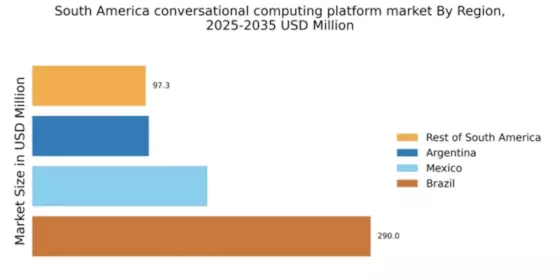
Brazil holds a commanding market share of 48.5% in the South American conversational computing-platform market, valued at $290.0 million. Key growth drivers include a burgeoning tech-savvy population, increasing smartphone penetration, and government initiatives promoting digital transformation. Demand trends show a rising preference for AI-driven customer service solutions, supported by regulatory policies that encourage innovation and investment in technology infrastructure.

Mexico : Emerging Hub for Tech Solutions

With a market share of 25.5% valued at $150.0 million, Mexico is rapidly becoming a key player in the conversational computing sector. Growth is fueled by increasing internet accessibility and a young demographic eager for tech solutions. The government has initiated programs to enhance digital literacy and support startups, creating a favorable environment for innovation. Consumption patterns indicate a shift towards personalized customer experiences, driving demand for advanced conversational platforms.

Argentina : Innovation Amid Economic Challenges

Argentina captures a market share of 16.5%, valued at $100.0 million, in the conversational computing landscape. Despite economic challenges, growth is driven by a strong startup ecosystem and increasing investment in AI technologies. Regulatory support for tech innovation and digital services is evident, with initiatives aimed at enhancing connectivity and infrastructure. Demand trends reflect a growing interest in voice-activated services, particularly in e-commerce and customer support sectors.

Rest of South America : Emerging Markets with Unique Needs

The Rest of South America holds a market share of 10.5%, valued at $97.26 million, showcasing diverse opportunities across various countries. Growth is driven by localized demand for conversational solutions tailored to specific industries, such as agriculture and tourism. Government initiatives aimed at improving digital infrastructure and connectivity are crucial for market expansion. The competitive landscape features both local startups and international players, creating a dynamic business environment.

South America Conversational Computing Platform Market Regional Image

Key Players and Competitive Insights

The conversational computing-platform market in South America is characterized by a dynamic competitive landscape, driven by rapid technological advancements and increasing consumer demand for interactive digital experiences. Major players such as Google (US), Amazon (US), and Microsoft (US) are strategically positioned to leverage their extensive resources and technological expertise. Google (US) focuses on enhancing its AI capabilities, particularly through its Google Assistant, which has seen significant integration into various devices and services across the region. Amazon (US), on the other hand, emphasizes its Alexa platform, expanding its reach through partnerships with local businesses to enhance user engagement. Microsoft (US) is investing heavily in cloud-based solutions, integrating its Azure platform with conversational AI tools to cater to enterprise needs, thereby shaping a competitive environment that prioritizes innovation and customer-centric solutions.

the market structure is moderately fragmented, with a mix of established players and emerging startups. Key business tactics include localizing services to meet regional preferences and optimizing supply chains to ensure efficient delivery of technology solutions. This collective influence of major companies fosters a competitive atmosphere where agility and responsiveness to market demands are crucial for success.

In October 2025, Google (US) announced a partnership with a leading South American telecommunications provider to enhance the deployment of its conversational AI technologies. This strategic move is likely to bolster Google’s market presence, allowing for improved accessibility and user experience in the region. Such partnerships are indicative of a broader trend where tech giants seek to collaborate with local entities to tailor their offerings to specific market needs.

In September 2025, Amazon (US) launched a new initiative aimed at integrating Alexa into smart home devices produced by local manufacturers. This initiative not only expands Amazon's ecosystem but also supports local businesses, potentially increasing market penetration. The strategic importance of this move lies in its ability to create a seamless user experience, thereby enhancing customer loyalty and driving sales.

In August 2025, Microsoft (US) unveiled a new suite of AI-driven tools designed specifically for small and medium-sized enterprises in South America. This initiative reflects Microsoft's commitment to democratizing access to advanced technologies, enabling smaller businesses to leverage conversational AI for improved customer interactions. The strategic significance of this development is profound, as it positions Microsoft as a key enabler of digital transformation in the region.

As of November 2025, current trends in the conversational computing-platform market are heavily influenced by digitalization, sustainability, and the integration of AI technologies. Strategic alliances among key players are reshaping the competitive landscape, fostering innovation and collaboration. The shift from price-based competition to a focus on technological advancement and supply chain reliability is evident, suggesting that future competitive differentiation will hinge on the ability to innovate and adapt to evolving consumer expectations.

Key Companies in the South America Conversational Computing Platform Market market include

Industry Developments

The South America Conversational Computing Platform Market is witnessing significant developments, characterized by an increase in demand for AI-driven solutions. Companies like Oracle, Google, SAP, and Microsoft are enhancing their offerings to cater to businesses focusing on customer engagement through chatbots and virtual assistants. In December 2022, SAP expanded its presence in Brazil with a new data center aimed at improving service delivery and local compliance, reflecting a growing trend in digital transformation across the region. 

Meanwhile, in September 2023, Nuance Communications announced a partnership with a leading Brazilian telecommunications company to enhance its customer service capabilities via automated solutions. Acquisition activities are also noteworthy; Amazon recently acquired a local startup to strengthen its AI initiatives within South America in July 2023. 

The overall valuation of the market is projected to grow as businesses increasingly recognize the importance of conversational interfaces. This trend aligns with the South American government's push towards digitalization, aiming to elevate technology adoption among small and medium enterprises, thereby boosting market potential and attracting investments from major players such as Salesforce and IBM.

Future Outlook

South America Conversational Computing Platform Market Future Outlook

The Conversational Computing Platform Market is projected to grow at a 12.32% CAGR from 2024 to 2035, driven by advancements in AI, increased mobile usage, and demand for personalized customer experiences.

New opportunities lie in:

  • Development of AI-driven customer support chatbots for e-commerce platforms.
  • Integration of voice recognition technology in smart home devices.
  • Creation of multilingual conversational interfaces for diverse user bases.

By 2035, the market is expected to achieve substantial growth, reflecting evolving consumer demands and technological advancements.

Market Segmentation

South America Conversational Computing Platform Market End User Outlook

  • Retail
  • Healthcare
  • Education
  • Telecommunications
  • Banking and Financial Services

South America Conversational Computing Platform Market Technology Outlook

  • Natural Language Processing
  • Machine Learning
  • Speech Synthesis
  • Text-to-Speech
  • Voice Recognition

South America Conversational Computing Platform Market Application Outlook

  • Customer Support
  • Virtual Assistants
  • Chatbots
  • Voice Interfaces
  • Speech Recognition

South America Conversational Computing Platform Market Deployment Type Outlook

  • Cloud-Based
  • On-Premise
  • Hybrid

Report Scope

MARKET SIZE 2024637.26(USD Million)
MARKET SIZE 2025715.77(USD Million)
MARKET SIZE 20352286.98(USD Million)
COMPOUND ANNUAL GROWTH RATE (CAGR)12.32% (2024 - 2035)
REPORT COVERAGERevenue Forecast, Competitive Landscape, Growth Factors, and Trends
BASE YEAR2024
Market Forecast Period2025 - 2035
Historical Data2019 - 2024
Market Forecast UnitsUSD Million
Key Companies Profiled["Google (US)", "Amazon (US)", "Microsoft (US)", "IBM (US)", "Apple (US)", "Facebook (US)", "Salesforce (US)", "Nuance Communications (US)", "Baidu (CN)", "Alibaba (CN)"]
Segments CoveredApplication, Deployment Type, End User, Technology
Key Market OpportunitiesIntegration of artificial intelligence in conversational computing-platforms enhances user engagement and personalization.
Key Market DynamicsRising demand for voice-activated interfaces drives innovation in the conversational computing-platform market across South America.
Countries CoveredBrazil, Mexico, Argentina, Rest of South America

Leave a Comment

FAQs

What is the expected market size of the South America Conversational Computing Platform Market in 2024?

The South America Conversational Computing Platform Market is expected to be valued at 636.0 million USD in 2024.

What will be the market size of the South America Conversational Computing Platform Market by 2035?

By 2035, the market value is projected to reach 2904.0 million USD.

What is the expected compound annual growth rate (CAGR) for the South America Conversational Computing Platform Market from 2025 to 2035?

The market is anticipated to grow at a CAGR of 14.804% from 2025 to 2035.

Which country is expected to hold the largest market share in the South America Conversational Computing Platform Market by 2035?

Brazil is expected to dominate the market with an estimated value of 900.0 million USD by 2035.

How is the South America Conversational Computing Platform Market segmented by application for 2024?

In 2024, the market segments include Customer Support valued at 120.0 million USD, Virtual Assistants at 150.0 million USD, Chatbots at 130.0 million USD, Voice Interfaces at 110.0 million USD, and Speech Recognition at 126.0 million USD.

What are the projected market values for Customer Support and Virtual Assistants by 2035?

By 2035, Customer Support is projected to reach 540.0 million USD and Virtual Assistants to 700.0 million USD.

Who are the key players in the South America Conversational Computing Platform Market?

Major players include Oracle, Google, Verint, Tidio, SAP, Yellow.ai, Salesforce, Nuance Communications, IBM, Infosys, Amazon, Microsoft, ManyChat, LivePerson, and Zendesk.

What will be the market value of chatbots in the South America Conversational Computing Platform Market by 2035?

The market value for chatbots is expected to reach 600.0 million USD by 2035.

What are the projected market sizes for Mexico and Argentina in 2024?

In 2024, Mexico is valued at 150.0 million USD while Argentina is valued at 100.0 million USD in the market.

What is the expected market size for Speech Recognition in 2035?

The market size for Speech Recognition is expected to reach 614.0 million USD by 2035.

Download Free Sample

Kindly complete the form below to receive a free sample of this Report

Compare Licence

×
Features License Type
Single User Multiuser License Enterprise User
Price $4,950 $5,950 $7,250
Maximum User Access Limit 1 User Upto 10 Users Unrestricted Access Throughout the Organization
Free Customization
Direct Access to Analyst
Deliverable Format
Platform Access
Discount on Next Purchase 10% 15% 15%
Printable Versions