×
Request Free Sample ×

Kindly complete the form below to receive a free sample of this Report

Leading companies partner with us for data-driven Insights

clients tt-cursor
Hero Background

North America Used Cooking Oil Market

ID: MRFR/FnB/63901-HCR
128 Pages
Pradeep Nandi
October 2025

North America Used Cooking Oil Market Research Report By Source (Food Manufacturers, HoReCa, Household, Others) and By Application (Biodiesel, Oleochemical Products, Animal Feed, Others)-Forecast to 2035

Share:
Download PDF ×

We do not share your information with anyone. However, we may send you emails based on your report interest from time to time. You may contact us at any time to opt-out.

North America Used Cooking Oil Market Infographic
Purchase Options

North America Used Cooking Oil Market Summary

As per MRFR analysis, the North America used cooking-oil market Size was estimated at 3100.0 USD Million in 2024. The North America used cooking-oil market is projected to grow from 3281.66 USD Million in 2025 to 5800.0 USD Million by 2035, exhibiting a compound annual growth rate (CAGR) of 5.86% during the forecast period 2025 - 2035.

Key Market Trends & Highlights

The North America used cooking-oil market is experiencing robust growth driven by sustainability initiatives and technological advancements.

  • The demand for biodiesel is rising significantly in the US, indicating a shift towards renewable energy sources.
  • Innovations in processing technologies are enhancing the efficiency of used cooking-oil recycling across North America.
  • The food service industry in Canada is increasingly participating in used cooking-oil collection programs, contributing to market expansion.
  • Regulatory support for waste management and growing awareness of environmental impact are key drivers propelling market growth.

Market Size & Forecast

2024 Market Size 3100.0 (USD Million)
2035 Market Size 5800.0 (USD Million)

Major Players

Bunge Limited (US), Cargill, Incorporated (US), Archer Daniels Midland Company (US), Wilmar International Limited (SG), Louis Dreyfus Company (NL), Noble Group Limited (SG), Mewah Group (SG), Austrian Oil and Gas (AT)

North America Used Cooking Oil Market Trends

The used cooking-oil market in North America is currently experiencing a notable transformation, driven by increasing awareness regarding sustainability and waste management. As consumers and businesses alike become more conscious of their environmental impact, the demand for recycling used cooking oil into biodiesel and other valuable products appears to be on the rise. This shift is likely influenced by various government initiatives aimed at promoting renewable energy sources and reducing landfill waste. Furthermore, the food service industry is adapting to these changes, with many establishments implementing practices to collect and recycle their used oils, thereby contributing to a circular economy. In addition to environmental considerations, economic factors also play a crucial role in shaping the used cooking-oil market. The potential for converting waste into a profitable resource is attracting investments and innovations in processing technologies. Companies are exploring advanced methods to extract and refine used cooking oil, enhancing its quality for various applications. This trend suggests a growing recognition of the economic viability of recycling used cooking oil, which may lead to increased competition and market expansion in the coming years. Overall, the landscape of the used cooking-oil market is evolving, reflecting a blend of ecological responsibility and economic opportunity.

Rising Demand for Biodiesel

The interest in biodiesel production from used cooking oil is increasing, driven by the need for renewable energy sources. This trend is supported by government policies that encourage the use of biofuels, which may lead to a more sustainable energy landscape.

Innovations in Processing Technologies

Advancements in technology for processing used cooking oil are emerging, enhancing the efficiency and quality of oil recycling. These innovations could potentially lower production costs and improve the market's overall competitiveness.

Increased Participation from Food Service Industry

The food service sector is becoming more engaged in recycling initiatives, with many establishments implementing systems to collect and process used cooking oil. This involvement not only supports sustainability efforts but also aligns with consumer preferences for environmentally responsible practices.

North America Used Cooking Oil Market Drivers

Regulatory Support for Waste Management

The used cooking-oil market in North America benefits from increasing regulatory support aimed at waste management and environmental sustainability. Governments are implementing stricter regulations on waste disposal, which encourages the recycling of used cooking oil. This regulatory framework not only promotes responsible waste management but also incentivizes businesses to participate in the collection and processing of used cooking oil. For instance, various states have introduced programs that provide financial assistance to companies that recycle used cooking oil, thereby enhancing the market's growth potential. The market is projected to expand as more businesses comply with these regulations, leading to an increase in the supply of used cooking oil for biodiesel production and other applications.

Growing Awareness of Environmental Impact

There is a notable increase in public awareness regarding the environmental impact of waste cooking oil, which is driving the used cooking-oil market in North America. Consumers and businesses alike are becoming more conscious of their ecological footprint, leading to a shift towards sustainable practices. This heightened awareness is fostering a demand for recycled products, including biodiesel derived from used cooking oil. According to recent studies, approximately 70% of consumers express a preference for products made from recycled materials, which is likely to boost the market for used cooking oil. As environmental concerns continue to rise, the industry is expected to see a significant uptick in demand for sustainable alternatives.

Rising Demand for Renewable Energy Sources

The increasing demand for renewable energy sources is a significant driver for the used cooking-oil market in North America. As governments and organizations strive to meet renewable energy targets, the need for biodiesel, which can be produced from used cooking oil, is on the rise. The U.S. Energy Information Administration reports that biodiesel production has grown by over 20% in recent years, indicating a robust market for used cooking oil as a feedstock. This trend is expected to continue as more states implement policies promoting renewable energy, thereby creating a favorable environment for the used cooking-oil market to thrive.

Technological Advancements in Oil Recycling

The used cooking-oil market is experiencing a transformation due to technological advancements in oil recycling processes. Innovations in filtration and purification technologies are enhancing the efficiency of converting used cooking oil into biodiesel and other valuable products. These advancements not only improve the quality of the end products but also reduce operational costs for recycling facilities. For example, new methods can increase oil recovery rates by up to 30%, making the recycling process more economically viable. As these technologies become more widely adopted, the market is likely to expand, attracting more players and increasing competition within the industry.

Economic Incentives for Recycling Initiatives

Economic incentives play a crucial role in shaping the used cooking-oil market in North America. Various state and federal programs offer financial benefits to businesses that engage in recycling initiatives, including the collection and processing of used cooking oil. These incentives can take the form of tax credits, grants, or subsidies, which lower the financial barriers for companies looking to enter the market. As a result, more businesses are likely to invest in recycling operations, leading to an increase in the availability of used cooking oil for biodiesel production. This trend not only supports the growth of the market but also contributes to a circular economy.

Market Segment Insights

By Application: Biodiesel Production (Largest) vs. Animal Feed (Fastest-Growing)

In the used cooking-oil market, biodiesel production holds a significant share, being the largest application. This segment caters to the growing demand for renewable energy and sustainable fuel alternatives. Following closely is animal feed, which is emerging rapidly in response to the rising need for cost-effective feed solutions in livestock farming. The industrial lubricants and soaps and detergents segments also contribute to the market but with comparatively lower shares. The growth trends in this segment are being driven by increasing environmental awareness and government initiatives towards renewable energy sources. The shift towards biofuels and sustainable animal feed formulations is fueling the growth of these segments. With regulations favoring eco-friendly options, both biodiesel production and animal feed are expected to see continued expansion, while industrial lubricants and soaps and detergents will maintain steady demand.

Biodiesel Production (Dominant) vs. Animal Feed (Emerging)

Biodiesel production is a dominant application in the use of cooking oil due to its established supply chains and significant impact on the renewable energy sector. This segment utilizes waste oils, minimizing environmental impacts while providing a sustainable fuel solution. In contrast, the animal feed segment is emerging as a viable alternative, capitalizing on the nutritional value of used cooking oil. It offers a cost-effective feed source that helps reduce feed expenses for farmers. Both segments exhibit strong potential for growth; biodiesel production is widely recognized, while animal feed is gaining traction, appealing to producers of livestock and pet food. The interplay between these segments shapes a dynamic landscape in the used cooking-oil market.

By End Use: Transportation Fuels (Largest) vs. Renewable Energy (Fastest-Growing)

In the used cooking-oil market, Transportation Fuels captures a significant share, leading the end-use applications. This segment's dominance is driven by increasing demand for sustainable fuel alternatives and regulatory incentives aimed at reducing carbon emissions. The Food Industry also contributes to the market, utilizing used cooking oil for various purposes, though it trails behind the transportation sector in terms of market share. Renewable Energy is emerging as the fastest-growing segment within this market, propelled by innovations in biofuel technology and growing awareness of renewable energy sources. This growth is supported by government policies promoting environmental sustainability and the transition to greener energy solutions. Expect to see substantial investments in infrastructure to bolster this emerging demand over the coming years.

Transportation Fuels (Dominant) vs. Renewable Energy (Emerging)

Transportation Fuels is the dominant end-use segment, pivotal in transforming used cooking oil into biodiesel and other fuels. This segment benefits from strong government backing and consumer trends favoring eco-friendly fuel alternatives, making it a cornerstone of the market. On the other hand, Renewable Energy is classified as an emerging segment, gaining traction from heightened interest in sustainable energy solutions. Its swift growth is driven by technological advancements, improving the efficiency of converting used cooking oil into energy, thus attracting investment and innovation. As both sectors evolve, their distinct roles highlight the versatility of used cooking oil in addressing energy needs.

By Source: Restaurants (Largest) vs. Households (Fastest-Growing)

The market for cooking oil recovery is significantly influenced by different sources. Restaurants are the largest contributors to the market share, driven by their high oil consumption and a robust supply chain for used oil collection. Following closely, households represent an emerging segment as consumers grow more conscious about recycling, aiding in their increasing contribution to the market's dynamics. Growth trends indicate that while restaurants maintain their dominance, households are rapidly expanding their footprint due to rising awareness and initiatives promoting sustainable practices. Food processing industries also contribute, yet their growth trajectory is less pronounced compared to the emerging household segment. Regulatory frameworks and environmental considerations are driving these trends as consumers and businesses alike prioritize responsible oil disposal methods.

Restaurants: Dominant vs. Households: Emerging

Restaurants play a pivotal role in shaping the used cooking-oil segment, characterized by large volumes of oil used and disposed of regularly. They have established systems for waste oil collection, thus ensuring a consistent flow into the recovery market. In contrast, households are becoming increasingly significant contributors due to growing initiatives promoting sustainability. The shift towards eco-friendly practices is prompting households to recycle their used cooking oil, which they previously discarded. Consequently, this segment is witnessing rapid growth as consumers become more environmentally conscious, making it a focal point for market development in the future.

By Processing Method: Physical Refining (Largest) vs. Chemical Refining (Fastest-Growing)

In the processing method segment, Physical Refining holds the largest market share due to its efficiency and cost-effectiveness in purifying used cooking oils. This segment benefits from a growing demand for natural and minimally processed products, aligning well with consumer preferences. Chemical Refining follows as a significant player, noted for its ability to deliver high-purity oils, but it faces challenges from increasing regulatory scrutiny and consumer demand for non-chemical processing methods. The growth trends within this segment are markedly driven by shifting consumer preferences towards sustainability and environmental considerations. Physical Refining benefits from its lower environmental impact, while Chemical Refining is starting to adopt greener practices to stay competitive. Blending remains a niche yet stable segment, favored for specific applications but not experiencing the aggressive growth seen in Chemical Refining, which is adapting rapidly to meet market demands.

Physical Refining (Dominant) vs. Chemical Refining (Emerging)

Physical Refining is characterized by its ability to purify oils without the use of harmful chemicals, making it a preferred choice for environmentally-conscious consumers. This segment has become the dominant processing method due to its cost-effectiveness and growing preference for natural products. In contrast, Chemical Refining is viewed as an emerging segment that is adapting to meet the needs of the market by incorporating more environmentally friendly processes. While historically significant, it must innovate to maintain its foothold in a market increasingly favoring less processed options. Blending serves as a supportive, stable element in the segment, catering to specific preferences but lacking the growth momentum of the primary methods.

Get more detailed insights about North America Used Cooking Oil Market

Regional Insights

US : Robust Demand and Infrastructure Growth

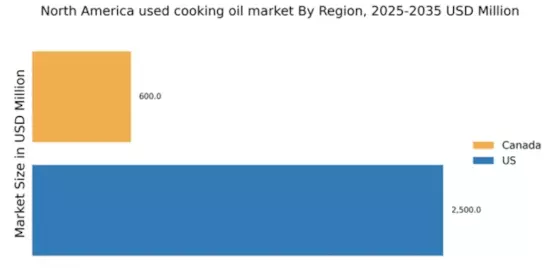
The US holds a commanding market share of approximately 80.3% in the North American used cooking oil market, valued at $2,500.0 million. Key growth drivers include increasing awareness of sustainable practices and government initiatives promoting recycling and biofuel production. Demand trends indicate a rising consumption of used cooking oil for biodiesel production, supported by favorable regulatory policies such as the Renewable Fuel Standard (RFS). Infrastructure improvements in collection and processing facilities further bolster market growth.

Canada : Sustainable Practices on the Rise

Canada's used cooking oil market, valued at $600.0 million, represents about 19.7% of the North American market. Growth is driven by increasing consumer awareness of environmental sustainability and government support for biofuel initiatives. Demand is rising in urban centers like Toronto and Vancouver, where local regulations encourage recycling. The Canadian government has implemented policies to promote the use of renewable energy sources, enhancing the market's appeal for investment and development.

North America Used Cooking Oil Market Regional Image

Key Players and Competitive Insights

The used cooking-oil market in North America is characterized by a competitive landscape that is increasingly shaped by sustainability initiatives and technological advancements. Key players such as Bunge Limited (US), Cargill, Incorporated (US), and Archer Daniels Midland Company (US) are actively pursuing strategies that emphasize innovation and operational efficiency. Bunge Limited (US) has focused on enhancing its supply chain capabilities, which appears to be a response to the growing demand for sustainable practices. Meanwhile, Cargill, Incorporated (US) is investing in digital transformation to optimize its operations, thereby positioning itself as a leader in the market. These strategies collectively contribute to a dynamic competitive environment where companies are not only vying for market share but also striving to meet evolving consumer expectations regarding sustainability and quality.

The business tactics employed by these companies include localizing manufacturing and optimizing supply chains to enhance responsiveness to market demands. The market structure is moderately fragmented, with several key players exerting influence over pricing and availability. This fragmentation allows for a variety of operational strategies, as companies seek to differentiate themselves through unique value propositions. The collective influence of these major players shapes the market dynamics, fostering an environment where innovation and efficiency are paramount.

In October 2025, Bunge Limited (US) announced a partnership with a leading technology firm to develop a new platform aimed at improving the traceability of used cooking oil. This strategic move is significant as it aligns with the increasing regulatory focus on sustainability and transparency in supply chains. By enhancing traceability, Bunge Limited (US) not only strengthens its market position but also addresses consumer concerns regarding the origins of their products.

In September 2025, Cargill, Incorporated (US) launched a new initiative to recycle used cooking oil into biodiesel, thereby expanding its product offerings and reinforcing its commitment to sustainability. This initiative is particularly noteworthy as it reflects a broader trend within the industry towards circular economy practices. By converting waste into valuable resources, Cargill, Incorporated (US) is likely to enhance its competitive edge while contributing to environmental sustainability.

In August 2025, Archer Daniels Midland Company (US) acquired a regional player specializing in the collection and processing of used cooking oil. This acquisition is indicative of a strategic move to consolidate market presence and enhance operational capabilities. By integrating this regional player, Archer Daniels Midland Company (US) can potentially streamline its operations and expand its customer base, thereby solidifying its position in the market.

As of November 2025, the competitive trends in the used cooking-oil market are increasingly defined by digitalization, sustainability, and the integration of artificial intelligence. Strategic alliances are becoming more prevalent, as companies recognize the value of collaboration in enhancing innovation and operational efficiency. Looking ahead, it is anticipated that competitive differentiation will evolve, shifting from traditional price-based competition to a focus on innovation, technology, and supply chain reliability. This transition underscores the importance of adapting to market demands and leveraging technological advancements to maintain a competitive edge.

Key Companies in the North America Used Cooking Oil Market market include

Industry Developments

Recent developments in the North America Used Cooking Oil Market have been notable, particularly regarding sustainability and biofuel production. Major players like Cargill and Darling Ingredients have been investing heavily in technologies to convert used cooking oil into renewable diesel, reflecting a growing emphasis on eco-friendly energy sources. In August 2023, Renewable Energy Group announced a partnership with Sustainable Oils aimed at increasing the collection of used cooking oil for biofuel production, which highlights a trend toward collaborative efforts in the industry.

Additionally, in July 2023, a merger between Biodico and Green Energy Biofuel increased market capacity and diversified product offerings in the biofuel sector. The market has seen significant valuation growth with a projected CAGR of around 7% over the next five years. This is primarily driven by the rising awareness of the environmental benefits of recycling cooking oil and the demand for sustainable fuel alternatives. Over the last couple of years, organizations have reported strides in regulations that incentivize the collection and usage of used cooking oil, further fostering investment in related technologies and infrastructure in North America.

Future Outlook

North America Used Cooking Oil Market Future Outlook

The used cooking-oil market is projected to grow at a 5.86% CAGR from 2024 to 2035, driven by increasing demand for biodiesel and sustainable practices.

New opportunities lie in:

  • Expansion of collection networks in urban areas
  • Development of advanced refining technologies for higher quality oil
  • Partnerships with food service companies for waste oil management

By 2035, the market is expected to achieve robust growth and increased sustainability.

Market Segmentation

North America Used Cooking Oil Market Source Outlook

  • Restaurants
  • Food Processing Industries
  • Households

North America Used Cooking Oil Market End Use Outlook

  • Transportation Fuels
  • Food Industry
  • Renewable Energy

North America Used Cooking Oil Market Application Outlook

  • Biodiesel Production
  • Animal Feed
  • Industrial Lubricants
  • Soaps and Detergents

North America Used Cooking Oil Market Processing Method Outlook

  • Physical Refining
  • Chemical Refining
  • Blending

Report Scope

MARKET SIZE 20243100.0(USD Million)
MARKET SIZE 20253281.66(USD Million)
MARKET SIZE 20355800.0(USD Million)
COMPOUND ANNUAL GROWTH RATE (CAGR)5.86% (2024 - 2035)
REPORT COVERAGERevenue Forecast, Competitive Landscape, Growth Factors, and Trends
BASE YEAR2024
Market Forecast Period2025 - 2035
Historical Data2019 - 2024
Market Forecast UnitsUSD Million
Key Companies Profiled["Bunge Limited (US)", "Cargill, Incorporated (US)", "Archer Daniels Midland Company (US)", "Wilmar International Limited (SG)", "Louis Dreyfus Company (NL)", "Noble Group Limited (SG)", "Mewah Group (SG)", "Austrian Oil and Gas (AT)"]
Segments CoveredApplication, End Use, Source, Processing Method
Key Market OpportunitiesGrowing demand for sustainable biofuels presents opportunities in the used cooking-oil market.
Key Market DynamicsRising demand for sustainable biofuels drives innovation and competition in the used cooking-oil market.
Countries CoveredUS, Canada

Leave a Comment

FAQs

What is the expected market size of the North America Used Cooking Oil Market in 2024?

The North America Used Cooking Oil Market is expected to be valued at 2.5 billion USD in 2024.

What is the projected market size for the North America Used Cooking Oil Market by 2035?

By 2035, the North America Used Cooking Oil Market is projected to reach 4.9 billion USD.

What is the expected CAGR for the North America Used Cooking Oil Market from 2025 to 2035?

The expected compound annual growth rate for the North America Used Cooking Oil Market from 2025 to 2035 is 6.309%.

Which segment contributes the largest market share for Food Manufacturers in the North America Used Cooking Oil Market in 2024?

In 2024, the Food Manufacturers segment is valued at 0.9 billion USD within the North America Used Cooking Oil Market.

What will be the value of the HoReCa segment in the North America Used Cooking Oil Market by 2035?

The HoReCa segment is projected to reach 1.5 billion USD by 2035 in the North America Used Cooking Oil Market.

How much is the Household segment expected to be worth in 2024 in the North America Used Cooking Oil Market?

The Household segment is expected to be valued at 0.6 billion USD in 2024.

Who are the key players in the North America Used Cooking Oil Market?

Major players in North America Used Cooking Oil Market include Recycle Cooking Oil, Cargill, and Renewable Energy Group.

What is the expected market value for the Others segment in the North America Used Cooking Oil Market by 2035?

The Others segment is projected to be valued at 0.4 billion USD by 2035

What is the market recognition of dynamic growth opportunities in the North America Used Cooking Oil Market?

The North America Used Cooking Oil Market is showcasing dynamic growth opportunities driven by renewable energy trends.

What are the challenges faced by the North America Used Cooking Oil Market currently?

Challenges in the North America Used Cooking Oil Market include regulatory constraints and fluctuating oil prices.

Download Free Sample

Kindly complete the form below to receive a free sample of this Report

Compare Licence

×
Features License Type
Single User Multiuser License Enterprise User
Price $4,950 $5,950 $7,250
Maximum User Access Limit 1 User Upto 10 Users Unrestricted Access Throughout the Organization
Free Customization
Direct Access to Analyst
Deliverable Format
Platform Access
Discount on Next Purchase 10% 15% 15%
Printable Versions