Download Free Sample
Kindly complete the form below to receive a free sample of this Report
Nursing Homes and Long-Term Care Facilities Market Research Report By Type of Care (Nursing Care, Assisted Living, Memory Care, Rehabilitation Services), By Facility Type (Nursing Homes, Retirement Communities, Continuing Care Retirement Communities, Residential Care Facilities), By Payment Source (Private Pay, Medicaid, Medicare, Long-Term Care Insurance), By Demographics (Elderly Population, Individuals with Disabilities, Chronic Illness Patients) and By Regional (North America, Europe, South America, Asia Pacific, Middle East and Africa) - Growth & Industry Forecast 2025 To 2035
Global Nursing Homes and Long-Term Care Facilities Market Size was valued at USD 500.27 Billion in 2024 & the market is projected to grow from USD 524.9 Billion in 2025 to USD 848.68 Billion by 2035, registering a CAGR of 4.92% during the forecast period 2025–2035. North America led the market with over 45.00% share, generating around USD 225.1 Billion in revenue.
The growing older population is the major growth factor for the Nursing Homes and Long-Term Care Facilities Industry. Increasing longevity and demand for specialized support are expanding the need for skilled nursing, assisted living, memory care, rehabilitation, and residential services worldwide.
WHO projects the global population aged 60 years and older to rise from 1.1 billion in 2023 to 1.4 billion by 2030, strengthening the long-term need for professional residential, nursing, and social care services.
The Nursing Homes and Long-Term Care Facilities Market is experiencing a transformative shift towards personalized and technologically integrated care solutions.
| 2024 Market Size | 500.27 (USD Billion) |
| 2035 Market Size | 848.68 (USD Billion) |
| CAGR (2025 - 2035) | 4.92% |
The Nursing Homes and Long-Term Care Facilities Market is currently experiencing a transformation driven by various factors, including demographic shifts and evolving consumer preferences. As the global population ages, there is an increasing demand for long-term care services, which appears to be reshaping the landscape of care facilities. This market is characterized by a growing emphasis on personalized care, with facilities striving to enhance the quality of life for residents.
Innovations in technology, such as telehealth and electronic health records, are also playing a pivotal role in improving service delivery and operational efficiency. Moreover, the market is witnessing a shift towards more integrated care models. This trend suggests that facilities are increasingly collaborating with healthcare providers to offer comprehensive services that address both medical and social needs.
The focus on holistic care may lead to better health outcomes and increased satisfaction among residents and their families. As the market continues to evolve, stakeholders must remain adaptable to these changes, ensuring that they meet the diverse needs of an aging population while maintaining high standards of care.
There is a notable trend towards personalized care initiatives within the Nursing Homes and Long-Term Care Facilities Industry. Facilities are increasingly tailoring services to meet the unique needs of each resident, which may enhance overall satisfaction and well-being. This approach often involves individualized care plans that consider medical history, preferences, and lifestyle choices.
The integration of technology into care practices is becoming more prevalent in the Nursing Homes and Long-Term Care Facilities Industry. Innovations such as telehealth services and electronic health records are being adopted to streamline operations and improve communication between caregivers and healthcare providers. This trend may lead to more efficient care delivery and better health management.
Collaborative care models are emerging as a significant trend in the market. Facilities are increasingly partnering with healthcare organizations to provide comprehensive services that address both medical and social needs. This approach may foster a more holistic view of resident care, potentially leading to improved health outcomes.
In the Nursing Homes and Long-Term Care Facilities Market, the major segments are Nursing Care, Assisted Living, Memory Care, and Rehabilitation Services. Nursing care holds the largest market share at 42% due to the high demand for skilled nursing services and personalized care provided to residents, especially the elderly population. Meanwhile, Memory Care, which focuses on patients with Alzheimer’s and other dementias, is witnessing a rapid increase in adoption as awareness of memory-related conditions grows, leading families to seek specialized support for their loved ones.
Brookdale Senior Living operated 647 communities across 41 states with capacity to serve approximately 58,000 residents as of December 31, 2024, demonstrating substantial scale in senior care delivery and supporting continued demand for nursing and personalized care services.
In the Nursing Homes and Long-Term Care Facilities Market, nursing homes represent the largest segment, capturing a significant 46% share of the market. This is largely due to the aging population requiring extensive care, making nursing homes a critical option for families seeking reliable long-term care solutions. Retirement Communities also feature prominently, appealing especially to seniors looking for active lifestyles without the burdens of home maintenance, providing a welcoming community setting.
Amedisys provides home health, hospice, palliative, and high-acuity services to more than 465,000 patients annually, demonstrating the expanding scale of structured healthcare delivery for older adults and patients requiring continuing care.
In the Nursing Homes and Long-Term Care Facilities Market, the distribution of payment sources reveals that private pay remains the largest segment, accounting for 48% and commanding a significant share of funding. Meanwhile, Medicaid plays a crucial role in supporting access for low-income individuals, capturing a growing portion of the market. As healthcare costs escalate, reliance on these payment sources will become increasingly vital, shaping the landscape for long-term care financing.
Private Pay (Dominant) vs. Medicaid (Emerging)
Private Pay is characterized by individuals or families directly covering the expenses of nursing home and long-term care facility services. This segment remains dominant due to the assets and savings often accumulated by seniors or their families. In contrast, Medicaid is an emerging force, particularly as the population ages and the demand for publicly funded care rises. The implications of Medicaid's expansion highlight its significance in providing equitable care access, especially for those financially constrained. Together, these payment options reflect the diverse funding structures that underpin the long-term care market, catering to varying financial capabilities and needs.
The Nursing Homes and Long-Term Care Facilities Market sees a significant concentration of individuals in two predominant segments: the elderly population and individuals with disabilities. The elderly demographic constitutes the largest share at 64%, driven by the increasing longevity and the pressing requirement for caregiving services as age-related health complications arise. In contrast, individuals with disabilities represent a burgeoning segment, as there is a societal push towards inclusivity and enhanced care options tailored to meet their unique needs. The integration of these varied demographics is reshaping the market landscape significantly.
Elderly Population: Dominant vs. Individuals with Disabilities: Emerging
The elderly population continues to dominate the market, benefitting from both demographic trends and healthcare initiatives aimed at providing long-term support. This segment is characterized by a high demand for specialized care services, including memory care and rehabilitation programs, as older adults often require consistent medical oversight. Meanwhile, individuals with disabilities are emerging as a crucial segment, with increasing advocacy initiating reforms in care approaches. This demographic experiences notable growth due to rising awareness around disability rights and the need for tailored living solutions, driving the demand for individualized care plans and facilities equipped to cater to these varied requirements.
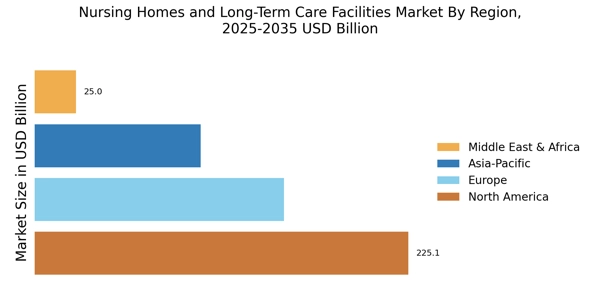
North America leads in the Nursing Homes And Long-Term Care Facilities Market Size, accounting for over 45.00% of the global revenue in 2024, highlighting its dominant role that reflects the region's aging population and demand for quality long-term care.
Europe Nursing Homes And Long-Term Care Facilities Market size was valued at USD 120 Billion in 2024, making it the second-largest regional market with a 23.99% share, driven by stringent regulations and a focus on enhancing elder care standards, while the APAC region is gaining traction with a valuation of 80.0 USD Billion, supported by a growing elderly demographic and rising disposable incomes.
South America, which captured a valuation of 30.0 USD Billion in 2023, is evolving, though it still holds a smaller share due to developing healthcare systems. Lastly, the MEA region, valued at 14.43 USD Billion, is on an upward trajectory as investments in healthcare infrastructure grow, yet it remains the least dominant. The market growth across these regions is influenced by unique factors such as cultural attitudes toward aging, healthcare policies, and economic conditions, collectively shaping the market revenue and its segmentation.
Source Primary Research, Secondary Research, Market Research Future Database and Analyst Review
The global market is characterized by a diverse range of players who provide a variety of services catering to the needs of seniors and individuals requiring prolonged care. This market has been experiencing significant growth due to various factors, including an aging population, an increased prevalence of chronic illnesses, and a growing preference for personalized care solutions.
Competitive insights in this sector highlight the importance of service differentiation, technological advancements, and strategic partnerships that enhance service delivery and patient experience. Players are increasingly adopting innovative care models and interdisciplinary approaches to enhance operational efficiency and drive patient satisfaction as they navigate the challenges posed by regulatory compliance and market dynamics.LHC Group stands out in the market due to its comprehensive range of services and strong emphasis on quality care delivery.
The company has established a solid footprint through its focus on integrating home health and hospice services with nursing facilities, thus providing a seamless continuum of care. LHC Group's strengths lie in its reputation for patient-centric services and a robust network of skilled healthcare professionals, ensuring that it meets the diverse needs of its clientele.
The company’s commitment to technology integration enhances operational efficiencies and enables better communication among care teams and patients, positioning it as a trusted provider in the competitive landscape of long-term care facilities.Senior Lifestyle has carved a distinct niche within the global market by emphasizing a holistic approach to senior living. The company prides itself on offering a variety of lifestyle and care options tailored to the preferences and needs of seniors, thus fostering a vibrant community atmosphere.
Senior Lifestyle has a strong market presence due to its focus on creating engaging living environments and providing personalized care plans that promote independence while ensuring safety and well-being. Its strengths are reflected in its commitment to enhancing the quality of life for residents through innovative programming, community involvement, and a strong emphasis on staff training and development, making it a reputable player in the long-term care sector.




Recent developments in the Nursing Homes and Long-Term Care Facilities Market have focused on the increasing demand for quality senior care services due to an aging population. Companies like Brookdale Senior Living and Atria Senior Living continue to expand their service offerings in response to this growing need.
Additionally, Comfort Keepers and Visiting Angels are enhancing home care services to cater to clients who prefer to age in place. Mergers and acquisitions are prominent, with LHC Group recently acquiring certain assets of a regional health system, bolstering its position in the market. Genesis Healthcare has also pursued strategic acquisitions to expand its footprint nationwide.
The overall market valuation of these companies reflects a positive growth trend attributed to ongoing investments in technology and personalized care solutions. The competitive landscape is evolving, with firms like Five Star Senior Living and Holiday Retirement innovating their operational models to improve client experiences. Increased regulatory focus on care quality is encouraging providers to elevate standards across the industry, thereby driving a shift toward more integrated care models that prioritize both facility and home-based services.
The Nursing Homes and Long-Term Care Facilities Industry size is projected to reach USD 848.68 Billion by 2035, growing at a CAGR of 4.92%, driven by an aging population, technological advancements, and increasing demand for personalized care.
New opportunities lie in:
By 2035, the market is expected to be robust, reflecting evolving care needs and innovative service delivery.
| MARKET SIZE 2024 | 500.27(USD Billion) |
| MARKET SIZE 2025 | 524.9(USD Billion) |
| MARKET SIZE 2035 | 848.68(USD Billion) |
| COMPOUND ANNUAL GROWTH RATE (CAGR) | 4.92% (2025 - 2035) |
| REPORT COVERAGE | Revenue Forecast, Competitive Landscape, Growth Factors, and Trends |
| BASE YEAR | 2024 |
| Market Forecast Period | 2025 - 2035 |
| Historical Data | 2019 - 2024 |
| Market Forecast Units | USD Billion |
| Key Companies Profiled | Brookdale Senior Living (US), Amedisys (US), LHC Group (US), Genesis HealthCare (US), Five Star Senior Living (US), Holiday Retirement (US), Encompass Health (US), Visiting Angels (US), Comfort Keepers (US) |
| Segments Covered | Type of Care, Facility Type, Payment Source, Demographics, Regional |
| Key Market Opportunities | Integration of advanced technologies enhances care quality in the market. |
| Key Market Dynamics | Rising demand for personalized care drives innovation and competition among nursing homes and long-term care facilities. |
| Countries Covered | North America, Europe, APAC, South America, MEA |
As of 2024, the market valuation stands at 500.27 USD Billion.
The market is expected to reach a valuation of 848.68 USD Billion by 2035.
Key segments include Nursing Care, Assisted Living, Memory Care, and Rehabilitation Services.
The Nursing Care segment is anticipated to grow from 200.0 USD Billion to 340.0 USD Billion by 2035.
Payment sources such as Medicaid and Private Pay are projected to significantly influence market dynamics, with Medicaid expected to range from 200.0 to 350.0 USD Billion.
The Memory Care segment is likely to expand from 80.0 USD Billion to 130.0 USD Billion by 2035.
The elderly population and individuals with disabilities are key demographics, with the elderly population projected to grow from 200.0 to 340.0 USD Billion.


Kindly complete the form below to receive a free sample of this Report

“This is really good guys. Excellent work on a tight deadline. I will continue to use you going forward and recommend you to others. Nice job”


“Thanks. It’s been a pleasure working with you, please use me as reference with any other Intel employees.”


“Thanks for sending the report it gives us a good global view of the Betaïne market.”


“Thank you, this will be very helpful for OQS.”


“We found the report very insightful! we found your research firm very helpful. I'm sending this email to secure our future business.”


“I am very pleased with how market segments have been defined in a relevant way for my purposes (such as "Portable Freezers & refrigerators" and "last-mile"). In general the report is well structured. Thanks very much for your efforts.”


“I have been reading the first document or the study, ,the Global HVAC and FP market report 2021 till 2026. Must say, good info! I have not gone in depth at all parts, but got a good indication of the data inside!”


“We got the report in time, we really thank you for your support in this process. I also thank to all of your team as they did a great job.”


“The Automotive 48V ECU Components Procurement Intelligence Study” was a complex project, but the Market Research Future (MRFR) team handled it with quality, agility, and customer-centricity. They delivered all requested data on time and within the agreed scope. The team, including Shubhendra Anand and Rahul Gotadki, was always readily available to clarify questions and swiftly implement necessary adjustments, driving the project to a successful conclusion within a very demanding timeframe.
I would also like to specifically commend Akshay Agarwal for his responsiveness and support at every stage—from our initial inquiry on May 6th through to final delivery on June 18th. His dedication made the entire process seamless.”



