×
Request Free Sample ×

Kindly complete the form below to receive a free sample of this Report

* Please use a valid business email

Leading companies partner with us for data-driven Insights

clients tt-cursor
Hero Background

Ocean Wind Farm Market

ID: MRFR/EnP/20239-HCR
128 Pages
Anshula Mandaokar
October 2025

Ocean Wind Farm Market Research Report Information By Component (Turbines, Electrical Infrastructure, Substructure, and Others), and by Location (Shallow Water, Transitional Water, and Deep Water), And By Region (North America, Europe, Asia-Pacific, And Rest Of The World)–Market Forecast Till 2035

Share:
Download PDF ×

We do not share your information with anyone. However, we may send you emails based on your report interest from time to time. You may contact us at any time to opt-out.

Ocean Wind Farm Market Infographic
Purchase Options

Ocean Wind Farm Market Summary

As per MRFR analysis, the Ocean Wind Farm Market Size was estimated at 11.74 USD Billion in 2024. The Ocean Wind Farm industry is projected to grow from 13.5 in 2025 to 54.79 by 2035, exhibiting a compound annual growth rate (CAGR) of 15.03 during the forecast period 2025 - 2035.

Key Market Trends & Highlights

The Ocean Wind Farm Market is poised for substantial growth driven by technological advancements and regulatory support.

  • North America remains the largest market for ocean wind farms, showcasing robust investment and development activities.
  • Asia-Pacific is emerging as the fastest-growing region, propelled by increasing energy demands and favorable policies.
  • Energy generation continues to dominate the market, while grid integration is rapidly gaining traction as a vital segment.
  • Rising energy demand and government incentives are key drivers fueling the expansion of floating wind turbines and fixed bottom turbines.

Market Size & Forecast

2024 Market Size 11.74 (USD Billion)
2035 Market Size 54.79 (USD Billion)
CAGR (2025 - 2035) 15.03%

Major Players

Orsted (DK), Siemens Gamesa (ES), GE Renewable Energy (US), Vestas (DK), MHI Vestas (DK), EDP Renewables (PT), RWE (DE), Iberdrola (ES), Enel Green Power (IT)

Ocean Wind Farm Market Trends

The Ocean Wind Farm Market is currently experiencing a transformative phase, driven by a confluence of technological advancements and increasing environmental awareness. As nations strive to meet renewable energy targets, offshore wind farms are emerging as a viable solution to harness wind energy efficiently. The integration of innovative turbine designs and enhanced grid connectivity appears to bolster the market's growth potential. Furthermore, the collaboration between governments and private entities seems to facilitate investment in infrastructure, thereby accelerating project development. In addition, the Ocean Wind Farm Market is witnessing a shift towards sustainability, with stakeholders emphasizing eco-friendly practices. This trend is likely to influence the design and operation of wind farms, ensuring minimal impact on marine ecosystems. As the global community prioritizes climate change mitigation, the demand for clean energy sources continues to rise, positioning the Ocean Wind Farm Market as a critical player in the energy transition. The future landscape may be characterized by increased competition and technological innovation, which could further enhance the market's appeal to investors and policymakers alike.

Technological Advancements

Recent innovations in turbine technology and energy storage solutions are reshaping the Ocean Wind Farm Market. Enhanced turbine efficiency and reliability are likely to improve energy output, while advancements in battery storage may facilitate better energy management.

Regulatory Support

Government policies and incentives are playing a pivotal role in the expansion of the Ocean Wind Farm Market. Supportive regulations and funding initiatives appear to encourage investment, thereby fostering the development of new projects.

Sustainability Focus

There is a growing emphasis on sustainable practices within the Ocean Wind Farm Market. Stakeholders are increasingly prioritizing eco-friendly designs and operations, which may lead to reduced environmental impacts and enhanced public acceptance.

Ocean Wind Farm Market Drivers

Market Growth Projections

The Global Ocean Wind Farm Market Industry is poised for remarkable growth, with projections indicating a market value of 120 USD Billion by 2035. This anticipated growth is underpinned by a robust CAGR of 11.85% from 2025 to 2035, reflecting the increasing investments and advancements in offshore wind technology. As countries ramp up their commitments to renewable energy, the market is likely to expand significantly, driven by both government initiatives and private sector investments. The combination of rising energy demands and the urgent need for sustainable solutions positions the ocean wind farm sector as a critical component of the global energy landscape.

Technological Advancements

Technological innovations play a crucial role in the expansion of the Global Ocean Wind Farm Market Industry. Advances in turbine design, materials, and installation techniques have enhanced the efficiency and reliability of offshore wind farms. For instance, the development of larger and more powerful turbines has increased energy output while reducing costs. These advancements not only improve the feasibility of new projects but also contribute to the overall reduction of the levelized cost of energy. As technology continues to evolve, it is likely that the market will witness accelerated growth, potentially achieving a CAGR of 11.85% from 2025 to 2035.

Growing Energy Security Concerns

Energy security concerns are increasingly influencing the Global Ocean Wind Farm Market Industry. As nations strive to reduce their dependence on fossil fuels and diversify their energy sources, offshore wind energy emerges as a viable alternative. The ability to harness abundant wind resources in coastal areas enhances energy independence and resilience against geopolitical tensions. This shift towards renewable energy sources is likely to drive investments in offshore wind farms, contributing to the overall growth of the market. The increasing focus on energy security may further accelerate the transition towards a more sustainable energy landscape.

Government Incentives and Policies

Government incentives and supportive policies are pivotal in driving the Global Ocean Wind Farm Market Industry. Many countries are implementing favorable regulatory frameworks and financial incentives to encourage investment in offshore wind projects. For example, feed-in tariffs, tax credits, and grants are being utilized to stimulate development and attract private investment. These measures not only lower the financial barriers for new projects but also create a more stable investment environment. As a result, the market is expected to flourish, with projections indicating a significant increase in capacity and investment over the next decade.

Rising Demand for Renewable Energy

The Global Ocean Wind Farm Market Industry is experiencing a surge in demand for renewable energy sources, driven by increasing awareness of climate change and the need for sustainable energy solutions. Governments worldwide are setting ambitious targets for reducing carbon emissions, which has led to a significant investment in offshore wind projects. In 2024, the market is valued at approximately 35 USD Billion, reflecting a growing commitment to harnessing wind energy. This trend is expected to continue, with projections indicating that the market could reach 120 USD Billion by 2035, highlighting the potential for substantial growth in the coming years.

Environmental Benefits and Public Support

The environmental benefits associated with offshore wind energy are fostering public support for the Global Ocean Wind Farm Market Industry. Offshore wind farms generate clean energy with minimal environmental impact compared to traditional fossil fuel sources. This has led to growing public awareness and acceptance of wind energy projects, as communities recognize the potential for job creation and economic development. As public sentiment continues to favor renewable energy, it is anticipated that more projects will receive the necessary approvals and support, further propelling the growth of the market in the coming years.

Market Segment Insights

By Application: Energy Generation (Largest) vs. Grid Integration (Fastest-Growing)

In the Ocean Wind Farm Market, Energy Generation holds the largest share, driven by increasing demand for renewable energy sources. It is a crucial component of offshore wind farm projects, as the primary objective is to harness wind energy to produce electricity. Meanwhile, Grid Integration, while currently smaller, is emerging rapidly due to technological advancements and policies aimed at improving energy efficiency and dissemination. The dynamic distribution of market share reflects the evolving priorities and innovations within the sector.

Energy Generation (Dominant) vs. Environmental Monitoring (Emerging)

Energy Generation is the cornerstone of the Ocean Wind Farm Market, representing a significant portion of market activities and investments. This segment focuses on the production of electricity through offshore wind turbines, utilizing vast marine resources effectively. Conversely, Environmental Monitoring is an emerging segment that is gaining importance as stakeholders increasingly recognize its role in sustainability and regulatory compliance. This area encompasses the assessment of ecosystem impacts and the mitigation of environmental risks associated with offshore installations. While Energy Generation remains dominant, Environmental Monitoring is critical for ensuring the long-term viability of wind farm projects.

By Technology: Floating Wind Turbines (Largest) vs. Fixed Bottom Turbines (Fastest-Growing)

The Ocean Wind Farm Market is increasingly shaped by diverse technologies, with Floating Wind Turbines establishing a leading position due to their adaptability in deep waters and cost-effectiveness. Fixed Bottom Turbines are also prominent, gaining traction in favorable, shallow-water locations, yet they face limitations in deployment flexibility. Hybrid Systems and Advanced Control Systems are emerging, contributing to improved efficiency and reliability in the sector.

Technology: Floating Wind Turbines (Dominant) vs. Fixed Bottom Turbines (Emerging)

Floating Wind Turbines are characterized by their ability to harness wind energy in deeper waters, enabling access to more powerful wind resources while mitigating sea bed restrictions. Their design and technology facilitate a significant reduction in installation costs and environmental impacts. Conversely, Fixed Bottom Turbines, while seen as emerging, dominate in well-established regions with specific conditions conducive to their deployment. They are more traditional, with established infrastructure and technology but face increasing competition from innovative floating turbine designs that offer greater future potential.

By End Use: Utility Scale (Largest) vs. Offshore Oil and Gas (Fastest-Growing)

In the Ocean Wind Farm Market, the 'By End Use' segment reveals a diverse distribution of market share among Utility Scale, Commercial, Residential, and Offshore Oil and Gas applications. Utility Scale continues to dominate the landscape, accounting for a significant proportion of installed capacity due to its ability to generate large amounts of energy efficiently. Conversely, the Offshore Oil and Gas sector is rapidly gaining traction as companies seek to adopt cleaner energy solutions, making it a key player in the future landscape of wind energy utilization. The growth trends within the segment indicate a robust expansion trajectory for Offshore Oil and Gas, driven by increasing investments in renewable energy and regulatory support for transitioning from fossil fuels. Both Utility Scale and Commercial segments are witnessing gradual growth, with advancements in turbine technology and project financing enhancing their competitiveness. This dual focus on establishing large-scale infrastructure while also tapping into emerging markets underscores the diversified landscape of the ocean wind energy sector.

Utility Scale (Dominant) vs. Commercial (Emerging)

The Utility Scale segment in the Ocean Wind Farm Market represents a well-established and dominant force, characterized by large installations that maximize energy output and optimize operational efficiency. Its strategic significance lies in its ability to provide substantial renewable energy to the grid, leveraging economies of scale while minimizing the cost per megawatt. On the other hand, the Commercial segment is emerging as a vital player, driven by small to medium-sized projects targeting businesses looking to enhance their sustainability profile. Commercial wind farms present a feasible option for enterprises, allowing them to harness localized wind energy while reducing their carbon footprint. This segment is anticipated to grow as more businesses invest in renewable energy solutions, highlighting an evolving interest in sustainable operations.

Get more detailed insights about Ocean Wind Farm Market

Regional Insights

North America : Growing Renewable Energy Sector

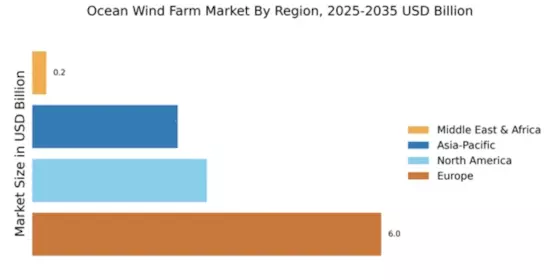
The North American ocean wind farm market is poised for significant growth, driven by increasing demand for renewable energy and supportive regulatory frameworks. With a market size of $3.0 billion, the region is focusing on reducing carbon emissions and enhancing energy security. The U.S. government has set ambitious targets for offshore wind capacity, aiming for 30 GW by 2030, which is expected to catalyze investments and innovation in the sector. Leading the charge in this market are the United States and Canada, where major players like GE Renewable Energy and Siemens Gamesa are actively involved. The competitive landscape is characterized by partnerships and collaborations aimed at technology advancement and cost reduction. As the market matures, the presence of established companies alongside emerging startups will drive further growth and diversification in the ocean wind sector.

Europe : Global Leader in Offshore Wind

Europe continues to lead The Ocean Wind Farm, boasting a market size of $6.0 billion. The region's growth is fueled by strong government policies, ambitious renewable energy targets, and significant investments in technology. Countries like the UK, Germany, and Denmark are at the forefront, with a combined share that reflects Europe's commitment to achieving 50% of its energy from renewables by 2030. Regulatory support, including streamlined permitting processes, is enhancing project viability. The competitive landscape is robust, featuring key players such as Orsted, Vestas, and Siemens Gamesa, which are driving innovation and efficiency in offshore wind technologies. The presence of established supply chains and skilled labor further strengthens Europe's position. As the market evolves, collaboration among stakeholders will be crucial to meet the increasing energy demands and sustainability goals across the continent.

Asia-Pacific : Emerging Market with High Potential

The Asia-Pacific region is emerging as a significant player in the ocean wind farm market, with a market size of $2.5 billion. Driven by increasing energy demands and government initiatives to promote renewable energy, countries like China, Japan, and South Korea are investing heavily in offshore wind projects. Regulatory frameworks are evolving to support this growth, with ambitious targets set for renewable energy generation, aiming for a substantial increase in installed capacity by 2030. China is leading the charge, with the largest number of offshore wind installations globally, while Japan and South Korea are rapidly expanding their capabilities. The competitive landscape is characterized by both local and international players, including MHI Vestas and Enel Green Power, who are collaborating to enhance technology and reduce costs. As the market matures, the focus will be on sustainability and innovation to meet the region's energy needs.

Middle East and Africa : Untapped Renewable Energy Potential

The Middle East and Africa region is still in the nascent stages of developing its ocean wind farm market, with a market size of $0.24 billion. However, there is a growing recognition of the potential for renewable energy sources, driven by the need for energy diversification and sustainability. Governments are beginning to implement policies that encourage investment in renewable technologies, with a focus on harnessing wind energy to meet future energy demands. Countries like South Africa and Morocco are exploring offshore wind projects, supported by international partnerships and investments. The competitive landscape is gradually evolving, with key players starting to enter the market. As regulatory frameworks improve and awareness of renewable energy benefits increases, the region is expected to see a gradual but steady growth in ocean wind capacity, aligning with global sustainability goals.

Key Players and Competitive Insights

The Ocean Wind Farm Market is currently characterized by a dynamic competitive landscape, driven by increasing demand for renewable energy and technological advancements. Key players such as Ørsted (DK), Siemens Gamesa (ES), and GE Renewable Energy (US) are at the forefront, each adopting distinct strategies to enhance their market positioning. Ørsted (DK) focuses on innovation and sustainability, aiming to lead in offshore wind capacity, while Siemens Gamesa (ES) emphasizes technological advancements in turbine efficiency. GE Renewable Energy (US) is leveraging its extensive experience in the energy sector to expand its footprint in offshore wind, indicating a trend towards specialization and technological prowess among leading firms.

The business tactics employed by these companies include localizing manufacturing and optimizing supply chains to enhance operational efficiency. The market structure appears moderately fragmented, with several players vying for market share, yet the influence of major companies is substantial. Their collective strategies not only shape competitive dynamics but also drive innovation and investment in the sector, fostering a more robust market environment.

In November 2025, Ørsted (DK) announced a strategic partnership with a leading technology firm to develop next-generation floating wind turbine technology. This move is significant as it positions Ørsted to capitalize on emerging markets where traditional fixed-bottom turbines may not be feasible, thereby expanding its operational capabilities and market reach. Such partnerships are indicative of a broader trend towards collaboration in technology development within the industry.

In October 2025, Siemens Gamesa (ES) unveiled a new offshore wind turbine model designed to enhance energy output and reduce costs. This innovation is crucial as it reflects the company's commitment to maintaining a competitive edge through technological advancements. By focusing on efficiency and cost-effectiveness, Siemens Gamesa is likely to attract new clients and strengthen its market position amidst growing competition.

In September 2025, GE Renewable Energy (US) secured a major contract for the supply of wind turbines for a large-scale offshore project in the North Sea. This contract not only underscores GE's strong market presence but also highlights the increasing scale of offshore wind projects. Such strategic wins are essential for maintaining competitive differentiation in a rapidly evolving market.

As of December 2025, current trends in the Ocean Wind Farm Market include a pronounced shift towards digitalization, sustainability, and the integration of AI technologies. Strategic alliances are increasingly shaping the competitive landscape, enabling companies to pool resources and expertise. Looking ahead, competitive differentiation is expected to evolve, with a greater emphasis on innovation and technology rather than solely on price. The focus on supply chain reliability and technological advancements will likely define the future trajectory of competition in this sector.

Key Companies in the Ocean Wind Farm Market market include

Industry Developments

  • Q1 2024: The first commercial-scale offshore wind power plant in the United States—the 132-megawatt (MW) South Fork Wind Farm—began delivering power to New York in November 2023 and was fully commissioned on March 14, 2024. South Fork Wind Farm became the first commercial-scale offshore wind project in the U.S. to be fully commissioned, marking a major milestone for the American offshore wind sector.
  • Q1 2024: As offshore wind continues to develop in the United States, significant funding in the domestic supply chain is critical to achieving U.S. renewable energy goals. The recent year indicates significant investor confidence, as $2.1 billion was funded since 2023 for port development, vessel orders, workforce development, research, and other supply chain funding. The U.S. offshore wind sector received $2.1 billion in funding since 2023, supporting port infrastructure, vessel construction, workforce training, and research to strengthen the domestic supply chain.

Future Outlook

Ocean Wind Farm Market Future Outlook

The Ocean Wind Farm Market is projected to grow at a 15.03% CAGR from 2024 to 2035, driven by technological advancements, regulatory support, and increasing energy demands.

New opportunities lie in:

  • Development of advanced floating turbine technologies for deeper waters.
  • Integration of energy storage solutions to enhance grid stability.
  • Expansion into emerging markets with untapped offshore wind potential.

By 2035, the market is expected to be robust, driven by innovation and global energy transition efforts.

Market Segmentation

Ocean Wind Farm Market End Use Outlook

  • Utility Scale
  • Commercial
  • Residential
  • Offshore Oil and Gas

Ocean Wind Farm Market Technology Outlook

  • Floating Wind Turbines
  • Fixed Bottom Turbines
  • Hybrid Systems
  • Advanced Control Systems

Ocean Wind Farm Market Application Outlook

  • Energy Generation
  • Energy Storage
  • Grid Integration
  • Environmental Monitoring

Report Scope

MARKET SIZE 202411.74(USD Billion)
MARKET SIZE 202513.5(USD Billion)
MARKET SIZE 203554.79(USD Billion)
COMPOUND ANNUAL GROWTH RATE (CAGR)15.03% (2024 - 2035)
REPORT COVERAGERevenue Forecast, Competitive Landscape, Growth Factors, and Trends
BASE YEAR2024
Market Forecast Period2025 - 2035
Historical Data2019 - 2024
Market Forecast UnitsUSD Billion
Key Companies ProfiledOrsted (DK), Siemens Gamesa (ES), GE Renewable Energy (US), Vestas (DK), MHI Vestas (DK), EDP Renewables (PT), RWE (DE), Iberdrola (ES), Enel Green Power (IT)
Segments CoveredApplication, Technology, End Use
Key Market OpportunitiesAdvancements in floating turbine technology enhance viability in deeper waters for the Ocean Wind Farm Market.
Key Market DynamicsRising investments in offshore wind technology drive competitive dynamics and regulatory advancements in the Ocean Wind Farm Market.
Countries CoveredNorth America, Europe, APAC, South America, MEA

Leave a Comment

FAQs

How big is the Ocean Wind Farm market?

The Ocean Wind Farm Market size was valued at Significant Value in 2023.

What is the growth rate of the Ocean Wind Farm market?

The global market is projected to grow at a CAGR of 12.5% from 2024 to 2032.

Which region held the largest market share in the Ocean Wind Farm market?

North America had the largest share of the global market.

Who are the key players in the Ocean Wind Farm market?

The key players in the market are General Electric, Vestas, Inc., Siemens Gamesa, and Goldwind, Shanghai.

Which Component led the Ocean Wind Farm market?

The turbines category dominated the market in 2023.

Which Location had the largest market share in the Ocean Wind Farm market?

Shallow water had the largest share of the global market.

Download Free Sample

Kindly complete the form below to receive a free sample of this Report

Compare Licence

×
Features License Type
Single User Multiuser License Enterprise User
Price $4,950 $5,950 $7,250
Maximum User Access Limit 1 User Upto 10 Users Unrestricted Access Throughout the Organization
Free Customization
Direct Access to Analyst
Deliverable Format
Platform Access
Discount on Next Purchase 10% 15% 15%
Printable Versions