Request Free Sample ×

Kindly complete the form below to receive a free sample of this Report

* Please use a valid business email

Leading companies partner with us for data-driven Insights

clients tt-cursor
Hero Background

Offshore Autonomous Underwater Vehicle Market

ID: MRFR/AD/6741-CR
168 Pages
Abbas Raut
Last Updated: January 13, 2026
Offshore Autonomous Underwater Vehicle (AUV) Market Size, Share, Industry Trend & Analysis Research Report Information by Type (Shallow, Medium and Large), Technology (Communication, Collision Avoidance, Navigation, Imaging and Propulsion), Payload (Sensors, Cameras, Synthetic Aperture Sonars and others), Application (Military & Defense; Oil & Gas; Oceanography; Environmental Protection and Monitoring; Archaeological and Exploration and Search and Salvage Operations) and Region (North America, Europe, Asia Pacific, Middle East and Africa and Latin America) - Forecast to 2035
Download PDF ×

We do not share your information with anyone. However, we may send you emails based on your report interest from time to time. You may contact us at any time to opt-out.

  1. 1 SECTION I: EXECUTIVE SUMMARY AND KEY HIGHLIGHTS
    1. 1.1 EXECUTIVE SUMMARY
      1. 1.1.1 Market Overview
      2. 1.1.2 Key Findings
      3. 1.1.3 Market Segmentation
      4. 1.1.4 Competitive Landscape
      5. 1.1.5 Challenges and Opportunities
      6. 1.1.6 Future Outlook
  2. 2 SECTION II: SCOPING, METHODOLOGY AND MARKET STRUCTURE
    1. 2.1 MARKET INTRODUCTION
      1. 2.1.1 Definition
      2. 2.1.2 Scope of the study
        1. 2.1.2.1 Research Objective
        2. 2.1.2.2 Assumption
        3. 2.1.2.3 Limitations
    2. 2.2 RESEARCH METHODOLOGY
      1. 2.2.1 Overview
      2. 2.2.2 Data Mining
      3. 2.2.3 Secondary Research
      4. 2.2.4 Primary Research
        1. 2.2.4.1 Primary Interviews and Information Gathering Process
        2. 2.2.4.2 Breakdown of Primary Respondents
      5. 2.2.5 Forecasting Model
      6. 2.2.6 Market Size Estimation
        1. 2.2.6.1 Bottom-Up Approach
        2. 2.2.6.2 Top-Down Approach
      7. 2.2.7 Data Triangulation
      8. 2.2.8 Validation
  3. 3 SECTION III: QUALITATIVE ANALYSIS
    1. 3.1 MARKET DYNAMICS
      1. 3.1.1 Overview
      2. 3.1.2 Drivers
      3. 3.1.3 Restraints
      4. 3.1.4 Opportunities
    2. 3.2 MARKET FACTOR ANALYSIS
      1. 3.2.1 Value chain Analysis
      2. 3.2.2 Porter's Five Forces Analysis
        1. 3.2.2.1 Bargaining Power of Suppliers
        2. 3.2.2.2 Bargaining Power of Buyers
        3. 3.2.2.3 Threat of New Entrants
        4. 3.2.2.4 Threat of Substitutes
        5. 3.2.2.5 Intensity of Rivalry
      3. 3.2.3 COVID-19 Impact Analysis
        1. 3.2.3.1 Market Impact Analysis
        2. 3.2.3.2 Regional Impact
        3. 3.2.3.3 Opportunity and Threat Analysis
  4. 4 SECTION IV: QUANTITATIVE ANALYSIS
    1. 4.1 Offshore Autonomous Underwater Vehicle Market, BY Application (USD Million)
      1. 4.1.1 Military
      2. 4.1.2 Scientific Research
      3. 4.1.3 Commercial Exploration
      4. 4.1.4 Environmental Monitoring
      5. 4.1.5 Underwater Inspection
    2. 4.2 Offshore Autonomous Underwater Vehicle Market, BY End Use (USD Million)
      1. 4.2.1 Oil and Gas
      2. 4.2.2 Marine Research
      3. 4.2.3 Defense
      4. 4.2.4 Telecommunications
      5. 4.2.5 Renewable Energy
    3. 4.3 Offshore Autonomous Underwater Vehicle Market, BY Vehicle Type (USD Million)
      1. 4.3.1 Remotely Operated Vehicle
      2. 4.3.2 Autonomous Underwater Vehicle
      3. 4.3.3 Hybrid Vehicle
      4. 4.3.4 Surface Vehicle
    4. 4.4 Offshore Autonomous Underwater Vehicle Market, BY Technology (USD Million)
      1. 4.4.1 Navigation Systems
      2. 4.4.2 Communication Systems
      3. 4.4.3 Power Systems
      4. 4.4.4 Sensor Technology
    5. 4.5 Offshore Autonomous Underwater Vehicle Market, BY Payload Capacity (USD Million)
      1. 4.5.1 Lightweight
      2. 4.5.2 Medium Weight
      3. 4.5.3 Heavyweight
    6. 4.6 Offshore Autonomous Underwater Vehicle Market, BY Region (USD Million)
      1. 4.6.1 North America
        1. 4.6.1.1 US
        2. 4.6.1.2 Canada
      2. 4.6.2 Europe
        1. 4.6.2.1 Germany
        2. 4.6.2.2 UK
        3. 4.6.2.3 France
        4. 4.6.2.4 Russia
        5. 4.6.2.5 Italy
        6. 4.6.2.6 Spain
        7. 4.6.2.7 Rest of Europe
      3. 4.6.3 APAC
        1. 4.6.3.1 China
        2. 4.6.3.2 India
        3. 4.6.3.3 Japan
        4. 4.6.3.4 South Korea
        5. 4.6.3.5 Malaysia
        6. 4.6.3.6 Thailand
        7. 4.6.3.7 Indonesia
        8. 4.6.3.8 Rest of APAC
      4. 4.6.4 South America
        1. 4.6.4.1 Brazil
        2. 4.6.4.2 Mexico
        3. 4.6.4.3 Argentina
        4. 4.6.4.4 Rest of South America
      5. 4.6.5 MEA
        1. 4.6.5.1 GCC Countries
        2. 4.6.5.2 South Africa
        3. 4.6.5.3 Rest of MEA
  5. 5 SECTION V: COMPETITIVE ANALYSIS
    1. 5.1 Competitive Landscape
      1. 5.1.1 Overview
      2. 5.1.2 Competitive Analysis
      3. 5.1.3 Market share Analysis
      4. 5.1.4 Major Growth Strategy in the Aerospace & Defense
      5. 5.1.5 Competitive Benchmarking
      6. 5.1.6 Leading Players in Terms of Number of Developments in the Aerospace & Defense
      7. 5.1.7 Key developments and growth strategies
        1. 5.1.7.1 New Product Launch/Service Deployment
        2. 5.1.7.2 Merger & Acquisitions
        3. 5.1.7.3 Joint Ventures
      8. 5.1.8 Major Players Financial Matrix
        1. 5.1.8.1 Sales and Operating Income
        2. 5.1.8.2 Major Players R&D Expenditure. 2023
    2. 5.2 Company Profiles
      1. 5.2.1 Teledyne Technologies (US)
        1. 5.2.1.1 Financial Overview
        2. 5.2.1.2 Products Offered
        3. 5.2.1.3 Key Developments
        4. 5.2.1.4 SWOT Analysis
        5. 5.2.1.5 Key Strategies
      2. 5.2.2 Kongsberg Gruppen (NO)
        1. 5.2.2.1 Financial Overview
        2. 5.2.2.2 Products Offered
        3. 5.2.2.3 Key Developments
        4. 5.2.2.4 SWOT Analysis
        5. 5.2.2.5 Key Strategies
      3. 5.2.3 Saab AB (SE)
        1. 5.2.3.1 Financial Overview
        2. 5.2.3.2 Products Offered
        3. 5.2.3.3 Key Developments
        4. 5.2.3.4 SWOT Analysis
        5. 5.2.3.5 Key Strategies
      4. 5.2.4 Ocean Infinity (GB)
        1. 5.2.4.1 Financial Overview
        2. 5.2.4.2 Products Offered
        3. 5.2.4.3 Key Developments
        4. 5.2.4.4 SWOT Analysis
        5. 5.2.4.5 Key Strategies
      5. 5.2.5 Lockheed Martin (US)
        1. 5.2.5.1 Financial Overview
        2. 5.2.5.2 Products Offered
        3. 5.2.5.3 Key Developments
        4. 5.2.5.4 SWOT Analysis
        5. 5.2.5.5 Key Strategies
      6. 5.2.6 General Dynamics (US)
        1. 5.2.6.1 Financial Overview
        2. 5.2.6.2 Products Offered
        3. 5.2.6.3 Key Developments
        4. 5.2.6.4 SWOT Analysis
        5. 5.2.6.5 Key Strategies
      7. 5.2.7 Boeing (US)
        1. 5.2.7.1 Financial Overview
        2. 5.2.7.2 Products Offered
        3. 5.2.7.3 Key Developments
        4. 5.2.7.4 SWOT Analysis
        5. 5.2.7.5 Key Strategies
      8. 5.2.8 Fugro (NL)
        1. 5.2.8.1 Financial Overview
        2. 5.2.8.2 Products Offered
        3. 5.2.8.3 Key Developments
        4. 5.2.8.4 SWOT Analysis
        5. 5.2.8.5 Key Strategies
      9. 5.2.9 Subsea 7 (GB)
        1. 5.2.9.1 Financial Overview
        2. 5.2.9.2 Products Offered
        3. 5.2.9.3 Key Developments
        4. 5.2.9.4 SWOT Analysis
        5. 5.2.9.5 Key Strategies
    3. 5.3 Appendix
      1. 5.3.1 References
      2. 5.3.2 Related Reports

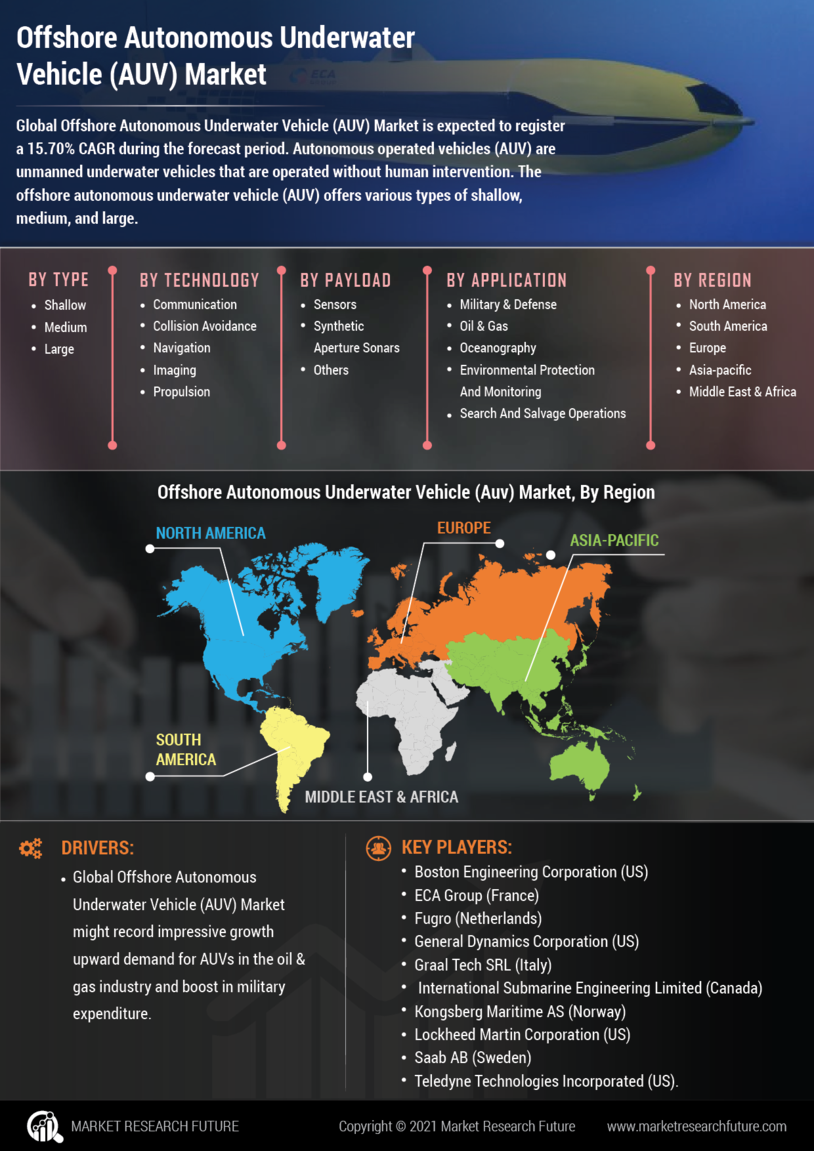
Offshore Autonomous Underwater Vehicle Market Segmentation

Offshore Autonomous Underwater Vehicle Market By Application (USD Million, 2025-2035)

  • Military
  • Scientific Research
  • Commercial Exploration
  • Environmental Monitoring
  • Underwater Inspection

Offshore Autonomous Underwater Vehicle Market By End Use (USD Million, 2025-2035)

  • Oil and Gas
  • Marine Research
  • Defense
  • Telecommunications
  • Renewable Energy

Offshore Autonomous Underwater Vehicle Market By Vehicle Type (USD Million, 2025-2035)

  • Remotely Operated Vehicle
  • Autonomous Underwater Vehicle
  • Hybrid Vehicle
  • Surface Vehicle

Offshore Autonomous Underwater Vehicle Market By Technology (USD Million, 2025-2035)

  • Navigation Systems
  • Communication Systems
  • Power Systems
  • Sensor Technology

Offshore Autonomous Underwater Vehicle Market By Payload Capacity (USD Million, 2025-2035)

  • Lightweight
  • Medium Weight
  • Heavyweight