×
Request Free Sample ×

Kindly complete the form below to receive a free sample of this Report

* Please use a valid business email

Leading companies partner with us for data-driven Insights

clients tt-cursor
Hero Background

Offshore Oil Gas Market

ID: MRFR/EnP/35702-HCR
111 Pages
Chitranshi Jaiswal
October 2025

Offshore Oil and Gas Market Research Report: By Application (Exploration, Production, Decommissioning, Subsea, Renewable Energy), By Type (Platform, Floating, Subsea, Ship-Based, Land-Based), By Service (Drilling, Completion, Production, Maintenance, Pipeline Installation), By End Use (Oil Extraction, Natural Gas Extraction, Hybrid Energy Systems) and By Regional (North America, Europe, South America, Asia Pacific, Middle East and Africa) - Forecast to 2035.

Share:
Download PDF ×

We do not share your information with anyone. However, we may send you emails based on your report interest from time to time. You may contact us at any time to opt-out.

Offshore Oil Gas Market
 Infographic
Purchase Options

Offshore Oil Gas Market Summary

As per MRFR analysis, the Offshore Oil and Gas Market Size was estimated at 1655.74 USD Billion in 2024. The Offshore Oil and Gas industry is projected to grow from 1713.06 USD Billion in 2025 to 2407.6 USD Billion by 2035, exhibiting a compound annual growth rate (CAGR) of 3.46 during the forecast period 2025 - 2035.

Key Market Trends & Highlights

The Offshore Oil and Gas Market is poised for growth driven by technological advancements and sustainability initiatives.

  • Technological innovation is reshaping operational efficiencies in the offshore oil and gas sector.
  • Sustainability initiatives are increasingly influencing investment decisions across North America and Asia-Pacific.
  • The production segment remains the largest, while the decommissioning segment is experiencing rapid growth.
  • Rising energy demand and geopolitical factors are key drivers propelling market expansion.

Market Size & Forecast

Major Players

ExxonMobil (US), Royal Dutch Shell (GB), Chevron (US), TotalEnergies (FR), BP (GB), Eni (IT), Equinor (NO), ConocoPhillips (US), Petrobras (BR)

Offshore Oil Gas Market Trends

The Offshore Oil and Gas Market is currently experiencing a transformative phase, driven by a confluence of technological advancements and evolving regulatory frameworks. Companies are increasingly adopting innovative extraction techniques and digital solutions to enhance operational efficiency and reduce environmental impact. This shift not only aligns with global sustainability goals but also addresses the growing demand for energy in various sectors. As the market adapts to these changes, it appears poised for growth, with stakeholders focusing on strategic investments and partnerships to navigate the complexities of this dynamic landscape. In addition, the Offshore Oil and Gas Market is witnessing a heightened emphasis on safety and risk management. Companies are prioritizing the implementation of robust safety protocols and advanced monitoring systems to mitigate potential hazards associated with offshore operations. This trend reflects a broader industry commitment to ensuring the well-being of personnel and the protection of marine ecosystems. As the market evolves, these factors may significantly influence operational strategies and investment decisions, shaping the future of offshore energy production.

Technological Innovation

The Offshore Oil and Gas Market is increasingly characterized by the integration of cutting-edge technologies. Innovations such as automation, artificial intelligence, and advanced data analytics are being utilized to optimize exploration and production processes. This trend not only enhances efficiency but also contributes to cost reduction and improved safety measures.

Sustainability Initiatives

There is a growing focus on sustainability within the Offshore Oil and Gas Market. Companies are actively seeking to minimize their environmental footprint by adopting cleaner technologies and practices. This shift aligns with global efforts to combat climate change and reflects a commitment to responsible resource management.

Regulatory Compliance

The Offshore Oil and Gas Market is navigating a complex landscape of regulatory requirements. Stricter environmental regulations and safety standards are prompting companies to enhance their compliance strategies. This trend underscores the importance of adhering to legal frameworks while maintaining operational efficiency.

Offshore Oil Gas Market Drivers

Geopolitical Factors

Geopolitical factors are increasingly influencing the Offshore Oil and Gas Market Industry. Political stability in oil-rich regions is crucial for ensuring uninterrupted supply chains and attracting foreign investments. Recent tensions in key oil-producing areas have led to fluctuations in oil prices, impacting the overall market dynamics. For instance, conflicts in the Middle East have historically resulted in price volatility, prompting companies to diversify their portfolios and explore offshore opportunities in more stable regions. Additionally, government policies and international relations play a pivotal role in shaping the regulatory landscape for offshore operations. As nations seek energy independence, the Offshore Oil and Gas Market Industry may experience shifts in investment patterns and operational strategies.

Rising Energy Demand

The Offshore Oil and Gas Market Industry is experiencing a surge in energy demand, driven by population growth and industrialization. As economies expand, the need for reliable energy sources becomes paramount. According to recent data, global energy consumption is projected to increase by approximately 30% by 2040. This rising demand is likely to stimulate investments in offshore oil and gas exploration and production, as these resources are essential for meeting energy needs. Furthermore, the Offshore Oil and Gas Market Industry is expected to play a crucial role in bridging the energy gap, particularly in regions where onshore resources are limited. Consequently, companies are focusing on enhancing their offshore capabilities to capitalize on this growing demand.

Environmental Regulations

The Offshore Oil and Gas Market Industry is increasingly subject to stringent environmental regulations aimed at minimizing ecological impact. Governments are implementing policies that require companies to adopt sustainable practices and reduce carbon emissions. For example, regulations mandating the use of cleaner technologies and the implementation of spill prevention measures are becoming more prevalent. These regulations not only aim to protect marine ecosystems but also encourage innovation within the industry. Companies that proactively comply with these environmental standards may gain a competitive advantage, as consumers and investors increasingly favor sustainable practices. Consequently, the Offshore Oil and Gas Market Industry is likely to evolve, focusing on environmentally responsible exploration and production methods.

Technological Advancements

Technological advancements are significantly shaping the Offshore Oil and Gas Market Industry. Innovations in drilling techniques, such as horizontal drilling and hydraulic fracturing, have enhanced the efficiency and safety of offshore operations. Moreover, the integration of digital technologies, including artificial intelligence and data analytics, is optimizing production processes and reducing operational costs. For instance, the implementation of advanced subsea technologies has improved the ability to extract oil and gas from challenging environments. As a result, the Offshore Oil and Gas Market Industry is likely to witness increased productivity and reduced environmental impact, making it more competitive in the energy sector. These advancements not only enhance operational efficiency but also contribute to the sustainability of offshore projects.

Investment in Renewable Energy Integration

The Offshore Oil and Gas Market Industry is witnessing a growing trend towards the integration of renewable energy sources. As the world shifts towards a more sustainable energy landscape, companies are exploring ways to combine offshore oil and gas operations with renewable technologies, such as wind and solar power. This integration could potentially enhance energy security and reduce reliance on fossil fuels. For instance, offshore wind farms are being developed alongside oil and gas platforms, allowing for shared infrastructure and reduced costs. This trend not only aligns with The Offshore Oil and Gas Industry as a key player in the transition to a low-carbon economy. The potential for hybrid energy solutions may redefine operational strategies and investment priorities in the coming years.
Market Segment Insights

By Application: Production (Largest) vs. Decommissioning (Fastest-Growing)

In the Offshore Oil and Gas Market, the application segment is divided into various critical areas including Exploration, Production, Decommissioning, Subsea, and Renewable Energy. Among these, Production holds the largest share, driving the majority of market activity and revenue. Additionally, Decommissioning is emerging as a rapidly growing segment, fueled by the increasing number of aging offshore platforms in need of safe and efficient removal processes. The growth of the Decommissioning segment is primarily driven by stricter environmental regulations and a heightened focus on sustainability. Furthermore, technological advancements are enabling more cost-effective and safer decommissioning methods. Meanwhile, the Production segment benefits from global energy demands and investments in exploration activities, maintaining its status as a crucial component of the offshore oil and gas landscape.

Production (Dominant) vs. Renewable Energy (Emerging)

The Production segment in the offshore oil and gas market is characterized by its dominance, heavily contributing to energy supplies worldwide due to ongoing global demand growth. It encompasses a wide range of activities from extracting hydrocarbons from underwater reserves to processing them for market distribution. As production technologies evolve and become more advanced, companies strive for operational efficiencies and sustainable practices. In contrast, the Renewable Energy segment, while still emerging, reflects an increasing shift towards sustainable solutions such as offshore wind and tidal energy. This transition is driven by rising environmental concerns and regulatory pushes for greener energy. Companies operating in this space are adapting their strategies to integrate renewable technologies, presenting opportunities for synergy with traditional offshore operations.

By Type: Platform (Largest) vs. Floating (Fastest-Growing)

Within the Offshore Oil and Gas Market, various types of operational setups are employed, primarily categorized into Platform, Floating, Subsea, Ship-Based, and Land-Based. Currently, the Platform segment dominates the market, buoyed by long-standing infrastructure and established technologies that have proven effective for offshore drilling. In contrast, the Floating segment has gained traction, appealing to operators seeking flexible solutions that can adapt to changing conditions and demands, thus steadily increasing its market presence.

Platform (Dominant) vs. Floating (Emerging)

The Platform segment remains the backbone of offshore oil and gas extraction, known for its reliability and extensive use in established oil fields. Platforms provide a stable and robust base for exploration and production, accommodating extensive infrastructure and personnel. Meanwhile, the Floating segment represents an emerging trend aimed at enhancing offshore exploration capabilities in deeper waters. Floating systems, including Floating Production Storage and Offloading (FPSO) units, offer mobility and versatility, making them ideal for regions where fixed platforms may be impractical. As technological advancements continue to unfold, the Floating segment is anticipated to attract significant interest from operators looking to tap into previously inaccessible reserves.

By Service: Production (Largest) vs. Drilling (Fastest-Growing)

In the Offshore Oil and Gas Market, the service segment showcases a dynamic distribution of market share among its various components. Production stands as the largest segment, reflecting its critical role in meeting global energy demands. This segment includes essential activities such as extraction, processing, and delivery of hydrocarbons. In contrast, drilling is emerging rapidly, characterized by innovative techniques and technologies that increase efficiency and reduce costs, capturing a notable share of the market as operators seek to optimize their operations. Growth trends in the offshore service segment are primarily driven by rising energy consumption and advancements in drilling technologies. Additionally, the push for sustainable practices and a shift towards deeper water exploration are propelling the demand for efficient service solutions. With the ongoing transition towards renewable energy sources, traditional oil and gas services are also adapting, prompting investments in new technologies and practices to enhance productivity and sustainability.

Production: Oil (Dominant) vs. Maintenance (Emerging)

Within the Offshore Oil and Gas Market, the production segment, particularly in oil extraction, dominates due to its established methods and significant investment. Oil production involves advanced techniques such as subsea systems and floating production platforms, ensuring efficiency and maximization of output. On the other hand, the maintenance segment is gaining traction as operators recognize the importance of upkeep in prolonging the life of offshore installations. With aging infrastructure and increasing operational complexities, maintenance is becoming a priority, emphasizing preventive measures to minimize downtime and enhance recovery rates. This emerging segment is crucial for optimizing operational efficiency and ensuring compliance with safety regulations.

By End Use: Oil Extraction (Largest) vs. Natural Gas Extraction (Fastest-Growing)

In the Offshore Oil and Gas Market, the distribution of market share among different end uses reveals significant trends. Oil extraction continues to dominate, capturing a substantial share due to its long-standing role and infrastructure investments. In comparison, natural gas extraction is emerging as a strong contender, fueled by the rising demand for cleaner energy sources and technological advancements that enhance extraction efficiency. Meanwhile, hybrid energy systems are gradually being adopted but currently hold a smaller share in comparison to oil extraction and natural gas extraction.

Oil Extraction (Dominant) vs. Natural Gas Extraction (Emerging)

Oil extraction remains the dominant segment in the Offshore Oil and Gas Market owing to its established presence and extensive investments in technology and infrastructure. This segment benefits from a large number of operational offshore drilling rigs and ongoing projects. Conversely, natural gas extraction is emerging rapidly, driven by global shifts towards reducing carbon emissions and transitioning to cleaner energy. The hybrid energy systems segment, while still minor in comparison, exemplifies innovation in combining traditional oil and gas extraction with renewable energy sources, indicating a shift towards more sustainable practices in offshore energy production.

Get more detailed insights about Offshore Oil Gas Market

Regional Insights

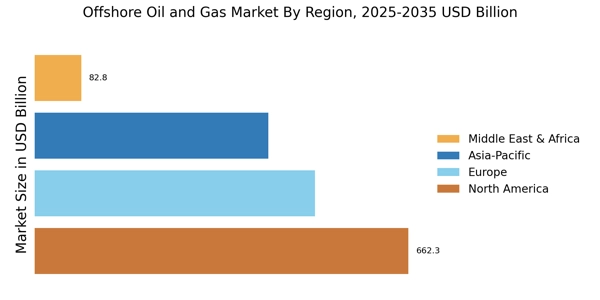
The Offshore Oil and Gas Market is presenting diverse regional dynamics, showcasing substantial valuations across its segments in 2023, with North America leading at 500.0 USD Billion, followed by Europe at 350.0 USD Billion and APAC at 400.0 USD Billion. North America's dominance is evident as it captures a significant market holding, driven by advanced infrastructure and technology, ensuring its continued growth toward 670.0 USD Billion by 2032.

Europe, with its supportive regulatory framework, maintains a considerable presence, expected to reach 460.0 USD Billion, while APAC's rapid industrialization plays a key role in its projected growth to 550.0 USD Billion.South America, valued at 150.0 USD Billion, reflects growing exploration efforts, but faces challenges in investment and infrastructure development. Meanwhile, the MEA region, valued at 146.76 USD Billion, presents opportunities amid geopolitical complexities and fluctuating oil prices, with potential growth reaching 200.0 USD Billion by 2032.

Overall, the Offshore Oil and Gas Market data highlights substantial growth opportunities, with market trends driven by energy demand and technological advancements across these key regions. 

Offshore Oil Gas Market
 Regional Image

Key Players and Competitive Insights

The Offshore Oil and Gas Market is currently characterized by a complex interplay of competitive dynamics, driven by factors such as technological advancements, regulatory changes, and a growing emphasis on sustainability. Major players like ExxonMobil (US), Royal Dutch Shell (GB), and TotalEnergies (FR) are strategically positioning themselves to leverage these trends. ExxonMobil (US) has been focusing on enhancing its operational efficiency through digital transformation initiatives, while Royal Dutch Shell (GB) is increasingly investing in renewable energy projects to diversify its portfolio. TotalEnergies (FR) appears to be concentrating on expanding its footprint in emerging markets, thereby shaping a competitive environment that is both innovative and adaptive to changing consumer demands.

In terms of business tactics, companies are localizing their operations and optimizing supply chains to enhance resilience and responsiveness. The market structure is moderately fragmented, with a mix of established players and emerging companies vying for market share. This fragmentation allows for a variety of competitive strategies, as key players leverage their strengths to influence market dynamics collectively.

In August 2025, Chevron (US) announced a significant partnership with a leading technology firm to develop AI-driven solutions aimed at optimizing offshore drilling operations. This strategic move is likely to enhance Chevron's operational efficiency and reduce costs, positioning the company favorably in a competitive landscape that increasingly values technological integration. Furthermore, this partnership underscores the growing trend of digitalization within the industry, as companies seek to harness data analytics for improved decision-making.

In September 2025, BP (GB) unveiled its ambitious plan to achieve net-zero emissions by 2030, which includes a substantial investment in carbon capture and storage technologies. This initiative not only reflects BP's commitment to sustainability but also positions the company as a leader in the transition towards greener energy solutions. The strategic importance of this move lies in its potential to attract environmentally conscious investors and customers, thereby enhancing BP's competitive edge in a market that is progressively prioritizing sustainability.

In October 2025, Eni (IT) launched a new offshore project in the Mediterranean, focusing on natural gas extraction. This project is significant as it aligns with the European Union's energy diversification goals, potentially reducing reliance on external energy sources. Eni's proactive approach in this venture indicates a strategic alignment with regional energy policies, which may enhance its market position and foster long-term growth.

As of October 2025, the Offshore Oil and Gas Market is witnessing a shift towards digitalization, sustainability, and AI integration, which are defining current competitive trends. Strategic alliances are increasingly shaping the landscape, enabling companies to pool resources and expertise to tackle complex challenges. Looking ahead, competitive differentiation is likely to evolve from traditional price-based competition to a focus on innovation, technology, and supply chain reliability, as companies strive to meet the demands of a rapidly changing market.

Key Companies in the Offshore Oil Gas Market market include

Industry Developments

The Offshore Oil and Gas Market continues to exhibit a dynamic landscape, with companies like BP and Royal Dutch Shell investing significantly in renewable energy projects while maintaining their core offshore operations. Recently, Chevron announced the acquisition of Noble Energy, enhancing its position in offshore natural gas, specifically in the Eastern Mediterranean. Concurrently, Equinor has made strides in offshore wind projects, showcasing a commitment to diversifying energy portfolios. Eni is focusing on expansion in Africa's offshore resources, significantly impacting its market valuation positively. Meanwhile, Halliburton and Schlumberger are exploring joint ventures to optimize drilling techniques in offshore settings.

TechnipFMC has been awarded substantial contracts for subsea technologies, reflecting growth from both oil and gas and renewable energy sectors. Petrobras continues to develop offshore assets in Brazil, bolstering its role as a leading player in this market. Baker Hughes is also ramping up investments in digital solutions for offshore projects. Overall, these developments indicate a strong interlinking of traditional offshore oil and gas operations with emerging trends in renewables, highlighting the evolving priorities within the industry.

Future Outlook

Offshore Oil Gas Market Future Outlook

The Offshore Oil and Gas Market is projected to grow at a 3.46% CAGR from 2024 to 2035, driven by technological advancements, increasing energy demand, and regulatory support.

New opportunities lie in:

  • Investment in advanced subsea robotics for enhanced exploration efficiency.
  • Development of integrated digital platforms for real-time data analytics.
  • Expansion of renewable energy integration in offshore operations.

By 2035, the market is expected to demonstrate robust growth and resilience.

Market Segmentation

Offshore Oil Gas Market Type Outlook

  • Platform
  • Floating
  • Subsea
  • Ship-Based
  • Land-Based

Offshore Oil Gas Market End Use Outlook

  • Oil Extraction
  • Natural Gas Extraction
  • Hybrid Energy Systems

Offshore Oil Gas Market Service Outlook

  • Drilling
  • Completion
  • Production
  • Maintenance
  • Pipeline Installation

Offshore Oil Gas Market Application Outlook

  • Exploration
  • Production
  • Decommissioning
  • Subsea
  • Renewable Energy

Report Scope

MARKET SIZE 20241655.74(USD Billion)
MARKET SIZE 20251713.06(USD Billion)
MARKET SIZE 20352407.6(USD Billion)
COMPOUND ANNUAL GROWTH RATE (CAGR)3.46% (2024 - 2035)
REPORT COVERAGERevenue Forecast, Competitive Landscape, Growth Factors, and Trends
BASE YEAR2024
Market Forecast Period2025 - 2035
Historical Data2019 - 2024
Market Forecast UnitsUSD Billion
Key Companies ProfiledMarket analysis in progress
Segments CoveredMarket segmentation analysis in progress
Key Market OpportunitiesAdoption of advanced subsea technologies enhances efficiency in the Offshore Oil and Gas Market.
Key Market DynamicsTechnological advancements and regulatory shifts are reshaping competitive dynamics in the Offshore Oil and Gas Market.
Countries CoveredNorth America, Europe, APAC, South America, MEA

Leave a Comment

FAQs

What is the projected market valuation of the Offshore Oil and Gas Market by 2035?

The Offshore Oil and Gas Market is projected to reach a valuation of 2407.6 USD Billion by 2035.

What was the overall market valuation of the Offshore Oil and Gas Market in 2024?

In 2024, the overall market valuation of the Offshore Oil and Gas Market was 1655.74 USD Billion.

What is the expected CAGR for the Offshore Oil and Gas Market during the forecast period 2025 - 2035?

The expected CAGR for the Offshore Oil and Gas Market during the forecast period 2025 - 2035 is 3.46%.

Which companies are considered key players in the Offshore Oil and Gas Market?

Key players in the Offshore Oil and Gas Market include ExxonMobil, Royal Dutch Shell, Chevron, TotalEnergies, BP, Eni, Equinor, ConocoPhillips, and Petrobras.

What are the projected values for the Exploration segment in the Offshore Oil and Gas Market?

The projected values for the Exploration segment range from 200.0 to 300.0 USD Billion.

How does the Production segment's valuation compare to other segments in the Offshore Oil and Gas Market?

The Production segment's valuation is projected between 800.0 and 1200.0 USD Billion, making it one of the largest segments.

What is the expected valuation range for the Decommissioning segment by 2035?

The Decommissioning segment is expected to have a valuation range of 150.0 to 250.0 USD Billion.

Download Free Sample

Kindly complete the form below to receive a free sample of this Report

Compare Licence

×
Features License Type
Single User Multiuser License Enterprise User
Price $4,950 $ $7,250
Maximum User Access Limit 1 User Upto 10 Users Unrestricted Access Throughout the Organization
Free Customization
Direct Access to Analyst
Deliverable Format
Platform Access
Discount on Next Purchase 10% 15% 15%
Printable Versions