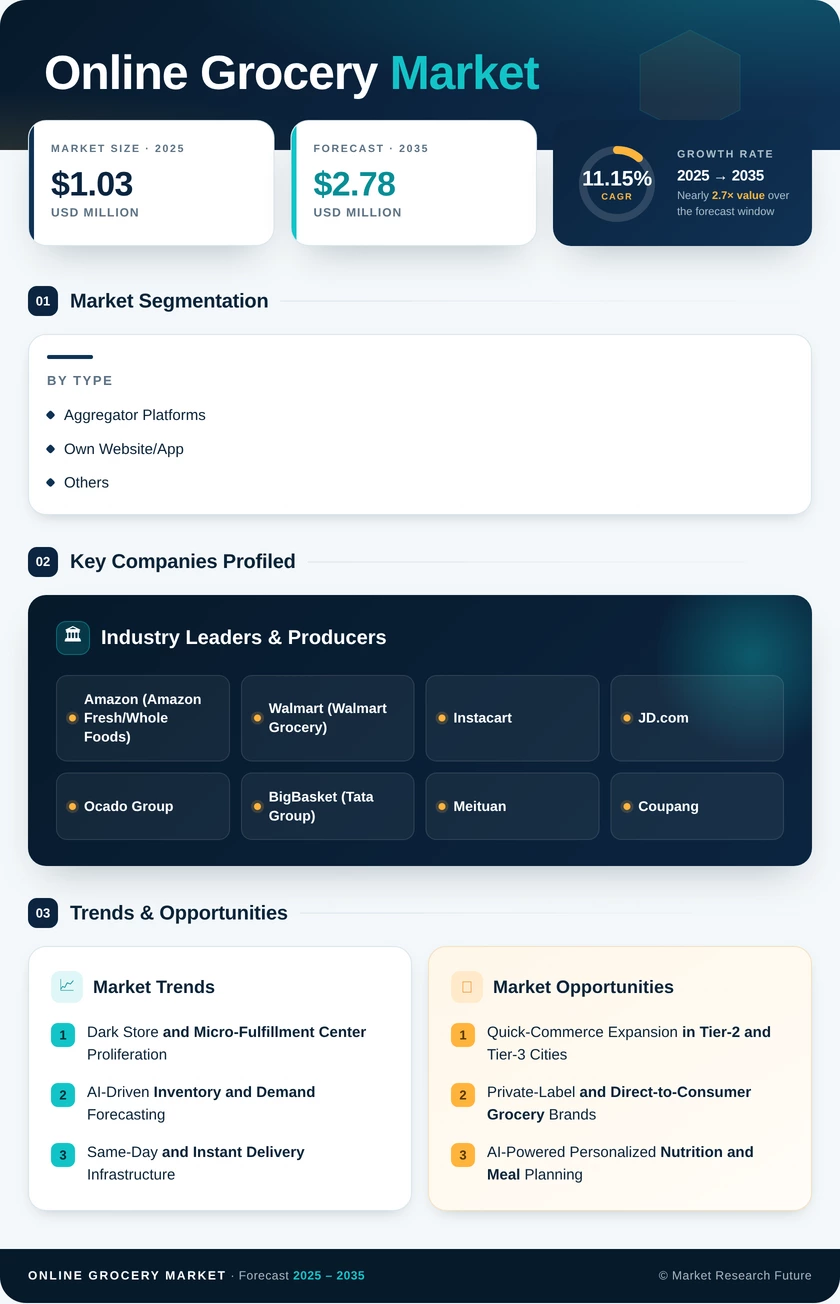
Online Grocery Market

ID: MRFR/CG/8148-CR
128 Pages
Snehal Singh
Last Updated: June 05, 2026
Online Grocery Market Size, Share, Industry Trend & Analysis Research Report: By Product Category (Fresh and Perishable Goods, Packaged Foods, Pantry Staples and Cooking Essentials, Beverages & Others), By Delivery Model (Same-Day Delivery, Instant Delivery, Scheduled Delivery, Other Models), By Platform Type (Aggregator Platforms, Own Website/App, Others), By Geography (North America, Europe, Asia-Pacific, South America, Middle East & Africa) - Forecast to 2035
Download PDF ×

We do not share your information with anyone. However, we may send you emails based on your report interest from time to time. You may contact us at any time to opt-out.

  1. 1 Market Overview |
    1. 1.1 Study Assumptions & Market Definition |
    2. 1.2 Scope of the Study |
    3. 1.3 Research Methodology
  2. 2 Market Summary & Key Takeaways
  3. 3 Market Dynamics |
    1. 3.1 Market Drivers Analysis | |
      1. 3.1.1 Dark Store & Micro-Fulfillment Center Proliferation | |
      2. 3.1.2 AI-Driven Inventory and Demand Forecasting | |
      3. 3.1.3 Same-Day and Instant Delivery Infrastructure | |
      4. 3.1.4 Smartphone Adoption in Emerging Economies | |
      5. 3.1.5 Government Digital Commerce Incentives | |
      6. 3.1.6 Subscription & Loyalty Program Proliferation | |
      7. 3.1.7 Autonomous Last-Mile Delivery Technology |
    2. 3.2 Market Restraints Analysis | |
      1. 3.2.1 Last-Mile Delivery Cost Pressures | |
      2. 3.2.2 Cold-Chain Infrastructure Deficits | |
      3. 3.2.3 Consumer Trust in Fresh Product Quality | |
      4. 3.2.4 Data Privacy and Platform Regulation | |
      5. 3.2.5 Low Margin Structure of Fresh Categories |
    3. 3.3 Market Opportunity Analysis | |
      1. 3.3.1 Quick-Commerce Expansion in Tier-2 and Tier-3 Cities | |
      2. 3.3.2 Private-Label and Direct-to-Consumer Grocery Brands | |
      3. 3.3.3 AI-Powered Personalized Nutrition and Meal Planning | |
      4. 3.3.4 Autonomous and Drone-Based Last-Mile Delivery | |
      5. 3.3.5 Data Monetization Through Retail Media Networks |
    4. 3.4 Industry Value Chain Analysis |
    5. 3.5 Porter's Five Forces Analysis
  4. 4 Global Online Grocery Market Size & Forecast (2021–2035) |
    1. 4.1 Historical Market Size (2021–2025) |
    2. 4.2 Current & Forecast Market Size (2026–2035) |
    3. 4.3 Market Size by Revenue (USD Trillion) |
    4. 4.4 Year-over-Year Growth Analysis
  5. 5 Segmentation Analysis |
    1. 5.1 By Product Category | |
      1. 5.1.1 Fresh and Perishable Goods | |
      2. 5.1.2 Packaged Foods | |
      3. 5.1.3 Pantry Staples and Cooking Essentials | |
      4. 5.1.4 Beverages & Others |
    2. 5.2 By Delivery Model | |
      1. 5.2.1 Same-Day Delivery | |
      2. 5.2.2 Instant Delivery | |
      3. 5.2.3 Scheduled Delivery | |
      4. 5.2.4 Other Models |
    3. 5.3 By Platform Type | |
      1. 5.3.1 Aggregator Platforms | |
      2. 5.3.2 Own Website/App | |
      3. 5.3.3 Others
  6. 6 Regional Analysis |
    1. 6.1 North America | |
      1. 6.1.1 United States | |
      2. 6.1.2 Canada | |
      3. 6.1.3 Mexico |
    2. 6.2 Europe | |
      1. 6.2.1 Germany | |
      2. 6.2.2 United Kingdom | |
      3. 6.2.3 France | |
      4. 6.2.4 Italy | |
      5. 6.2.5 Spain | |
      6. 6.2.6 Nordic Countries | |
      7. 6.2.7 Russia | |
      8. 6.2.8 Rest of Europe |
    3. 6.3 Asia-Pacific | |
      1. 6.3.1 China | |
      2. 6.3.2 India | |
      3. 6.3.3 Japan | |
      4. 6.3.4 South Korea | |
      5. 6.3.5 ASEAN | |
      6. 6.3.6 Rest of Asia-Pacific |
    4. 6.4 South America | |
      1. 6.4.1 Brazil | |
      2. 6.4.2 Argentina | |
      3. 6.4.3 Rest of South America |
    5. 6.5 Middle East & Africa | |
      1. 6.5.1 Saudi Arabia | |
      2. 6.5.2 UAE | |
      3. 6.5.3 South Africa | |
      4. 6.5.4 Egypt | |
      5. 6.5.5 Rest of MEA
  7. 7 Competitive Landscape |
    1. 7.1 Market Share Analysis (2025) |
    2. 7.2 Competitive Benchmarking Matrix |
    3. 7.3 Company Profiles | |
      1. 7.3.1 Amazon (Amazon Fresh / Whole Foods) | |
      2. 7.3.2 Walmart (Walmart Grocery) | |
      3. 7.3.3 Instacart | |
      4. 7.3.4 JD.com | |
      5. 7.3.5 Ocado Group | |
      6. 7.3.6 BigBasket (Tata Group) | |
      7. 7.3.7 Meituan | |
      8. 7.3.8 Coupang | |
      9. 7.3.9 Carrefour | |
      10. 7.3.10 Gopuff
  8. 8 Future Outlook & Strategic Recommendations (2026–2035) |
    1. 8.1 AI and Autonomous Operations Transform Fulfillment |
    2. 8.2 Platform Economics and Consolidation |
    3. 8.3 Sustainability and Circular Grocery Supply Chains |
    4. 8.4 Embedded Finance and Social Commerce Integration
  9. 9 Recent Developments & News
  10. 10 Frequently Asked Questions (FAQs)
  11. 11 Report Scope & Methodology |
    1. 11.1 Study Period & Base Year |
    2. 11.2 Data Sources & Citations |
    3. 11.3 Abbreviations
  12. 12 LIST OF TABLES |
  13. TABLE 1 Global Online Grocery Market Size & Forecast, by Revenue (USD Trillion), 2021–2035 |
  14. TABLE 2 Global Online Grocery Market – Year-over-Year Growth Analysis, 2021–2035 |
  15. TABLE 3 Global Online Grocery Market – Driver Impact Analysis, 2026–2035 |
  16. TABLE 4 Global Online Grocery Market – Restraint Impact Analysis, 2026–2035 |
  17. TABLE 5 Global Online Grocery Market Size, by Product Category, 2021–2035 (USD Billion) |
  18. TABLE 6 Global Online Grocery Market Size, by Delivery Model, 2021–2035 (USD Billion) |
  19. TABLE 7 Global Online Grocery Market Size, by Platform Type, 2021–2035 (USD Billion) |
  20. TABLE 8 Global Online Grocery Market Size, by Region, 2021–2035 (USD Billion) |
  21. TABLE 9 North America Online Grocery Market Size, by Country, 2021–2035 (USD Billion) |
  22. TABLE 10 Europe Online Grocery Market Size, by Country, 2021–2035 (USD Billion) |
  23. TABLE 11 Asia-Pacific Online Grocery Market Size, by Country, 2021–2035 (USD Billion) |
  24. TABLE 12 South America Online Grocery Market Size, by Country, 2021–2035 (USD Billion) |
  25. TABLE 13 Middle East & Africa Online Grocery Market Size, by Country, 2021–2035 (USD Billion) |
  26. TABLE 14 Competitive Benchmarking Matrix – Global Online Grocery Market, 2025 |
  27. TABLE 15 Company Profiles – Key Players, Global Online Grocery Market |
  28. TABLE 16 Recent Developments & Strategic Announcements, 2023–2025 |
  29. TABLE 17 North America Online Grocery Market Size, by Product Category, 2021–2035 (USD Billion) |
  30. TABLE 18 North America Online Grocery Market Size, by Delivery Model, 2021–2035 (USD Billion) |
  31. TABLE 19 North America Online Grocery Market Size, by Platform Type, 2021–2035 (USD Billion) |
  32. TABLE 20 Europe Online Grocery Market Size, by Product Category, 2021–2035 (USD Billion) |
  33. TABLE 21 Europe Online Grocery Market Size, by Delivery Model, 2021–2035 (USD Billion) |
  34. TABLE 22 Europe Online Grocery Market Size, by Platform Type, 2021–2035 (USD Billion) |
  35. TABLE 23 Asia-Pacific Online Grocery Market Size, by Product Category, 2021–2035 (USD Billion) |
  36. TABLE 24 Asia-Pacific Online Grocery Market Size, by Delivery Model, 2021–2035 (USD Billion) |
  37. TABLE 25 Asia-Pacific Online Grocery Market Size, by Platform Type, 2021–2035 (USD Billion) |
  38. TABLE 26 South America Online Grocery Market Size, by Product Category, 2021–2035 (USD Billion) |
  39. TABLE 27 South America Online Grocery Market Size, by Delivery Model, 2021–2035 (USD Billion) |
  40. TABLE 28 South America Online Grocery Market Size, by Platform Type, 2021–2035 (USD Billion) |
  41. TABLE 29 Middle East & Africa Online Grocery Market Size, by Product Category, 2021–2035 (USD Billion) |
  42. TABLE 30 Middle East & Africa Online Grocery Market Size, by Delivery Model, 2021–2035 (USD Billion) |
  43. TABLE 31 Middle East & Africa Online Grocery Market Size, by Platform Type, 2021–2035 (USD Billion) |
  44. TABLE 32 Report Scope & Methodology Summary |
  45. TABLE 33 Detailed Sources and Citations
  46. 13 LIST OF FIGURES |
  47. FIGURE 1 Global Online Grocery Market Dynamics (Drivers, Restraints, Opportunities) |
  48. FIGURE 2 Industry Value Chain Analysis — Online Grocery Market |
  49. FIGURE 3 Porter's Five Forces Analysis — Online Grocery Market |
  50. FIGURE 4 Global Online Grocery Market Size Trend & Forecast, 2021–2035 (USD Trillion) |
  51. FIGURE 5 Global Online Grocery Market Share, by Product Category, 2025 (%) |
  52. FIGURE 6 Global Online Grocery Market Share, by Delivery Model, 2025 (%) |
  53. FIGURE 7 Global Online Grocery Market Share, by Platform Type, 2025 (%) |
  54. FIGURE 8 Global Online Grocery Market Share, by Region, 2025 (%) |
  55. FIGURE 9 North America Online Grocery Market Size, by Country, 2025 (%) |
  56. FIGURE 10 Europe Online Grocery Market Size, by Country, 2025 (%) |
  57. FIGURE 11 Asia-Pacific Online Grocery Market Size, by Country, 2025 (%) |
  58. FIGURE 12 South America Online Grocery Market Size, by Country, 2025 (%) |
  59. FIGURE 13 Middle East & Africa Online Grocery Market Size, by Country, 2025 (%) |
  60. FIGURE 14 Competitive Landscape — Market Share Distribution, 2025 (%) |
  61. FIGURE 15 Competitive Positioning Matrix — Key Players, 2025

SEGMENTATION QUICK REFERENCE

DimensionSub-SegmentsDominant SegmentFastest Growing Segment
Product CategoryFresh and Perishable Goods; Packaged Foods; Pantry Staples and Cooking Essentials; Beverages & OthersFresh and Perishable GoodsPackaged Foods
Delivery ModelSame-Day Delivery; Instant Delivery; Scheduled Delivery; Other ModelsSame-Day DeliveryInstant Delivery
Platform TypeAggregator Platforms; Own Website/App; OthersAggregator PlatformsOwn Website/App
GeographyNorth America; Europe; Asia-Pacific; South America; Middle East & AfricaNorth AmericaAsia-Pacific


MARKET SEGMENTATION OVERVIEW

By Product Category

Sub-SegmentKey Trend
Fresh and Perishable GoodsCold-chain innovation and quality guarantees are driving online adoption of traditionally in-store categories
Packaged FoodsSubscription auto-replenishment models are accelerating repeat purchase frequency on digital platforms
Pantry Staples and Cooking EssentialsBulk-buy promotions and pantry-stocking behavior are sustaining high average order values online
Beverages & OthersAlcohol delivery deregulation and specialty beverage demand are expanding the addressable category scope


Product category segmentation reflects the Online Grocery Market's evolution from shelf-stable convenience purchases toward full-basket shopping that includes fresh proteins, dairy, and produce. Advances in cold-chain packaging and real-time temperature monitoring during last-mile delivery are steadily eroding the quality perception gap between in-store and online fresh grocery purchases.

By Delivery Model

Sub-SegmentKey Trend
Same-Day DeliveryRemains the default expectation in urban markets; fulfillment centers optimize for sub-4-hour windows
Instant DeliveryDark store proliferation enabling sub-60-minute and even sub-15-minute grocery fulfillment in top metros
Scheduled DeliveryCost-efficient option for suburban and rural consumers; aligns with planned weekly shopping patterns
Other ModelsClick and collect, locker pickup, and curbside options are gaining traction for contactless convenience


Delivery model segmentation highlights the tension between speed and profitability in the Online Grocery Market. Instant delivery commands premium willingness-to-pay but requires dense infrastructure investment, while scheduled delivery achieves better unit economics at the cost of competitive differentiation in speed-sensitive markets.

By Platform Type

Sub-SegmentKey Trend
Aggregator PlatformsThe multi-retailer marketplace model dominates consumer acquisition but faces margin pressure
Own Website/AppRetailers are investing heavily in proprietary digital channels for data ownership and loyalty integration
OthersSocial commerce, messaging-based ordering, and super-app embedded grocery modules are emerging rapidly


Platform type segmentation captures a strategic inflection point where retailers are reclaiming digital customer relationships from third-party aggregators. The shift toward owned platforms is driven by the desire to control first-party data, integrate loyalty programs, and capture retail media advertising revenue that aggregator models redirect away from the retailer.