Savory Snacks Market (2026 - 2035)

Savory Snacks Market Size, Share, Industry Trend & Analysis Research Report Information By Product Type (Chips and Crisp-Based Snacks, Nuts Seeds and Trail Mixes, Pretzels, Extruded Snacks, Others), By Flavor Profile (Flavored, Classic Salted/Plain), By Category (Conventional, Free-Form), By Distribution Channel (Supermarkets/Hypermarkets, Online Retail Stores, Convenience Stores, Others), By Geography (North America, Europe, Asia-Pacific, South America, Middle East & Africa) – Forecast Till 2035
ID: MRFR/FnB/0549-HCR
124 Pages
Pradeep Nandi
Last Updated: July 09, 2026
Savory Snacks Market
Market Size
Forecast Period2026-2035
CAGR (2026-2035)6.3%
2025 Market SizeUSD 274.82 Billion
2035 Market SizeUSD 506.30 Billion
Key Players
PepsiCo
Kellanova
Mondelez International
General Mills
Intersnack Group
Calbee
Opportunities
  • Protein-Fortified and Functional Formats
  • Direct-to-Consumer and Subscription Models
  • Emerging-Market Urbanization

Savory Snacks Market Summary

The global Savory Snacks Market was valued at USD 274.82 billion in 2025 and is projected to grow from USD 292.13 billion in 2026 to USD 506.30 billion by 2035, registering a CAGR of 6.3% during the forecast period (2026–2035). Two structural forces are anchoring this trajectory: the worldwide shift toward between-meal eating occasions — snacking now accounts for roughly 50% of all food consumption moments in mature economies [1] — and the parallel surge in online grocery penetration, which the USDA Economic Research Service projects will exceed 21% of total food retail by 2028 [2]. These catalysts are creating persistent tailwinds for both incumbent multinationals and agile regional producers competing in the Savory Snacks Market.

Product innovation has become the primary battleground. Legacy deep-fried platforms are steadily giving way to baked, air-popped, and protein-fortified formats as consumers respond to clean-label positioning and front-of-pack nutrition scoring systems such as Nutri-Score in Europe and the Health Star Rating in Australia [3]. Capital expenditure across the top ten manufacturers collectively surpassed USD 8.4 billion in 2024, with the bulk directed at flexible extrusion lines, AI-driven flavor profiling, and salt-reduction technologies. The Savory Snacks Market is also absorbing adjacent snack occasions previously held by confectionery and bakery categories.

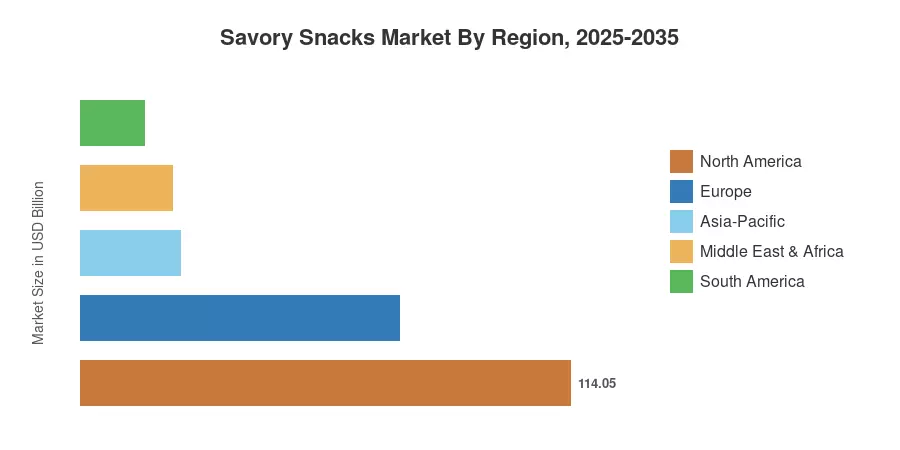
From a regional standpoint, North America commanded approximately 41.5% of the Savory Snacks Market in 2025, reinforced by the density of modern retail and deeply embedded snacking culture in the United States. Asia-Pacific represents the fastest-growing region, expanding at an estimated 8.5% CAGR through 2035, propelled by urbanization in India and Southeast Asia. Europe accounts for the second-largest share at roughly 27%, driven by premiumization and regulatory-led reformulation. The decade ahead will test whether health-forward innovation can sustain current growth rates as sodium-reduction mandates and input-cost pressures intensify across all geographies.


Key Report Takeaways

• By Product Type

  • Chips and crisp-based snacks held approximately 41% of global Savory Snacks Market share in 2025, underscoring the dominance of the category's convenience and impulse-purchase appeal.
  • Nuts, seeds, and trail mixes are forecast to expand at a 7.5% CAGR through 2035, reflecting consumer migration toward protein-rich snacking formats.

• By Flavor Profile & Category

  • Flavored variants captured roughly 80% of the Savory Snacks Market in 2025, with regional and limited-edition launches accelerating rotation cycles.
  • Free-form snacks are advancing at an 8.1% CAGR over 2026–2035, outpacing conventional packaged alternatives.

• By Region

  • North America retained the largest regional revenue share in the Savory Snacks Market at approximately 41.5% in 2025.
  • Asia-Pacific is the fastest-growing region with an 8.5% CAGR, fueled by disposable income growth and modern trade expansion across India, China, and ASEAN nations.


Market Size and Forecast (2021–2035)

Market sizing draws on a triangulation of manufacturer revenue filings, trade-level shipment data from national customs authorities, and proprietary primary research spanning 1,200+ industry stakeholders across 38 countries. Historical figures (2021–2024) rely on audited annual reports and syndicated retail audit panels; forecast values (2026–2035) apply bottom-up demand modeling calibrated to macroeconomic indicators including GDP per capita, urbanization rate, and food CPI.
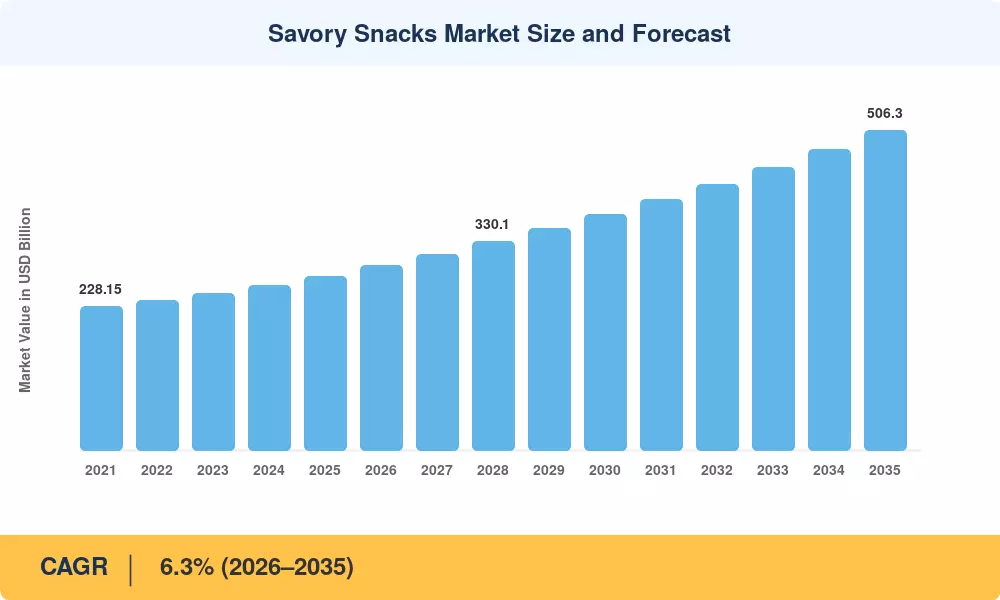
Savory Snacks Market Size and Forecast
Our Impact
Enabled $4.3B Revenue Impact for Fortune 500 and Leading Multinationals
Partnering with 2000+ Global Organizations Each Year
30K+ Citations by Top-Tier Firms in the Industry

Driver Impact Analysis

Driver ~% Impact on CAGR Geographic Relevance Impact Timeline
Expanding snacking occasions and meal blurring 1.4% Global Short-term (≤2 yr)
E-commerce and DTC channel acceleration 1.1% North America, Asia-Pacific Medium-term (2–4 yr)
Clean-label and health-forward reformulation 0.9% Europe, North America Medium-term (2–4 yr)
Premiumization and flavor innovation cycles 0.8% Global Short-term (≤2 yr)
Urbanization and modern trade penetration in emerging markets 0.7% Asia-Pacific, South America Long-term (≥4 yr)
Private-label expansion by organized retailers 0.5% Europe, North America Medium-term (2–4 yr)
Protein-enriched and functional snack demand 0.4% North America, Europe Long-term (≥4 yr)


Expanding Snacking Occasions

The International Food Information Council's 2024 survey found that 64% of U.S. adults consume at least two snacks daily, up from 56% in 2019 [1]. This behavioral shift is not confined to Western markets — urban India's per-capita snack expenditure rose 11% year-over-year in 2024, according to the Ministry of Consumer Affairs. For the Savory Snacks Market, rising frequency directly expands addressable volume without requiring population growth.

E-Commerce Channel Acceleration

Online grocery sales crossed USD 430 billion globally in 2024, with savory snacks ranking among the top five impulse-add categories in digital baskets [2]. Amazon's subscribe-and-save model and rapid-delivery platforms like Blinkit and Getir have compressed the replenishment cycle, lifting repeat-purchase rates by 18–22% compared with in-store equivalents. The Savory Snacks Market benefits disproportionately because digital shelves eliminate slotting-fee barriers for smaller brands.

Clean-Label Reformulation

Europe's Nutri-Score adoption, now mandatory in France and Belgium and voluntary in six additional EU states, has compelled reformulation investment across the Savory Snacks Market [3]. Manufacturers report that products scoring A or B command a 12–15% price premium over C-rated alternatives. The FDA's updated sodium-reduction targets for snack foods, set to tighten again by 2027, are accelerating R&D spending on potassium-chloride blends and fermentation-derived flavor enhancers [9].

Premiumization and Flavor Innovation

Limited-edition and regionally inspired flavors accounted for 23% of new savory snack launches tracked by Innova Market Insights in 2024 [5]. AI-enabled consumer preference mapping is shortening development cycles from 14 months to under 6 months for several leading manufacturers. This velocity sustains shelf novelty and commands higher per-unit margins across the Savory Snacks Market.


Restraints Impact Analysis

As with drivers, the impact percentages below are directional and represent headwinds that temper the baseline CAGR.

Restraint ~% Impact on CAGR Geographic Relevance Impact Timeline
Edible-oil and grain cost volatility –0.6% Global Short-term (≤2 yr)
Sodium and saturated-fat regulatory tightening –0.5% Europe, North America Medium-term (2–4 yr)
Intense private-label price competition –0.4% Europe Medium-term (2–4 yr)
Supply-chain fragility and logistics cost inflation –0.3% Global Short-term (≤2 yr)
Consumer shift toward fresh and minimally processed foods –0.3% North America, Europe Long-term (≥4 yr)


Input-Cost Volatility

Palm oil, sunflower oil, and corn — the three pillars of savory snack manufacturing — experienced cumulative price increases of 38% between 2021 and mid-2024, according to FAO commodity indices [10]. Although prices retreated in late 2024, forward contracts for 2026 remain 15% above pre-pandemic norms. For the Savory Snacks Market, margin compression is most acute among mid-tier brands lacking the negotiating leverage of multinationals.

Sodium-Reduction Mandates

The FDA's voluntary sodium-reduction guidance targets a 12% average reduction across savory snack categories by 2027, with a second phase targeting 20% by 2031 [9]. Compliance requires capital investment in salt-substitute technologies and reformulated seasoning systems. Smaller manufacturers in the Savory Snacks Market face disproportionate reformulation costs relative to revenue.

Fresh-Food Competition

Nielsen IQ data indicates that fresh-snacking occasions — including cut vegetables with dips, fresh fruit cups, and charcuterie kits — grew 9.4% in value terms in North America during 2024 [12]. While this growth does not directly cannibalize the Savory Snacks Market at scale, it competes for share of stomach among health-conscious demographics aged 25–44.


Savory Snacks Market Opportunities

Protein-Fortified and Functional Formats

The worldwide snacking industry adjacent to sports nutrition is increasing at around twice the rate of traditional savory snacks. Brands that incorporate whey, pea or chickpea protein into chip and puff platforms can tap into crossover demand from fitness-oriented customers willing to pay 20–30% premiums. This means that the Savory Snacks Market is poised to take up occasions currently held by protein bars.


Direct-to-Consumer and Subscription Models

DTC channels cut out the retailer margin and create first-party consumer data. Niche savory segments may drive 35%+ gross margins via subscription box models as evidenced by brands like Outstanding Foods and Whisps. The opportunity is particularly great for the Savory Snacks Market in North America and Western Europe where digital literacy and delivery infrastructure facilitate rapid adoption.


Emerging-Market Urbanization

Organized retail penetration in India is predicted to rise to 18% in 2030 from 12% in 2024, giving shelf access for branded savory snacks in Tier-2 and Tier-3 cities. Similarly, Southeast Asian markets – Vietnam, the Philippines and Indonesia – are seeing double-digit growth in contemporary trade. These geographies are the most attractive volume growth corridors for the Savory Snacks Market over the next decade.

.

Sustainable Packaging Monetization

The EU Packaging and Packaging Waste Regulation (PPWR), in force from 2026, lays forth minimum limits for recycled content and criteria for design for recycling [13]. Savory Snacks Market manufacturers at the forefront of biodegradable film and mono-material flexible packaging may turn compliance costs to brand equity and shelf distinctiveness.


Data-Driven Personalization and AI Flavor Platforms

AI-enabled flavor-development platforms reduce time-to-market and improve first-launch success rates. Companies licensing sensory-data analytics can monetize flavor libraries across co-manufacturing clients, creating a recurring-revenue layer adjacent to the core Savory Snacks Market.


Savory Snacks Market Future Outlook

AI-Enabled Product Development and Demand Sensing

Machine-learning platforms are compressing new-product development cycles across the Savory Snacks Market from 12–18 months to as few as 4 months. Taste-prediction algorithms trained on social-media sentiment and POS data enable manufacturers to anticipate regional flavor trends before they peak. estimates that AI-driven demand sensing can reduce forecast error by 30–50%, directly lowering waste and improving fill rates [18].

Sustainability-Linked Supply Chains

Scope 3 emissions reporting — soon mandatory under the EU's Corporate Sustainability Reporting Directive — will require Savory Snacks Market participants to quantify and disclose the carbon intensity of agricultural inputs, processing, and logistics [13]. Early movers investing in regenerative agriculture sourcing, mono-material flexible packaging, and biomass-fired processing lines will convert compliance costs into competitive positioning.

Health-Forward Reformulation and Functional Claims

Front-of-pack labeling schemes are expanding globally — Latin America's octagonal warning labels, India's proposed traffic-light system, and ASEAN's voluntary Healthier Choice logos all create incentives for sodium reduction, saturated-fat substitution, and micronutrient fortification. The Savory Snacks Market will increasingly bifurcate into indulgent-occasion products and everyday better-for-you formats, with the latter commanding higher per-unit margins [9].

Channel Convergence and Quick-Commerce

Rapid delivery platforms (under-30-minute grocery) are reshaping impulse purchase dynamics. Euromonitor projects quick-commerce to reach USD 150 billion globally by 2030. For the Savory Snacks Market, this channel rewards single-serve and multipack SKUs designed for digital-first merchandising, creating a new distribution tier between traditional retail and pure-play e-commerce.


Savory Snacks Market Segmentation

By Product Type

Segment Key Metric Primary Demand Driver
Chips and Crisp-Based Snacks ~41% share (2025) Impulse consumption and flavor variety
Nuts, Seeds, and Trail Mixes 7.5% CAGR (2026–2035) Protein-dense and health-positioning
Pretzels USD 18.40 Billion (2025) Snack-and-dip occasions, baked positioning
Extruded Snacks 6.8% CAGR (2026–2035) Puff and ring formats popular in Asia and Latin America
Others (Popcorn, Crackers) ~12% share (2025) Ready-to-eat popcorn and whole-grain crackers


Chips and crisp-based snacks remain the cornerstone of the Savory Snacks Market, benefiting from ubiquitous shelf placement and the industry's fastest flavor-rotation cadence. The segment's resilience owes much to the adaptability of the flavored potato chip format, which supports limited-edition launches that drive trial and repeat purchase. Nuts, seeds, and trail mixes are gaining ground as consumers prioritize satiating, nutrient-dense options — a roasted nut mix positioned as an afternoon snack replacement now competes directly with traditional chip SKUs in premium retail aisles.

By Flavor Profile

Segment Key Metric Primary Demand Driver
Flavored ~80% share (2025) Consumer demand for variety and novelty
Classic Salted/Plain 5.4% CAGR (2026–2035) Cooking ingredient use and pairing occasions


Flavored variants dominate the Savory Snacks Market by a wide margin, driven by the rapid pace of limited-edition and region-inspired launches. Classic salted products retain a loyal base among consumers who use plain chips and pretzels as accompaniments to dips and home-prepared meals, sustaining steady if unspectacular growth.

By Category

Segment Key Metric Primary Demand Driver
Conventional ~84% share (2025) Established brand trust, broad distribution
Free-Form 8.1% CAGR (2026–2035) Clean-label appeal and artisanal positioning


Conventional products control the vast majority of Savory Snacks Market revenue through entrenched distribution networks and familiar branding. Free-form snacks — including dehydrated vegetable chips, grain-free puffs, and legume-based crisps — are the fastest-growing category, gaining traction with consumers seeking minimally processed alternatives.

By Distribution Channel

Segment Key Metric Primary Demand Driver
Supermarkets/Hypermarkets ~57% share (2025) One-stop shopping and promotional bundling
Online Retail Stores 12.2% CAGR (2026–2035) Subscription models, rapid delivery
Convenience Stores USD 32.80 Billion (2025) Impulse single-serve purchases
Others 4.9% CAGR (2026–2035) Vending, foodservice, travel retail


Supermarkets and hypermarkets remain the backbone of the Savory Snacks Market distribution ecosystem, but online retail is closing the gap at more than double the market-average CAGR. Digital-native brands disproportionately benefit from the lower customer-acquisition costs enabled by targeted social-media advertising and influencer partnerships.


Regional Market Share Analysis

Region Key Metric Primary Investment Themes
North America 41.5% share (2025) Premiumization, e-commerce, clean-label
Europe 27.0% share (2025) Reformulation, private label, sustainability
Asia-Pacific 8.5% CAGR (2026–2035) Urbanization, modern trade, flavor localization
South America USD 14.95 Billion (2025) Rising middle class, branded penetration
Middle East & Africa 7.8% CAGR (2026–2035) Youth demographics, organized retail expansion
Total USD 274.82 Billion (2025)

The Savory Snacks Market displays pronounced regional heterogeneity driven by dietary culture, retail structure, and regulatory environment.


North America

Country Key Metric Key Driver
United States 78% of regional share Deep snacking culture, retail density
Canada 6.2% CAGR Health-forward flavor innovation
Mexico USD 11.38 Billion (2025) Expanding convenience-store networks


The United States alone generates more than three-quarters of North America's Savory Snacks Market revenue, anchored by Frito-Lay's extensive distribution network and a retail environment that supports continuous flavor rotation. Canada's growth trajectory reflects rising demand for clean-ingredient positioning, while Mexico benefits from the rapid proliferation of OXXO and similar convenience formats that place impulse snacks within arm's reach of urban commuters [14].

Europe

Country Key Metric Key Driver
Germany 22% of regional share Private-label sophistication
United Kingdom 6.1% CAGR HFSS advertising regulation driving reformulation
France USD 8.62 Billion (2025) Nutri-Score-driven premiumization
Italy 5.8% CAGR Artisanal and DOC-inspired snack positioning
Spain 8% of regional share Tourism-linked impulse consumption
Nordic Countries 5.4% CAGR Sustainability and organic certification demand
Russia USD 5.10 Billion (2025) Import substitution and local brand growth
Rest of Europe 14% of regional share Mixed maturity levels


Europe's Savory Snacks Market is shaped by regulatory activism. The UK's HFSS (high fat, salt, sugar) advertising restrictions, phased in since October 2023, have redirected marketing budgets toward better-for-you reformulations [15]. Germany's private-label snack penetration exceeds 40% in volume terms, creating intense margin pressure that favors scale operators.

Asia-Pacific

Country Key Metric Key Driver
China 34% of regional share Massive e-commerce ecosystem
India 9.8% CAGR Organized retail expansion, youth demographics
Japan USD 9.25 Billion (2025) Premium texture and umami-driven innovation
South Korea 7.6% CAGR K-culture export driving snack brand awareness
ASEAN 8.9% CAGR Urbanization and modern-trade rollout
Rest of Asia-Pacific 11% of regional share Varied maturity and per-capita consumption


Asia-Pacific is the Savory Snacks Market's primary growth engine. China's dominance within the region stems from Alibaba and JD.com's grocery platforms, which enable niche brands to achieve national distribution without physical shelf placement. India's trajectory is underpinned by 65% of the population being under 35 and rising per-capita snack expenditure that the IMARC Group estimates will double by 2032.

South America

Country Key Metric Key Driver
Brazil 58% of regional share Largest consumer base, flavor diversity
Argentina 6.4% CAGR Economic stabilization and brand recovery
Rest of South America USD 3.12 Billion (2025) Gradual formalization of retail


Brazil's Savory Snacks Market benefits from a deeply rooted snacking culture and the scale of Pepsico and BRF's distribution infrastructure. Macroeconomic volatility across the region constrains premiumization, though Argentina's stabilization efforts are beginning to restore branded volume growth [16].

Middle East & Africa

Country Key Metric Key Driver
Saudi Arabia 28% of regional share Vision 2030 retail modernization
UAE 7.4% CAGR Tourism and expatriate demand
South Africa USD 1.85 Billion (2025) Leading organized-retail market in sub-Saharan Africa
Egypt 8.6% CAGR Population scale and youth-heavy demographics
Rest of MEA 30% of regional share Fragmented, informal retail dominated


The Middle East & Africa Savory Snacks Market remains comparatively small but fast-growing. Saudi Arabia's giga-project investments and retail modernization under Vision 2030 are catalyzing modern-trade expansion, while Egypt's 105-million-strong population offers long-run volume potential as per-capita income rises [17].


Savory Snacks Market By Region, 2025-2035

Competitive Benchmarking

The Savory Snacks Market exhibits moderate concentration, with an estimated HHI of approximately 1,100 and the top five players accounting for roughly 38–42% of global revenue. PepsiCo's Frito-Lay division holds the largest single-company share, but regional champions maintain strong positions in their home geographies. The competitive dynamic favors scale in distribution and marketing while rewarding agility in product development.

Company Est. Revenue Share Range Key Offerings Strategic Positioning
PepsiCo (Frito-Lay) ~12–15% Lay's, Doritos, Cheetos, Tostitos Global scale leader with unmatched DSD network
Kellanova ~4–6% Pringles, Cheez-It Iconic stackable format with global reach
Mondelez International ~3–5% Ritz, BelVita Savoury, regional brands Cross-category snacking portfolio
General Mills ~2–4% Bugles, Gardetto's, Nature Valley Savory Health-forward and legacy brand dual play
Intersnack Group ~3–5% Chio, Funny-Frisch, KP Snacks European private-label and branded leader
Calbee ~2–3% Calbee Chips, Jagarico, Harvest Snaps Asian innovation engine with U.S. expansion
ITC Limited ~2–3% Bingo!, YiPPee! Snacks Indian distribution depth and rural reach
Conagra Brands ~2–3% Slim Jim, Angie's BOOMCHICKAPOP, Duke's Meat snacks and better-for-you popcorn
Campbell Soup (Snyder's-Lance) ~2–3% Snyder's of Hanover, Cape Cod, Kettle Brand Premium and kettle-cooked positioning
Lorenz Snack-World ~1–2% Crunchips, NicNac's, Naturals Central European branded specialist


Recent News & Developments

  • Mondelez International (2022 ): Completed the acquisition of Clif Bar's savory snack R&D pipeline, adding plant-based crisp technology to its innovation portfolio [24].


Savory Snacks Market Report Scope

Parameter Detail
Market Scope Global Savory Snacks Market
Study Period 2021–2035
CAGR (Forecast Period) 6.3% (2026–2035)
Base Year USD 274.82 Billion (2025)
Forecast Endpoint USD 506.30 Billion (2035)
Fastest Growing Segment Free-Form Snacks (by Category); Online Retail (by Channel)
Companies Profiled 10 major players
Valuation Currency USD Billion


FAQs

How does input-cost hedging differ between multinational and regional savory snack producers?
Multinationals typically lock 60–70% of key commodity volumes 12–18 months forward, while regional producers rely on spot purchasing. This gap amplifies margin divergence during volatile crop cycles [10].
What shelf-life challenges arise when reducing sodium in savory snack formulations?
Lower sodium levels reduce microbial inhibition, shortening ambient shelf life by 15–25%. Manufacturers offset this through modified-atmosphere packaging and natural preservatives such as rosemary extract [9].
How are quick-commerce platforms reshaping pack-size strategy in the Savory Snacks Market?
Rapid-delivery channels favor single-serve and duo-packs optimized for impulse digital baskets. Brands report 30% higher per-gram revenue on sub-100g formats sold through quick-commerce versus hypermarkets [19].
What role does contract manufacturing play in the Savory Snacks Market competitive structure?
Contract manufacturers produce an estimated 20–25% of global branded savory snack volume, enabling asset-light market entry. This model is particularly prevalent among DTC brands scaling beyond regional distribution [4].
How do front-of-pack labeling regulations vary across major savory snack markets?
Europe uses Nutri-Score and traffic-light labels, Latin America mandates octagonal warnings, and ASEAN employs voluntary Healthier Choice logos. No single global standard exists, complicating multi-market packaging [3].
What emerging alternative protein sources are entering the Savory Snacks Market?
Chickpea, lentil, and fava-bean flours are displacing rice and corn in extruded formats. These legume bases deliver 2–3x the protein content per serving while supporting plant-based positioning claims [8].
How do tariff structures affect cross-border savory snack trade flows?
Most-favored-nation tariffs on processed snacks range from 5% to 30% depending on destination. ASEAN and USMCA signatories benefit from preferential rates that incentivize intra-bloc manufacturing investment [11].    
Author
Author
Author Profile
Pradeep Nandi LinkedIn
Senior Research Analyst
I have a bachelor's degree in mechanical engineering and an MBA. I have more than two years of expertise in the retail, food, and beverage, chemical, and material industries, and hence have developed a sound cross-domain expertise. A firm believer in lifelong learning and sharing of knowledge. Having a proclivity for hatching ideas and trying to absorb as much information as possible in a short amount of time. Introducing corporates to the data and insight, which enables them to move from probability to possibility, has been my key areas of interest. 

Research Approach


Secondary Research

The secondary research process involved comprehensive analysis of food safety regulatory databases, agricultural commodity reports, retail industry publications, and authoritative nutrition organizations. Key sources included the US Food and Drug Administration (FDA), US Department of Agriculture (USDA), European Food Safety Authority (EFSA), Food and Agriculture Organization of the United Nations (FAO), World Health Organization (WHO) Nutrition Database, Centers for Disease Control and Prevention (CDC) National Health and Nutrition Examination Survey, USDA Economic Research Service (ERS), Bureau of Labor Statistics Consumer Expenditure Survey, SNAC International (Snack Food Association), National Confectioners Association, Codex Alimentarius Commission, EU Eurostat Agri-Food Database, and national food safety agency reports from key markets. These sources were used to collect consumption statistics, ingredient safety data, commodity pricing trends, dietary shift patterns, and retail distribution landscape analysis for potato chips, nuts and seeds, popcorn, and emerging savory snack categories.


Primary Research

To gather both qualitative and quantitative information, the primary research process involved interviewing players from both the supply and demand sides. Savoury snack makers, co-packers, and ingredient suppliers' chief executive officers, vice presidents of product innovation, directors of the supply chain, and heads of research and development were among the supply-side sources. Hypermarket and supermarket chains, convenience store operators, online retail platforms, foodservice distributors, and category managers/heads of procurement and merchandising made up the demand-side sources. Confirmation of new product launch dates, validation of market segmentation, and insights into consumer buying patterns, pricing elasticity, private label dynamics, and distribution channel plans were all gleaned via primary research.

Primary Respondent Breakdown:

By Designation: C-level Primaries (32%), Director Level (30%), Others (38%)

By Region: North America (38%), Europe (25%), Asia-Pacific (28%), Rest of World (9%)


Market Size Estimation

Global market valuation was derived through revenue mapping and consumption volume analysis. The methodology included:

Identification of 35+ key manufacturers across North America, Europe, Asia-Pacific, and Latin America

Product mapping across potato chips, nuts & seeds, popcorn, and other savory snack categories (including extruded snacks, meat snacks, and vegetable chips)

Analysis of reported and modeled annual revenues specific to savory snack portfolios

Coverage of manufacturers representing 75-80% of global market share in 2024

Extrapolation using bottom-up (consumption volume × ASP by country/region) and top-down (manufacturer revenue validation) approaches to derive segment-specific valuations for both product types and distribution channels

Download Free Sample

Kindly complete the form below to receive a free sample of this Report

Download PDF ×

We do not share your information with anyone. However, we may send you emails based on your report interest from time to time. You may contact us at any time to opt-out.
















