Operating Table Parts Market Research Report, By Product Type (General, Specialty Surgery Table), Procedure (Anesthesia, Orthopedic, Neurology, Urology), Accessory (Standard Accessory), End-Users (Hospital, Clinics) - Global Forecast Till 2035
Forecast Period
2025 - 2035
CAGR
5.67%
2024 Market Size
$ 1,181.45 Million
2035 Market Size
$ 2,176.59 Million
Medical Device● Updated May 15, 2026Report ID: MRFR/MED/4346-CR|Pages: 100|Author: Vikita Thakur, Rahul Gotadki
Operating Table Parts Market Summary
As per MRFR analysis, the Operating Table Parts Market Size was estimated at 1181.45 USD Million in 2024. The Operating Table Parts industry is projected to grow from 1261.98 USD Million in 2025 to 2176.59 USD Million by 2035, exhibiting a compound annual growth rate (CAGR) of 5.67% during the forecast period 2025 - 2035.
Key Market Trends & Highlights
The Operating Table Parts Market is experiencing a dynamic evolution driven by technological advancements and changing healthcare needs.
Technological advancements are reshaping the design and functionality of operating table parts, enhancing surgical precision.
Customization and modularity are increasingly prioritized, allowing for tailored solutions in diverse surgical environments.
The focus on ergonomics is becoming more pronounced, particularly in North America, to improve surgeon comfort and reduce fatigue during procedures.
Rising surgical procedures and an aging population are key drivers propelling market growth, especially in hospitals and emergency procedures.
Market Size & Forecast
2024 Market Size
1181.45 (USD Million)
2035 Market Size
2176.59 (USD Million)
CAGR (2025 - 2035)
5.67%
Major Players
Stryker (US), Medtronic (US), Hill-Rom (US), Getinge (SE), Mizuho OSI (US), Alvo (PL), Steris (US), Schmitz (DE), Brandon Medical (GB)
Our Impact
Enabled $4.3B Revenue Impact for Fortune 500 and Leading Multinationals
Partnering with 2000+ Global Organizations Each Year
30K+ Citations by Top-Tier Firms in the Industry
Operating Table Parts Market Trends
The Operating Table Parts Market is currently experiencing a dynamic evolution, driven by advancements in surgical technology and an increasing emphasis on patient safety. The integration of innovative materials and designs into operating table components appears to enhance functionality and adaptability, catering to a diverse range of surgical procedures. Furthermore, the growing demand for minimally invasive surgeries suggests a shift towards more specialized operating table parts that can accommodate such techniques. This trend may lead to the development of modular systems that allow for greater customization and efficiency in surgical environments.
In addition, the Operating Table Parts Market is likely influenced by the rising awareness of ergonomic designs that prioritize both patient comfort and surgeon accessibility. Manufacturers are focusing on creating components that not only meet regulatory standards but also improve the overall surgical experience. As healthcare facilities continue to invest in upgrading their equipment, the market may see a surge in demand for high-quality, durable parts that can withstand the rigors of frequent use. Overall, the Operating Table Parts Market is poised for growth, reflecting the ongoing transformation within the healthcare sector.
Technological Advancements
The Operating Table Parts Market is witnessing a trend towards the incorporation of cutting-edge technology. Enhanced features such as integrated imaging systems and automated adjustments are becoming more prevalent, allowing for improved precision during surgical procedures.
Customization and Modularity
There is a growing inclination towards customizable and modular operating table parts. This trend enables healthcare providers to tailor their equipment to specific surgical needs, thereby enhancing operational efficiency and patient outcomes.
Focus on Ergonomics
An increasing emphasis on ergonomic designs is evident within the Operating Table Parts Market. Manufacturers are prioritizing the development of components that promote comfort for both patients and surgeons, potentially leading to better surgical results.
Operating Table Parts Market Drivers
Emerging Markets Growth
The Global Operating Table Parts Market Industry is witnessing substantial growth in emerging markets, where healthcare systems are evolving rapidly. Countries in Asia-Pacific and Latin America are investing heavily in healthcare infrastructure, leading to increased demand for advanced surgical equipment. As these regions expand their healthcare capabilities, the need for reliable operating table parts becomes more pronounced. This trend is likely to contribute to the overall market growth, with expectations of reaching 1.32 USD Billion by 2035, up from 0.48 USD Billion in 2024.
Focus on Patient Safety
The Global Operating Table Parts Market Industry is increasingly influenced by a heightened focus on patient safety and quality of care. Hospitals and surgical centers are prioritizing equipment that minimizes risks during surgical procedures. Enhanced operating table designs that incorporate safety features, such as adjustable height and stability mechanisms, are gaining traction. This shift towards prioritizing patient safety is likely to drive demand for advanced operating table parts, contributing to the market's growth from 0.48 USD Billion in 2024 to an anticipated 1.32 USD Billion by 2035.
Rising Surgical Procedures
An increase in the number of surgical procedures globally is a significant driver for the Global Operating Table Parts Market Industry. Factors such as an aging population and a rise in chronic diseases contribute to this trend. As healthcare systems adapt to meet the growing demand for surgical interventions, the need for reliable and efficient operating table parts becomes paramount. This trend is expected to sustain the market's growth trajectory, with projections indicating a rise from 0.48 USD Billion in 2024 to 1.32 USD Billion by 2035, highlighting the critical role of operating table parts in modern healthcare.
Technological Advancements
The Global Operating Table Parts Market Industry is experiencing a surge in demand due to rapid technological advancements. Innovations such as integrated imaging systems and robotic-assisted surgery tables enhance surgical precision and efficiency. These advancements not only improve patient outcomes but also streamline surgical workflows, thereby increasing the adoption of advanced operating tables. As hospitals and surgical centers invest in modern equipment, the market is projected to grow from 0.48 USD Billion in 2024 to 1.32 USD Billion by 2035, reflecting a compound annual growth rate of 9.62% from 2025 to 2035.
Government Initiatives and Funding
Government initiatives aimed at improving healthcare infrastructure significantly impact the Global Operating Table Parts Market Industry. Many countries are investing in modernizing their healthcare facilities, which includes upgrading surgical equipment. Such initiatives often come with funding programs that encourage hospitals to acquire advanced operating tables and their components. This influx of capital is expected to bolster the market, with projections indicating growth from 0.48 USD Billion in 2024 to 1.32 USD Billion by 2035, driven by supportive government policies and funding.
Market Segment Insights
By Application: Surgical Procedures (Largest) vs. Diagnostic Procedures (Fastest-Growing)
The application segment in the Operating Table Parts Market is composed of Surgical Procedures, Diagnostic Procedures, Emergency Procedures, and Rehabilitation Procedures. Among these, Surgical Procedures constitute the largest segment, reflecting the reliance on advanced operating tables for successful surgical outcomes. With a broad scope ranging from elective surgeries to complex operations, this category remains a crucial driver of demand for operating table parts.
On the other hand, Diagnostic Procedures are emerging as the fastest-growing segment, driven by the increasing emphasis on early detection and preventive healthcare. The rise in outpatient diagnostic services, including imaging and endoscopic procedures, will further bolster this segment, indicating a shift in market dynamics as healthcare providers invest in versatile operating table solutions to enhance patient care.
Surgical Procedures: Dominant vs. Rehabilitation Procedures: Emerging
Surgical Procedures continue to dominate the Operating Table Parts Market, characterized by the high demand for specialized tables tailored for various surgical techniques. These operating tables are designed with advanced features such as adjustable height, various position settings, and interoperability with surgical equipment, catering to diverse surgical specialties. In contrast, Rehabilitation Procedures are emerging as the next significant segment, reflecting the evolving landscape of patient care. Enhanced recovery protocols and minimally invasive surgical techniques are driving the need for adaptable tables that facilitate rehabilitation processes. As hospitals and clinics adapt to these trends, the need for multifunctional operating tables that support both surgical and rehabilitation functionalities will likely increase.
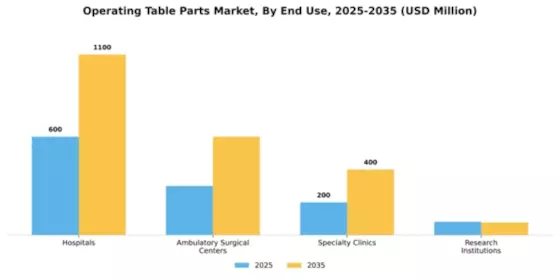
By End Use: Hospitals (Largest) vs. Ambulatory Surgical Centers (Fastest-Growing)
In the Operating Table Parts Market, hospitals dominate the end-use segment, commanding the largest share due to their extensive surgical needs and investment in advanced healthcare technology. Ambulatory surgical centers, while smaller in market share, are rapidly gaining traction owing to the shift towards outpatient procedures, which are becoming increasingly popular. Specialty clinics and research institutions also play significant roles, catering to niche markets with specific surgical requirements and research applications.
Hospitals (Dominant) vs. Ambulatory Surgical Centers (Emerging)
Hospitals represent the dominant segment in the Operating Table Parts Market, primarily because they require a wide range of surgical equipment to support various hundreds of procedures. Their robust infrastructure and sustained investments in modern operating tables ensure that they remain a vital component of the healthcare system. On the other hand, ambulatory surgical centers are emerging as a significant force, leveraging advances in minimally invasive surgery and a growing trend towards outpatient care. These centers are innovating to provide cost-effective and efficient surgical solutions, appealing to patients seeking quick recovery and lower healthcare costs. As a result, both segments fulfill essential roles, reflecting different healthcare delivery models.
By Type: Electric Operating Tables (Largest) vs. Hydraulic Operating Tables (Fastest-Growing)
In the Operating Table Parts Market, the distribution of market share reveals that Electric Operating Tables dominate the segment due to their advanced features and user-friendly operation. They have become the preferred choice in surgical settings, as they offer precision and ease of use, thus ensuring better surgical outcomes. Hydraulic Operating Tables, while historically favored for their reliability and cost-effectiveness, are witnessing a significant rise in popularity owing to their enhanced adaptability and performance.
The growth trends in this segment are largely driven by technological advancements in electric tables, offering features such as automated positioning and integrated imaging systems. Hydraulic tables are gaining traction as hospitals seek versatile solutions for varying surgical needs. As the demand for minimally invasive procedures rises, both Electric and Hydraulic Operating Tables are expected to play pivotal roles in the evolving healthcare landscape.
Electric Operating Tables (Dominant) vs. Hydraulic Operating Tables (Emerging)
Electric Operating Tables are regarded as the dominant segment in the Operating Table Parts Market due to their superior functionalities, which include automated height adjustments, tilt, and rotation, providing optimal positioning during surgeries. They are heavily utilized in advanced surgical environments, ensuring precision and reducing the effort for surgical teams. Conversely, Hydraulic Operating Tables are emerging as a versatile option, appealing to budget-conscious healthcare facilities with their manual adjustment features, while still offering reliability and ease of maintenance. The increasing trend towards budget optimization in healthcare spending is driving the adoption of hydraulic models, making them a significant player in this dynamic market.
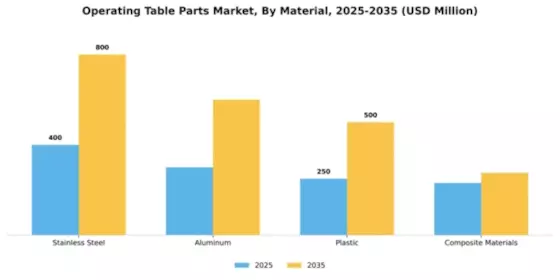
By Material: Stainless Steel (Largest) vs. Aluminum (Fastest-Growing)
The Operating Table Parts Market showcases a significant distribution of materials, with stainless steel dominating the segment due to its durability and reliability in surgical environments. The aesthetic appeal and strength of stainless steel cater to the functional needs of operating tables, securing a substantial market share. Meanwhile, aluminum is emerging as a fast-growing alternative, attracting attention for its lightweight properties and ease of handling, making it a favorable option in various surgical settings.
Stainless Steel (Dominant) vs. Aluminum (Emerging)
Stainless steel remains the dominant material in the Operating Table Parts Market, prized for its strength, corrosion resistance, and ability to withstand rigorous sterilization processes. It continues to be the material of choice for high-quality operating tables. Conversely, aluminum is fast becoming an emerging option due to its light weight, aiding in the mobility and ease of use in operating rooms. While stainless steel excels in durability, aluminum offers versatility and cost-effectiveness, attracting manufacturers looking for innovative solutions and expanding their market share.
Get more detailed insights about Operating Table Parts MarketRequest Free Sample
Regional Insights
North America : Market Leader in Innovation
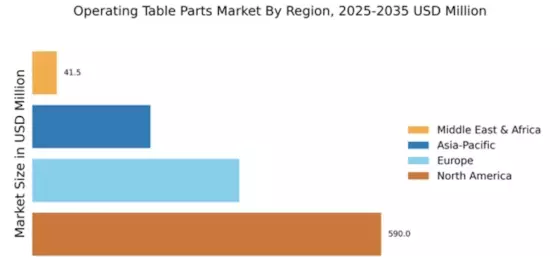
North America is poised to maintain its leadership in the Operating Table Parts Market, holding a significant market share of 590.0M in 2024. The region's growth is driven by advanced healthcare infrastructure, increasing surgical procedures, and a rising demand for innovative medical technologies. Regulatory support and investment in healthcare facilities further catalyze market expansion, ensuring a robust environment for growth.
The competitive landscape in North America is characterized by the presence of key players such as Stryker, Medtronic, and Hill-Rom. These companies are at the forefront of technological advancements, offering a range of operating table parts that enhance surgical efficiency. The U.S. remains the leading country, supported by a strong focus on research and development, ensuring that North America continues to set the standard in the global market.
Europe : Emerging Market with Growth Potential
Europe's Operating Table Parts Market is valued at 350.0M, reflecting a growing demand driven by an aging population and increasing surgical interventions. Regulatory frameworks in countries like Germany and France are evolving to support healthcare advancements, fostering innovation in medical equipment. The region is witnessing a shift towards minimally invasive surgeries, further propelling the market's growth.
Leading countries in Europe include Germany, France, and the UK, where key players like Getinge and Schmitz are making significant contributions. The competitive landscape is marked by collaborations and partnerships aimed at enhancing product offerings. The European market is expected to see continued growth as healthcare systems adapt to new technologies and patient needs, ensuring a dynamic environment for operating table parts.
Asia-Pacific : Rapidly Growing Healthcare Sector
The Asia-Pacific region, with a market size of 200.0M, is experiencing rapid growth in the Operating Table Parts Market. This surge is attributed to increasing healthcare expenditures, a growing population, and rising awareness of advanced surgical techniques. Countries like China and India are investing heavily in healthcare infrastructure, which is expected to drive demand for operating table parts significantly.
China and India are leading the charge in the Asia-Pacific market, with a competitive landscape featuring both local and international players. Companies like Mizuho OSI and Alvo are expanding their presence, catering to the rising demand for surgical equipment. The region's focus on improving healthcare access and quality is likely to sustain growth, making it a key player in the global market for operating table parts.
Middle East and Africa : Emerging Market with Challenges
The Middle East and Africa (MEA) region, with a market size of 41.45M, is gradually emerging in the Operating Table Parts Market. Growth is driven by increasing investments in healthcare infrastructure and a rising number of surgical procedures. However, regulatory challenges and economic disparities across countries pose significant hurdles to market expansion. Governments are working to improve healthcare access, which is expected to enhance market dynamics in the coming years.
Leading countries in the MEA region include South Africa and the UAE, where key players like Steris and Brandon Medical are establishing a foothold. The competitive landscape is evolving, with local manufacturers beginning to emerge. As healthcare systems improve and regulations become more favorable, the MEA region is poised for gradual growth in the operating table parts market.
Key Players and Competitive Insights
The Operating Table Parts Market is characterized by a dynamic competitive landscape, driven by technological advancements, increasing surgical procedures, and a growing emphasis on patient safety. Key players such as Stryker (US), Medtronic (US), and Getinge (SE) are at the forefront, each adopting distinct strategies to enhance their market presence. Stryker (US) focuses on innovation, particularly in robotic-assisted surgery, while Medtronic (US) emphasizes digital transformation through integrated surgical solutions. Getinge (SE) is actively pursuing regional expansion, particularly in emerging markets, which collectively shapes a competitive environment that is increasingly reliant on technological differentiation and strategic partnerships.In terms of business tactics, companies are localizing manufacturing to reduce costs and optimize supply chains, which is crucial in a moderately fragmented market. The collective influence of these key players is significant, as they not only drive innovation but also set benchmarks for quality and service standards across the industry. This competitive structure allows for a diverse range of offerings, catering to various surgical needs and preferences.
In November Stryker (US) announced the launch of its latest robotic surgical system, which integrates advanced imaging technology to enhance precision in surgical procedures. This strategic move is pivotal as it positions Stryker (US) as a leader in the robotic surgery segment, potentially increasing its market share and reinforcing its commitment to innovation. The introduction of such technology is likely to attract healthcare facilities seeking to improve surgical outcomes and operational efficiency.
In October Medtronic (US) unveiled a new digital platform designed to streamline surgical workflows and improve data management. This initiative reflects Medtronic's (US) focus on digital transformation, aiming to enhance the overall surgical experience for both healthcare providers and patients. By leveraging data analytics, the company could significantly improve decision-making processes in the operating room, thereby enhancing patient safety and operational efficiency.
In September Getinge (SE) expanded its manufacturing capabilities in Asia, aiming to meet the rising demand for operating table parts in the region. This strategic expansion is crucial as it not only reduces lead times but also positions Getinge (SE) to better serve a growing market. The move indicates a proactive approach to regional demand fluctuations and highlights the importance of localized production in maintaining competitive advantage.
As of December current trends in the Operating Table Parts Market include a strong focus on digitalization, sustainability, and the integration of AI technologies. Strategic alliances are increasingly shaping the competitive landscape, allowing companies to pool resources and expertise to drive innovation. The shift from price-based competition to a focus on technological advancement and supply chain reliability is evident, suggesting that future competitive differentiation will hinge on the ability to innovate and adapt to evolving market demands.
Key Companies in the Operating Table Parts Market include
Industry Developments
The key market players launched the new version of the operating table in 2021. The hybrid version comes with a smart-hand control feature that enhances production efficiency. The table can be adjusted with ease through the hand control feature.
In 2021 the key market players in the US launched the precision surgical table. The table is suitable for chronic surgeries that require accurate patient body positions.
Future Outlook
Operating Table Parts Market Future Outlook
The Operating Table Parts Market is projected to grow at a 5.67% CAGR from 2025 to 2035, driven by technological advancements, increasing surgical procedures, and rising healthcare expenditures.
New opportunities lie in:
Development of modular operating table components for enhanced customization.
Integration of IoT technology for real-time monitoring and maintenance.
Expansion into emerging markets with tailored product offerings.
By 2035, the market is expected to achieve robust growth, reflecting evolving healthcare demands.
Market Segmentation
Operating Table Parts Market Type Outlook
Electric Operating Tables
Hydraulic Operating Tables
Manual Operating Tables
Modular Operating Tables
Operating Table Parts Market End Use Outlook
Hospitals
Ambulatory Surgical Centers
Specialty Clinics
Research Institutions
Operating Table Parts Market Material Outlook
Stainless Steel
Aluminum
Plastic
Composite Materials
Operating Table Parts Market Application Outlook
Surgical Procedures
Diagnostic Procedures
Emergency Procedures
Rehabilitation Procedures
Report Scope
MARKET SIZE 2024
1181.45(USD Million)
MARKET SIZE 2025
1261.98(USD Million)
MARKET SIZE 2035
2176.59(USD Million)
COMPOUND ANNUAL GROWTH RATE (CAGR)
5.67% (2025 - 2035)
REPORT COVERAGE
Revenue Forecast, Competitive Landscape, Growth Factors, and Trends
BASE YEAR
2024
Market Forecast Period
2025 - 2035
Historical Data
2019 - 2024
Market Forecast Units
USD Million
Key Companies Profiled
Stryker (US), Medtronic (US), Hill-Rom (US), Getinge (SE), Mizuho OSI (US), Alvo (PL), Steris (US), Schmitz (DE), Brandon Medical (GB)
Segments Covered
Application, End Use, Type, Material
Key Market Opportunities
Integration of advanced robotics and automation in the Operating Table Parts Market enhances surgical precision and efficiency.
Key Market Dynamics
Technological advancements and regulatory changes drive innovation and competition in the Operating Table Parts Market.
What is the projected market valuation for the Operating Table Parts Market in 2035?
The projected market valuation for the Operating Table Parts Market in 2035 is 2176.59 USD Million.
What was the overall market valuation for the Operating Table Parts Market in 2024?
The overall market valuation for the Operating Table Parts Market in 2024 was 1181.45 USD Million.
What is the expected CAGR for the Operating Table Parts Market during the forecast period 2025 - 2035?
The expected CAGR for the Operating Table Parts Market during the forecast period 2025 - 2035 is 5.67%.
Which companies are considered key players in the Operating Table Parts Market?
Key players in the Operating Table Parts Market include Stryker, Medtronic, Hill-Rom, Getinge, Mizuho OSI, Alvo, Steris, Schmitz, and KLS Martin.
How are the Operating Table Parts segmented by application?
The Operating Table Parts are segmented by application into Surgical Procedures, Diagnostic Procedures, Emergency Procedures, and Rehabilitation Procedures.
What were the market values for Surgical Procedures in 2024?
In 2024, the market value for Surgical Procedures was 354.43 USD Million.
What is the market value range for Electric Operating Tables by 2035?
The market value range for Electric Operating Tables is projected to be between 300.0 and 600.0 USD Million by 2035.
How do the market values for hospitals compare to ambulatory surgical centers?
In 2024, hospitals had a market value of 600.0 USD Million, while ambulatory surgical centers had a value of 300.0 USD Million.
What materials are used in the construction of operating tables?
Operating tables are constructed using materials such as Stainless Steel, Aluminum, Plastic, and Composite Materials.
What is the projected market value for Manual Operating Tables by 2035?
The projected market value for Manual Operating Tables by 2035 is expected to range from 400.0 to 800.0 USD Million.
Author
Author
Vikita Thakur
Senior Research Analyst
She holds an experience of about 5+ years in market research and business consulting projects for sectors such as life sciences, medical devices, and healthcare IT. She possesses a robust background in data analysis, market estimation, competitive intelligence, pipeline analysis market trend identification, and consumer behavior insights. Her expertise lies in technical Sales support, client interaction and project management, designing and implementing market research studies, conducting competitive analysis, and synthesizing complex data into actionable recommendations that drive business growth.
read more
Co-Author
Rahul Gotadki
Research Manager
He holds an experience of about 9+ years in Market Research and Business Consulting, working under the spectrum of Life Sciences and Healthcare domains. Rahul conceptualizes and implements a scalable business strategy and provides strategic leadership to the clients. His expertise lies in market estimation, competitive intelligence, pipeline analysis, customer assessment, etc.
The secondary research process involved comprehensive analysis of regulatory databases, peer-reviewed medical engineering journals, healthcare infrastructure publications, and authoritative medical device organizations. Key sources included the US Food & Drug Administration (FDA) Center for Devices and Radiological Health, European Medicines Agency (EMA) Medical Device Coordination Group, International Organization for Standardization (ISO 13485 Medical Device Quality Management), International Electrotechnical Commission (IEC 60601 Medical Electrical Equipment standards), Association for the Advancement of Medical Instrumentation (AAMI), American Hospital Association (AHA), American Society of Anesthesiologists (ASA), World Federation of Societies of Anaesthesiologists (WFSA), International Federation of Gynecology and Obstetrics (FIGO), World Health Organization (WHO) Global Health Observatory, Organization for Economic Co-operation and Development (OECD) Health Statistics, EU Eurostat Healthcare Database, National Center for Health Statistics (NCHS) CDC, Healthcare Cost and Utilization Project (HCUP), American College of Surgeons (ACS), International Society for Quality in Health Care (ISQua), and national health ministry reports from key markets including China's National Medical Products Administration (NMPA), Japan's Ministry of Health, Labour and Welfare (MHLW), and India's Central Drugs Standard Control Organization (CDSCO). These sources were used to collect surgical procedure statistics, regulatory approval data, medical device safety studies, healthcare infrastructure trends, and market landscape analysis for electric operating tables, hydraulic operating tables, manual operating tables, and modular operating table systems.
Primary Research
Qualitative and quantitative insights were obtained by interviewing supply-side and demand-side stakeholders during the primary research process. The supply-side sources consisted of CEOs, VPs of Product Development, regulatory affairs chiefs, and commercial directors from operating table manufacturers, medical device OEMs, and component suppliers. The demand-side sources included procurement leads from hospitals, ambulatory surgical centers, specialty clinics, and healthcare facility administrators, as well as chief of surgery, operating room managers, and biomedical equipment managers. Market segmentation was validated, product pipeline timelines were confirmed, and insights regarding clinical adoption patterns, pricing strategies, and procurement dynamics were obtained through primary research.
Primary Respondent Breakdown:
By Designation: C-level Primaries (32%), Director Level (31%), Others (37%)
By Region: North America (32%), Europe (30%), Asia-Pacific (28%), Rest of World (10%)
Market Size Estimation
Global market valuation was derived through revenue mapping and surgical procedure volume analysis. The methodology included:
Identification of 40+ key manufacturers across North America, Europe, Asia-Pacific, and Latin America
Product mapping across electric operating tables, hydraulic operating tables, manual operating tables, and modular operating table categories
Analysis of reported and modeled annual revenues specific to operating table parts portfolios
Coverage of manufacturers representing 72-78% of global market share in 2024
Extrapolation using bottom-up (surgical procedure volume × ASP by country/region) and top-down (manufacturer revenue validation) approaches to derive segment-specific valuations across product types (general tables, specialty surgery tables), procedures (anesthesia, orthopedic, neurology, urology), accessories (standard accessories), and end-users (hospitals, clinics, ambulatory surgical centers, research institutions)
“This is really good guys. Excellent work on a tight deadline. I will continue to use you going forward and recommend you to others. Nice job”
Noah MalgeriCo-Founder
“Thanks. It’s been a pleasure working with you, please use me as reference with any other Intel employees.”
Joseph AguayoSales Operations & Pricing Manager
“Thanks for sending the report it gives us a good global view of the Betaïne market.”
Peter Groot koerkampAccount and Business Manager
“Thank you, this will be very helpful for OQS.”
La Terria DoddProgram Support Specialist
“We found the report very insightful! we found your research firm very helpful. I'm sending this email to secure our future business.”
Younghwan ChoiSenior Retail Manager
“I am very pleased with how market segments have been defined in a relevant way for my purposes (such as "Portable Freezers & refrigerators" and "last-mile").
In general the report is well structured. Thanks very much for your efforts.”
Mark IrwinManagement Consultant
“I have been reading the first document or the study, ,the Global HVAC and FP market report 2021 till 2026. Must say, good info! I have not gone in depth at all parts, but got a good indication of the data inside!”
Rob KooikerGroup Product Manager HVAC & Fire Protection GMA
“We got the report in time, we really thank you for your support in this process. I also thank to all of your team as they did a great job.”
Akif MorogluStrategy & Business Development Director
“The Automotive 48V ECU Components Procurement Intelligence Study” was a complex project, but the Market Research Future (MRFR) team handled it with quality, agility, and customer-centricity. They delivered all requested data on time and within the agreed scope. The team, including Shubhendra Anand and Rahul Gotadki, was always readily available to clarify questions and swiftly implement necessary adjustments, driving the project to a successful conclusion within a very demanding timeframe.
I would also like to specifically commend Akshay Agarwal for his responsiveness and support at every stage—from our initial inquiry on May 6th through to final delivery on June 18th. His dedication made the entire process seamless.”
Guilherme Gomes MartinsProduct Management Director