Optical Satellite Communication Market

Key Players: Mynaric AG, Tesat-Spacecom (Airbus), CACI International, Honeywell Aerospace, Thales Alenia Space, Ball Aerospace (BAE Systems), General Atomics EMS, Skyloom Global

Optical Satellite Communication Market

Optical Satellite Communication Market Size, Share, Industry Trend & Analysis Research Report By Component (Optical Transceiver Terminals, Optical Ground Stations, Beam-Steering Assemblies, Signal Processing & Modems, Others), By Orbit (Low-Earth Orbit (LEO), Medium-Earth Orbit (MEO), Geostationary Orbit (GEO), High-Elliptical & Cislunar), By Payload (Small Satellite (< 300 kg), Medium Satellite (300–1,000 kg), Large Satellite (> 1,000 kg)), By End-User (Government & Defense, Commercial Telecommunications, Academic & Scientific, Others), By Geography (North America, Europe, Asia-Pacific, South America, Middle East & Africa) - Forecast to 2035.
ID: MRFR/AD/28354-HCR
128 Pages
Shubham Munde, Sejal Akre
Last Updated: June 22, 2026

Optical Satellite Communication Market Summary

The optical satellite communication market was valued at USD 1.67 Billion in 2025 and is projected to grow from USD 2.03 Billion in 2026 to USD 11.72 Billion by 2035, registering a CAGR of 21.5% during the forecast period (2026–2035). This expansion is anchored in escalating demand for high-bandwidth optical satellite systems capable of moving terabits of data per second across Low-Earth-Orbit mega-constellations. NASA's Space Communications and Navigation program allocated over USD 650 million through 2025 for laser-based satellite data relay demonstrations, while the European Space Agency committed EUR 1.9 billion to its ARTES ScyLight program for secure inter-satellite optical link development[2].

Legacy radio-frequency transponders—once the backbone of satellite data relay—are rapidly giving way to free-space optical laser communication terminals that deliver 10–100× higher throughput at a fraction of the mass and power budget. The U.S. Space Development Agency's Tranche 2 procurement alone calls for more than 200 laser-equipped satellites, injecting roughly USD 2.4 billion into optical ground station technology and flight-qualified transceivers between 2024 and 2028 [3]. Private constellation operators such as SpaceX and Amazon's Project Kuiper are simultaneously embedding inter-satellite optical link hardware across thousands of spacecraft.

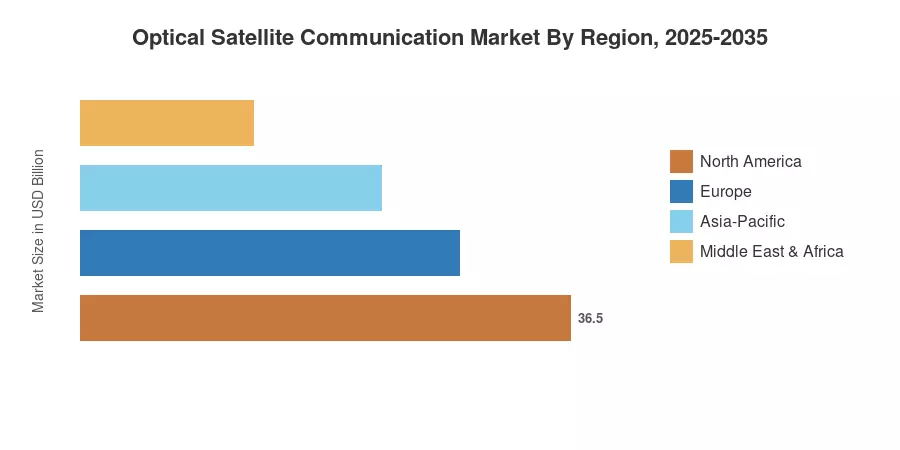
North America commands a 24.6% share of the optical satellite communication market, driven by Pentagon-backed investment and Silicon Valley venture capital. Asia-Pacific is the fastest-growing region at a 23.2% CAGR, fueled by China's 100 Gbps space-to-ground laser tests and India's newly funded optical payload roadmap. Europe holds the second-largest share at approximately 23.1%, with Airbus-Tesat's EDRS constellation serving as a commercial proof point. The decade ahead will see free-space optical laser communication shift from a technology differentiator to a baseline requirement for any satellite operator bidding on sovereign or commercial capacity.

Key Report Takeaways

• By Component

  • Optical transceiver terminals captured a 29.2% revenue share of the optical satellite communication market in 2024, reflecting defense procurement momentum.
  • Beam-steering assemblies are projected to register a 24.6% CAGR through 2035, as adaptive optics become critical for high-bandwidth optical satellite downlinks.
  • Optical ground station technology segments are expanding across allied nations, investing in sovereign laser receive sites.

• By Orbit & Payload

  • LEO platforms accounted for 63.8% of the optical satellite communication market share in 2024, driven by mega-constellation rollouts.
  • Medium satellites represent the fastest payload segment at a 23.7% CAGR, reflecting laser-based satellite data relay integration on 500-kg class buses.

• By End-User

  • Government and defense programs commanded a 52.6% share in 2024, underscoring security-driven demand for inter-satellite optical link infrastructure.


• By Region


  • Asia-Pacific is forecasted to expand at a 23.2% CAGR, making it the fastest-growing geography in the optical satellite communication market.

Market Size and Forecast (2021–2035)

Market sizing combines top-down revenue analysis of satellite prime contractor filings with bottom-up terminal shipment tracking across 14 countries. Historical figures (2021–2024) rely on disclosed contract values and launch manifests; forecast projections apply MRFR's proprietary demand model calibrated to constellation build-out timelines and spectrum-migration schedules.
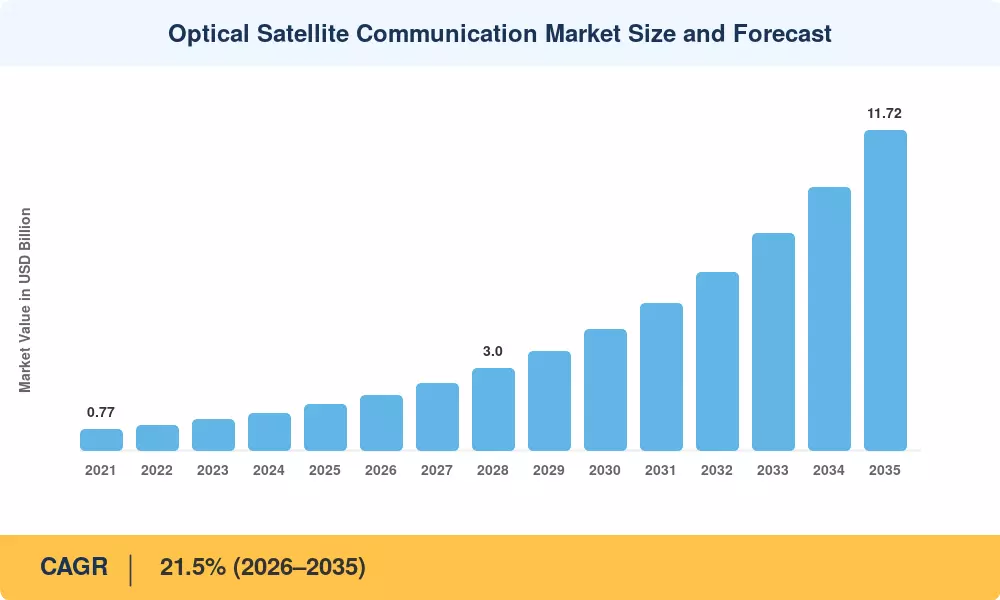
Optical Satellite Communication Market Size and Forecast
Our Impact
Enabled $4.3B Revenue Impact for Fortune 500 and Leading Multinationals
Partnering with 2000+ Global Organizations Each Year
30K+ Citations by Top-Tier Firms in the Industry

Driver Impact Analysis

Driver ~% Impact on CAGR Geographic Relevance Impact Timeline
LEO mega-constellation buildouts ~22% Global Short-term (≤2 yr)
RF spectrum congestion & regulatory pressure ~18% North America, Europe Medium-term (2–4 yr)
Defense & intelligence laser terminal procurement ~20% North America, Asia-Pacific Short-term (≤2 yr)
Quantum-secure communication mandates ~12% Europe, Asia-Pacific Long-term (≥4 yr)
Cislunar & deep-space relay architectures ~8% North America Long-term (≥4 yr)
Cost reduction in photonics-grade optics ~12% Global Medium-term (2–4 yr)
5G/6G backhaul via satellite optical trunks ~8% Asia-Pacific, Europe Long-term (≥4 yr)


LEO Mega-Constellation Buildouts

SpaceX's Starlink network has equipped more than 4,000 satellites with inter-satellite optical link terminals since 2023, generating the single largest volume demand for space-qualified laser transceivers. Amazon's Project Kuiper plans to deploy 3,236 satellites with laser crosslinks by 2029, while Telesat's Lightspeed constellation has awarded optical terminal contracts valued at over USD 400 million [5][12]. This buildout cycle drives component standardization, compresses per-unit pricing, and expands the addressable optical satellite communication market beyond government buyers into commercial broadband.

Defense & Intelligence Procurement

The U.S. Space Development Agency's Transport Layer—Tranche 2 alone represents a USD 2.4 billion procurement cycle requiring laser-based satellite data relay capability on every node. Allied programs in the UK (Project Titania), Japan (JAXA's optical data relay satellite), and Australia (JP9102) collectively add another USD 1.8 billion in committed spending through 2030 [3][13]. These procurements are accelerating the maturation of high-bandwidth optical satellite terminals rated for contested electromagnetic environments.

RF Spectrum Congestion

The ITU World Radiocommunication Conference 2023 highlighted acute Ka- and Ku-band congestion, with interference complaints rising 34% year-over-year among geostationary operators [8]. Free-space optical laser communication eliminates shared-spectrum coordination burdens and offers an unlicensed pathway for inter-satellite optical link capacity, pushing commercial operators to adopt optical payloads ahead of regulatory mandate timelines.

Quantum-Secure Communication Mandates

The EU's EuroQCI initiative allocated EUR 1 billion through 2027 for satellite-based quantum key distribution, all of which requires optical ground station technology as the physical transport layer [9]. China's Micius program and the U.S. National Quantum Initiative complement this trend, positioning the optical satellite communication market as the enabling infrastructure for post-quantum network security.

Restraints Impact Analysis

Restraint ~% Drag on CAGR Geographic Relevance Impact Timeline
Atmospheric attenuation & cloud cover ~25% Global (tropical regions worst) Persistent
Photonics-grade material supply-chain strain ~22% Global Short-term (≤2 yr)
High capital cost of flight-qualified terminals ~20% Emerging markets Medium-term (2–4 yr)
Lack of interoperability standards ~18% Global Medium-term (2–4 yr)
Pointing, acquisition & tracking complexity ~15% Global Long-term (≥4 yr)


Atmospheric Attenuation & Cloud Cover

Optical ground station technology performance degrades sharply under cloud cover, fog, and heavy precipitation—conditions that persist over 40% of daylight hours in tropical and maritime climates [14]. Site-diversity networks (placing multiple receive stations 50–200 km apart) mitigate availability risk but increase terrestrial infrastructure cost by 30–60%, constraining the pace at which the optical satellite communication market penetrates equatorial nations.

Photonics-Grade Material Supply-Chain Strain

China's 2023 export restrictions on gallium and germanium—two elements critical for infrared laser diodes and detector arrays—pushed spot prices up 45% within six months [10]. Satellite prime contractors responded with vertical integration strategies, but smaller terminal manufacturers face margin pressure that slows the commercialization of low-cost laser-based satellite data relay modules.

Interoperability Gaps

The Consultative Committee for Space Data Systems (CCSDS) has yet to ratify a binding standard for inter-satellite optical link waveforms and protocols. Without interoperability, operators cannot route traffic across different constellation meshes, limiting the network-effects multiplier that would otherwise accelerate optical satellite communication market adoption [16].

Optical Satellite Communication Market Opportunities

Optical-as-a-Service Business Models

Relay-capacity leasing, when a constellation operator leases laser trunk bandwidth to third-party missions, is akin to a managed-services transition in terrestrial telecoms. Airbus’s EDRS SpaceDataHighway already sells per-gigabyte relay pricing to Copernicus Earth-observation missions, creating recurring revenue that derisks capital expenditure on free-space optical laser communication infrastructure[4]


Emerging-Market Ground-Station Expansion

Today, there are fewer than 15 active optical receive sites in Africa, South East Asia and South America combined, however these are the fastest growing satellite broadband markets. The deployment of optical ground station technology networks in Kenya, Indonesia and Brazil could release USD 300-500 million incremental relay revenue by 2032[18].


Cislunar and Deep-Space Relay Networks

Both the NASA LunaNet architecture and the European Large Logistics Lander mission require high bandwidth optical satellite relay capability between lunar orbit and Earth. This niche is a premium-margin area for laser terminal suppliers, albeit minor now, with Artemis program missions ramping post-2028[2].


Quantum Key Distribution Overlay

Every QKD satellite mission necessitates an optical downlink path, establishing a captive demand channel for inter-satellite optical link hardware. Governments across the EU, China, Japan and Singapore have invested USD 3.2 billion in satellite QKD programs through 2030, directly increasing the addressable optical satellite communication market[9].


Data Monetization via Relay Analytics

Operators capturing metadata on relay latency, link availability, and atmospheric conditions can package these datasets for weather services, aviation safety, and insurance underwriters—turning operational telemetry into a secondary revenue stream without additional hardware spend.

Optical Satellite Communication Market Future Outlook

AI-Driven Beam Management and Autonomous Routing

Machine-learning algorithms are already optimizing pointing, acquisition, and tracking sequences aboard laser terminals, cutting link-establishment time from minutes to seconds. By 2030, autonomous routing engines will dynamically reroute traffic across inter-satellite optical link meshes based on real-time atmospheric telemetry and congestion data, enabling carrier-grade uptime guarantees that unlock commercial SLA-based pricing for the optical satellite communication market [17].

Platform Economics and Relay-as-a-Service

The shift from capex-heavy private constellations toward shared relay infrastructure mirrors the cloud-computing model. Operators such as Airbus (EDRS) and Skyloom are positioning relay-capacity marketplaces where any mission can purchase laser-based satellite data relay bandwidth on demand. BloombergNEF projects that managed optical relay revenues could reach USD 1.2 billion annually by 2033, fundamentally reshaping the economics of the optical satellite communication market [20].

Convergence with 6G Terrestrial Networks

The ITU's IMT-2030 framework explicitly identifies non-terrestrial networks as a native 6G layer, with free-space optical laser communication serving as the preferred inter-satellite trunk technology. Trials in South Korea and Japan aim to demonstrate seamless handoff between terrestrial fiber and optical satellite trunks by 2029, creating a unified backhaul fabric that expands addressable demand for high-bandwidth optical satellite links [11].

Sustainability and Space-Debris Mitigation

ESA's Zero Debris Charter (2023) incentivizes satellite operators to minimize RF interference and mass budgets—both areas where optical terminals outperform legacy transponders. Laser terminals weigh 30–50% less than equivalent-throughput RF systems and generate zero electromagnetic pollution, positioning them as the ESG-aligned choice for constellation operators facing investor scrutiny on orbital sustainability [21].

Optical Satellite Communication Market Segmentation

By Component

Segment Metric Primary Demand Driver
Optical Transceiver Terminals 29.2% share (2024) Mega-constellation deployments
Optical Ground Stations USD 0.38 Billion (2025) Site-diversity network expansion
Beam-Steering Assemblies 24.6% CAGR Adaptive-optics advancements
Signal Processing & Modems 18.3% CAGR Higher-order modulation for 100 Gbps+
Others (Cabling, Mounts, Thermal) USD 0.11 Billion (2025) Platform integration kits


Optical transceiver terminals remain the revenue anchor of the optical satellite communication market, accounting for the largest share as constellation operators place volume orders for flight-qualified units. Mynaric's CONDOR Mk3 and Tesat's LCT-135 represent the two most widely deployed terminal families, with combined annual shipments exceeding 600 units by late 2024 [15]. Beam-steering assemblies—comprising fast-steering mirrors and micro-electromechanical actuators—are the fastest-growing component because they directly enable inter-satellite optical link stability in high-vibration LEO environments.

By Orbit

Segment Metric Primary Demand Driver
Low-Earth Orbit (LEO) 63.8% share (2024) Broadband mega-constellations
Medium-Earth Orbit (MEO) USD 0.14 Billion (2025) Navigation augmentation systems
Geostationary Orbit (GEO) 16.7% CAGR Relay hub positioning
High-Elliptical & Cislunar 22.4% CAGR Artemis & deep-space programs


LEO dominates the optical satellite communication market because free-space optical laser communication thrives at shorter ranges where atmospheric path loss is minimized during ground passes. GEO platforms, though fewer in number, represent high-value nodes that function as laser-based satellite data relay hubs for LEO constellations needing real-time downlink access outside ground-station visibility windows [4].

By Payload

Segment Metric Primary Demand Driver
Small Satellite (< 300 kg) 46.2% share (2024) CubeSat & smallsat constellation volume
Medium Satellite (300–1,000 kg) 23.7% CAGR Defense & commercial imaging buses
Large Satellite (> 1,000 kg) USD 0.29 Billion (2025) GEO relay platforms & flagship missions


Small satellites dominate unit volume in the optical satellite communication market, driven by the thousands of laser-equipped nodes in Starlink and Kuiper constellations. Medium satellites are gaining share faster, however, as defense programs specify high-bandwidth optical satellite terminals on 500–800 kg buses that carry more powerful laser payloads and larger aperture optics [3].

By End-User

Segment Metric Primary Demand Driver
Government & Defense 52.6% share (2024) Sovereign communications & ISR relay
Commercial Telecommunications 21.8% CAGR Broadband & trunk connectivity
Academic & Scientific 22.8% CAGR Earth observation; deep-space research
Others (Civil, Humanitarian) USD 0.05 Billion (2025) Disaster-response data relay


Government and defense agencies control the majority of the optical satellite communication market today, but commercial telecoms are closing the gap as constellation operators such as SpaceX, Telesat, and OneWeb operationalize inter-satellite optical link architectures for broadband service delivery. Academic and scientific users represent the fastest-growing end-user category, driven by missions that require optical ground station technology for high-volume Earth-observation data downlink [2][13].

Regional Market Share Analysis

Region Metric Primary Investment Themes
North America 24.6% share (2024) Defense procurement; commercial mega-constellations
Europe 23.1% share (2024) EDRS relay; IRIS² sovereign connectivity; EuroQCI
Asia-Pacific 23.2% CAGR (2026–2035) LEO broadband; 100 Gbps demonstrations; QKD
South America USD 0.09 Billion (2025) Ground-station site diversity; broadband backhaul
Middle East & Africa 19.8% CAGR (2026–2035) Smart-city backhaul; defense modernization
Total USD 1.67 Billion (2025) —

The optical satellite communication market displays pronounced geographic asymmetry, with three regions—North America, Europe, and Asia-Pacific—collectively representing over 70% of global revenue. Investment themes diverge: North America prioritizes defense; Europe emphasizes sovereign connectivity; Asia-Pacific pursues commercial scale.


North America

Country Metric Key Driver
US 78.4% of regional share SDA Transport Layer; NASA LCRD
Canada 12.7% CAGR Telesat Lightspeed optical mesh
Mexico USD 0.02 Billion (2025) Satellite backhaul for rural connectivity


The US anchors North American demand through the Space Development Agency's multi-tranche procurement of laser-equipped satellites and NASA's Laser Communications Relay Demonstration. Canada's contribution revolves around Telesat's Lightspeed LEO constellation, which integrates inter-satellite optical link hardware across all 298 planned nodes. Mexico remains nascent but is investing in optical ground station technology to support cross-border data backhaul [3][12].

Europe

Country Metric Key Driver
Germany 22.5% of regional share Tesat-Spacecom / Mynaric HQ; DLR programs
UK 19.3% CAGR Project Titania; OneWeb laser links
France USD 0.07 Billion (2025) Thales Alenia Space terminals; CNES ORION
Italy 14.8% CAGR Leonardo optical payload development
Spain USD 0.03 Billion (2025) ESA ground-station hosting (Canary Islands)
Nordic Countries 16.2% CAGR Arctic relay stations; Esrange space center
Russia USD 0.02 Billion (2025) Roscosmos Sphere constellation (limited growth)
Rest of Europe 15.4% CAGR Switzerland, Netherlands ESA contractors


Europe's optical satellite communication market benefits from Airbus's EDRS operational heritage and Germany's position as a laser terminal manufacturing hub. The EU's IRIS² sovereign constellation, expected to begin deployment in 2028, will require free-space optical laser communication payloads across its multi-orbit architecture [7].

Asia-Pacific

Country Metric Key Driver
China 34.2% of regional share 100 Gbps space-to-ground demo; commercial constellations
India 26.1% CAGR ISRO optical payload roadmap; defense modernization
Japan USD 0.06 Billion (2025) JAXA LUCAS optical data relay satellite
South Korea 22.8% CAGR KARI laser terminal R&D; 6G backhaul pilot
ASEAN USD 0.04 Billion (2025) Ground-station site diversity for tropical mitigation
Rest of Asia-Pacific 20.5% CAGR Emerging launch providers integrating optical payloads


Asia-Pacific leads the optical satellite communication market in growth velocity. China's Academy of Sciences demonstrated a 100 Gbps bidirectional high-bandwidth optical satellite link in 2024, while India's ISRO has earmarked INR 1,200 crore (~USD 140 million) for laser-based satellite data relay payloads on its next-generation observation satellites [6].

South America

Country Metric Key Driver
Brazil 58.3% of regional share Telebras ground-station partnerships
Argentina 21.4% CAGR CONAE small-sat optical payloads
Rest of South America USD 0.01 Billion (2025) Emerging interest in relay-as-a-service


Brazil is establishing optical ground station technology sites in the Amazon basin to support site-diversity architectures for European and North American constellation operators seeking equatorial relay coverage [18].

Middle East & Africa

Country Metric Key Driver
Saudi Arabia 23.6% CAGR NEOM smart-city satellite backhaul
UAE 34.1% of regional share Yahsat / Al Yah optical upgrades
South Africa USD 0.01 Billion (2025) SKA telescope data relay applications
Egypt 18.9% CAGR NileSat modernization; defense links
Rest of MEA USD 0.01 Billion (2025) Nascent market; ground-station hosting potential


The UAE leads the Middle East optical satellite communication market through Yahsat's investment in laser crosslink technology for its Al Yah 4 program, while Saudi Arabia's NEOM initiative is piloting high-bandwidth optical satellite backhaul for its smart-city infrastructure [19].

Optical Satellite Communication Market By Region, 2025-2035

Competitive Benchmarking

The optical satellite communication market exhibits medium concentration, with the top five players commanding an estimated 38–46% of global revenue. The Herfindahl-Hirschman Index sits in the 900–1,200 range, indicating a moderately competitive structure where established defense primes coexist with venture-backed pure-play laser terminal specialists. M&A activity—such as CACI's acquisition of SA Photonics in 2022—signals ongoing consolidation.

Company Est. Revenue Share Range Key Offerings Strategic Positioning
Mynaric AG ~8–11% CONDOR Mk3 laser terminals; HAWK ground receivers Volume LEO terminal supplier; SDA-qualified
Tesat-Spacecom (Airbus) ~7–10% LCT-135 terminals; EDRS relay constellation GEO relay pioneer; European institutional anchor
CACI International ~6–9% Crossbeam optical terminals (ex-SA Photonics) US defense prime; SDA Tranche integrator
Honeywell Aerospace ~5–8% Compact optical terminals for smallsats Avionics crossover; pointing system IP
Thales Alenia Space ~5–8% Optical payloads for Nilesat, IRIS², Copernicus Full-stack satellite manufacturer
Ball Aerospace (BAE Systems) ~4–7% Laser comm flight heritage (LLCD, LCRD) NASA mission heritage; deep-space links
General Atomics EMS ~3–6% GA-ASI laser terminals for ISR platforms Defense-airborne optical crosslinks
Skyloom Global ~2–5% LEO-GEO relay constellation; data relay marketplace Relay-as-a-service business model
Xenesis Inc. ~2–4% Xen-Hub optical terminals Cloud-edge satellite connectivity
Hensoldt AG ~2–4% OGSM ground station systems European optical ground station technology


Recent News & Developments


  • US Space Force (May 2025) gives CACI, General Atomics and ViaSat USD 100 million Enterprise Space Terminal Phase 2 awards for standardised laser terminals.


Optical Satellite Communication Market Report Scope

Parameter Detail
Market Scope Global optical satellite communication market — terminals, ground stations, components, and relay services
Study Period 2021–2035
CAGR 21.5% (2026–2035)
Base Year Market Size USD 1.67 Billion (2025)
Forecast Endpoint USD 11.72 Billion (2035)
Fastest Growing Segment Beam-Steering Assemblies (by component); Asia-Pacific (by region)
Companies Profiled 10 (Mynaric, Tesat-Spacecom, CACI, Honeywell, Thales Alenia, Ball Aerospace, GA-EMS, Skyloom, Xenesis, Hensoldt)
Valuation Currency USD Billion


FAQs

How does weather affect the reliability of optical satellite communication links compared to RF?

Cloud cover, fog, and heavy rain can attenuate laser signals by 20–40 dB, far exceeding typical RF fade margins. Operators mitigate this through site-diversity networks of three to four optical ground stations spaced 100–200 km apart, achieving 99.5%+ link availability [14].

What minimum order quantity do laser terminal manufacturers typically require for constellation programs?

Most suppliers set a minimum commitment of 50–100 units per production lot to justify flight-qualification tooling costs. Volume orders above 300 units unlock 15–25% unit-price reductions due to automated assembly line economies [15].

Can optical satellite communication terminals support quantum key distribution simultaneously with data relay?

Yes—hybrid QKD-data terminals time-multiplex quantum and classical channels on the same aperture. ESA's Eagle-1 mission, scheduled for 2026, will demonstrate dual-mode operation at 10 Gbps data plus QKD overlay on a single high-bandwidth optical satellite payload [9].

What is the typical power consumption of a space-qualified free-space optical laser communication terminal?

Current-generation terminals (e.g., Mynaric CONDOR Mk3) draw 60–120 watts, roughly half the power budget of an equivalent-throughput Ka-band transponder. Next-generation designs target sub-50 W for smallsat-class platforms [22].

How do export control regulations affect the optical satellite communication market supply chain?

ITAR and EAR restrictions classify many laser terminal subsystems as defense articles, requiring export licenses that add 3–9 months to international procurement cycles. European manufacturers like Mynaric and Tesat benefit from comparatively streamlined EU dual-use export frameworks [13].

What role do adaptive-optics systems play in improving inter-satellite optical link performance from ground to LEO?

Adaptive optics correct atmospheric wavefront distortion in real time, boosting received signal power by 6–10 dB. This allows smaller, lower-cost ground telescopes to achieve the same link budget as a conventional 1-meter aperture optical ground station technology installation [17].

Are there commercially available insurance products that cover laser-based satellite data relay mission failures?

Specialty space insurers now offer optical payload endorsements priced at 8–12% of insured value—comparable to RF payload premiums. Underwriters factor in link-availability data from EDRS and LCRD missions to calibrate risk models for the optical satellite communication market [20].    
Author
Author
Author Profile
Shubham Munde LinkedIn
Team Lead - Research
Shubham brings over 7 years of expertise in Market Intelligence and Strategic Consulting, with a strong focus on the Automotive, Aerospace, and Defense sectors. Backed by a solid foundation in semiconductors, electronics, and software, he has successfully delivered high-impact syndicated and custom research on a global scale. His core strengths include market sizing, forecasting, competitive intelligence, consumer insights, and supply chain mapping. Widely recognized for developing scalable growth strategies, Shubham empowers clients to navigate complex markets and achieve a lasting competitive edge. Trusted by start-ups and Fortune 500 companies alike, he consistently converts challenges into strategic opportunities that drive sustainable growth.
Co-Author
Co-Author Profile
Sejal Akre LinkedIn
Senior Research Analyst
She has over 5 years of rich experience, in market research and consulting providing valuable market insights to client. Hands on expertise in management consulting, and extensive knowledge in domain including ICT, Automotive & Transportation and Aerospace & Defense. She is skilled in Go-to market strategy, industry analysis, market sizing, in depth company profiling, competitive intelligence & benchmarking and value chain amongst others.

Research Approach


Secondary Research

The secondary research process involved comprehensive analysis of regulatory databases, peer-reviewed aerospace journals, technical publications, and authoritative space and telecommunications organizations. Key sources included the National Aeronautics and Space Administration (NASA), European Space Agency (ESA), Federal Communications Commission (FCC), International Telecommunication Union (ITU), National Oceanic and Atmospheric Administration (NOAA), United Nations Office for Outer Space Affairs (UNOOSA), Space Foundation, Satellite Industry Association (SIA), Consultative Committee for Space Data Systems (CCSDS), International Astronautical Federation (IAF), Institute of Electrical and Electronics Engineers (IEEE) Aerospace & Electronic Systems Society, International Society for Optics and Photonics (SPIE), Journal of Optical Communications and Networking, Journal of Lightwave Technology, SpaceNews, Euroconsult, Bryce Space and Technology, Union of Concerned Scientists (UCS) Satellite Database, and national space agency reports from key markets including JAXA (Japan), ISRO (India), CNSA (China), and UK Space Agency. These sources were used to collect satellite deployment statistics, spectrum allocation data, laser communication technology advancements, regulatory approval frameworks, orbital debris mitigation guidelines, and market landscape analysis for Ka-band, Q/V-band, Ku-band, X-band, and S-band communication systems across GEO, MEO, and LEO orbits.


Primary Research

In order to gather both qualitative and quantitative insights, supply-side and demand-side stakeholders were interviewed during the primary research process. CEOs, VPs of satellite programs, chief technology officers, laser communication engineers, heads of regulatory affairs, and commercial directors from satellite makers, optical payload developers, ground station operators, and space launch service providers were examples of supply-side sources. Satellite operators, telecom companies, defense procurement officers from military and defense agencies, directors of maritime communications, managers of aviation connectivity, and principal investigators from scientific and research institutions were examples of demand-side sources. Primary research obtained information on frequency band adoption patterns, modulation technique preferences (ASK, FSK, PSK, QAM), antenna type selection criteria (parabolic reflector, phased array, flat panel), and pricing strategies for optical ground stations versus traditional RF systems. It also confirmed optical inter-satellite link deployment timelines and validated market segmentation across military and defense, maritime, aviation, commercial, and scientific applications.

Primary Respondent Breakdown:

By Designation: C-level Primaries (28%), Director Level (32%), Others (40%)

By Region: North America (32%), Europe (30%), Asia-Pacific (28%), Rest of World (10%)


Market Size Estimation

Global market valuation was derived through revenue mapping and satellite deployment volume analysis. The methodology included:

Identification of 50+ key manufacturers and service providers across North America, Europe, Asia-Pacific, and Latin America specializing in optical communication terminals, laser payload systems, and ground station infrastructure

Product mapping across Ka-band, Q/V-band, Ku-band, X-band, and S-band frequency allocations for GEO, MEO, and LEO satellite orbits

Analysis of reported and modeled annual revenues specific to optical satellite communication portfolios, including optical inter-satellite links (OISL), laser communication terminals, and photonic integrated circuits

Coverage of manufacturers and operators representing 72-78% of global market share in 2024

Extrapolation using bottom-up (satellite unit deployment Ă— optical payload ASP by orbit type and application) and top-down (manufacturer revenue validation) approaches to derive segment-specific valuations for military and defense, maritime, aviation, commercial, and scientific and research applications

Download Free Sample

Kindly complete the form below to receive a free sample of this Report

Download PDF ×

We do not share your information with anyone. However, we may send you emails based on your report interest from time to time. You may contact us at any time to opt-out.
















