Download Free Sample
Kindly complete the form below to receive a free sample of this Report
Organic Face Care Ingredients Market Size, Share, Industry Trend & Analysis Research Report Information By Type (Surfactants, Emollients, Active Ingredients, Sugar Polymers, Preservatives, Others), By Application (Face Wash, Cleansing Wipes, Skin-Whitening Creams, Anti-Aging Creams, Others) And By Region (North America, Europe, Asia-Pacific, And Rest Of The World) – Forecast Till 2035
As per MRFR analysis, the Organic Face Care Ingredients Market Size was estimated at 6.05 USD Billion in 2024. The Organic Face Care Ingredients industry is projected to grow from 6.3 USD Billion in 2025 to 9.54 by 2035, exhibiting a compound annual growth rate (CAGR) of 4.23% during the forecast period 2025 - 2035.
The market is experiencing a robust shift towards sustainability and personalization.
| 2024 Market Size | 6.05 (USD Billion) |
| 2035 Market Size | 9.54 (USD Billion) |
| CAGR (2025 - 2035) | 4.23% |
Burt's Bees (US), The Body Shop (GB), L'Oreal (FR), Neutrogena (US), Aveda (US), Weleda (CH), Dr. Hauschka (DE), Tatcha (US), Kiehl's (US)
Our Impact
Enabled $4.3B Revenue Impact for Fortune 500 and Leading Multinationals
Partnering with 2000+ Global Organizations Each Year
30K+ Citations by Top-Tier Firms in the Industry
The landscape of Organic Face Care Ingredients is evolving, reflecting a growing consumer preference for natural and sustainable products. This shift is driven by an increasing awareness of the potential adverse effects of synthetic chemicals on skin health and the environment. As consumers become more discerning, they seek formulations that not only enhance beauty but also align with their values regarding health and sustainability. Consequently, brands are responding by innovating and reformulating their offerings to include a wider array of organic components, which are perceived as safer and more effective. This trend indicates a broader movement towards holistic wellness, where skincare is viewed as an integral part of overall health and lifestyle choices. In addition, the demand for transparency in ingredient sourcing and product formulation is becoming more pronounced. Consumers are increasingly interested in understanding the origins of the ingredients used in their skincare products. This has led to a rise in brands that prioritize ethical sourcing and provide detailed information about their supply chains. As a result, The market is likely to witness a surge in products that emphasize clean, traceable, and responsibly sourced components. This trend not only enhances consumer trust but also fosters a deeper connection between brands and their clientele, ultimately shaping the future of the industry.
There is a notable emphasis on sustainable sourcing within the Organic Face Care Ingredients market. Brands are increasingly prioritizing ingredients that are harvested in an environmentally friendly manner, ensuring minimal impact on ecosystems. This trend reflects a broader commitment to sustainability and resonates with consumers who value eco-conscious practices.
The trend towards personalization is gaining traction, as consumers seek products tailored to their unique skin types and concerns. This shift encourages brands to develop customizable formulations that incorporate organic ingredients, allowing for a more individualized approach to skincare. Such personalization enhances customer satisfaction and loyalty.
The integration of holistic wellness into skincare routines is becoming more prevalent. Consumers are looking for Organic Face Care Ingredients that not only address cosmetic concerns but also promote overall well-being. This trend suggests a shift towards products that incorporate therapeutic properties, aligning skincare with broader health and wellness goals.
The Global Organic Face Care Ingredients Market Industry is poised for substantial growth, with projections indicating an increase from 6.05 USD Billion in 2024 to 9.53 USD Billion by 2035. This growth trajectory reflects a compound annual growth rate of 4.22% from 2025 to 2035. Factors contributing to this expansion include rising consumer demand for organic products, regulatory support for organic standards, and technological advancements in ingredient extraction. As the market evolves, stakeholders are likely to adapt to changing consumer preferences and invest in innovative solutions to meet the growing demand for organic face care ingredients.
Sustainability is becoming a central theme in the Global Organic Face Care Ingredients Market Industry. Consumers are increasingly seeking products that align with their values regarding environmental responsibility. Brands that adopt sustainable practices, such as eco-friendly packaging and ethical sourcing, are likely to resonate with this conscientious consumer base. This focus on sustainability not only enhances brand loyalty but also drives market growth. As the industry evolves, companies that prioritize sustainability may capture a larger share of the market, contributing to the projected growth trajectory of 6.05 USD Billion in 2024 and beyond.
Government regulations promoting organic standards significantly influence the Global Organic Face Care Ingredients Market Industry. Various countries are implementing stricter guidelines to ensure the authenticity and safety of organic products. This regulatory framework not only enhances consumer trust but also encourages manufacturers to adopt organic practices. For instance, the European Union has established comprehensive regulations that govern organic labeling and certification. Such initiatives are expected to bolster market growth, with projections indicating a rise to 9.53 USD Billion by 2035. Compliance with these regulations may also lead to increased investment in organic ingredient sourcing.
The Global Organic Face Care Ingredients Market Industry experiences a notable surge in consumer preference for natural and organic products. This trend is driven by increasing awareness regarding the harmful effects of synthetic chemicals in skincare. As consumers become more educated about ingredient sourcing and sustainability, they are gravitating towards products that feature organic components. This shift is reflected in the market's projected growth, with an estimated value of 6.05 USD Billion in 2024, indicating a robust demand for organic face care solutions. Brands that prioritize transparency and ethical sourcing are likely to thrive in this evolving landscape.
The impact of social media and influencers on consumer purchasing behavior is a driving force in the Global Organic Face Care Ingredients Market Industry. Platforms like Instagram and TikTok have become vital channels for brands to showcase their organic products and engage with consumers. Influencers often promote the benefits of organic skincare, leading to increased visibility and sales. This trend is particularly pronounced among younger demographics who prioritize authenticity and sustainability in their purchasing decisions. As brands leverage social media marketing strategies, the organic face care segment is expected to see substantial growth, aligning with broader market trends.
Innovations in extraction technologies are reshaping the Global Organic Face Care Ingredients Market Industry. Advanced methods such as cold-press extraction and supercritical CO2 extraction are enhancing the quality and efficacy of organic ingredients. These technologies allow for the preservation of bioactive compounds, resulting in more effective skincare formulations. As a result, brands are increasingly incorporating these high-quality organic ingredients into their products, appealing to health-conscious consumers. The anticipated compound annual growth rate of 4.22% from 2025 to 2035 suggests that the integration of advanced extraction methods will play a crucial role in market expansion.
In the Organic Face Care Ingredients market, moisturizers have established themselves as the largest segment, capturing a significant portion of the market share. This success can be attributed to the growing consumer demand for hydration and anti-aging solutions, which are increasingly sought after in organic formulations. Cleansers, exfoliators, and masks also hold notable shares, but moisturizers lead the pack due to more extensive advertising and established brand loyalty among consumers. Meanwhile, serums are emerging rapidly, appealing especially to younger demographics prioritizing potent skincare solutions. The growth trends in the Organic Face Care Ingredients segment are largely driven by factors such as increasing consumer awareness about the benefits of organic ingredients and a desire for more sustainable skincare options. The push for clean beauty products is fueling demand for serums, which are viewed as effective for targeted skincare benefits. Similarly, natural moisturizers have carved an impressive niche for themselves, as consumers increasingly favor products that nourish the skin without harsh chemicals.
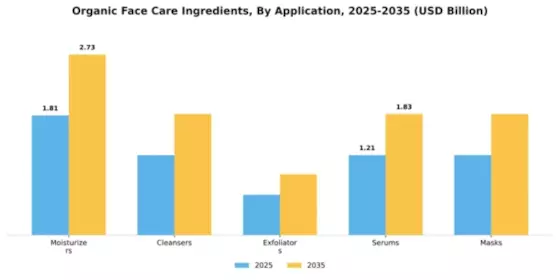
Moisturizers: Dominant vs. Serums: Emerging
Moisturizers are a dominant force in the Organic Face Care Ingredients market, characterized by their widespread use in daily skincare routines. Their formulations typically emphasize hydration through natural emollients and oils, appealing to a diverse consumer base. These products are often marketed with claims of deep nourishment and long-lasting hydration, making them essential for consumers focused on skincare health. Conversely, serums are emerging as a dynamic player, notable for their high concentration of active ingredients designed to address specific skin concerns, such as wrinkles or pigmentation. Their lightweight nature and versatility in layering with other products make serums particularly attractive for consumers seeking customizable skincare solutions, thus driving their rapid adoption in the market.
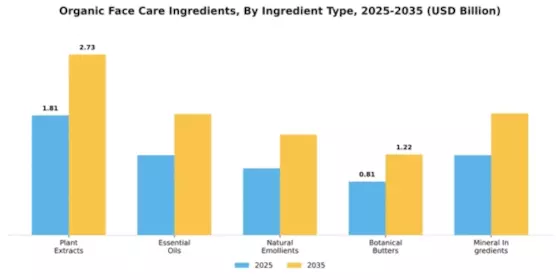
In the Organic Face Care Ingredients market, Plant Extracts hold the largest share, driven by their versatile applications and consumer preference for natural ingredients. Essential Oils, while comprising a smaller portion, are gaining momentum due to their aromatic benefits and multifunctionality, appealing to consumers seeking holistic skincare solutions. These two ingredient types are key players in the market, reflecting the growing trend towards organic and natural formulations. As consumer awareness regarding the benefits of natural ingredients continues to rise, the demand for Essential Oils is rapidly increasing, positioning them as the fastest-growing segment. Plant Extracts maintain their dominance through well-established formulations, while Essential Oils are becoming popular in innovative product launches. The synergy between these segments is expected to shape the future of organic face care products.
Plant Extracts (Dominant) vs. Botanical Butters (Emerging)
Plant Extracts are the dominant players in the organic face care ingredients market, valued for their efficacy in addressing various skin concerns and their ability to cater to diverse consumer preferences. They are widely recognized for their anti-aging, anti-inflammatory, and hydrating properties, making them essential in many formulations. In contrast, Botanical Butters, while still emerging in the market, are gaining traction for their emollient characteristics that provide great moisturizing benefits. The growing trend towards sustainable sourcing and the clean beauty movement are propelling Botanical Butters into the spotlight, as they can be included in formulations that emphasize ethical consumerism. This positions them as a valuable complement to Plant Extracts in future product formulations.
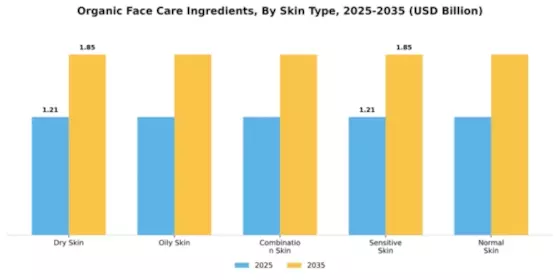
In the Organic Face Care Ingredients market, dry skin products hold the largest share, driven by the increasing demand for moisturizing and hydrating solutions that cater to consumers with parched skin. Oily skin products, while currently smaller in market share, are rapidly gaining traction, as they address concerns such as shine control and acne prevention using natural ingredients. As consumer awareness of skin health grows, both segments are gaining attention in the organic segment of skincare.
Dry Skin: Dominant vs. Oily Skin: Emerging
Dry skin care products remain the dominant force in the organic face care market, appealing to consumers looking for effective solutions to combat dryness and maintain skin hydration. These products often include naturally derived ingredients like aloe vera and shea butter, which are renowned for their moisturizing properties. On the other hand, oily skin products are emerging as a significant segment due to the heightened focus on acne treatment and shine reduction without harsh chemicals. The growth trend in this area reflects a shift towards gentle, organic formulations that resonate well with consumers seeking effective yet natural skincare solutions.
In the Organic Face Care Ingredients market, formulation types exhibit diverse market share dynamics. Creams hold the largest segment share, owing to their rich texture and moisturizing benefits, making them a preferred choice among consumers seeking hydration and anti-aging properties. Gels, while currently smaller in market share, are rapidly gaining traction due to their lightweight formulation and suitability for oily and combination skin, answering the growing demand for refreshing and non-greasy products. Growth trends within this segment are influenced by consumer preferences shifting towards natural and organic ingredients. The increasing focus on clean beauty fuels demand for products free from synthetic additives. Gels are becoming the fastest-growing category as consumers seek effective and efficient formulations. Additionally, the rise of social media influencers promoting clean and organic beauty further propels interest in these innovative formulations.
Creams: Dominant vs. Gels: Emerging
Creams are currently the dominant formulation in the organic face care ingredients market due to their rich, emollient properties that cater to various skin concerns, including dryness, aging, and sensitivity. They often include high concentrations of active ingredients, such as natural oils and botanical extracts, making them highly effective and desirable for consumers. In contrast, gels represent an emerging segment, leveraging the trend toward lighter formulations that provide hydration without heaviness. Their unique texture appeals to a younger demographic, particularly those with oily or combination skin. Gels often contain soothing ingredients like aloe vera and green tea, enhancing their appeal as refreshing alternatives in the growing segment of consumers seeking clean and effective beauty products.
The Organic Face Care Ingredients market showcases a diverse consumer demographic with a significant concentration in the 25-34 age range, which represents the largest share. This age group prioritizes natural and organic products, driven by increasing consciousness towards skincare and overall health. Meanwhile, the gender diversity in the market reveals that while females traditionally dominate the organic skincare segment, the male segment is rapidly expanding, highlighting a notable shift in purchasing behavior as men increasingly seek organic options for face care. Growth trends point to an increasing interest in organic beauty solutions among younger consumers, particularly Generation Z and Millennials. These demographics are more inclined to invest in sustainable and ethically sourced ingredients, spurred by social media influence and environmental awareness. Additionally, the supported growth from both genders is fostering a more inclusive market, where brands are tailoring their offerings to meet the specific needs of diverse consumer bases, thus expanding their reach and appeal.
Age Group: 25-34 (Dominant) vs. Gender: Male (Emerging)
The age group of 25-34 emerges as a dominant consumer base in the Organic Face Care Ingredients sector, characterized by a strong inclination towards eco-friendly and organic skincare products. This demographic is not only health-conscious but also highly engaged in social conversations around sustainability, favoring brands that align with their values. On the other hand, the male segment represents an emerging market, with increasing recognition among brands of the necessity to cater to men's skincare needs. This shift is driven by changing attitudes towards skincare among men, emphasizing the importance of maintaining healthy skin. As brands innovate to offer organic solutions for men's face care, growth within this segment is expected to accelerate, diversifying the market landscape.
Get more detailed insights about Organic Face Care Ingredients Market Request Free Sample
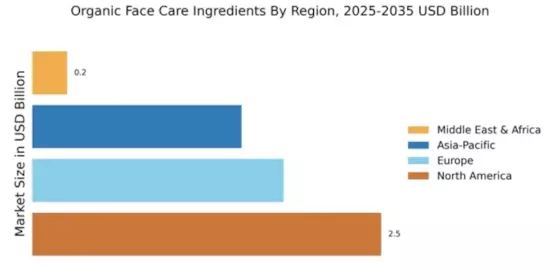
North America continues to lead the organic face care ingredients market, holding a significant share of 2.5 billion in 2024. The growth is driven by increasing consumer awareness regarding natural products, coupled with stringent regulations promoting organic formulations. The demand for clean beauty products is surging, with consumers prioritizing sustainability and ethical sourcing in their purchasing decisions. Regulatory bodies are also encouraging transparency in ingredient sourcing, further boosting market growth. The competitive landscape is robust, with key players like Burt's Bees, Neutrogena, and Aveda dominating the market. The U.S. is the largest contributor, supported by a strong retail presence and innovative product launches. Companies are increasingly investing in R&D to develop new organic formulations, catering to the growing demand for personalized skincare solutions. This dynamic environment positions North America as a pivotal region in the organic face care sector.
Europe's organic face care ingredients market is valued at 1.8 billion, reflecting a growing trend towards sustainability and eco-friendly products. The region benefits from stringent regulations that promote organic certifications, enhancing consumer trust. The demand for organic ingredients is further fueled by rising health consciousness and a shift towards natural beauty solutions. Regulatory frameworks in countries like Germany and France are pivotal in shaping market dynamics, ensuring high standards for organic products. Leading countries such as Germany, France, and the UK are at the forefront of this market, with brands like The Body Shop and L'Oreal leading the charge. The competitive landscape is characterized by a mix of established players and emerging brands focusing on niche organic offerings. The emphasis on ethical sourcing and transparency is driving innovation, making Europe a key player in The Organic Face Care Ingredients.
The Asia-Pacific region, valued at 1.5 billion, is witnessing rapid growth in the organic face care ingredients market. This surge is driven by increasing disposable incomes, urbanization, and a growing awareness of skincare among consumers. Regulatory support for organic products is also enhancing market dynamics, as governments promote natural ingredients to meet rising consumer demand. The region's diverse consumer base is increasingly seeking products that align with their health and wellness goals, further propelling market growth. Countries like China, Japan, and India are leading the charge, with a mix of local and international brands competing for market share. Key players such as Tatcha and Weleda are expanding their presence, focusing on innovative formulations that cater to local preferences. The competitive landscape is evolving, with brands investing in marketing strategies that highlight the benefits of organic ingredients, making Asia-Pacific a significant player in the global market.
The Middle East and Africa (MEA) region, with a market size of 0.25 billion, presents emerging opportunities in the organic face care ingredients sector. The growth is primarily driven by increasing consumer awareness of organic products and a shift towards natural beauty solutions. Regulatory bodies are beginning to implement guidelines that promote organic certifications, which is expected to enhance market credibility and consumer trust. The region's diverse demographics are increasingly inclined towards products that offer health benefits, further driving demand. Countries like South Africa and the UAE are leading the market, with a growing number of local brands entering the organic space. The competitive landscape is characterized by a mix of established international brands and emerging local players. Companies are focusing on product innovation and marketing strategies that resonate with the region's unique cultural preferences, positioning MEA as a promising market for organic face care ingredients.
The market for Organic Face Care Ingredients is characterized by a dynamic competitive landscape, driven by increasing consumer demand for natural and sustainable products. Key players such as Burt's Bees (US), The Body Shop (GB), and L'Oreal (FR) are strategically positioned to leverage this trend. Burt's Bees (US) focuses on innovation in product formulations, emphasizing the use of responsibly sourced ingredients. The Body Shop (GB) has adopted a strong sustainability narrative, integrating ethical sourcing and community trade into its operational ethos. L'Oreal (FR), on the other hand, is investing heavily in digital transformation and e-commerce capabilities, aiming to enhance customer engagement and streamline distribution channels. Collectively, these strategies not only enhance brand loyalty but also shape a competitive environment that increasingly prioritizes sustainability and innovation.In terms of business tactics, companies are localizing manufacturing and optimizing supply chains to respond swiftly to market demands. The competitive structure of the market appears moderately fragmented, with a mix of established brands and emerging players. This fragmentation allows for diverse consumer choices but also intensifies competition among key players, who are vying for market share through unique value propositions and differentiated offerings.In November Burt's Bees (US) announced the launch of a new line of face care products that utilize a proprietary blend of organic botanicals aimed at enhancing skin hydration. This strategic move underscores the company's commitment to innovation and aligns with consumer preferences for natural ingredients. By introducing this line, Burt's Bees (US) not only reinforces its market position but also responds to the growing trend of consumers seeking effective yet environmentally friendly skincare solutions.In October The Body Shop (GB) unveiled its partnership with a local community in Ghana to source shea butter, thereby enhancing its supply chain transparency and sustainability credentials. This initiative not only supports local economies but also strengthens The Body Shop's (GB) brand image as a socially responsible entity. Such partnerships are likely to resonate with consumers who prioritize ethical consumption, thereby potentially increasing customer loyalty and market share.In September L'Oreal (FR) launched an AI-driven skincare diagnostic tool on its e-commerce platform, allowing consumers to receive personalized product recommendations based on their skin type and concerns. This technological advancement signifies L'Oreal's (FR) commitment to integrating digital solutions into its customer experience. By leveraging AI, L'Oreal (FR) enhances consumer engagement and positions itself as a leader in the digital transformation of the beauty industry.As of December current trends in the organic face care market are heavily influenced by digitalization, sustainability, and the integration of advanced technologies such as AI. Strategic alliances, like those seen with The Body Shop (GB), are shaping the landscape by fostering community engagement and ethical sourcing. Looking ahead, competitive differentiation is likely to evolve from traditional price-based competition to a focus on innovation, technology, and supply chain reliability. This shift suggests that brands that prioritize sustainable practices and technological integration will be better positioned to thrive in an increasingly discerning market.


February 2022: Honasa Consumer Pvt. Ltd launched a new skincare brand called Ayuga based on Ayurvedic recipes. The products of Ayuga are completely organic, and Ayurveda-based herbs are used in those products.
December 2021: Loreal signed an agreement to acquire Youth to the People, an American skincare company based in California. The reason behind the acquisition was to create health-conscious vegan-based skin care products.
The market is projected to grow at a 4.23% CAGR from 2025 to 2035, driven by increasing consumer demand for natural products and sustainability.
New opportunities lie in:
By 2035, the market is expected to solidify its position as a leader in sustainable beauty.
| MARKET SIZE 2024 | 6.05(USD Billion) |
| MARKET SIZE 2025 | 6.3(USD Billion) |
| MARKET SIZE 2035 | 9.54(USD Billion) |
| COMPOUND ANNUAL GROWTH RATE (CAGR) | 4.23% (2025 - 2035) |
| REPORT COVERAGE | Revenue Forecast, Competitive Landscape, Growth Factors, and Trends |
| BASE YEAR | 2024 |
| Market Forecast Period | 2025 - 2035 |
| Historical Data | 2019 - 2024 |
| Market Forecast Units | USD Billion |
| Key Companies Profiled | Burt's Bees (US), The Body Shop (GB), L'Oreal (FR), Neutrogena (US), Aveda (US), Weleda (CH), Dr. Hauschka (DE), Tatcha (US), Kiehl's (US) |
| Segments Covered | Application, Ingredient Type, Skin Type, Formulation Type, Consumer Demographics |
| Key Market Opportunities | Growing consumer demand for sustainable and natural formulations in Organic Face Care Ingredients. |
| Key Market Dynamics | Rising consumer demand for natural ingredients drives innovation and competition in organic face care formulations. |
| Countries Covered | North America, Europe, APAC, South America, MEA |
The projected market valuation for Organic Face Care Ingredients is expected to reach 9.54 USD Billion by 2035.
The market valuation for Organic Face Care Ingredients was 6.05 USD Billion in 2024.
The expected CAGR for the Organic Face Care Ingredients market during the forecast period 2025 - 2035 is 4.23%.
Key players in the Organic Face Care Ingredients market include Burt's Bees, The Body Shop, L'Oreal, Neutrogena, Aveda, Dr. Hauschka, Weleda, Tatcha, and Kiehl's.
The market for moisturizers in Organic Face Care Ingredients increased from 1.81 USD Billion in 2024 to 2.73 USD Billion in 2025.
The market size for cleansers in the Organic Face Care Ingredients segment was 1.21 USD Billion in 2024 and is projected to grow to 1.83 USD Billion by 2025.



Kindly complete the form below to receive a free sample of this Report

“This is really good guys. Excellent work on a tight deadline. I will continue to use you going forward and recommend you to others. Nice job”


“Thanks. It’s been a pleasure working with you, please use me as reference with any other Intel employees.”


“Thanks for sending the report it gives us a good global view of the Betaïne market.”


“Thank you, this will be very helpful for OQS.”


“We found the report very insightful! we found your research firm very helpful. I'm sending this email to secure our future business.”


“I am very pleased with how market segments have been defined in a relevant way for my purposes (such as "Portable Freezers & refrigerators" and "last-mile"). In general the report is well structured. Thanks very much for your efforts.”


“I have been reading the first document or the study, ,the Global HVAC and FP market report 2021 till 2026. Must say, good info! I have not gone in depth at all parts, but got a good indication of the data inside!”


“We got the report in time, we really thank you for your support in this process. I also thank to all of your team as they did a great job.”


“The Automotive 48V ECU Components Procurement Intelligence Study” was a complex project, but the Market Research Future (MRFR) team handled it with quality, agility, and customer-centricity. They delivered all requested data on time and within the agreed scope. The team, including Shubhendra Anand and Rahul Gotadki, was always readily available to clarify questions and swiftly implement necessary adjustments, driving the project to a successful conclusion within a very demanding timeframe.
I would also like to specifically commend Akshay Agarwal for his responsiveness and support at every stage—from our initial inquiry on May 6th through to final delivery on June 18th. His dedication made the entire process seamless.”



