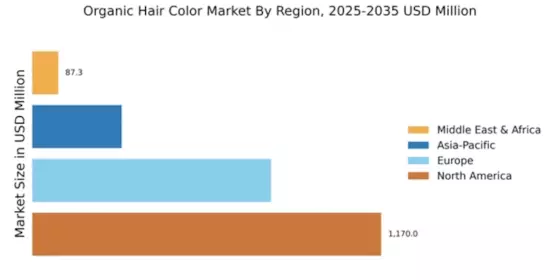
As per MRFR analysis, the Organic Hair Color Market Size was estimated at 2357.3 USD Million in 2024. The Organic Hair Color industry is projected to grow from 2628.67 USD Million in 2025 to 7815.43 USD Million by 2035, exhibiting a compound annual growth rate (CAGR) of 11.51% during the forecast period 2025 - 2035. North America holds the largest share of the global Organic Hair Color Market at approximately 33%, driven by strong consumer health consciousness, a growing preference for chemical-free hair coloring solutions, and a well-developed organic beauty retail market led by the United States. The United States is the leading country within North America, capturing approximately 27% of the global Organic Hair Color Market share, supported by high spending on natural and organic beauty products, widespread availability of certified organic hair color brands, and strong demand from health-conscious millennial and Gen Z consumers. Permanent Hair Color dominates the Organic Hair Color Market as the largest product type segment, accounting for approximately 42% of the global market share in 2025, driven by consumer preference for long-lasting results, strong demand for salon-quality organic hair color products, and innovation in plant-based permanent dye formulations.
Key Market Trends & Highlights
The Organic Hair Color Market is experiencing a notable shift towards natural and sustainable products.
- The demand for organic hair color is driven by a rising preference for natural ingredients among consumers in North America.
- Sustainability and eco-friendly practices are becoming increasingly important, particularly in the fast-growing Asia-Pacific region.
- Diversity in color offerings is expanding, with hair coloring remaining the largest segment while hair highlighting is rapidly gaining traction.
- Consumer awareness of chemical risks and the influence of social media are key drivers propelling the market forward.
Market Size & Forecast
| 2024 Market Size | 2357.3 (USD Million) |
| 2035 Market Size | 7815.43 (USD Million) |
| CAGR (2025 - 2035) | 11.51% |
Major Players
Herbatint (IT), Naturtint (ES), Tints of Nature (GB), Madison Reed (US), Oway (IT), EcoColors (US), Sienna Naturals (US), Aveda (US), Logona (DE)