×
Hero Background
English
Chinese
French
Japanese
Korean
German
Spanish

Organic Soaps Market Analysis

ID: MRFR/CG/9037-HCR
90 Pages
Snehal Singh
October 2025

Organic Soaps Market Research Report Information by Form (Liquid, Bar, Paper), Distribution Channel (Store-Based {Supermarkets & Hypermarkets, Convenience Stores, and Others} and Non-Store-Based), and Region (North America, Europe, Asia-Pacific, and Rest of the World) - Forecast till 2035

Share:
Download PDF ×

We do not share your information with anyone. However, we may send you emails based on your report interest from time to time. You may contact us at any time to opt-out.

Organic Soaps Market Infographic
Purchase Options

Market Analysis

In-depth Analysis of Organic Soaps Market Industry Landscape

The organic soaps market is currently experiencing dynamic shifts driven by a growing consumer preference for natural and sustainable products. Market dynamics in this segment are influenced by several key factors that reflect changing consumer behaviours and market trends. Driven by deepening consumer inclination toward organic options transversing the personal care industry. A reduced use of traditional soaps connotes an increased worldwide acceptance for organic soaps. This will drive demand for organic soaps as it reflects consumer behavior which is moving towards an increased awareness about the many benefits of these products in the personal care industry. One of the key trends contributing to the growth of the organic soap market is the growing consciousness of the users about the potential adverse effects of synthetic chemicals present in widely used commercial soaps. With a growing awareness of health and environmental consciousness by people, there is an increasing demand for organic soaps that are made with natural ingredients and free from harsh chemical additives. The catering towards safe and organic personal care products has become a key factor defining the market's path. The market dynamics are also based on the growing reach of the e-commerce and digital platforms. The digital distribution channels are the main ones now for organic soaps, it gives the consumers an easy access to a huge variety of products and information. The rapid growth of e-commerce sales over time is mainly because of the convenience of online shopping, and the ease to compare products and read reviews. Brands utilize e-commerce channels to reach out to a larger base and hence generate a direct contact with consumers. The interactions of social media and digital marketing domains are also remarkable aspects of the soap industry development. The consumers today are more empowered and connected than they have ever been before asking recommendation and reviews from social networking websites. The effect of digital trend has resulted in blurring of the lines of information about organic soap brands, leading to the wave effect that promotes market growth. Brands that can properly tap into the power of social media through their marketing efforts sometimes stand in front of the consumers. Besides these elements, the regulation initiatives and certifications are other factors that contribute to market evolution. Consumers are increasingly looking for products that carry organic certifications, as these symbols provide assurance of the product's authenticity and adherence to stringent quality standards. Regulatory support for organic and natural products further instills confidence in consumers, contributing to the overall positive momentum of the organic soaps market.
Author
Snehal Singh
Assistant Manager - Research

High acumen in analyzing complex macro & micro markets with more than 6 years of work experience in the field of market research. By implementing her analytical skills in forecasting and estimation into market research reports, she has expertise in Packaging, Construction, and Equipment domains. She handles a team size of 20-25 resources and ensures smooth running of the projects, associated marketing activities, and client servicing.

Leave a Comment

FAQs

Who are the top players in the global organic soaps market?

Unilever plc (UK), Osmia Organics (US), Lush (UK), Oregon Soap Company (US), EO Products (US), Pangea Organics, Inc. (US), Rocky Mountain Soap Company Inc.(Canada), Brittanies Thyme (US), Neal's Yard (Natural Remedies) Limited (UK), and Khadi Natural (India) are some of the top players in the global organic soaps market.

What would be the organic soaps market CAGR during the forecast period (2020-2027)?

Organic soaps market CAGR would be 8.2% during the forecast period.

How much is the global organic soaps market worth in the future?

Organic soaps market is estimated to reach a valuation of approx. USD 432 million by the end of 2032.

Which region holds the largest share in the global organic soaps industry?

North America holds the largest share in the global organic soaps industry.

Market Summary

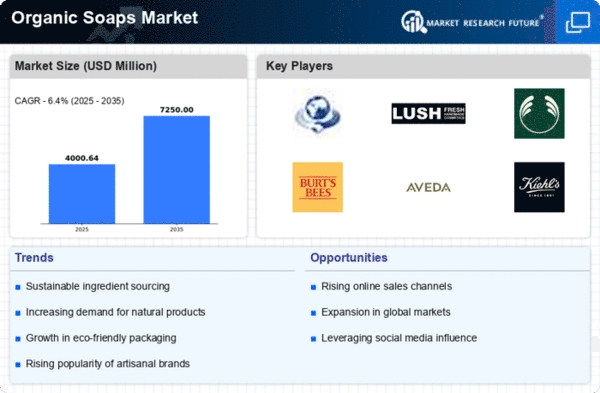
As per MRFR analysis, the Organic Soaps Market Size was estimated at 3760.0 USD Million in 2024. The Organic Soaps industry is projected to grow from 4040.0 in 2025 to 7250.0 by 2035, exhibiting a compound annual growth rate (CAGR) of 6.4 during the forecast period 2025 - 2035.

Key Market Trends & Highlights

The Organic Soaps Market is experiencing robust growth driven by eco-conscious consumer behavior and innovative product offerings.

  • The rise of eco-conscious consumers is reshaping purchasing decisions in the Organic Soaps Market, particularly in North America.
  • Innovation in formulations is leading to a diverse range of organic soap products, appealing to a broader audience.
  • Increased online presence is facilitating access to organic soaps, especially in the rapidly growing Asia-Pacific region.
  • Market drivers such as rising health awareness and sustainability concerns are propelling demand in the personal care segment, particularly for liquid soaps.

Market Size & Forecast

2024 Market Size 3760.0 (USD Million)
2035 Market Size 7250.0 (USD Million)
CAGR (2025 - 2035) 6.4%
Largest Regional Market Share in 2024 North America

Major Players

<p>Dr. Bronner's (US), Lush (GB), The Body Shop (GB), Burt's Bees (US), Aveda (US), Kahina Giving Beauty (US), Ethique (NZ), Suds & Co. (US)</p>

Market Trends

The Organic Soaps Market is currently experiencing a notable shift towards natural and eco-friendly products. Consumers are increasingly aware of the potential harmful effects of synthetic ingredients found in conventional soaps. This heightened awareness has led to a growing preference for organic alternatives, which are perceived as safer and more environmentally sustainable. As a result, manufacturers are adapting their product lines to meet this demand, often highlighting the use of organic ingredients and sustainable sourcing practices. Furthermore, the rise of e-commerce platforms has facilitated access to a wider range of organic soap products, allowing consumers to explore various brands and formulations with ease. In addition to consumer preferences, regulatory frameworks are evolving to support the growth of the Organic Soaps Market. Governments are implementing stricter guidelines regarding labeling and ingredient transparency, which encourages brands to adopt cleaner formulations. This regulatory push not only enhances consumer trust but also fosters competition among manufacturers to innovate and differentiate their offerings. As the market continues to expand, it appears poised for further growth, driven by a combination of consumer demand, regulatory support, and a broader societal shift towards sustainability and wellness.

Rise of Eco-Conscious Consumers

There is a discernible trend of consumers gravitating towards eco-friendly products, including organic soaps. This shift is largely driven by a desire to minimize environmental impact and support sustainable practices. Brands that emphasize their commitment to sustainability are likely to resonate more with this demographic.

Innovation in Formulations

The Organic Soaps Market is witnessing a wave of innovation, with manufacturers exploring unique formulations that incorporate diverse natural ingredients. This trend reflects a growing interest in personalized skincare solutions, as consumers seek products tailored to their specific needs and preferences.

Increased Online Presence

The expansion of e-commerce has significantly influenced the Organic Soaps Market. Consumers are increasingly turning to online platforms for their purchases, seeking convenience and a broader selection of organic products. This trend encourages brands to enhance their digital marketing strategies and improve online customer engagement.

Organic Soaps Market Market Drivers

E-commerce Growth

The rapid growth of e-commerce is transforming the Global Organic Soaps Market Industry. Online platforms provide consumers with easy access to a wide range of organic soap products, facilitating informed purchasing decisions. This trend is particularly relevant as consumers increasingly prefer the convenience of online shopping. The market is expected to benefit from this shift, with projections indicating a rise to 547.2 USD Million by 2035. E-commerce not only expands market reach but also allows smaller brands to compete effectively, thereby diversifying the product offerings available to consumers.

Regulatory Support

Regulatory support for organic products is a crucial driver in the Global Organic Soaps Market Industry. Governments worldwide are increasingly implementing regulations that promote the use of organic ingredients and sustainable practices in personal care products. This regulatory framework not only enhances consumer trust but also encourages manufacturers to adhere to higher standards. As a result, the market is poised for growth, with an anticipated increase to 240 USD Million in 2024. Such supportive policies may further stimulate innovation and investment in organic soap production, fostering a more robust market landscape.

Sustainability Trends

Sustainability trends play a pivotal role in shaping the Global Organic Soaps Market Industry. As environmental concerns gain traction, consumers are gravitating towards products that align with their values. Organic soaps, often packaged in biodegradable materials and free from harmful additives, resonate with eco-conscious buyers. This shift towards sustainable consumption is likely to propel the market, with projections indicating a growth to 547.2 USD Million by 2035. Companies that prioritize sustainable practices may find themselves at a competitive advantage, as consumers increasingly favor brands that demonstrate a commitment to environmental stewardship.

Rising Consumer Awareness

The Global Organic Soaps Market Industry experiences a notable surge in consumer awareness regarding the benefits of organic products. As consumers increasingly seek natural alternatives to synthetic chemicals, the demand for organic soaps is expected to rise. This trend is supported by educational campaigns and information dissemination through various media channels. In 2024, the market is projected to reach 240 USD Million, reflecting a growing preference for eco-friendly products. This heightened awareness not only drives sales but also encourages manufacturers to innovate and expand their organic product lines, thereby enhancing market growth.

Health and Wellness Movement

The ongoing health and wellness movement significantly influences the Global Organic Soaps Market Industry. Consumers are becoming more health-conscious, seeking products that promote well-being and avoid harmful chemicals. Organic soaps, known for their natural ingredients and skin-friendly properties, are gaining traction among health-oriented consumers. This trend is likely to contribute to a compound annual growth rate of 7.78% from 2025 to 2035, as more individuals prioritize their health and opt for organic alternatives. The market's expansion is indicative of a broader societal shift towards holistic health and self-care.

Market Segment Insights

By Application: Personal Care (Largest) vs. Pet Care (Fastest-Growing)

<p>The Organic Soaps Market is dominated by the Personal Care application, encompassing products such as body washes, hand soaps, and facial cleansers. This segment holds a significant share of the market, driven by increasing consumer preferences for organic and natural ingredients in daily hygiene products. In contrast, the Pet Care segment, while smaller in comparison, is rapidly gaining traction as pet owners increasingly seek eco-friendly and organic solutions for their pets' grooming needs, contributing to its growth in recent years.</p>

<p>Personal Care: Dominant vs. Pet Care: Emerging</p>

<p>The Personal Care segment of the Organic Soaps Market is characterized by its wide range of products catering to diverse consumer needs, including skin types and personal preferences. This dominant category benefits from heightened awareness about the benefits of organic ingredients, leading consumers towards safer and more sustainable choices. Meanwhile, the Pet Care segment is emerging as a notable player, fueled by an increasing humanization of pets where owners are more inclined to invest in organic grooming products that ensure the well-being of their pets. As consumers continue to prioritize health, safety, and sustainability, both these segments are poised for further development in the Organic Soaps Market.</p>

By Formulation Type: Liquid (Largest) vs. Bar (Fastest-Growing)

<p>The Organic Soaps Market demonstrates diverse formulation types, with liquid soaps commanding the largest share among consumers due to their ease of use and convenience. Bar soaps, on the other hand, are experiencing significant growth and popularity, particularly as consumers increasingly seek natural and sustainable options in their personal care routines. As a result, bar soaps are not only gaining traction among eco-conscious consumers but are also enhancing their market presence.</p>

<p>Liquid (Dominant) vs. Bar (Emerging)</p>

<p>Liquid organic soaps represent the dominant formulation in the market, favored for their versatility, quick lathering, and moisturizing properties. They appeal to a broad audience, including families and individuals looking for gentle cleansing solutions. Meanwhile, bar organic soaps have emerged as a strong alternative, particularly among health-conscious consumers pursuing sustainable lifestyles. These soaps offer unique advantages, such as longer shelf life and reduced packaging waste, aligning with the increasing demand for eco-friendly products. The shift towards natural ingredients further amplifies the appeal of bar soaps, making them a relevant choice in contemporary personal care.</p>

By Ingredient Type: Natural Oils (Largest) vs. Essential Oils (Fastest-Growing)

<p>The Organic Soaps Market showcases a diverse array of ingredient types, with natural oils commanding a significant portion of the market share. Among these ingredients, natural oils stand out due to their moisturizing properties and safe nature, making them a preferred choice for consumers. Essential oils, although currently smaller in market share compared to natural oils, are gaining rapid traction, reflecting a growing trend towards aromatherapy and holistic wellness in personal care routines. As consumer preferences shift towards natural and sustainable products, herbal extracts and botanical ingredients are also witnessing increased demand. This shift is driven by heightened awareness of chemical ingredients in personal care products and the desire for more environmentally friendly options. The growth in essential oils can be attributed to their multi-functional usage in formulations and their perceived health benefits, positioning them as the fastest-growing ingredient in the organic soaps category.</p>

<p>Natural Oils: Dominant vs. Essential Oils: Emerging</p>

<p>Natural oils are characterized by their nourishing properties and are widely utilized in organic soaps for their hydrating qualities. They enhance the skin's natural moisture barrier and are sourced from nuts, fruits, and seeds, making them appealing to consumers seeking gentle and effective skincare. In contrast, essential oils are distilled from plants and herbs, valued for their aromatic properties and therapeutic benefits. This emerging segment is rapidly gaining popularity as consumers increasingly seek products that provide not just cleansing benefits but also emotional and physical well-being through scent. The synergy between natural and essential oils in organic soap formulations offers consumers a holistic approach to skincare, balancing efficacy and sensory experience.</p>

By Distribution Channel: Online Retail (Largest) vs. Health Stores (Fastest-Growing)

<p>In the Organic Soaps Market, Online Retail holds the largest share among distribution channels, significantly driven by the surge in e-commerce and changing consumer preferences that favor online shopping. Supermarkets and pharmacies also contribute to market share, yet they lag behind in comparison to the rapid adoption of online purchasing across demographics. Alongside these, health stores maintain a solid presence, catering to a niche but dedicated consumer base seeking organic products.</p>

<p>Supermarkets: Traditional Channel (Dominant) vs. Direct Sales: Emerging Model (Emerging)</p>

<p>Supermarkets serve as the dominant distribution channel in the Organic Soaps Market, leveraging their extensive reach and established customer trust to promote organic products. They provide consumers with the convenience of accessibility and variety. However, as consumer awareness and demand for organic products grow, Direct Sales emerges as an innovative model. This channel allows businesses to engage consumers directly, providing personalized experiences and education about organic soaps. The rise in preference for in-home shopping experiences, coupled with a growing trend towards sustainable living, positions Direct Sales as an exciting emerging segment, appealing predominantly to eco-conscious consumers.</p>

By Consumer Demographics: Age Group (Largest) vs. Health Consciousness (Fastest-Growing)

<p>The Organic Soaps Market has a diverse consumer demographic composition, illustrated by a significant preference among younger consumers aged 18-35, who represent the largest share in this segment. This age group is increasingly drawn to organic products, driven by their ecological concerns and environmental awareness. Conversely, while the contribution of older age groups is notable, the younger segment has outpaced them in adopting organic soaps, indicating a shift towards sustainable consumerism that is shaping the market today. As health consciousness rises among consumers, particularly in the 25-45 age range, this segment is rapidly becoming the fastest-growing demographic in the organic soaps sector. This awareness correlates with increased demand for natural ingredients free from harmful chemicals. Additionally, economic factors, such as disposable income growth in this demographic, fuel the market's expansion as consumers actively seek healthier alternatives for personal care and wellness, propelling this segment forward in the marketplace.</p>

<p>Age Group: 18-35 (Dominant) vs. Health Consciousness (Emerging)</p>

<p>In the Organic Soaps Market, the age group of 18-35 stands out as the dominant consumer segment, characterized by their preference for environmentally friendly products and a strong inclination towards brands that promote natural ingredients. This demographic tends to prioritize product transparency and ethical sourcing, making them more likely to support brands that align with their values. On the other hand, health consciousness emerges as a rapidly growing demographic, driven by an increased awareness of health and wellness. This segment seeks products that not only provide cleansing benefits but also contribute to their overall well-being, preferring organic soaps that are devoid of synthetic compounds, thus enhancing the appeal of market offerings tailored to their needs.</p>

Get more detailed insights about Organic Soaps Market Research Report - Forecast till 2035

Regional Insights

North America : Market Leader in Organic Soaps

North America continues to lead the organic soaps market, holding a significant share of 1880.0 million. The growth is driven by increasing consumer awareness regarding the benefits of organic products, coupled with a shift towards sustainable living. Regulatory support for organic labeling and eco-friendly practices further fuels demand. The region's market is characterized by a robust retail environment and a growing preference for natural ingredients. The competitive landscape is dominated by key players such as Dr. Bronner's, Burt's Bees, and Aveda, which are well-established in the market. The U.S. is the largest contributor, with a strong inclination towards premium organic products. The presence of innovative brands and a focus on ethical sourcing are pivotal in shaping consumer preferences, ensuring a dynamic market environment.

Europe : Emerging Market for Organic Products

Europe's organic soaps market is valued at 1120.0 million, reflecting a growing trend towards eco-conscious consumerism. The region benefits from stringent regulations promoting organic certification, which enhances consumer trust. Factors such as increasing disposable income and a shift towards natural personal care products are driving market growth. The European Union's Green Deal aims to boost organic farming, further supporting the sector's expansion. Leading countries include Germany, the UK, and France, where brands like Lush and The Body Shop thrive. The competitive landscape is marked by a mix of established players and emerging brands focusing on sustainability. The presence of a diverse range of products catering to various consumer preferences ensures a vibrant market. The emphasis on ethical sourcing and transparency is reshaping the industry, making it a key player in The Organic Soaps.

Asia-Pacific : Rapidly Growing Market Potential

The Asia-Pacific organic soaps market, valued at 640.0 million, is witnessing rapid growth driven by rising health consciousness and a shift towards natural products. The increasing urban population and disposable income are significant factors contributing to this trend. Regulatory frameworks are gradually evolving to support organic certifications, enhancing consumer confidence in product quality. The region's diverse consumer base is increasingly seeking eco-friendly alternatives, propelling market expansion. Countries like Japan, Australia, and India are leading the charge, with local brands and international players like Ethique gaining traction. The competitive landscape is characterized by innovation and a focus on unique formulations. The presence of both established and emerging brands fosters a dynamic market environment, catering to the growing demand for organic personal care products.

Middle East and Africa : Niche Market with Growth Potential

The Middle East and Africa organic soaps market, valued at 120.0 million, is still in its nascent stages but shows promising growth potential. Increasing awareness of health and wellness, along with a rising trend towards natural products, is driving demand. Regulatory bodies are beginning to recognize the importance of organic certifications, which is expected to enhance market credibility. The region's unique cultural preferences also influence product offerings, creating opportunities for niche markets. Countries like South Africa and the UAE are at the forefront, with a growing number of local brands emerging. The competitive landscape is evolving, with both local artisans and international brands vying for market share. The increasing availability of organic products in retail and online platforms is expected to further stimulate growth, making this region an attractive market for investment.

Key Players and Competitive Insights

The Organic Soaps Market is currently characterized by a dynamic competitive landscape, driven by increasing consumer demand for sustainable and eco-friendly products. Key players are strategically positioning themselves through innovation, regional expansion, and partnerships, which collectively shape the market's competitive environment. Companies such as Dr. Bronner's (US), Lush (GB), and The Body Shop (GB) are at the forefront, leveraging their brand equity and commitment to ethical sourcing to capture market share. Their operational focus on transparency and sustainability resonates with a growing demographic of environmentally conscious consumers, thereby enhancing their competitive edge.

In terms of business tactics, companies are increasingly localizing manufacturing to reduce carbon footprints and optimize supply chains. The market appears moderately fragmented, with a mix of established brands and emerging players vying for consumer attention. This competitive structure allows for diverse product offerings, yet the influence of key players remains substantial, as they set industry standards and consumer expectations.

In November 2025, Lush (GB) announced the launch of a new line of organic soaps that utilize locally sourced ingredients, emphasizing their commitment to sustainability. This strategic move not only enhances their product portfolio but also strengthens their brand narrative around environmental responsibility. By focusing on local sourcing, Lush aims to reduce transportation emissions and support local economies, which could potentially resonate well with their target market.

In October 2025, Dr. Bronner's (US) unveiled a partnership with a non-profit organization aimed at promoting fair trade practices in the soap industry. This collaboration underscores the company's dedication to ethical sourcing and social responsibility. By aligning with a reputable non-profit, Dr. Bronner's enhances its credibility and reinforces its position as a leader in the organic soap segment, appealing to consumers who prioritize ethical consumption.

In September 2025, The Body Shop (GB) launched an innovative digital platform that allows consumers to customize their organic soap products. This initiative reflects a broader trend towards personalization in consumer goods, enabling The Body Shop to engage customers more deeply and foster brand loyalty. The integration of technology into their product offerings may serve to differentiate them in a crowded market, potentially attracting a younger demographic that values customization.

As of December 2025, the Organic Soaps Market is witnessing trends such as digitalization, sustainability, and the integration of AI in product development and marketing strategies. Strategic alliances are increasingly shaping the competitive landscape, allowing companies to pool resources and expertise. Looking ahead, competitive differentiation is likely to evolve from traditional price-based competition to a focus on innovation, technology, and supply chain reliability. This shift suggests that companies that prioritize sustainable practices and technological advancements may emerge as leaders in the market.

Key Companies in the Organic Soaps Market market include

Industry Developments

Future Outlook

Organic Soaps Market Future Outlook

<p>The Organic Soaps Market is projected to grow at a 6.4% CAGR from 2024 to 2035, driven by increasing consumer demand for natural products and sustainability.</p>

New opportunities lie in:

  • <p>Expansion into e-commerce platforms for direct consumer sales.</p>
  • <p>Development of subscription-based delivery services for organic soap products.</p>
  • <p>Collaboration with eco-friendly brands for co-branded product lines.</p>

<p>By 2035, the Organic Soaps Market is expected to solidify its position as a leader in sustainable personal care.</p>

Market Segmentation

Organic Soaps Market Application Outlook

  • Personal Care
  • Household Cleaning
  • Therapeutic
  • Cosmetic
  • Pet Care

Organic Soaps Market Ingredient Type Outlook

  • Natural Oils
  • Herbal Extracts
  • Essential Oils
  • Botanical Ingredients
  • Organic Surfactants

Organic Soaps Market Formulation Type Outlook

  • Liquid
  • Bar
  • Foam
  • Gel
  • Powder

Organic Soaps Market Distribution Channel Outlook

  • Online Retail
  • Supermarkets
  • Health Stores
  • Pharmacies
  • Direct Sales

Organic Soaps Market Consumer Demographics Outlook

  • Age Group
  • Gender
  • Income Level
  • Lifestyle
  • Health Consciousness

Report Scope

MARKET SIZE 20243760.0(USD Million)
MARKET SIZE 20254040.0(USD Million)
MARKET SIZE 20357250.0(USD Million)
COMPOUND ANNUAL GROWTH RATE (CAGR)6.4% (2024 - 2035)
REPORT COVERAGERevenue Forecast, Competitive Landscape, Growth Factors, and Trends
BASE YEAR2024
Market Forecast Period2025 - 2035
Historical Data2019 - 2024
Market Forecast UnitsUSD Million
Key Companies ProfiledDr. Bronner's (US), Lush (GB), The Body Shop (GB), Burt's Bees (US), Aveda (US), Kahina Giving Beauty (US), Ethique (NZ), Suds & Co. (US)
Segments CoveredApplication, Formulation Type, Ingredient Type, Distribution Channel, Consumer Demographics
Key Market OpportunitiesGrowing consumer preference for sustainable and natural ingredients in the Organic Soaps Market.
Key Market DynamicsRising consumer preference for natural ingredients drives innovation and competition in the organic soaps market.

Countries CoveredNorth America, Europe, APAC, South America, MEA

FAQs

Who are the top players in the global organic soaps market?

Unilever plc (UK), Osmia Organics (US), Lush (UK), Oregon Soap Company (US), EO Products (US), Pangea Organics, Inc. (US), Rocky Mountain Soap Company Inc.(Canada), Brittanies Thyme (US), Neal's Yard (Natural Remedies) Limited (UK), and Khadi Natural (India) are some of the top players in the global organic soaps market.

What would be the organic soaps market CAGR during the forecast period (2020-2027)?

Organic soaps market CAGR would be 8.2% during the forecast period.

How much is the global organic soaps market worth in the future?

Organic soaps market is estimated to reach a valuation of approx. USD 432 million by the end of 2032.

Which region holds the largest share in the global organic soaps industry?

North America holds the largest share in the global organic soaps industry.

  1. EXECUTIVE SUMMARY
  2. MARKET INTRODUCTION
    1. Market Definition
    2. Scope of the Study
    3. Research Objectives
    4. Assumptions & Limitations
    5. Market Structure
  3. MARKET RESEARCH METHODOLOGY
    1. Research Process
    2. Secondary Research
    3. Primary Research
    4. Forecast Model
  4. MARKET FACTOR ANALYSIS
    1. Supply Chain Analysis
      1. Raw Material Suppliers
      2. Manufacturers/Producers
      3. Distributors/Retailers/Wholesalers/E-Commerce
      4. End Users
    2. Porter’s Five
      1. Bargaining Power of Suppliers
      2. Threat of Substitutes
      3. Rivalry
    3. Forces Analysis
    4. Threat of New Entrants
    5. Bargaining Power of Buyers
    6. Impact of COVID-19 Outbreak on the Global Organic
      1. Impact on Pricing
      2. Impact on Store-Based VS Non-Store-Based Sales
      3. Others
    7. Soaps Market
    8. Impact on Production
    9. Impact on Consumer Buying Behavior
  5. MARKET DYNAMICS
    1. Introduction
    2. Drivers
    3. Restraints
    4. Opportunities
    5. Challenges
  6. GLOBAL ORGANIC SOAPS
  7. MARKET, BY FORM
    1. Introduction
    2. Liquid
    3. Market Estimates & Forecast, 2024-2032
    4. Bar
    5. Market Estimates & Forecast, 2024-2032
    6. Paper
    7. Market Estimates & Forecast, 2024-2032
  8. Market Estimates & Forecast, by Region,
  9. Market Estimates & Forecast, by Region,
  10. Market Estimates & Forecast, by Region,
  11. GLOBAL ORGANIC SOAPS MARKET, BY DISTRIBUTION CHANNEL
    1. Introduction
    2. Store-Based
      1. Market Estimates & Forecast, 2024-2032
      2. Market Estimates
      3. Supermarkets&Hypermarkets
      4. Convenience Stores
      5. Others
    3. & Forecast, by Region, 2024-2032
    4. & Forecast, by Region, 2024-2032
    5. & Forecast, by Region, 2024-2032
    6. & Forecast, by Region, 2024-2032
    7. Non-Store-Based
      1. Market Estimates & Forecast, 2024-2032
      2. Market Estimates
    8. & Forecast, by Region, 2024-2032
  12. GLOBAL ORGANIC SOAPS MARKET, BY REGION
    1. Introduction
    2. North America
      1. Market Estimates
      2. Market Estimates & Forecast, by Form, 2024-2032
      3. Market Estimates
      4. Market Estimates & Forecast, by Country,
    3. & Forecast, 2024-2032
    4. & Forecast, by Distribution Channel, 2024-2032
    5. US
  13. Market Estimates & Forecast, by Form, 2024-2032
    1. Channel, 2024-2032
    2. Canada
  14. Market Estimates & Forecast, by Distribution
  15. Market Estimates & Forecast, by Form, 2024-2032
    1. Channel, 2024-2032
    2. Mexico
  16. Market Estimates & Forecast, by Distribution
  17. Market Estimates & Forecast, by Form, 2024-2032
    1. Channel, 2024-2032
    2. Europe
    3. Market Estimates & Forecast, 2024-2032
  18. Market Estimates & Forecast, by Distribution
  19. Market Estimates & Forecast, by Form,
  20. Market Estimates & Forecast, by Distribution Channel, 2024-2032
    1. Forecast, by Country, 2024-2032
    2. & Forecast, by Distribution Channel, 2024-2032
    3. & Forecast, by Distribution Channel, 2024-2032
  21. Market Estimates &
  22. Germany
  23. Market Estimates & Forecast, by Form, 2024-2032
  24. Market Estimates
  25. UK
  26. Market Estimates & Forecast, by Form, 2024-2032
  27. Market Estimates
  28. France
  29. Market Estimates & Forecast, by Form,
  30. Market Estimates & Forecast, by Distribution Channel, 2024-2032
    1. Forecast, by Form, 2024-2032
    2. Italy
  31. Spain
  32. Market Estimates &
  33. Market Estimates & Forecast, by Distribution Channel,
  34. Market Estimates & Forecast, by Form, 2024-2032
    1. Channel, 2024-2032
    2. Rest of Europe
  35. Market Estimates & Forecast, by Distribution
  36. Market Estimates & Forecast, by Form, 2024-2032
    1. Channel, 2024-2032
    2. Asia-Pacific
    3. Market Estimates & Forecast, 2024-2032
  37. Market Estimates & Forecast, by Distribution
  38. Market Estimates & Forecast, by Form,
  39. Market Estimates & Forecast, by Distribution Channel, 2024-2032
    1. Forecast, by Country, 2024-2032
    2. & Forecast, by Distribution Channel, 2024-2032
  40. Market Estimates &
  41. China
  42. Market Estimates & Forecast, by Form, 2024-2032
  43. Market Estimates
  44. Japan
  45. Market Estimates & Forecast, by Form,
  46. Market Estimates & Forecast, by Distribution Channel, 2024-2032
    1. Forecast, by Form, 2024-2032
    2. Australia & New Zealand
    3. & Forecast, by Distribution Channel, 2024-2032
  47. India
  48. Market Estimates &
  49. Market Estimates & Forecast, by Distribution Channel,
  50. Market Estimates & Forecast, by Form, 2024-2032
  51. Market Estimates
  52. Rest of Asia-Pacific
  53. Market Estimates & Forecast, by Form,
  54. Market Estimates & Forecast, by Distribution Channel, 2024-2032
    1. Rest of the World
      1. Market Estimates
      2. Market Estimates & Forecast, by Form, 2024-2032
      3. Market Estimates
      4. Market Estimates & Forecast, by Region,
    2. & Forecast, 2024-2032
    3. & Forecast, by Distribution Channel, 2024-2032
    4. South America
  55. Market Estimates & Forecast, by Form, 2024-2032
    1. Channel, 2024-2032
    2. Middle East
  56. Market Estimates & Forecast, by Distribution
  57. Market Estimates & Forecast, by Form, 2024-2032
    1. Channel, 2024-2032
    2. Africa
  58. Market Estimates & Forecast, by Distribution
  59. Market Estimates & Forecast, by Form, 2024-2032
    1. Channel, 2024-2032
  60. Market Estimates & Forecast, by Distribution
  61. COMPETITIVE LANDSCAPE
    1. Introduction
    2. Market Strategy
    3. Key Development Analysis
    4. (Expansions/Mergers & Acquisitions/Joint Ventures/New Product Developments/Agreements/Investments)
  62. COMPANY PROFILES
    1. Unilever plc
      1. Company Overview
      2. Financial Updates
      3. Product/Business
      4. Strategies
      5. Key Developments
      6. SWOT Analysis
    2. Segment Overview
    3. Strategies
    4. Key Developments
    5. SWOT Analysis
    6. Osmia Organics
    7. Company Overview
    8. Financial Updates
    9. Product/Business Segment Overview
    10. Lush
      1. Company Overview
      2. Financial Updates
      3. Product/Business Segment Overview
      4. Strategies
      5. Key Developments
      6. SWOT Analysis
    11. Oregon Soap Company
      1. Company Overview
      2. Financial Updates
      3. Product/Business
      4. Strategies
      5. Key Developments
      6. SWOT Analysis
    12. Segment Overview
    13. Strategies
    14. Key Developments
    15. SWOT Analysis
    16. EO Products
    17. Company Overview
    18. Financial Updates
    19. Product/Business Segment Overview
    20. Pangea Organics, Inc.
      1. Company Overview
      2. Financial Updates
      3. Product/Business Segment Overview
      4. Strategies
      5. Key Developments
      6. SWOT Analysis
    21. Rocky Mountain
      1. Strategies
      2. Key Developments
      3. SWOT Analysis
    22. Soap Company Inc.
    23. Company Overview
    24. Financial Updates
    25. Product/Business Segment Overview
    26. Brittanies Thyme
      1. Company Overview
      2. Financial Updates
      3. Product/Business Segment Overview
      4. Strategies
      5. Key Developments
      6. SWOT Analysis
    27. Neal''s Yard (Natural
      1. Strategies
      2. Key Developments
      3. SWOT Analysis
    28. Remedies) Limited
    29. Company Overview
    30. Financial Updates
    31. Product/Business Segment Overview
    32. Khadi Natural
      1. Company Overview
      2. Financial Updates
      3. Product/Business Segment Overview
      4. Strategies
      5. Key Developments
      6. SWOT Analysis
  63. CONCLUSION
  64. LIST OF TABLES
  65. Global
  66. Organic Soaps Market, by Region, 2024–2032 (USD Million)
  67. Global Organic Soaps
  68. Market, by Form, 2024–2032 (USD Million)
  69. Global Organic Soaps Market, by Distribution
    1. Channel, 2024–2032 (USD Million)
  70. North America: Organic Soaps Market, by Country,
  71. North America: Organic Soaps Market, by Form, 2024–2032
    1. (USD Million)
    2. TABLE
  72. North America: Organic Soaps Market, by Distribution Channel, 2024–2032
    1. (USD Million)
    2. TABLE
  73. US: Organic Soaps Market, by Form, 2024–2032 (USD Million)
  74. US: Organic Soaps Market,
    1. by Distribution Channel, 2024–2032 (USD Million)
  75. TABLE 9Canada: Organic Soaps Market, by Form, 2024–2032
    1. (USD Million)
    2. TABLE
  76. 10Canada: Organic Soaps Market, by Distribution Channel, 2024–2032 (USD Million)
    1. TABLE 11Mexico: Organic
  77. Soaps Market, by Form, 2024–2032 (USD Million)
  78. TABLE 12Mexico: Organic Soaps Market, by Distribution
    1. Channel, 2024–2032 (USD Million)
  79. Europe: Organic Soaps Market, by Country, 2024–2032
    1. (USD Million)
    2. TABLE
  80. Europe: Organic Soaps Market, by Form, 2024–2032 (USD Million)
  81. Europe: Organic
  82. Soaps Market, by Distribution Channel, 2024–2032 (USD Million)
    1. TABLE 16Germany: Organic Soaps
  83. Market, by Form, 2024–2032 (USD Million)
  84. TABLE 17Germany: Organic Soaps Market, by Distribution
    1. Channel, 2024–2032 (USD Million)
  85. TABLE 18France: Organic Soaps Market, by Form, 2024–2032
    1. (USD Million)
    2. TABLE
  86. 19France: Organic Soaps Market, by Distribution Channel, 2024–2032 (USD Million)
    1. TABLE 20Italy: Organic
  87. Soaps Market, by Form, 2024–2032 (USD Million)
  88. TABLE 21Italy: Organic Soaps Market, by Distribution
    1. Channel, 2024–2032 (USD Million)
  89. TABLE 22Spain: Organic Soaps Market, by Form, 2024–2032
    1. (USD Million)
    2. TABLE
  90. 23Spain: Organic Soaps Market, by Distribution Channel, 2024–2032 (USD Million)
    1. TABLE 24UK: Organic Soaps
  91. Market, by Form, 2024–2032 (USD Million)
  92. TABLE 25UK: Organic Soaps Market, by Distribution
    1. Channel, 2024–2032 (USD Million)
  93. TABLE 26Rest of Europe: Organic Soaps Market, by Form, 2024–2032
    1. (USD Million)
    2. TABLE
  94. 27Rest of Europe: Organic Soaps Market, by Distribution Channel, 2024–2032
    1. (USD Million)
    2. TABLE
  95. Asia-Pacific: Organic Soaps Market, by Country, 2024–2032 (USD Million)
  96. Asia-Pacific:
  97. Organic Soaps Market, by Form, 2024–2032 (USD Million)
  98. Asia-Pacific: Organic Soaps Market, by Distribution
    1. Channel, 2024–2032 (USD Million)
  99. TABLE 31China: Organic Soaps Market, by Form, 2024–2032
    1. (USD Million)
    2. TABLE32China:
  100. Organic Soaps Market, by Distribution Channel, 2024–2032 (USD Million)
    1. TABLE 33India: Organic
  101. Soaps Market, by Form, 2024–2032 (USD Million)
  102. TABLE 34India: Organic Soaps Market, by Distribution
    1. Channel, 2024–2032 (USD Million)
  103. TABLE 35Japan: Organic Soaps Market, by Form, 2024–2032
    1. (USD Million)
    2. TABLE
  104. 36Japan: Organic Soaps Market, by Distribution Channel, 2024–2032 (USD Million)
    1. TABLE 37Rest of Asia-Pacific:
  105. Organic Soaps Market, by Form, 2024–2032 (USD Million)
    1. TABLE 38Rest of Asia-Pacific: Organic Soaps Market,
    2. by Distribution Channel, 2024–2032 (USD Million)
  106. Rest of the World (RoW): Organic Soaps Market,
    1. by Region, 2024–2032 (USD Million)
    2. TABLE 40Rest of the World (RoW): Organic Soaps Market, by
    3. Form, 2024–2032 (USD Million)
    4. TABLE 41Rest of the World (RoW): Organic Soaps Market, by
    5. Distribution Channel, 2024–2032 (USD Million)
  107. TABLE 42South America: Organic Soaps Market, by Form,
  108. TABLE 43South America: Organic Soaps Market, by Distribution Channel,
  109. TABLE 44Middle East: Organic Soaps Market, by Form, 2024–2032
    1. (USD Million)
    2. TABLE
  110. 45Middle East: Organic Soaps Market, by Distribution Channel, 2024–2032 (USD
    1. Million)
    2. TABLE
  111. 46Africa: Organic Soaps Market, by Form, 2024–2032 (USD Million)
    1. TABLE 47Africa: Organic
  112. Soaps Market, by Distribution Channel, 2024–2032 (USD Million)
  113. LIST OF FIGURES
  114. Global Organic
    1. Soaps Market Segmentation
  115. Forecast Research Methodology
  116. Five Forces Analysis of the Global Organic
    1. Soaps Market
    2. FIGURE
  117. Value Chain of the Global Organic Soaps Market
  118. Share of the Global Organic Soaps Market
    1. in 2024, by Country (%)
  119. Global Organic Soaps Market, by Region, 2024–2032
  120. Global Organic
  121. Soaps Market Size, by Form, 2024
  122. Share of the Global Organic Soaps Market, by Form, 2024–2032
    1. (%)
    2. FIGURE
  123. Global Organic Soaps Market Size, by Distribution Channel, 2024
  124. Share of the Global
  125. Organic Soaps Market, by Distribution Channel, 2024–2032(%)

Organic Soaps Market Segmentation

Market Segmentation Overview

  • Detailed segmentation data will be available in the full report
  • Comprehensive analysis by multiple parameters
  • Regional and country-level breakdowns
  • Market size forecasts by segment
Infographic

Free Sample Request

Kindly complete the form below to receive a free sample of this Report

Get Free Sample

Customer Strories

Compare Licence

×
Features License Type
Single User Multiuser License Enterprise User
Price $4,950 $5,950 $7,250
Maximum User Access Limit 1 User Upto 10 Users Unrestricted Access Throughout the Organization
Free Customization
Direct Access to Analyst
Deliverable Format
Platform Access
Discount on Next Purchase 10% 15% 15%
Printable Versions