Download Free Sample
Kindly complete the form below to receive a free sample of this Report
Organic Soaps Market Size, Share, Industry Trend & Analysis Research Report Information by Form (Liquid, Bar, Paper), Distribution Channel (Store-Based {Supermarkets & Hypermarkets, Convenience Stores, and Others} and Non-Store-Based), and Region (North America, Europe, Asia-Pacific, and Rest of the World) - Forecast till 2035
As per MRFR analysis, the Organic Soaps Market Size was estimated at 3760.0 USD Million in 2024. The Organic Soaps industry is projected to grow from 4040.0 in 2025 to 7250.0 by 2035, exhibiting a compound annual growth rate (CAGR) of 6.4% during the forecast period 2025 - 2035.
The Organic Soaps Market is experiencing a robust growth trajectory driven by sustainability and consumer preferences.
| 2024 Market Size | 3760.0 (USD Million) |
| 2035 Market Size | 7250.0 (USD Million) |
| CAGR (2025 - 2035) | 6.4% |
Dr. Bronner's (US), Lush (GB), The Body Shop (GB), Burt's Bees (US), Aveda (US), Kiehl's (US), Weleda (DE), Puracy (US), Alba Botanica (US)
Our Impact
Enabled $4.3B Revenue Impact for Fortune 500 and Leading Multinationals
Partnering with 2000+ Global Organizations Each Year
30K+ Citations by Top-Tier Firms in the Industry
The Organic Soaps Market is currently experiencing a notable transformation, driven by a growing consumer preference for natural and eco-friendly products. This shift is largely influenced by heightened awareness regarding the adverse effects of synthetic ingredients on health and the environment. As consumers increasingly seek transparency in product formulations, brands are responding by emphasizing organic certifications and sustainable sourcing practices. This trend appears to be fostering a more informed customer base that values ethical consumption, thereby reshaping purchasing behaviors across various demographics. Moreover, the Organic Soaps Market is witnessing innovation in product offerings, with manufacturers exploring diverse formulations that cater to specific skin types and concerns. The rise of artisanal and handcrafted soaps is indicative of a broader movement towards personalized skincare solutions. Additionally, the integration of unique botanical ingredients and essential oils is enhancing the sensory experience of using organic soaps, appealing to consumers' desire for luxury and self-care. As the market evolves, it seems poised for continued growth, driven by both consumer demand and a commitment to sustainability.
The Organic Soaps Market is increasingly characterized by a commitment to sustainability. Brands are prioritizing eco-friendly packaging and sourcing practices, which resonate with environmentally conscious consumers. This trend reflects a broader societal shift towards reducing waste and promoting responsible consumption.
There is a growing trend towards the personalization of organic soap products. Consumers are seeking formulations tailored to their specific skin needs, leading to an increase in niche products that address various skin concerns. This trend highlights the importance of individual preferences in the market.
The Organic Soaps Market is witnessing a surge in artisanal brands that emphasize handcrafted quality and unique ingredients. These brands often appeal to consumers looking for authenticity and a connection to the production process, differentiating themselves from mass-produced alternatives.
The rapid growth of e-commerce is transforming the Global Organic Soaps Market Industry. Online platforms provide consumers with easy access to a wide range of organic soap products, facilitating informed purchasing decisions. This trend is particularly relevant as consumers increasingly prefer the convenience of online shopping. The market is expected to benefit from this shift, with projections indicating a rise to 547.2 USD Million by 2035. E-commerce not only expands market reach but also allows smaller brands to compete effectively, thereby diversifying the product offerings available to consumers.
Regulatory support for organic products is a crucial driver in the Global Organic Soaps Market Industry. Governments worldwide are increasingly implementing regulations that promote the use of organic ingredients and sustainable practices in personal care products. This regulatory framework not only enhances consumer trust but also encourages manufacturers to adhere to higher standards. As a result, the market is poised for growth, with an anticipated increase to 240 USD Million in 2024. Such supportive policies may further stimulate innovation and investment in organic soap production, fostering a more robust market landscape.
Sustainability trends play a pivotal role in shaping the Global Organic Soaps Market Industry. As environmental concerns gain traction, consumers are gravitating towards products that align with their values. Organic soaps, often packaged in biodegradable materials and free from harmful additives, resonate with eco-conscious buyers. This shift towards sustainable consumption is likely to propel the market, with projections indicating a growth to 547.2 USD Million by 2035. Companies that prioritize sustainable practices may find themselves at a competitive advantage, as consumers increasingly favor brands that demonstrate a commitment to environmental stewardship.
The Global Organic Soaps Market Industry experiences a notable surge in consumer awareness regarding the benefits of organic products. As consumers increasingly seek natural alternatives to synthetic chemicals, the demand for organic soaps is expected to rise. This trend is supported by educational campaigns and information dissemination through various media channels. In 2024, the market is projected to reach 240 USD Million, reflecting a growing preference for eco-friendly products. This heightened awareness not only drives sales but also encourages manufacturers to innovate and expand their organic product lines, thereby enhancing market growth.
The ongoing health and wellness movement significantly influences the Global Organic Soaps Market Industry. Consumers are becoming more health-conscious, seeking products that promote well-being and avoid harmful chemicals. Organic soaps, known for their natural ingredients and skin-friendly properties, are gaining traction among health-oriented consumers. This trend is likely to contribute to a compound annual growth rate of 7.78% from 2025 to 2035, as more individuals prioritize their health and opt for organic alternatives. The market's expansion is indicative of a broader societal shift towards holistic health and self-care.
The Organic Soaps Market is dominated by the Personal Care application, encompassing products such as body washes, hand soaps, and facial cleansers. This segment holds a significant share of the market, driven by increasing consumer preferences for organic and natural ingredients in daily hygiene products. In contrast, the Pet Care segment, while smaller in comparison, is rapidly gaining traction as pet owners increasingly seek eco-friendly and organic solutions for their pets' grooming needs, contributing to its growth in recent years.
Personal Care: Dominant vs. Pet Care: Emerging
The Personal Care segment of the Organic Soaps Market is characterized by its wide range of products catering to diverse consumer needs, including skin types and personal preferences. This dominant category benefits from heightened awareness about the benefits of organic ingredients, leading consumers towards safer and more sustainable choices. Meanwhile, the Pet Care segment is emerging as a notable player, fueled by an increasing humanization of pets where owners are more inclined to invest in organic grooming products that ensure the well-being of their pets. As consumers continue to prioritize health, safety, and sustainability, both these segments are poised for further development in the Organic Soaps Market.
The Organic Soaps Market is characterized by a diverse range of formulation types, with the Liquid formulation holding the largest market share. This segment appeals to consumers for its ease of use and versatility, making it a preferred choice for everyday bathing and washing needs. Bar soaps, while traditionally popular, are experiencing a resurgence as consumers gravitate towards sustainable and eco-friendly products, thereby positioning themselves as the fastest-growing segment in this market. The growth trends in the formulation type segment are driven by changing consumer preferences towards natural ingredients and sustainable practices. Liquid soaps are favored for their convenience, but bar soaps are becoming increasingly sought after due to their minimal packaging and reduced environmental impact. The rise of formulations that cater to specific skin concerns and the growing popularity of artisanal and handcrafted soaps further influence the growth trajectory of both segments, offering consumers a more personalized approach to organic skincare.
Liquid (Dominant) vs. Bar (Emerging)
The Liquid formulation of organic soaps is well-established in the market, known for its convenience and efficacy. It tends to be favored by families and individuals seeking easy-to-use solutions for cleansing and moisturizing. Liquid soaps often come enriched with essential oils and organic extracts, enhancing their appeal in the organic segment. In contrast, Bar soaps are showing promising growth as consumers seek sustainable options with less packaging. This emerging segment is characterized by its artisanal production methods and diverse scents, catering to niche markets that prioritize eco-friendliness and skin health. Together, these segments showcase a dynamic shift in consumer behavior, reflecting a balance between convenience and sustainability in organic personal care.
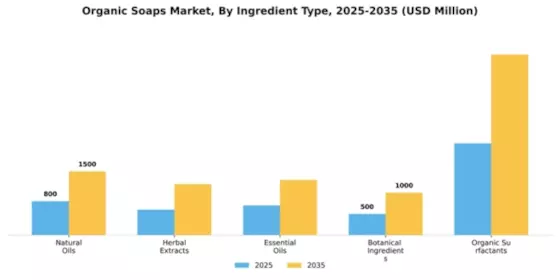
The ingredient type segment in the organic soaps market is diverse, with natural oils holding the largest share. Popular choices like coconut, olive, and almond oils are favored for their moisturizing properties, appealing to health-conscious consumers. Essential oils are rapidly gaining traction, attributed to their therapeutic benefits and aromatic qualities, making them an integral component in premium organic soap formulations.
Natural Oils (Dominant) vs. Essential Oils (Emerging)
Natural oils serve as the dominant ingredient in the organic soaps market, favored for their nourishing properties and skin compatibility. They provide a hydrating base, attracting consumers who prioritize natural ingredients. In contrast, essential oils are an emerging trend, appealing to consumers seeking natural fragrances and therapeutic benefits. Their rapid growth is driven by increasing consumer awareness of holistic health and the benefits of aromatherapy, pushing brands to innovate with unique essential oil blends that enhance product appeal.
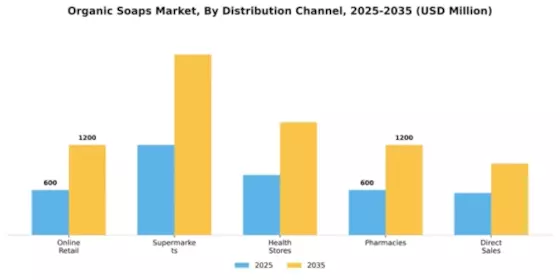
In the Organic Soaps Market, Online Retail holds the largest share among distribution channels, significantly driven by the surge in e-commerce and changing consumer preferences that favor online shopping. Supermarkets and pharmacies also contribute to market share, yet they lag behind in comparison to the rapid adoption of online purchasing across demographics. Alongside these, health stores maintain a solid presence, catering to a niche but dedicated consumer base seeking organic products.
Supermarkets: Traditional Channel (Dominant) vs. Direct Sales: Emerging Model (Emerging)
Supermarkets serve as the dominant distribution channel in the Organic Soaps Market, leveraging their extensive reach and established customer trust to promote organic products. They provide consumers with the convenience of accessibility and variety. However, as consumer awareness and demand for organic products grow, Direct Sales emerges as an innovative model. This channel allows businesses to engage consumers directly, providing personalized experiences and education about organic soaps. The rise in preference for in-home shopping experiences, coupled with a growing trend towards sustainable living, positions Direct Sales as an exciting emerging segment, appealing predominantly to eco-conscious consumers.
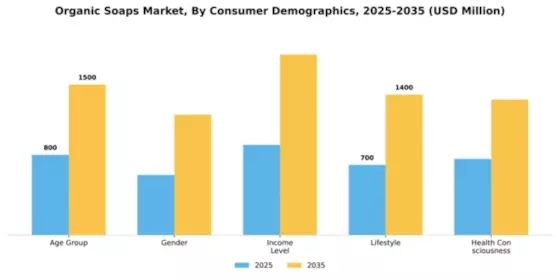
In the Organic Soaps Market, the age group segment demonstrates significant market share distribution, with millennials representing the largest demographic. This group, predominantly aged between 25-40 years, shows a strong inclination towards environmentally friendly products, making them key consumers of organic soaps. Moreover, the increasing awareness among older age groups about the benefits of organic ingredients is solidifying their presence in the market as well. As health consciousness grows across various age groups, brands are positioning themselves to appeal to this demographic through targeted marketing campaigns.
Health Consciousness: Millennials (Dominant) vs. Gen Z (Emerging)
In the Organic Soaps Market, millennials are identified as dominant players due to their elevated health consciousness, often seeking products with natural ingredients that align with their lifestyle choices. They prefer organic soaps that not only cleanse but also nurture the skin without harmful chemicals. On the other hand, Gen Z, while still emerging, are rapidly becoming significant consumers of organic soaps. This group values authenticity and sustainability, influencing brands to adapt their offerings. With their staunch advocacy for eco-friendly products, they are driving growth in this segment, compelling companies to innovate and adopt more sustainable practices.
Get more detailed insights about Organic Soaps Market Request Free Sample
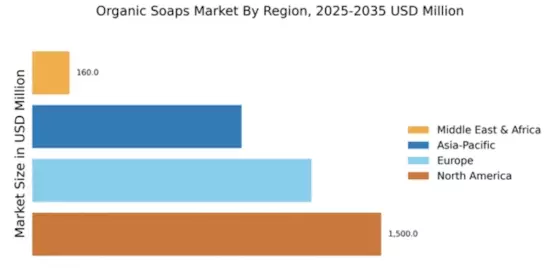
North America continues to lead the organic soaps market, holding a significant share of 1500.0 million in 2024. The growth is driven by increasing consumer awareness regarding natural ingredients and sustainability. Regulatory support for organic products further fuels demand, as consumers seek eco-friendly alternatives. The region's robust retail infrastructure and e-commerce platforms also contribute to market expansion, making organic soaps more accessible to a wider audience. The competitive landscape in North America is characterized by key players such as Dr. Bronner's, Burt's Bees, and Aveda, who are known for their commitment to quality and sustainability. The presence of these brands, along with a growing number of niche players, enhances market dynamics. The U.S. remains the largest market, with Canada also showing promising growth in organic soap consumption, reflecting a shift towards healthier personal care products.
Europe's organic soaps market is valued at 1200.0 million, reflecting a growing trend towards natural and organic personal care products. Factors such as stringent regulations on chemical ingredients and increasing consumer preference for sustainable products are driving this growth. The European Union's commitment to environmental sustainability and health regulations further supports the organic market, encouraging brands to innovate and comply with eco-friendly standards. Leading countries in this region include Germany, the UK, and France, where brands like Lush and The Body Shop are prominent. The competitive landscape is vibrant, with both established and emerging brands focusing on organic formulations. The presence of regulatory bodies ensures that products meet high safety and quality standards, fostering consumer trust and driving market growth.
The Asia-Pacific region, valued at 900.0 million, is witnessing a rapid increase in demand for organic soaps, driven by rising disposable incomes and changing consumer preferences. The growing awareness of health and wellness, coupled with a shift towards natural ingredients, is propelling market growth. Regulatory frameworks in countries like Japan and Australia are also evolving to support organic product standards, enhancing consumer confidence in these products. Key players in this region include local brands and international companies expanding their footprint. Countries like Japan, Australia, and India are leading the charge, with a mix of traditional and modern retail channels facilitating access to organic soaps. The competitive landscape is becoming increasingly dynamic, with brands focusing on unique formulations and sustainable practices to capture market share.
The Middle East and Africa region, with a market size of 160.0 million, is gradually developing an interest in organic soaps. Factors such as increasing health consciousness and a growing middle class are contributing to this trend. Regulatory bodies are beginning to recognize the importance of organic products, which is expected to catalyze market growth. The region's unique cultural preferences also influence the types of organic soaps that gain popularity, with a focus on natural ingredients and traditional formulations. Countries like South Africa and the UAE are at the forefront of this emerging market, with local brands and international players vying for consumer attention. The competitive landscape is still in its infancy, but there is a noticeable shift towards organic offerings as consumers seek healthier alternatives. As awareness grows, the market is poised for significant expansion in the coming years.
The Organic Soaps Market is currently characterized by a dynamic competitive landscape, driven by increasing consumer demand for natural and sustainable products. Key players are strategically positioning themselves through innovation, regional expansion, and partnerships, which collectively shape the market's competitive environment. Notably, Dr. Bronner's (US) emphasizes ethical sourcing and fair trade practices, while Lush (GB) focuses on product innovation and sustainability, leveraging its strong brand identity to attract eco-conscious consumers. The Body Shop (GB) has been enhancing its digital presence, aiming to reach a broader audience, whereas Burt's Bees (US) continues to expand its product line with a focus on natural ingredients, appealing to health-conscious consumers.In terms of business tactics, companies are increasingly localizing manufacturing to reduce carbon footprints and optimize supply chains. The market appears moderately fragmented, with several key players exerting influence through their unique value propositions. This competitive structure allows for a diverse range of products, catering to various consumer preferences and enhancing market resilience.
In November Lush (GB) announced the launch of a new line of organic soaps that utilize locally sourced ingredients, reflecting its commitment to sustainability and community support. This strategic move not only strengthens Lush's brand image but also aligns with the growing consumer preference for locally produced goods, potentially increasing customer loyalty and market share.
In October Burt's Bees (US) unveiled a partnership with a leading organic farming cooperative to enhance its supply chain transparency and sustainability efforts. This collaboration is likely to bolster Burt's Bees' reputation as a leader in natural products, while also ensuring a consistent supply of high-quality ingredients, which is crucial in maintaining product integrity and consumer trust.
In September The Body Shop (GB) launched an innovative digital platform that allows consumers to customize their organic soap products. This initiative not only enhances customer engagement but also positions The Body Shop at the forefront of digital transformation in the beauty sector, potentially attracting a younger demographic that values personalization and technology.
As of December the Organic Soaps Market is witnessing trends such as digitalization, sustainability, and the integration of AI technologies. Strategic alliances among companies are increasingly shaping the competitive landscape, fostering innovation and collaboration. The shift from price-based competition to a focus on innovation, technology, and supply chain reliability is evident, suggesting that future differentiation will hinge on these factors. Companies that can effectively leverage these trends are likely to secure a competitive edge in the evolving market.


The Organic Soaps Market is projected to grow at a 6.4% CAGR from 2025 to 2035, driven by increasing consumer demand for natural products and sustainability.
New opportunities lie in:
By 2035, the Organic Soaps Market is expected to achieve substantial growth, reflecting evolving consumer preferences.
| MARKET SIZE 2024 | 3760.0(USD Million) |
| MARKET SIZE 2025 | 4040.0(USD Million) |
| MARKET SIZE 2035 | 7250.0(USD Million) |
| COMPOUND ANNUAL GROWTH RATE (CAGR) | 6.4% (2025 - 2035) |
| REPORT COVERAGE | Revenue Forecast, Competitive Landscape, Growth Factors, and Trends |
| BASE YEAR | 2024 |
| Market Forecast Period | 2025 - 2035 |
| Historical Data | 2019 - 2024 |
| Market Forecast Units | USD Million |
| Key Companies Profiled | Dr. Bronner's (US), Lush (GB), The Body Shop (GB), Burt's Bees (US), Aveda (US), Kiehl's (US), Weleda (DE), Puracy (US), Alba Botanica (US) |
| Segments Covered | Application, Formulation Type, Ingredient Type, Distribution Channel, Consumer Demographics |
| Key Market Opportunities | Growing consumer preference for sustainable and eco-friendly products drives demand in the Organic Soaps Market. |
| Key Market Dynamics | Rising consumer preference for natural ingredients drives innovation and competition in the organic soaps market. |
| Countries Covered | North America, Europe, APAC, South America, MEA |
The Organic Soaps Market was valued at 3760.0 USD Million in 2024.
The market is projected to reach 7250.0 USD Million by 2035.
The expected CAGR for the Organic Soaps Market from 2025 to 2035 is 6.4%.
The Personal Care segment is expected to grow from 1120.0 to 2200.0 USD Million by 2035.



Kindly complete the form below to receive a free sample of this Report

“This is really good guys. Excellent work on a tight deadline. I will continue to use you going forward and recommend you to others. Nice job”


“Thanks. It’s been a pleasure working with you, please use me as reference with any other Intel employees.”


“Thanks for sending the report it gives us a good global view of the Betaïne market.”


“Thank you, this will be very helpful for OQS.”


“We found the report very insightful! we found your research firm very helpful. I'm sending this email to secure our future business.”


“I am very pleased with how market segments have been defined in a relevant way for my purposes (such as "Portable Freezers & refrigerators" and "last-mile"). In general the report is well structured. Thanks very much for your efforts.”


“I have been reading the first document or the study, ,the Global HVAC and FP market report 2021 till 2026. Must say, good info! I have not gone in depth at all parts, but got a good indication of the data inside!”


“We got the report in time, we really thank you for your support in this process. I also thank to all of your team as they did a great job.”


“The Automotive 48V ECU Components Procurement Intelligence Study” was a complex project, but the Market Research Future (MRFR) team handled it with quality, agility, and customer-centricity. They delivered all requested data on time and within the agreed scope. The team, including Shubhendra Anand and Rahul Gotadki, was always readily available to clarify questions and swiftly implement necessary adjustments, driving the project to a successful conclusion within a very demanding timeframe.
I would also like to specifically commend Akshay Agarwal for his responsiveness and support at every stage—from our initial inquiry on May 6th through to final delivery on June 18th. His dedication made the entire process seamless.”



