Oxygen Therapy and Respiratory Care Devices Market Summary
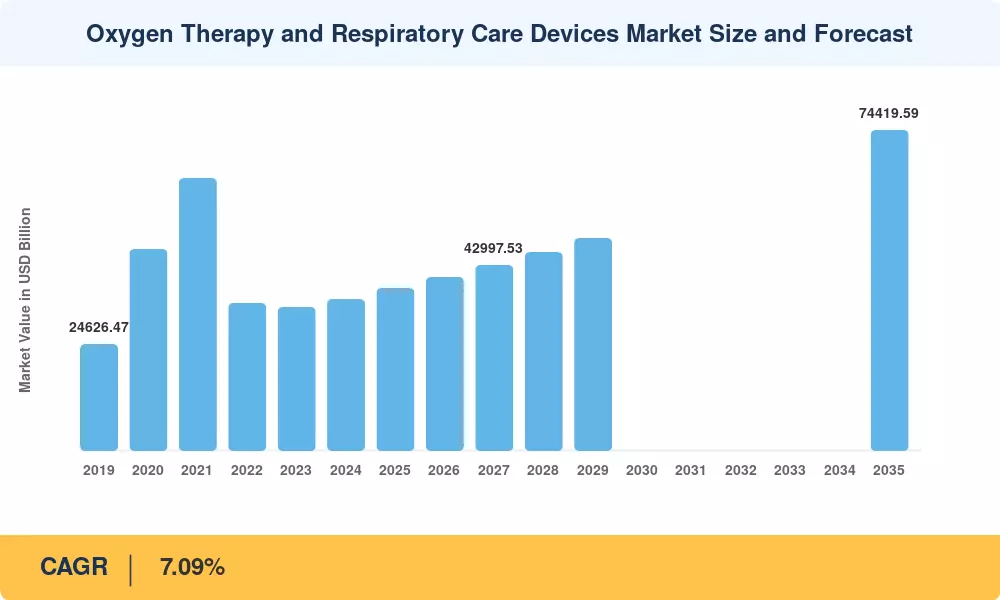
The global oxygen therapy and respiratory care devices market was valued at USD 37.57 billion in 2025 and is projected to reach USD 74.42 billion by 2035, expanding at a compound annual growth rate (CAGR) of 7.09% during the 2026–2035 forecast period. Growth is underpinned by several converging structural forces: the rising global prevalence of chronic obstructive pulmonary disease (COPD), asthma, and pulmonary fibrosis is driving sustained demand for supplemental oxygen and automated respiratory support systems. Concurrently, the aging population across developed economies is amplifying the need for long-term oxygen therapy and home-based respiratory care solutions. Technological advancements in automated breathing devices — including smart ventilation platforms, AI-integrated monitoring, and portable oxygen concentrator systems — are further accelerating market expansion by improving clinical outcomes and patient adherence. The expansion of hospital and critical-care capacity, particularly in intensive care unit (ICU) settings, adds a significant institutional demand layer that complements the growing home healthcare segment.
From a product and technology standpoint, respiratory care devices constitute the dominant product category with a 2025 market size of USD 22,518.20 million, reflecting the breadth of ventilators, CPAP/BiPAP devices, nebulizers, humidifiers, respiratory monitoring devices, and airway management solutions within this segment. Respiratory monitoring devices alone account for USD 12,198.77 million in 2025, underscoring the clinical emphasis on continuous patient surveillance. The fastest-growing product type is intelligent oxygen delivery systems, which, although relatively nascent at USD 79.73 million in 2025, are expanding at a remarkable CAGR of 14.67%, signaling a paradigm shift toward closed-loop, AI-enabled respiratory management. AI-enabled technology platforms as a whole are growing at 11.17% CAGR. Key commercial milestones include Getinge's expansion of its Servo-c ventilator portfolio with neonatal capabilities, broadening the addressable patient population from premature infants to adults, and Inogen's launch of the Voxi 5 stationary oxygen concentrator to improve long-term care access across the United States.
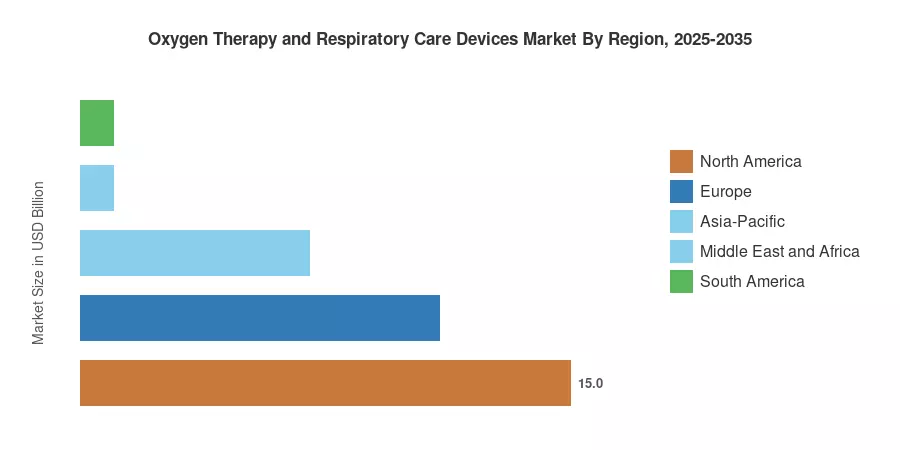
Regionally, Europe oxygen therapy and respiratory care devices market is the dominant market with a 2025 revenue of USD 11,498.64 million, driven by well-established reimbursement frameworks, high per-capita healthcare expenditure, and a large elderly population base. North America, valued at USD 15,263.19 million in 2025, is the fastest-growing region with a CAGR of 6.05%, propelled by robust adoption of portable and home-care oxygen systems and expanding telehealth integration. Asia-Pacific represents the highest growth trajectory at a 9.21% CAGR, fueled by rising healthcare infrastructure investment, urbanization-linked respiratory disease burden, and expanding insurance coverage in China, India, and Southeast Asian markets. The market outlook through 2035 remains strongly positive, driven by the convergence of demographic aging, chronic disease burden escalation, and the continued digitalization of respiratory care delivery.
Key Report Takeaways
| Segment Dimension | Key Metric | Notes |
| Product — Dominant | Respiratory Care Devices: USD 22,518.20 Mn (2025) | Largest product category, encompassing ventilators, monitoring, CPAP, nebulizers |
| Product — Fastest Growing | Respiratory Care Devices: 7.73% CAGR | Driven by ventilator upgrades and respiratory monitoring adoption |
| Type — Dominant | Respiratory Monitoring Devices: USD 12,198.77 Mn (2025) | Reflects emphasis on continuous patient surveillance in ICU and home settings |
| Type — Fastest Growing | Intelligent Oxygen Delivery Systems: 14.67% CAGR | Emerging segment with highest growth potential across all device types |
| Technology — Dominant | Continuous Flow: USD 23,785.52 Mn (2025) | Established delivery modality for institutional and home oxygen therapy |
| Technology — Fastest Growing | AI-enabled: 11.17% CAGR | Reflects rapid integration of artificial intelligence in respiratory device platforms |
| Device Portability — Dominant | Stationary: USD 22,802.62 Mn (2025) | Institutional demand anchors stationary device revenue |
| Device Portability — Fastest Growing | Portable: 8.13% CAGR | Home care and ambulatory trends driving portable device adoption |
| Indication — Dominant | COPD: USD 11,634.62 Mn (2025) | Largest therapeutic indication by revenue |
| Indication — Fastest Growing | Obstructive Sleep Apnea (OSA): 8.42% CAGR | Rising diagnosis rates and CPAP/BiPAP adoption fueling growth |
| End User — Dominant | Hospitals: USD 18,460.50 Mn (2025) | Primary care setting for acute and chronic respiratory management |
| End User — Fastest Growing | Long-term Care Facilities: 9.58% CAGR | Aging population driving institutional long-term respiratory care demand |
| Region — Dominant | Europe: USD 11,498.64 Mn (2025) | Mature reimbursement systems and high healthcare expenditure |
| Region — Fastest Growing | Asia-Pacific: 9.21% CAGR | Infrastructure expansion and rising chronic respiratory disease burden |
Market Size and Forecast (2019–2035)
MRFR's market sizing methodology combines bottom-up revenue estimation from company filings, product-level shipment data, and regional reimbursement analysis with top-down demand modeling based on disease prevalence, healthcare infrastructure capacity, and demographic projections. Forecast values for 2026–2035 are derived using a constant CAGR of 7.09% applied to the validated 2025 base year estimate, cross-referenced against supply-side capacity additions and regulatory pipeline assessments. Historical values (2019–2024) reflect reported and estimated actual market performance.