×
Request Free Sample ×

Kindly complete the form below to receive a free sample of this Report

* Please use a valid business email

Leading companies partner with us for data-driven Insights

clients tt-cursor
Hero Background

Packaging Film Market

ID: MRFR/PCM/39973-HCR
200 Pages
Garvit Vyas
October 2025

Packaging Film Market Research Report: By Application (Food Packaging, Pharmaceutical Packaging, Cosmetics Packaging, Industrial Packaging, Agricultural Packaging), By Material Type (Polyethylene, Polypropylene, Polyvinyl Chloride, Polyester, Others), By Thickness (Up to 20 Micron, 20 to 50 Micron, 50 to 100 Micron, Above 100 Micron), By End User (Food Beverage, Healthcare, Personal Care, Electronics, Textiles) and By Regional (North America, Europe, South America, Asia Pacific, Middle East and Africa) - Forecast to 2035.

Share:
Download PDF ×

We do not share your information with anyone. However, we may send you emails based on your report interest from time to time. You may contact us at any time to opt-out.

Packaging Film Market Infographic
Purchase Options

Packaging Film Market Summary

As per MRFR analysis, The Global Packaging Film Market Size was estimated at 105.27 USD Billion in 2024. The packaging film industry is projected to grow from 107.68 USD Billion in 2025 to 135.04 USD Billion by 2035, exhibiting a compound annual growth rate (CAGR) of 2.29 during the forecast period 2025 - 2035.

Key Market Trends & Highlights

The Global Packaging Film Market is experiencing a robust shift towards sustainability and innovation.

  • North America remains the largest market for packaging films, driven by increasing consumer demand for sustainable solutions.
  • The Asia-Pacific region is emerging as the fastest-growing market, fueled by rapid industrialization and urbanization.
  • Food packaging continues to dominate the market, while pharmaceutical packaging is witnessing the highest growth rates due to rising health awareness.
  • Key market drivers include the growing consumer preference for convenience and the push for regulatory compliance in sustainable packaging.

Market Size & Forecast

2024 Market Size 105.27 (USD Billion)
2035 Market Size 135.04 (USD Billion)
CAGR (2025 - 2035) 2.29%

Major Players

Amcor (AU), Sealed Air (US), BASF (DE), Mondi Group (GB), Berry Global (US), DuPont (US), Constantia Flexibles (AT), Sappi (ZA), Wipak (FI), Clondalkin Group (IE)

Packaging Film Market Trends

The Global Packaging Film Market is currently experiencing a dynamic evolution, driven by various factors including sustainability, technological advancements, and changing consumer preferences. As environmental concerns gain prominence, manufacturers are increasingly focusing on developing eco-friendly packaging solutions. This shift not only aligns with regulatory pressures but also caters to a growing consumer base that prioritizes sustainability in their purchasing decisions. Furthermore, innovations in materials and production processes are enhancing the functionality and performance of packaging films, making them more appealing to a diverse range of industries. In addition to sustainability, the demand for convenience and efficiency in packaging is reshaping the landscape of The Global Packaging Film Market. As e-commerce continues to expand, the need for protective and lightweight packaging solutions is becoming more critical. Companies are investing in advanced technologies to create films that offer superior barrier properties, ensuring product integrity during transit. This trend indicates a potential for growth as businesses seek to optimize their packaging strategies while meeting consumer expectations for quality and convenience.

Sustainable Packaging Solutions

There is a noticeable shift towards eco-friendly materials in The Global Packaging Film Market. Companies are increasingly adopting biodegradable and recyclable films to meet consumer demand for sustainable options. This trend reflects a broader commitment to reducing environmental impact and aligns with regulatory initiatives aimed at minimizing plastic waste.

Technological Innovations

Advancements in technology are significantly influencing The Global Packaging Film Market. Innovations in material science and production techniques are leading to the development of films with enhanced properties, such as improved barrier performance and durability. These technological improvements are likely to drive market growth by offering better solutions for various applications.

E-commerce Driven Demand

The rise of e-commerce is reshaping packaging requirements within The Global Packaging Film Market. As online shopping becomes more prevalent, there is an increasing need for lightweight, protective packaging solutions that ensure product safety during shipping. This trend suggests a potential for growth as businesses adapt to the evolving landscape of consumer purchasing behavior.

Packaging Film Market Drivers

Regulatory Compliance

Regulatory compliance is an essential driver influencing The Global Packaging Film Industry. Governments worldwide are implementing stringent regulations aimed at reducing plastic waste and promoting sustainable packaging practices. These regulations often require manufacturers to adopt eco-friendly materials and processes, thereby shaping the market dynamics. Compliance with these regulations can be challenging, yet it presents opportunities for innovation and differentiation. Companies that proactively adapt to these regulatory changes are likely to gain a competitive edge in the market. Furthermore, adherence to safety and quality standards is paramount, as it ensures consumer trust and brand loyalty. As the regulatory landscape continues to evolve, The Global Packaging Film Industry must remain agile and responsive to these changes, fostering a culture of sustainability and responsibility.

E-commerce Driven Demand

The rapid growth of e-commerce is a significant catalyst for The Global Packaging Film Industry. As online shopping becomes increasingly prevalent, the need for effective packaging solutions that ensure product safety during transit has surged. Packaging films play a crucial role in protecting goods from damage and contamination, which is vital for maintaining customer satisfaction. Recent statistics indicate that e-commerce sales have seen a substantial increase, with projections suggesting continued growth in the coming years. This trend necessitates the development of packaging films that are not only protective but also lightweight and cost-effective. Companies are adapting their packaging strategies to meet the unique challenges posed by e-commerce logistics, thereby driving demand for specialized packaging films. The Global Packaging Film Industry is likely to experience robust growth as it aligns with the evolving needs of the e-commerce sector.

Technological Innovations

Technological advancements are reshaping the landscape of The Global Packaging Film Industry. Innovations in material science and manufacturing processes are enabling the development of high-performance films that offer enhanced barrier properties, durability, and flexibility. For instance, the introduction of nanotechnology in packaging films has led to improved shelf life and product protection. Additionally, automation and smart packaging technologies are gaining traction, allowing for better tracking and inventory management. The integration of digital printing technologies is also revolutionizing branding and customization options for packaging films. As these technologies continue to evolve, they are expected to drive efficiency and reduce costs in production, thereby expanding the market's potential. The Global Packaging Film Industry is poised to benefit from these advancements, as they cater to the growing demand for innovative and efficient packaging solutions.

Sustainable Packaging Solutions

The increasing emphasis on sustainability is a pivotal driver for The Global Packaging Film Industry. Consumers and businesses alike are becoming more environmentally conscious, leading to a surge in demand for eco-friendly packaging solutions. This trend is reflected in the growing adoption of biodegradable and recyclable materials in packaging films. According to recent data, the market for sustainable packaging is projected to grow at a compound annual growth rate of over 10% in the coming years. Companies are investing in research and development to create innovative materials that minimize environmental impact while maintaining functionality. This shift not only aligns with consumer preferences but also complies with stringent regulations aimed at reducing plastic waste. As a result, The Global Packaging Film Industry is likely to witness a significant transformation towards more sustainable practices.

Consumer Preferences for Convenience

Consumer preferences for convenience are driving transformation within The Global Packaging Film Industry. As lifestyles become increasingly fast-paced, there is a growing demand for packaging solutions that offer ease of use and accessibility. This trend is particularly evident in sectors such as food and beverage, where consumers favor single-serve and ready-to-eat products. Packaging films that facilitate quick opening, resealability, and portability are gaining popularity among consumers. Market data suggests that products with convenient packaging options are more likely to attract consumer attention and drive sales. Consequently, manufacturers are focusing on developing packaging films that cater to these preferences, enhancing user experience while maintaining product integrity. The Global Packaging Film Industry is thus adapting to meet the evolving demands of consumers, ensuring that convenience remains a key consideration in packaging design.
Market Segment Insights

By Application: Food Packaging (Largest) vs. Pharmaceutical Packaging (Fastest-Growing)

The Global Packaging Film Market is prominently shaped by its application segments, with Food Packaging holding the largest share. This segment thrives due to the increasing demand for convenience, ready-to-eat meals, and the rising trend of online grocery shopping. As consumers prioritize freshness and shelf life, manufacturers are focusing on innovative packaging solutions that enhance the overall consumer experience in the food sector. In contrast, Pharmaceutical Packaging is emerging as the fastest-growing segment, driven by the increasing pharmaceutical supply chain complexities and regulatory mandates for packaging designs that ensure drug safety. As the pharmaceutical industry continues to advance with new medications and biologics, the demand for specialized packaging solutions that offer enhanced protection and functionality is becoming paramount, thus propelling this segment towards rapid growth.

Food Packaging (Dominant) vs. Agricultural Packaging (Emerging)

Food Packaging remains a dominant force within The Global Packaging Film Market, owing to consumer preferences for convenient and safe food options, along with the increasing online shopping trend. Films used in this sector are designed for barrier protection, extending the shelf life of products and maintaining freshness. In contrast, Agricultural Packaging is an emerging segment, gaining momentum as sustainable farming practices become adopted widely. This category includes biodegradable films and solutions designed to safeguard agricultural products during transport and storage. Furthermore, the dual focus on sustainability and efficiency in agricultural operations is fostering innovation in packaging materials that cater specifically to the unique needs of the agricultural industry.

By Material Type: Polyethylene (Largest) vs. Polypropylene (Fastest-Growing)

In The Global Packaging Film Market, the material type segment plays a crucial role in determining the overall growth trajectory. Polyethylene dominates this sector, being the most widely used due to its versatility, cost-effectiveness, and excellent barrier properties. Following closely are Polypropylene and Polyvinyl Chloride, which also hold significant shares but are slowly being overshadowed by the rising demand for Polyethylene. Other materials, including polyester and various biodegradable options, also contribute to the market dynamics but to a lesser extent compared to the leading materials.

Polyethylene (Dominant) vs. Polypropylene (Emerging)

Polyethylene, known for its flexibility and moisture resistance, continues to be the leading material in the packaging film sector, thanks to its extensive applications in food, consumer goods, and industrial packaging. Its dominance stems from its ability to provide cost-effective solutions without compromising durability. On the other hand, Polypropylene is rapidly gaining traction as an emerging material due to its superior clarity, strength, and lightweight nature. This shift can be attributed to increasing consumer awareness regarding sustainability, leading manufacturers to explore innovative applications for Polypropylene films, making them a viable alternative in various packaging applications.

By Thickness: Up to 20 Micron (Largest) vs. Above 100 Micron (Fastest-Growing)

In The Global Packaging Film Market, the segment of 'Up to 20 Micron' is the largest, capturing a significant portion of the overall market share. This thickness range is widely utilized for flexible packaging applications, such as food products and consumer goods, offering excellent barrier properties and lightweight advantages. On the other hand, the 'Above 100 Micron' segment is recognized as the fastest-growing, driven by the rising demand for durable and protective packaging solutions in various industries, including industrial and pharmaceutical sectors.

Up to 20 Micron (Dominant) vs. Above 100 Micron (Emerging)

The 'Up to 20 Micron' thickness segment is characterized by its versatility and widespread application in everyday packaging needs. This segment is dominant due to its cost-effectiveness and ability to provide excellent moisture and oxygen barriers, making it ideal for perishable goods. In contrast, the 'Above 100 Micron' segment is emerging rapidly as manufacturers seek innovative packaging solutions that offer enhanced strength and protection. This thickness is particularly favored in heavy-duty applications, such as industrial packaging, where robust performance is essential. As sustainability becomes increasingly critical, both segments are adapting to incorporate eco-friendly materials, ensuring that they meet the evolving demands of consumers and regulatory standards.

By End User: Food & Beverage (Largest) vs. Healthcare (Fastest-Growing)

The end user segment of The Global Packaging Film Market is predominantly driven by the food and beverage sector, which commands the largest share. This segment's demand is fueled by the increasing consumer preference for packaged goods, on-the-go food options, and innovative packaging solutions that enhance product shelf life. Conversely, the healthcare segment is experiencing rapid growth due to the rising demand for medical packaging solutions, essential for preserving the integrity and safety of pharmaceutical products.

Food & Beverage (Dominant) vs. Healthcare (Emerging)

The Food & Beverage segment is characterized by high demand for various packaging films like barrier films, shrink films, and flexible packaging solutions that facilitate the preservation of food products. This segment focuses on innovations in sustainable packaging materials and design, targeting eco-conscious consumers. On the other hand, the Healthcare segment is marked by its stringent regulations and growing need for tamper-evident and sterile packaging. Increasing healthcare expenditure and a surge in online pharmaceutical sales are driving the demand for advanced packaging solutions in this emerging segment, as companies adapt to the evolving landscape of medicine distribution.

Get more detailed insights about Packaging Film Market

Regional Insights

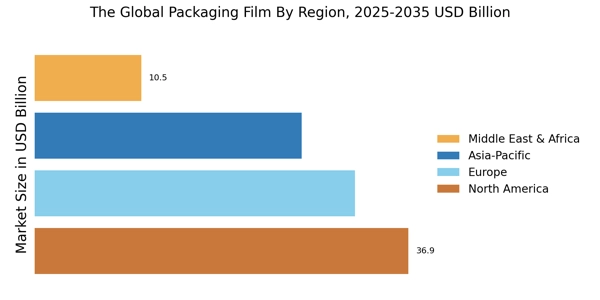
The Packaging Film Market is projected to experience significant growth across various regions, highlighting the market's diverse segmentation. In 2024, North America is valued at 30.0 USD Billion, representing a substantial share of the market, driven by the demand for sustainable packaging solutions and innovative products. Europe follows closely with a valuation of 25.0 USD Billion, focusing on environmentally friendly materials and advanced technology in packaging.

APAC dominates the market with 38.0 USD Billion, showcasing a robust growth trajectory attributed to rapid industrialization and increased consumer spending in sectors such as food and beverage.South America and MEA hold smaller valuations, at 6.0 USD Billion and 6.27 USD Billion respectively in 2024, signifying emerging opportunities but facing challenges in infrastructure development. The notable performance of APAC emphasizes its importance as a key player in the Global Packaging Film Market, largely due to its majority holding and expanding consumer base.

Overall, the regional dynamics reflect varying demands driven by economic activities, demographic trends, and environmental pressures, creating diverse opportunities for growth within the industry.

Packaging Film Market Regional Image

Key Players and Competitive Insights

The Packaging Film Market has witnessed significant growth due to the increase in demand for flexible packaging solutions across various industries. This market is characterized by a diverse range of players who compete to offer innovative packaging films that cater to the specific needs of end-users. With a focus on sustainability, efficiency, and functionality, companies are constantly looking for ways to enhance their product offerings to meet consumer preferences. The competitive landscape is marked by both established firms and new entrants, which contribute to a dynamic environment where technological advancements and market strategies play crucial roles in determining success.

Moreover, collaboration and partnerships are common strategies among market players to enhance their portfolio and expand their geographical reach, leading to a highly competitive marketplace.Berry Global has established a strong presence in the Global Packaging Film Market, showcasing its commitment to producing high-quality, innovative products tailored to meet the changing demands of customers. The company leverages its extensive manufacturing capabilities and a deep understanding of material science to develop packaging solutions that not only meet functional requirements but also align with sustainable practices. 

Berry is known for its diverse range of packaging films, including stretch films, shrink films, and other specialty films designed for various applications. Its strong distribution network and global footprint enable the company to serve a wide array of industries, from food and beverage to healthcare, thus solidifying its position as a key player in the market.

The company's emphasis on research and development allows Berry Global to stay ahead of trends and consistently deliver advanced packaging solutions that enhance customer satisfaction.Sealed Air has a robust foundation within the Global Packaging Film Market, primarily due to its innovative approach to protective packaging solutions. The company focuses on creating value through its extensive portfolio of films designed to protect products during transportation and storage, particularly in sectors such as food and e-commerce. Sealed Air stands out with its commitment to sustainability, offering solutions that minimize waste while maximizing performance.

The brand is recognized for its advanced film technologies, which not only enhance product preservation but also promote optimal resource utilization. With strong emphasis on customer collaboration, Sealed Air continuously seeks feedback to refine its offerings and ensure they meet the evolving needs of its clientele. Through strategic investments in technology and sustainable practices, Sealed Air is well-positioned to remain a competitive force within the packaging film industry.

Key Companies in the Packaging Film Market market include

Industry Developments

In the recent landscape of the Global Packaging Film Market, companies such as Berry Global, Amcor, and Dow are focusing on sustainability and the development of environmentally friendly packaging solutions to meet consumer demand. Sealed Air has introduced innovative packaging technologies that enhance product protection while reducing waste, reflecting the industry's shift towards eco-conscious practices. Mergers and acquisitions in the market have also been significant, with Novolex acquiring a major competitor to expand its product range and strengthen its market position.

Mondi's strategic partnerships aim to enhance its packaging capabilities, while CCL Industries continues to grow through acquisitions that broaden its scale and expertise in packaging films. Moreover, BASF and DuPont are investing in research to develop high-performance materials that ensure stronger and more efficient packaging solutions. The growth in market valuation for these companies indicates a robust demand for packaging films, driven by e-commerce and the food and beverage sector, impacting overall production and innovation trends within the industry. Companies are continuously adapting to consumer preferences while navigating supply chain challenges, showcasing a dynamic market environment.

Future Outlook

Packaging Film Market Future Outlook

The Global Packaging Film Market is projected to grow at a 2.29% CAGR from 2024 to 2035, driven by sustainability trends, technological advancements, and increasing demand for flexible packaging solutions.

New opportunities lie in:

  • Invest in biodegradable film production technologies to meet eco-friendly packaging demands.
  • Develop smart packaging solutions integrating IoT for enhanced supply chain management.
  • Expand into emerging markets with tailored packaging solutions for local industries.

By 2035, the market is expected to solidify its position as a leader in innovative packaging solutions.

Market Segmentation

Packaging Film Market End User Outlook

  • Food Beverage
  • Healthcare
  • Personal Care
  • Electronics
  • Textiles

Packaging Film Market Thickness Outlook

  • Up to 20 Micron
  • 20 to 50 Micron
  • 50 to 100 Micron
  • Above 100 Micron

Packaging Film Market Application Outlook

  • Food Packaging
  • Pharmaceutical Packaging
  • Cosmetics Packaging
  • Industrial Packaging
  • Agricultural Packaging

Packaging Film Market Material Type Outlook

  • Polyethylene
  • Polypropylene
  • Polyvinyl Chloride
  • Polyester
  • Others

Report Scope

MARKET SIZE 2024105.27(USD Billion)
MARKET SIZE 2025107.68(USD Billion)
MARKET SIZE 2035135.04(USD Billion)
COMPOUND ANNUAL GROWTH RATE (CAGR)2.29% (2024 - 2035)
REPORT COVERAGERevenue Forecast, Competitive Landscape, Growth Factors, and Trends
BASE YEAR2024
Market Forecast Period2025 - 2035
Historical Data2019 - 2024
Market Forecast UnitsUSD Billion
Key Companies ProfiledMarket analysis in progress
Segments CoveredMarket segmentation analysis in progress
Key Market OpportunitiesAdoption of sustainable materials drives innovation in The Global Packaging Film.
Key Market DynamicsRising demand for sustainable packaging solutions drives innovation and competition in the packaging film sector.
Countries CoveredNorth America, Europe, APAC, South America, MEA

Leave a Comment

FAQs

What is the current valuation of The Global Packaging Film?

As of 2024, The Global Packaging Film was valued at 105.27 USD Billion.

What is the projected market valuation for The Global Packaging Film in 2035?

The market is projected to reach a valuation of 135.04 USD Billion by 2035.

What is the expected CAGR for The Global Packaging Film during the forecast period 2025 - 2035?

The expected CAGR for The Global Packaging Film during the forecast period 2025 - 2035 is 2.29%.

Which application segment holds the largest market share in The Global Packaging Film?

The Food Packaging segment held the largest market share, valued at 50.0 USD Billion in 2024.

How does the Pharmaceutical Packaging segment perform in terms of market valuation?

The Pharmaceutical Packaging segment was valued at 25.0 USD Billion in 2024 and is expected to grow further.

What are the leading materials used in The Global Packaging Film?

Polyethylene and Polypropylene are the leading materials, with valuations of 50.0 USD Billion and 30.0 USD Billion, respectively, in 2024.

What thickness range is most prevalent in The Global Packaging Film?

The 20 to 50 Micron thickness range was valued at 35.0 USD Billion in 2024, indicating its prevalence.

Which end-user segment is projected to show significant growth in The Global Packaging Film?

The Healthcare end-user segment, valued at 30.0 USD Billion in 2024, is projected to show significant growth.

Who are the key players in The Global Packaging Film?

Key players include Amcor, Sealed Air, BASF, Mondi Group, and Berry Global, among others.

What trends are influencing The Global Packaging Film?

Trends such as sustainability and innovation in materials are likely to influence the market dynamics through 2035.

Download Free Sample

Kindly complete the form below to receive a free sample of this Report

Compare Licence

×
Features License Type
Single User Multiuser License Enterprise User
Price $4,950 $5,950 $7,250
Maximum User Access Limit 1 User Upto 10 Users Unrestricted Access Throughout the Organization
Free Customization
Direct Access to Analyst
Deliverable Format
Platform Access
Discount on Next Purchase 10% 15% 15%
Printable Versions