Passenger Security Market
Passenger Security Market Summary
As per MRFR analysis, the Passenger Security Market Size was estimated at 8.6 USD Million in 2024. The Passenger Security industry is projected to grow from 9.3 in 2025 to 22.1 by 2035, exhibiting a compound annual growth rate (CAGR) of 9.04% during the forecast period 2025 - 2035.
Key Market Trends & Highlights
The Passenger Security Market is poised for substantial growth driven by technological advancements and increasing safety concerns.
- The integration of biometric technologies is transforming security protocols across various sectors.
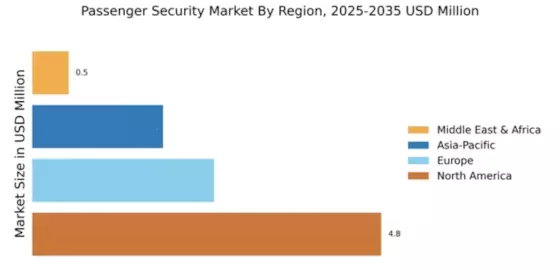
- North America remains the largest market for passenger security solutions, while Asia-Pacific is emerging as the fastest-growing region.
- Surveillance systems dominate the market, yet access control solutions are rapidly gaining traction.
- Rising terrorism threats and growing awareness of passenger safety are key drivers propelling market expansion.
Market Size & Forecast
| 2024 Market Size | 8.6 (USD Million) |
| 2035 Market Size | 22.1 (USD Million) |
| CAGR (2025 - 2035) | 9.04% |
Major Players
Thales Group (FR), Raytheon Technologies (US), L3Harris Technologies (US), Smiths Detection (GB), Honeywell International (US), SAFRAN (FR), Aviat Networks (US), SITA (CH), Cognitec Systems (DE)
Passenger Security Market Trends
Passenger Security Market Drivers
Increasing Global Air Travel Demand
The Global passenger security Market Industry is experiencing a notable surge in demand driven by the increasing volume of air travel. In 2024, the market is projected to reach 4.73 USD Billion, reflecting the growing number of passengers traveling internationally. This trend is likely to continue as global tourism rebounds and more individuals opt for air travel. Enhanced security measures are essential to ensure passenger safety, leading to investments in advanced screening technologies and personnel training. As the number of travelers rises, the need for robust security solutions becomes paramount, thereby propelling the growth of the Global Passenger Security Market Industry.
Regulatory Compliance and Standards
The Global Passenger Security Market Industry is heavily shaped by stringent regulatory compliance requirements imposed by governments and international organizations. These regulations mandate enhanced security measures at airports and other transportation hubs to mitigate risks associated with terrorism and other threats. Compliance with these standards necessitates significant investments in security infrastructure and personnel training, thereby driving market growth. As governments worldwide continue to update and enforce these regulations, the demand for advanced security solutions is likely to increase. This dynamic is expected to sustain the Global Passenger Security Market Industry's growth trajectory, particularly as it approaches the anticipated market value of 10.8 USD Billion by 2035.
Rising Security Threats and Terrorism
The Global Passenger Security Market Industry faces increasing pressure due to the rising threats of terrorism and other security risks. High-profile incidents have underscored the necessity for enhanced security measures in public transportation systems. As threats evolve, so too must the strategies employed to counteract them. This has led to a heightened focus on developing comprehensive security frameworks that incorporate advanced technologies and intelligence-sharing among agencies. The urgency to protect passengers and ensure safe travel experiences is driving investments in security solutions, which is likely to contribute to the market's growth, with projections indicating a CAGR of 7.84% from 2025 to 2035.
Growing Public Awareness and Expectations
The Global Passenger Security Market Industry is also influenced by the growing public awareness regarding security issues in transportation. Passengers are increasingly concerned about their safety while traveling, prompting airports and airlines to enhance their security measures. This heightened awareness has led to greater expectations for efficient and effective security processes. As a result, stakeholders in the industry are compelled to adopt innovative security technologies and practices to meet these demands. The focus on passenger experience, alongside security, is likely to drive investments in the Global Passenger Security Market Industry, ensuring that it remains responsive to evolving public expectations.
Technological Advancements in Security Solutions
The Global Passenger Security Market Industry is significantly influenced by rapid technological advancements. Innovations such as biometric screening, artificial intelligence, and machine learning are transforming security protocols at airports and other transit hubs. These technologies enhance the efficiency and accuracy of passenger screening processes, thereby improving overall security. For instance, biometric systems can reduce wait times while ensuring thorough identity verification. As these technologies become more integrated into security frameworks, they are expected to drive market growth, contributing to the projected increase to 10.8 USD Billion by 2035. The ongoing evolution of security technology is a critical driver for the Global Passenger Security Market Industry.
Market Segment Insights
By Application: Screening (Largest) vs. Access Control (Fastest-Growing)
In the Passenger Security Market, the application segments show distinct market share distributions, where Screening holds the largest share due to its indispensable role in ensuring safety at checkpoints. Access Control, while slightly smaller in market share, is gaining traction rapidly, driven by advancements in technology and the increasing focus on secure access to sensitive areas, further emphasizing its critical importance in security protocols. As the market for passenger security evolves, the demand for various applications is shifting. The rise in global travel, coupled with heightened security concerns, propels the growth of Screening, while Access Control is experiencing the fastest growth, driven by innovations in biometric technologies and smart access solutions that enhance security measures. This dynamic creates a competitive landscape with significant opportunities for growth in both areas.
Screening (Dominant) vs. Incident Management (Emerging)
Screening is positioned as the dominant application in the Passenger Security Market, primarily due to its established presence and critical function in preventing threats at airports and transportation hubs. Its comprehensive processes include the use of advanced imaging technology and X-ray systems that efficiently detect potential security risks. On the other hand, Incident Management is emerging as a significant player, focusing on the response and management of incidents post-event. This area emphasizes real-time communication and quick response protocols to handle security threats, relying on data analysis and incident reporting tools to enhance emergency responses. As the landscape of passenger travel continues to evolve, both Screening and Incident Management will play vital roles in shaping security strategies.
By End Use: Aviation (Largest) vs. Railways (Fastest-Growing)
In the Passenger Security Market, the 'Aviation' segment remains the largest, accounting for a significant portion of the total market share. This prominence is primarily due to heightened security measures at airports worldwide, driven by the increasing volume of air travel and the need for enhanced safety protocols. Other segments such as 'Railways', 'Public Transport', 'Stadiums', and 'Events' contribute to the overall market but to a lesser extent, reflecting varied security demands across different transportation modalities and events.
Railways: Security Scanners (Dominant) vs. Event Monitoring Systems (Emerging)
Within the railway segment, security is characterized by the implementation of advanced security scanners, which serve as the dominant solution to ensure passenger safety. These scanners are integrated into the transport infrastructure, providing efficient monitoring without compromising passenger flow. In contrast, monitoring systems for events have emerged as a crucial element in addressing the increasing demand for safety in crowded spaces. As various events attract larger audiences, the need for real-time monitoring and swift security responses becomes vital, indicating a shifting focus towards enhancing security protocols in temporary and high-traffic environments.
By Technology: Biometric Systems (Largest) vs. Artificial Intelligence (Fastest-Growing)
In the Passenger Security Market, various technologies play critical roles, with Biometric Systems commanding the largest market share. Following closely are X-ray Screening and Video Analytics, which cater to specific security needs at passenger checkpoints. Emerging technologies like Artificial Intelligence and advanced Metal Detectors are gradually gaining traction, showcasing the industry's shift toward intelligent security solutions. The distribution reflects a blend of established technologies and innovative systems, addressing the evolving requirements for passenger safety and efficiency.
Biometric Systems: Dominant vs. Artificial Intelligence: Emerging
Biometric Systems are a dominant force in the Passenger Security Market, leveraging unique personal attributes for identification, thus enhancing security effectiveness. In contrast, Artificial Intelligence stands out as an emerging technology, known for its capacity to analyze vast amounts of data and improve decision-making processes in real-time. Biometric Systems integrate seamlessly into existing security frameworks, offering reliability and accuracy, while AI technologies introduce adaptive learning capabilities, continually evolving to counter new threats. This dynamic interplay indicates a trend where established players may integrate AI to strengthen their offerings, ensuring a comprehensive security environment.
By Component: Cameras (Largest) vs. Software (Fastest-Growing)
The Passenger Security Market exhibits a diverse distribution among its component segments, highlighting significant market shares from cameras, sensors, software, alarm systems, and access control systems. Cameras have established themselves as the largest segment due to their critical role in surveillance and monitoring, providing essential security measures necessary in passenger transit areas. Following closely, sensors and software components play vital roles in enhancing the efficiency and functionality of security systems within transportation hubs.
Surveillance: Cameras (Dominant) vs. Software (Emerging)
Cameras dominate the passenger security market by providing vital visual surveillance capabilities that deter unlawful activities and ensure passenger safety across airports, train stations, and other transit hubs. Their extensive deployment is complemented by advanced imaging technology that enhances monitoring efficiency. On the other hand, software solutions have emerged as a pivotal force in this sector, leveraging algorithms and data analytics to integrate various security measures, provide real-time alerts, and enhance operational efficiency. As the demand for integrated security solutions grows, software is likely to experience rapid adoption, particularly in evolving technological landscapes where automation and AI become increasingly imperative.
By Service Type: Consulting (Largest) vs. Training (Fastest-Growing)
In the Passenger Security Market, the service type segment is characterized by its diverse offerings, with consulting services holding the largest share. This segment benefits from increasing investments in security infrastructure and an emphasis on compliance with safety regulations. Installation services follow closely, catering to the demand for advanced security systems. Maintenance and support services are also essential, as they ensure the ongoing functionality and reliability of security systems. Training services, while currently smaller in share, are rapidly rising due to the growing need for skilled personnel to manage evolving security technologies and protocols.
Consulting (Dominant) vs. Training (Emerging)
Consulting services play a dominant role in the Passenger Security Market, offering expertise in risk assessment, regulatory compliance, and strategic planning for organizations. These services are crucial as businesses navigate complex security landscapes and seek tailored solutions to optimize their security measures. In contrast, training services are emerging as a critical component of this market, driven by the need for personnel proficient in handling advanced security technologies. This growth is fueled by the increasing complexity of security threats and the necessity for constant skill development in the workforce, highlighting a shift towards proactive security management.
Regional Insights
Key Players and Competitive Insights
The Passenger Security Market is currently characterized by a dynamic competitive landscape, driven by increasing global travel demand and heightened security concerns. Key players such as Thales Group (FR), Raytheon Technologies (US), and Smiths Detection (GB) are strategically positioned to leverage innovation and technological advancements. Thales Group (FR) focuses on integrating advanced biometric systems and AI-driven analytics to enhance security measures, while Raytheon Technologies (US) emphasizes the development of next-generation surveillance technologies. Smiths Detection (GB) is actively pursuing partnerships to expand its product offerings in the detection and screening domain, thereby shaping a competitive environment that prioritizes technological sophistication and operational efficiency.In terms of business tactics, companies are increasingly localizing manufacturing to reduce costs and enhance supply chain resilience. The market appears moderately fragmented, with a mix of established players and emerging firms vying for market share. The collective influence of these key players fosters a competitive structure that encourages innovation and collaboration, as companies seek to differentiate themselves through unique value propositions.
In November Thales Group (FR) announced a strategic partnership with a leading AI firm to develop cutting-edge facial recognition technology aimed at improving passenger flow management at airports. This collaboration is expected to enhance the efficiency of security processes, thereby reducing wait times and improving overall passenger experience. The strategic importance of this move lies in Thales' commitment to integrating AI into its security solutions, positioning the company as a leader in the digital transformation of passenger security.
In October Raytheon Technologies (US) unveiled a new line of advanced screening equipment designed to detect a wider range of threats with greater accuracy. This launch is indicative of the company's focus on innovation and its response to evolving security challenges. By enhancing the capabilities of its screening technologies, Raytheon aims to solidify its market position and address the growing demand for effective security solutions in high-traffic environments.
In September Smiths Detection (GB) expanded its product portfolio by acquiring a startup specializing in AI-driven threat detection algorithms. This acquisition is expected to bolster Smiths' technological capabilities and enhance its competitive edge in the market. The strategic significance of this move lies in the integration of advanced analytics into Smiths' existing product lines, which could lead to improved detection rates and operational efficiencies.
As of December the Passenger Security Market is witnessing trends such as digitalization, sustainability, and AI integration, which are reshaping competitive dynamics. Strategic alliances are becoming increasingly prevalent, as companies recognize the value of collaboration in driving innovation. Looking ahead, competitive differentiation is likely to evolve from traditional price-based competition to a focus on technological innovation, supply chain reliability, and enhanced customer experiences. This shift underscores the importance of adaptability and forward-thinking strategies in navigating the complexities of the Passenger Security Market.
Key Companies in the Passenger Security Market include
Industry Developments
-
Smiths Detection (UK): Information on recent developments is a little scarce online, but they are a major player known for continuous innovation. You can expect them to be at the forefront of advancements in passenger security.
-
Honeywell International (US): They've been focusing on integrated security solutions. This means creating systems that combine various security technologies for a more holistic approach.
-
Axis Communications (Sweden): In 2019, they launched a new high-resolution, multi-directional camera offering 24/7 operation and 360-degree coverage. This improves situational awareness for security personnel.
Future Outlook
Passenger Security Market Future Outlook
The Passenger Security Market is projected to grow at a 9.04% CAGR from 2025 to 2035, driven by technological advancements, regulatory changes, and increasing passenger volumes.
New opportunities lie in:
- Integration of AI-driven surveillance systems for enhanced threat detection.
- Development of biometric authentication solutions for seamless passenger processing.
- Expansion of mobile security applications for real-time alerts and monitoring.
By 2035, the Passenger Security Market is expected to be robust, reflecting substantial growth and innovation.
Market Segmentation
Passenger Security Market End Use Outlook
- Airports
- Railways
- Bus Stations
- Public Transport
- Event Venues
Passenger Security Market Component Outlook
- Cameras
- Sensors
- Alarm Systems
- Software Solutions
Passenger Security Market Technology Outlook
- Biometric Systems
- Video Analytics
- Artificial Intelligence
- Metal Detectors
- X-ray Screening
Passenger Security Market Application Outlook
- Access Control
- Surveillance
- Screening
- Incident Management
- Emergency Response
Passenger Security Market Service Type Outlook
- Consulting Services
- Installation Services
- Maintenance Services
- Training Services
Report Scope
| MARKET SIZE 2024 | 8.6(USD Million) |
| MARKET SIZE 2025 | 9.3(USD Million) |
| MARKET SIZE 2035 | 22.1(USD Million) |
| COMPOUND ANNUAL GROWTH RATE (CAGR) | 9.04% (2025 - 2035) |
| REPORT COVERAGE | Revenue Forecast, Competitive Landscape, Growth Factors, and Trends |
| BASE YEAR | 2024 |
| Market Forecast Period | 2025 - 2035 |
| Historical Data | 2019 - 2024 |
| Market Forecast Units | USD Million |
| Key Companies Profiled | Thales Group (FR), Raytheon Technologies (US), L3Harris Technologies (US), Smiths Detection (GB), Honeywell International (US), SAFRAN (FR), Aviat Networks (US), SITA (CH), Cognitec Systems (DE) |
| Segments Covered | Application, End Use, Technology, Service Type, Component |
| Key Market Opportunities | Integration of advanced biometric technologies enhances efficiency in the Passenger Security Market. |
| Key Market Dynamics | Rising technological advancements and regulatory changes drive innovation in the Passenger Security Market. |
| Countries Covered | North America, Europe, APAC, South America, MEA |
Market Highlights
FAQs
What is the projected market valuation of the Passenger Security Market by 2035?
The Passenger Security Market is projected to reach a valuation of 22.1 USD Million by 2035.
What was the market valuation of the Passenger Security Market in 2024?
In 2024, the Passenger Security Market had a valuation of 8.6 USD Million.
What is the expected CAGR for the Passenger Security Market during the forecast period 2025 - 2035?
The expected CAGR for the Passenger Security Market during the forecast period 2025 - 2035 is 9.04%.
Which companies are considered key players in the Passenger Security Market?
Key players in the Passenger Security Market include Thales, L3Harris Technologies, Raytheon Technologies, and Smiths Detection.
What are the main application segments of the Passenger Security Market?
The main application segments include Access Control, Surveillance, Screening, Incident Management, and Threat Detection.
How does the Aviation sector contribute to the Passenger Security Market?
What technologies are driving the Passenger Security Market?
What components are essential in the Passenger Security Market?
What services are offered within the Passenger Security Market?
What is the projected growth for the Screening application segment by 2035?
Kindly complete the form below to receive a free sample of this Report
Customer Stories
“This is really good guys. Excellent work on a tight deadline. I will continue to use you going forward and recommend you to others. Nice job”
“Thanks. It’s been a pleasure working with you, please use me as reference with any other Intel employees.”
“Thanks for sending the report it gives us a good global view of the Betaïne market.”
“Thank you, this will be very helpful for OQS.”
“We found the report very insightful! we found your research firm very helpful. I'm sending this email to secure our future business.”
“I am very pleased with how market segments have been defined in a relevant way for my purposes (such as "Portable Freezers & refrigerators" and "last-mile"). In general the report is well structured. Thanks very much for your efforts.”
“I have been reading the first document or the study, ,the Global HVAC and FP market report 2021 till 2026. Must say, good info! I have not gone in depth at all parts, but got a good indication of the data inside!”
“We got the report in time, we really thank you for your support in this process. I also thank to all of your team as they did a great job.”