×
Request Free Sample ×

Kindly complete the form below to receive a free sample of this Report

* Please use a valid business email

Leading companies partner with us for data-driven Insights

clients tt-cursor
Hero Background

Personal Protective Textile Market

ID: MRFR/CnM/27244-HCR
111 Pages
Chitranshi Jaiswal
October 2025

Personal Protective Textile Market Research Report: By Application (Medical and Healthcare, Industrial and Manufacturing, Construction, Military and Defense, Fire Fighting), By Material (Spunbonded Polypropylene, Meltblown Polypropylene, Polyethylene, Nylon, Aramid), By Product Type (Coveralls, Gowns, Masks, Gloves, Boots), By Protection Level (Level 1, Level 2, Level 3, Level 4) and By Regional (North America, Europe, South America, Asia-Pacific, Middle East and Africa) - Forecast to 2035

Share:
Download PDF ×

We do not share your information with anyone. However, we may send you emails based on your report interest from time to time. You may contact us at any time to opt-out.

Personal Protective Textile Market Infographic
Purchase Options

Personal Protective Textile Market Summary

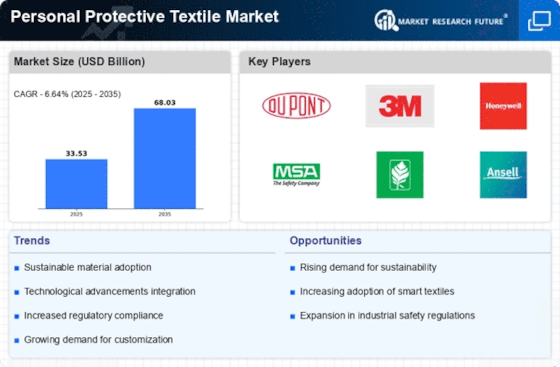
As per MRFR analysis, the Personal Protective Textile Market Size was estimated at 33.53 USD Billion in 2024. The Personal Protective Textile industry is projected to grow from 35.76 USD Billion in 2025 to 68.03 USD Billion by 2035, exhibiting a compound annual growth rate (CAGR) of 6.64 during the forecast period 2025 - 2035.

Key Market Trends & Highlights

The Personal Protective Textile Market is experiencing robust growth driven by technological advancements and increasing safety awareness.

  • Technological advancements in fabrics are enhancing the performance and functionality of personal protective textiles.
  • Sustainability trends are gaining traction, with a growing emphasis on eco-friendly materials in product development.
  • North America remains the largest market, while Asia-Pacific is emerging as the fastest-growing region in this sector.
  • Key market drivers include technological innovations and the increasing awareness of workplace safety, particularly in the medical and healthcare segment.

Market Size & Forecast

2024 Market Size 33.53 (USD Billion)
2035 Market Size 68.03 (USD Billion)
CAGR (2025 - 2035) 6.64%

Major Players

DuPont (US), 3M (US), Honeywell (US), MSA Safety (US), Lakeland Industries (US), Ansell (AU), Kimberly-Clark (US), Sioen Industries (BE), Portwest (IE), Carhartt (US)

Personal Protective Textile Market Trends

The Personal Protective Textile Market is currently experiencing a notable evolution, driven by increasing awareness regarding safety and health standards across various industries. This market encompasses a wide range of products designed to protect individuals from hazardous environments, including chemical, thermal, and mechanical risks. As industries continue to prioritize worker safety, the demand for advanced protective textiles is likely to rise. Innovations in fabric technology, such as the integration of smart textiles and enhanced durability, appear to be at the forefront of this transformation. Furthermore, the growing emphasis on sustainability may influence the development of eco-friendly materials, which could reshape consumer preferences and industry standards. In addition to technological advancements, regulatory frameworks are becoming more stringent, compelling manufacturers to adhere to higher safety standards. This regulatory pressure may drive the adoption of more sophisticated protective solutions, thereby expanding the market's scope. The Personal Protective Textile Market seems poised for growth, as stakeholders increasingly recognize the importance of investing in protective gear. As the landscape evolves, collaboration between manufacturers, researchers, and regulatory bodies will likely play a crucial role in shaping future developments within this sector.

Technological Advancements in Fabrics

The Personal Protective Textile Market is witnessing a surge in technological innovations, particularly in fabric development. New materials that offer enhanced protection while maintaining comfort are emerging. These advancements may include the incorporation of nanotechnology, which could improve resistance to chemicals and pathogens, thereby increasing the effectiveness of protective gear.

Sustainability Trends

There is a growing trend towards sustainability within the Personal Protective Textile Market. Manufacturers are increasingly focusing on eco-friendly materials and production processes. This shift not only addresses environmental concerns but also aligns with consumer preferences for sustainable products, potentially influencing purchasing decisions.

Regulatory Compliance and Standards

The landscape of the Personal Protective Textile Market is heavily influenced by evolving regulatory standards. As safety regulations become more stringent, manufacturers are compelled to enhance their product offerings to meet compliance requirements. This trend may lead to increased investment in research and development to ensure that protective textiles adhere to the latest safety protocols.

Personal Protective Textile Market Drivers

Expansion of End-User Industries

The expansion of end-user industries is a crucial factor propelling the growth of the Personal Protective Textile Market. Sectors such as healthcare, construction, and manufacturing are witnessing significant growth, leading to an increased demand for protective textiles. The healthcare sector, in particular, is experiencing a surge in demand for protective clothing and textiles due to heightened awareness of infection control and safety protocols. Additionally, the construction industry is expanding rapidly, necessitating the use of durable and reliable protective gear to ensure worker safety. Market analysts project that the demand for personal protective textiles will continue to rise, with the industry expected to reach a valuation of several billion dollars in the near future. This expansion underscores the critical role that protective textiles play in safeguarding workers across diverse sectors.

Regulatory Standards and Compliance

The Personal Protective Textile Market is significantly influenced by stringent regulatory standards and compliance requirements established by various governing bodies. These regulations mandate the use of certified protective textiles in industries such as construction, healthcare, and manufacturing, ensuring that products meet specific safety criteria. Compliance with these standards not only protects workers but also shields companies from potential liabilities associated with workplace accidents. As regulations evolve, manufacturers are compelled to innovate and enhance their product offerings to meet these requirements. The market is likely to see a continuous influx of new products that adhere to the latest safety standards, thereby fostering growth and ensuring that protective textiles remain a vital component of occupational safety.

Growing Awareness of Workplace Safety

In recent years, there has been an increasing emphasis on workplace safety across various industries, which is driving demand within the Personal Protective Textile Market. Organizations are recognizing the importance of equipping their workforce with appropriate protective gear to mitigate risks associated with occupational hazards. This heightened awareness is reflected in the rising investments in safety training and equipment, with many companies allocating substantial budgets to ensure compliance with safety regulations. The market for personal protective equipment, including textiles, is expected to witness a robust growth trajectory, with projections indicating a valuation exceeding several billion dollars by the end of the decade. This trend underscores the critical role that protective textiles play in safeguarding workers and enhancing overall workplace safety.

Sustainability and Eco-Friendly Materials

Sustainability is becoming a pivotal driver in the Personal Protective Textile Market, as consumers and businesses alike are increasingly prioritizing eco-friendly materials. The demand for sustainable textiles is prompting manufacturers to explore biodegradable and recycled materials that reduce environmental impact while maintaining protective qualities. This shift towards sustainability is not only a response to consumer preferences but also aligns with broader corporate social responsibility initiatives. The market for sustainable personal protective equipment is projected to expand, with estimates suggesting a growth rate of around 15% annually. This trend indicates a growing recognition of the importance of environmentally responsible practices in the production of protective textiles, which could reshape the industry landscape in the years to come.

Technological Innovations in Personal Protective Textiles

The Personal Protective Textile Market is experiencing a surge in technological innovations that enhance the performance and functionality of protective fabrics. Advanced materials such as nanofibers and smart textiles are being developed to provide superior protection against various hazards, including chemicals, flames, and biological agents. For instance, the integration of sensors into textiles allows for real-time monitoring of environmental conditions, which is particularly beneficial in hazardous work environments. The market for smart textiles is projected to grow significantly, with estimates suggesting a compound annual growth rate of over 20% in the coming years. This trend indicates a shift towards more sophisticated protective gear that not only meets safety standards but also improves user comfort and mobility.


Market Segment Insights

By Application: Medical and Healthcare (Largest) vs. Industrial and Manufacturing (Fastest-Growing)

In the Personal Protective Textile Market, the 'Medical and Healthcare' segment holds the largest market share, driven by the increasing demand for protective apparel in hospitals and healthcare settings. This segment encompasses a wide range of products, including surgical gowns, masks, and gloves, enhancing safety protocols amid rising health concerns globally. In contrast, the 'Industrial and Manufacturing' segment is witnessing rapid growth due to stringent safety regulations and a rising focus on worker safety. This sector includes protective clothing for various industries, aiming to reduce workplace accidents and injuries.

Medical and Healthcare: Dominant vs. Industrial and Manufacturing: Emerging

The 'Medical and Healthcare' segment remains dominant in the Personal Protective Textile Market due to the critical need for protective gear in medical settings. This segment is characterized by the production of high-quality, specialized fabrics that provide infection control and safety, reflecting the ongoing advances in textile technology. Meanwhile, the 'Industrial and Manufacturing' segment is emerging rapidly, underpinned by a booming industrial sector and evolving workplace safety standards. As industries adopt more comprehensive safety measures, the demand for protective textiles that meet specific hazard requirements continues to rise. Innovations in durable and breathable materials are attracting investments, propelling this segment's growth as manufacturers seek efficient and compliant protective solutions.

By Material: Spunbonded Polypropylene (Largest) vs. Aramid (Fastest-Growing)

The Personal Protective Textile Market features a diverse range of materials, with Spunbonded Polypropylene holding the largest share. Its lightweight properties and cost-effectiveness have made it a preferred choice in various applications, from disposable gowns to protective clothing. Following closely are Meltblown Polypropylene and Nylon, both of which contribute significantly to market dynamics but lag behind Spunbonded Polypropylene in terms of overall market share. Aramid represents the fastest-growing segment within the Personal Protective Textile Market, driven by its exceptional heat-resistant properties and strength. The rising demand for high-performance protective gear in industries such as firefighting, military, and industrial sectors is propelling Aramid's growth forward. Additionally, a growing focus on worker safety and regulatory mandates are further enhancing the adoption of this material, signaling its potential for sustained growth in the coming years.

Spunbonded Polypropylene (Dominant) vs. Aramid (Emerging)

Spunbonded Polypropylene is a dominant force in the Personal Protective Textile Market, praised for its affordability, versatility, and effective barrier properties. It is often found in applications that require reliable protection without the burden of excessive weight or cost, making it an ideal choice for disposable personal protective equipment (PPE). On the other hand, Aramid, characterized by its superior tensile strength and thermal stability, is regarded as an emerging player. Its capability to withstand extreme conditions is carving out a niche in specialized protective applications, such as high-temperature environments. As industries continue to prioritize safety and performance, both Spunbonded Polypropylene and Aramid are poised to play critical roles: the former maintaining mass-market appeal while the latter captures the high-performance segment.

By Product Type: Coveralls (Largest) vs. Masks (Fastest-Growing)

In the Personal Protective Textile Market, coveralls represent the largest segment, dominating market share due to their widespread use in various industries, including healthcare, construction, and manufacturing. They provide comprehensive protection, contributing to their significant adoption rates amongst end-users. Meanwhile, masks have emerged as the fastest-growing segment, gaining traction especially in the wake of global health concerns and heightened awareness of hygiene practices, leading to increased demand across both medical and consumer-oriented sectors.

Coveralls (Dominant) vs. Masks (Emerging)

Coveralls are established as the dominant product type in Personal Protective Textiles, widely recognized for their ability to provide full-body protection against hazardous materials. Their sturdy fabric and design cater to diverse sectors, making them indispensable in environments where safety is paramount. Conversely, masks are the emerging product, experiencing rapid growth. As public awareness around health and safety escalates, masks have transitioned from specialized medical use to everyday necessities for various activities. This versatility and innovation in designs have positioned masks at the forefront of protective solutions.

By Protection Level: Level 2 (Largest) vs. Level 4 (Fastest-Growing)

In the Personal Protective Textile Market, the distribution of market share among different protection levels shows that Level 2 currently holds the largest share, primarily due to its versatile applications across various industries. This level is well-known for providing essential protection while maintaining comfort and breathability, making it a preferred choice for many industries such as construction and healthcare. Conversely, Level 4 is the fastest-growing segment, driven by increasing awareness of workplace safety and regulatory requirements. As industries evolve, the demand for advanced protection solutions against hazardous environments is surging, which enhances the appeal of Level 4 textiles in sectors like manufacturing and emergency services, where higher protection levels are critical.

Level 2 (Dominant) vs. Level 3 (Emerging)

Level 2 personal protective textiles stand out as the dominant segment within the market due to their broad applicability and reliable performance. These textiles offer essential protection against common workplace hazards while ensuring ease of movement, making them ideal for a variety of industries. On the other hand, Level 3 textiles represent the emerging force, designed to meet stricter safety standards and provide enhanced defense against significant risks. While Level 3 is gaining traction, propelled by heightened safety regulations, it still trails behind Level 2 in terms of market penetration. The growth potential for Level 3 textiles is significant as industries seek to improve safety measures, making it a compelling segment for future investment.

Get more detailed insights about Personal Protective Textile Market

Regional Insights

North America : Market Leader in Protection

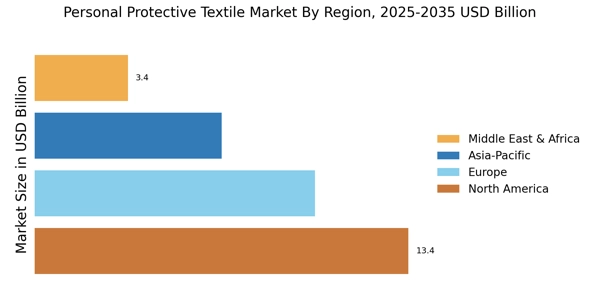
North America is the largest market for personal protective textiles, holding approximately 40% of the global share. The region's growth is driven by stringent safety regulations, increasing workplace safety awareness, and a robust manufacturing sector. The demand for high-performance protective gear is further fueled by the construction, healthcare, and industrial sectors, which are expanding rapidly. Regulatory bodies like OSHA enforce strict guidelines, enhancing market growth. The United States is the leading country in this region, with major players such as DuPont, 3M, and Honeywell dominating the market. The competitive landscape is characterized by innovation and technological advancements, with companies investing heavily in R&D to develop advanced materials. The presence of established brands and a strong distribution network further solidify North America's position in the personal protective textile market.

Europe : Regulatory-Driven Market Growth

Europe is the second-largest market for personal protective textiles, accounting for approximately 30% of the global market share. The region's growth is significantly influenced by stringent regulations and standards set by the European Union, which mandate high safety levels in various industries. The increasing focus on worker safety and health, coupled with the rise in industrial activities, is driving demand for protective textiles across sectors such as construction, manufacturing, and healthcare. Leading countries in Europe include Germany, France, and the UK, where key players like Sioen Industries and Portwest are prominent. The competitive landscape is marked by a mix of established companies and innovative startups, all striving to meet the evolving safety standards. The presence of advanced manufacturing capabilities and a strong emphasis on sustainability further enhance the region's market dynamics.

Asia-Pacific : Emerging Market Potential

Asia-Pacific is witnessing rapid growth in the personal protective textile market, holding approximately 20% of the global share. The region's expansion is driven by increasing industrialization, urbanization, and a growing awareness of workplace safety. Countries like China and India are leading this growth, supported by government initiatives aimed at enhancing safety standards across various sectors. The rising demand for protective gear in manufacturing, construction, and healthcare is further propelling market dynamics. China is the largest market in the region, with significant contributions from local manufacturers and international players. The competitive landscape is evolving, with companies focusing on innovation and cost-effective solutions to cater to the growing demand. The presence of key players like Ansell and Kimberly-Clark highlights the region's potential for growth in personal protective textiles, as they adapt to local market needs and regulations.

Middle East and Africa : Untapped Market Opportunities

The Middle East and Africa region is gradually emerging in the personal protective textile market, holding about 10% of the global share. The growth is primarily driven by increasing safety awareness and regulatory frameworks being established in various industries. The oil and gas sector, along with construction, is a significant contributor to the demand for protective textiles. Governments are beginning to implement stricter safety regulations, which is expected to further boost market growth in the coming years. Leading countries in this region include South Africa and the UAE, where the presence of both local and international players is growing. The competitive landscape is characterized by a mix of established companies and new entrants, all vying for market share. The focus on improving safety standards and the increasing investment in infrastructure projects are key factors that will shape the future of the personal protective textile market in this region.

Personal Protective Textile Market Regional Image

Key Players and Competitive Insights

Major players in the Personal Protective Textile Market industry are constantly striving to develop innovative products and technologies to meet the evolving needs of customers. Leading Personal Protective Textile Market players are investing in research and development to improve the performance and durability of their products. Personal Protective Textile Market development is also being driven by the growing adoption of advanced materials and technologies, such as nanotechnology and smart textiles. The increasing demand for lightweight, breathable, and comfortable protective clothing is also driving Personal Protective Textile Market growth.

The competitive landscape of the Personal Protective Textile Market is expected to remain fragmented, with a large number of small and medium-sized players operating alongside a few large, established companies.DuPont is a leading player in the Personal Protective Textile Market, offering a wide range of protective fabrics and garments for various industries, including healthcare, manufacturing, and construction. The company has a strong focus on innovation and has developed a number of patented technologies, such as Nomex and Kevlar, which are used in its protective garments.

DuPont has a global presence and operates in over 90 countries.3M is another major player in the Personal Protective Textile Market, offering a wide range of protective fabrics and garments for various industries, including healthcare, manufacturing, and construction. The company has a strong focus on research and development and has developed a number of innovative products, such as Scotchgard and Thinsulate, which are used in its protective garments. 3M has a global presence and operates in over 200 countries.

Key Companies in the Personal Protective Textile Market market include

Industry Developments

Rising concerns about workplace safety and stringent government regulations are driving market growth. Technological advancements, such as the development of lightweight and breathable materials, are further fueling demand. Key market players are focusing on expanding their product portfolios and investing in research and development to meet the evolving needs of end-users. Recent news developments include the launch of innovative products, such as cut-resistant textiles and flame-retardant fabrics, and strategic partnerships between manufacturers and distributors to enhance market reach.

Future Outlook

Personal Protective Textile Market Future Outlook

The Personal Protective Textile Market is projected to grow at a 6.64% CAGR from 2024 to 2035, driven by increasing safety regulations, technological advancements, and rising awareness of workplace safety.

New opportunities lie in:

  • Development of smart textiles with integrated sensors for real-time monitoring.
  • Expansion into emerging markets with tailored protective solutions.
  • Partnerships with industries for customized protective gear solutions.

By 2035, the market is expected to be robust, driven by innovation and strategic partnerships.

Market Segmentation

Personal Protective Textile Market Material Outlook

  • Spunbonded Polypropylene
  • Meltblown Polypropylene
  • Polyethylene
  • Nylon
  • Aramid

Personal Protective Textile Market Application Outlook

  • Medical and Healthcare
  • Industrial and Manufacturing
  • Construction
  • Military and Defense
  • Fire Fighting

Personal Protective Textile Market Product Type Outlook

  • Coveralls
  • Gowns
  • Masks
  • Gloves
  • Boots

Personal Protective Textile Market Protection Level Outlook

  • Level 1
  • Level 2
  • Level 3
  • Level 4

Report Scope

MARKET SIZE 202433.53(USD Billion)
MARKET SIZE 202535.76(USD Billion)
MARKET SIZE 203568.03(USD Billion)
COMPOUND ANNUAL GROWTH RATE (CAGR)6.64% (2024 - 2035)
REPORT COVERAGERevenue Forecast, Competitive Landscape, Growth Factors, and Trends
BASE YEAR2024
Market Forecast Period2025 - 2035
Historical Data2019 - 2024
Market Forecast UnitsUSD Billion
Key Companies ProfiledMarket analysis in progress
Segments CoveredMarket segmentation analysis in progress
Key Market OpportunitiesIntegration of smart textiles enhances functionality in the Personal Protective Textile Market.
Key Market DynamicsRising demand for advanced protective textiles driven by regulatory changes and technological innovations in safety standards.
Countries CoveredNorth America, Europe, APAC, South America, MEA

Leave a Comment

FAQs

What is the current valuation of the Personal Protective Textile Market?

The market valuation reached 33.53 USD Billion in 2024.

What is the projected market size for the Personal Protective Textile Market by 2035?

The market is expected to grow to 68.03 USD Billion by 2035.

What is the expected CAGR for the Personal Protective Textile Market during the forecast period 2025 - 2035?

The market is projected to experience a CAGR of 6.64% from 2025 to 2035.

Which application segment holds the largest market share in the Personal Protective Textile Market?

The Industrial and Manufacturing segment is anticipated to dominate, with a valuation range of 10.0 to 20.0 USD Billion.

What are the key materials used in Personal Protective Textiles?

Key materials include Nylon, Aramid, and Polyethylene, with valuations ranging from 7.0 to 16.0 USD Billion.

Which product type is expected to generate the highest revenue in the Personal Protective Textile Market?

Coveralls are projected to lead the market, with a valuation range of 8.0 to 16.0 USD Billion.

Who are the leading companies in the Personal Protective Textile Market?

Key players include DuPont, 3M, Honeywell, and MSA Safety, among others.

What is the expected growth trend for the Fire Fighting segment in the Personal Protective Textile Market?

The Fire Fighting segment is projected to grow, with a valuation range of 5.53 to 11.03 USD Billion.

How does the Protection Level segment contribute to the market?

The Protection Level segment is expected to show strong performance, with Level 3 projected to reach 10.0 to 25.0 USD Billion.

What factors are driving the growth of the Personal Protective Textile Market?

Growth is likely driven by increasing safety regulations and demand for high-performance protective gear across various industries.

Download Free Sample

Kindly complete the form below to receive a free sample of this Report

Compare Licence

×
Features License Type
Single User Multiuser License Enterprise User
Price $4,950 $5,950 $7,250
Maximum User Access Limit 1 User Upto 10 Users Unrestricted Access Throughout the Organization
Free Customization
Direct Access to Analyst
Deliverable Format
Platform Access
Discount on Next Purchase 10% 15% 15%
Printable Versions