Pharmaceutical Quality Control Market

Key Players: Companies such as Thermo Fisher Scientific (US), Abbott Laboratories (US), Roche Holding AG (CH), Merck KGaA (DE), Danaher Corporation (US), Agilent Technologies (US), Lonza Group AG (CH), Charles River Laboratories (US), SGS SA (CH) are some of the major participants in the global market.

Pharmaceutical Quality Control Market

Pharmaceutical Quality Control Market Research Report Information By Product (Consumable, Instruments, and Services), By Analysis Type (Sterility Testing, Bioburden Testing, Endotoxin Testing, Stability Testing, Extractable & Leachable Testing, Raw Material Testing, and Others), By Products Tested (Vaccines, Plasma Product, and Drugs), and By Region (North America, Europe, Asia-Pacific, and Rest Of The World) - Growth & Industry Forecast 2025 To 2035
ID: MRFR/Pharma/8233-HCR
120 Pages
Vikita Thakur, Kinjoll Dey
Last Updated: June 22, 2026

Pharmaceutical Quality Control Market Summary

The Global Pharmaceutical Quality Control Market size was valued at USD 2.54 Billion in 2024, and the market is projected to grow from USD 2.79 Billion in 2025 to USD 6.32 Billion by 2035, registering a CAGR of 8.59% during the forecast period 2025–2035. North America led the market in 2024 with over 50% share, generating around USD 2.03 Billion in revenue.
 
The Pharmaceutical Quality Control Market is expanding due to increasingly stringent global regulatory requirements that compel manufacturers to adopt advanced quality assurance and testing protocols. Growing emphasis on product safety, efficacy, and compliance is driving investments in sophisticated quality control technologies across pharmaceutical production facilities.
 
According to the World Health Organization (WHO), over 2 million different pharmaceutical products are circulated globally through regulated healthcare systems, reinforcing the need for robust quality control frameworks to ensure product safety, consistency, and regulatory compliance throughout manufacturing and distribution processes.

Key Market Trends & Highlights

The Pharmaceutical Quality Control Market is poised for substantial growth driven by technological advancements and increasing regulatory demands.

  • Chemical Testing held an estimated 44% market share in 2024, supported by increasing pharmaceutical purity and safety requirements.
  • Chromatography represented approximately 36% of technology revenue in 2024, remaining the leading analytical testing platform.
  • North America led the market with over 50% share in 2024, generating approximately USD 1.27 billion in revenue.
  • Europe accounted for nearly 29% market share in 2024, reaching approximately USD 740.96 million in revenue.

Market Size & Forecast

2024 Market Size 2541.92 (USD Million)
2035 Market Size 6319.67 (USD Million)
CAGR (2025 - 2035) 8.59%

Major Players

Companies such as Thermo Fisher Scientific (US), Abbott Laboratories (US), Roche Holding AG (CH), Merck KGaA (DE), Danaher Corporation (US), Agilent Technologies (US), Lonza Group AG (CH), Charles River Laboratories (US), SGS SA (CH) are some of the major participants in the global market.

Our Impact
Enabled $4.3B Revenue Impact for Fortune 500 and Leading Multinationals
Partnering with 2000+ Global Organizations Each Year
30K+ Citations by Top-Tier Firms in the Industry

Pharmaceutical Quality Control Market Drivers

Market Growth Projections

The Global Pharmaceutical Quality Control Industry is poised for substantial growth, with projections indicating a market value of 5.16 USD Billion in 2024 and an anticipated increase to 16.2 USD Billion by 2035. This growth trajectory suggests a compound annual growth rate (CAGR) of 10.96% from 2025 to 2035.
 
The factors driving this growth include rising regulatory compliance, technological advancements, increasing demand for biopharmaceuticals, globalization of supply chains, and growing consumer awareness. These dynamics collectively indicate a robust future for the quality control sector within the pharmaceutical industry.
 

  • According to the World Bank, global health expenditure exceeded USD 9.8 trillion, reflecting sustained investments in healthcare infrastructure, pharmaceuticals, and regulatory systems. Rising healthcare spending worldwide continues to create favorable conditions for pharmaceutical quality control solutions, supporting long-term market expansion and increased adoption of advanced testing technologies.

Rising Regulatory Compliance

The Global Pharmaceutical Quality Control Industry is experiencing heightened scrutiny from regulatory bodies, necessitating stringent adherence to quality standards. Regulatory agencies such as the FDA and EMA impose rigorous guidelines that pharmaceutical companies must follow to ensure product safety and efficacy. This compliance is crucial, as non-compliance can lead to severe penalties and product recalls.
 
As a result, companies are investing significantly in quality control measures, which is projected to drive the market value to 5.16 USD Billion in 2024. The emphasis on regulatory compliance is likely to sustain growth in the industry, fostering innovations in quality assurance technologies.
 

  • A growing body of studies indexed in PubMed highlights that implementation of advanced quality management systems can reduce manufacturing deviations by more than 30% in regulated pharmaceutical environments. This increasing focus on compliance is encouraging manufacturers to strengthen quality assurance programs and invest in sophisticated testing platforms.

Increasing Demand for Biopharmaceuticals

The Global Pharmaceutical Quality Control Industry is witnessing a surge in demand for biopharmaceuticals, which necessitates robust quality control measures. Biopharmaceuticals, including monoclonal antibodies and vaccines, require stringent quality assessments to ensure their safety and effectiveness. As the biopharmaceutical sector expands, driven by advancements in biotechnology, the need for specialized quality control processes becomes paramount.
 
This trend is likely to contribute to the market's growth, as companies invest in sophisticated quality control systems to meet the unique challenges posed by biopharmaceuticals. The industry's evolution is expected to align with the projected CAGR of 10.96% from 2025 to 2035.

Globalization of Pharmaceutical Supply Chains

The globalization of pharmaceutical supply chains is significantly impacting the Global Pharmaceutical Quality Control Industry. As companies source raw materials and components from various regions, ensuring consistent quality across the supply chain becomes increasingly complex. This globalization necessitates the implementation of comprehensive quality control systems to monitor and manage quality at every stage of production.
 
Companies are compelled to adopt standardized quality practices to mitigate risks associated with supply chain variability. This trend is likely to drive investments in quality control technologies and processes, further propelling market growth in the coming years.

Technological Advancements in Quality Control

Technological innovations are transforming the Global Pharmaceutical Quality Control Industry, enhancing the efficiency and accuracy of quality assessments. Advanced technologies such as artificial intelligence, machine learning, and automation are being integrated into quality control processes. These technologies facilitate real-time monitoring and data analysis, allowing for quicker decision-making and improved product quality.
 
As companies adopt these innovations, the market is expected to grow significantly, with projections indicating a rise to 16.2 USD Billion by 2035. The ongoing technological evolution is likely to create a competitive edge for organizations that prioritize quality control in their operations.

Growing Consumer Awareness and Safety Concerns

Consumer awareness regarding pharmaceutical product safety is on the rise, influencing the Global Pharmaceutical Quality Control Industry. Patients and healthcare providers are increasingly demanding transparency and assurance of product quality. This heightened awareness drives pharmaceutical companies to prioritize quality control measures to maintain consumer trust and meet regulatory expectations.
 
As a result, organizations are investing in quality assurance programs and certifications to demonstrate their commitment to safety. This trend is expected to contribute to the market's expansion, as companies recognize the importance of quality control in sustaining their reputation and competitiveness.

Market Segment Insights

By Application: Quality Assurance (Largest) vs. Quality Control (Fastest-Growing)

In the Pharmaceutical Quality Control Market, the application segments showcase a varied distribution of market share, with Quality Assurance leading by a significant margin at 47%. Quality Assurance serves as the backbone of product safety and efficacy, demanding rigorous processes in pharmaceutical manufacturing. Following closely is Quality Control, which is growing rapidly as companies focus on minimizing errors and ensuring compliance with regulatory standards. Regulatory Compliance and Process Validation, though important, hold smaller shares in comparison, emphasizing the critical nature of maintaining high quality in drug production. The growth trends within this segment are primarily driven by increasing regulatory scrutiny and the need for pharmaceutical companies to enhance their quality protocols. Quality Control, in particular, is witnessing a surge in adoption due to technological advancements, including automation and real-time monitoring. As manufacturers strive to provide safer products, the emphasis on both Quality Assurance and Quality Control solutions is poised to expand, with investments in these areas likely to accelerate in response to evolving market demands.

Merck KGaA continues expanding its quality assurance and analytical testing portfolio through investments in life science solutions. The company generated approximately EUR 21 billion in revenue, supporting advanced quality management technologies that help pharmaceutical manufacturers maintain regulatory compliance and product consistency across global operations.

By End Use: Pharmaceutical Manufacturers (Largest) vs. Contract Research Organizations (Fastest-Growing)

The Pharmaceutical Quality Control Market is significantly shaped by various end-user segments, with Pharmaceutical Manufacturers holding the largest market share of 58% due to their continuous requirement for stringent quality assurance processes.. This sector accounts for a substantial portion of the market, driven by the need for regulatory compliance and high-quality product delivery. Contract Research Organizations, on the other hand, are emerging as a substantial contributor, rapidly increasing their market presence as they provide specialized services to support pharmaceutical research and development.

Danaher Corporation supports pharmaceutical manufacturers through extensive analytical instrumentation and quality testing solutions. With annual revenue exceeding USD 23 billion, the company continues advancing laboratory technologies that enable manufacturers to improve production quality, accelerate testing workflows, and strengthen regulatory compliance.

By Testing Type: Chemical Testing (Largest) vs. Microbiological Testing (Fastest-Growing)

The Pharmaceutical Quality Control Market showcases significant segmentation across various testing types, with Chemical Testing holding the largest market share at 44%. This segment is crucial due to its role in analyzing the chemical composition and purity of pharmaceutical products, ensuring safety and efficacy. Microbiological Testing, while smaller in share, is rapidly gaining traction as regulations surrounding microbial contamination and sterility testing intensify, hence being recognized as the fastest-growing area within the sector.

Lonza Group AG continues strengthening pharmaceutical analytical and testing capabilities through ongoing investments in manufacturing quality systems. The company reported revenue exceeding CHF 6 billion, reflecting growing demand for chemical testing solutions that ensure product purity, stability, and compliance with global pharmaceutical standards.

By Product Type: Laboratory Equipment (Largest) vs. Software Solutions (Fastest-Growing)

In the Pharmaceutical Quality Control Market, the product type segment is characterized by a diverse mix of offerings, including Laboratory Equipment, Consumables, Software Solutions, and Services. Among these, Laboratory Equipment holds the largest market share at 49%, driven by the essential role it plays in ensuring quality compliance in pharmaceutical manufacturing. Consumables also contribute significantly, serving as vital components in daily operations. Software Solutions, while growing rapidly, represent a smaller portion of the market but are gaining traction thanks to advancements in technology and the increasing need for data management and regulatory compliance.

Charles River Laboratories continues enhancing laboratory infrastructure supporting pharmaceutical quality assessment. The company generated approximately USD 4 billion in annual revenue, demonstrating strong industry demand for advanced laboratory equipment used in analytical testing, validation procedures, and pharmaceutical quality assurance programs.

By Technology: Chromatography (Largest) vs. Mass Spectrometry (Fastest-Growing)

In the Pharmaceutical Quality Control Market, the technology segment is characterized by distinct techniques including Chromatography, Spectroscopy, Mass Spectrometry, and Microbial Testing. Among these, Chromatography emerges as the largest contributor, accounting for 36% of the market and substantially influencing market dynamics due to its widespread application in pharmaceutical analysis. On the other hand, Mass Spectrometry is recognized for its rapid growth potential, increasingly being adopted for its precise analytical capabilities and efficiency in the quality control processes.

SGS SA continues expanding analytical testing services utilizing chromatography technologies across pharmaceutical applications. With revenue exceeding CHF 6.7 billion, the company supports growing demand for highly accurate analytical methods that improve impurity detection, product characterization, and regulatory compliance within pharmaceutical manufacturing.

Get more detailed insights about Pharmaceutical Quality Control Market

Regional Insights

North America : Market Leader in Quality Control

North America continues to lead the market, holding a significant share of 1270.96M in 2024. The region's growth is driven by stringent regulatory frameworks, increasing R&D investments, and a rising demand for high-quality pharmaceuticals. The FDA's rigorous standards and the push for innovation in drug development further catalyze market expansion.

  • According to CDC data, the United States records more than 6 billion prescription drug fills annually, highlighting the scale of pharmaceutical consumption and reinforcing the need for rigorous quality control systems to ensure product safety, efficacy, and regulatory compliance throughout manufacturing and distribution networks.

The United States is the primary contributor, with major players like Thermo Fisher Scientific, Abbott Laboratories, and Merck KGaA establishing a strong foothold. The competitive landscape is characterized by continuous advancements in technology and a focus on quality assurance. This dynamic environment fosters collaboration among key stakeholders, ensuring the delivery of safe and effective pharmaceutical products.

  • Agilent Technologies reported annual revenue of approximately USD 6.5 billion, supported by strong demand for chromatography, spectroscopy, and laboratory testing solutions. The company's continued investment in analytical technologies strengthens pharmaceutical quality control capabilities across North America and supports compliance with stringent FDA standards.

Europe : Emerging Hub for Quality Assurance

Europe's market is valued at 740.96M, reflecting a robust growth trajectory. The region benefits from a well-established regulatory environment, with agencies like the EMA enforcing strict compliance standards. The increasing focus on patient safety and product efficacy drives demand for advanced quality control solutions, making Europe a pivotal player in the global market.

Germany, France, and the UK are leading countries, hosting numerous key players such as Roche Holding AG and Merck KGaA. The competitive landscape is marked by innovation and strategic partnerships, enhancing the region's capabilities in quality assurance. As the market evolves, European firms are increasingly investing in cutting-edge technologies to meet regulatory demands and improve operational efficiency.

  • The European Medicines Agency (EMA) oversees a pharmaceutical market serving more than 450 million people across the European Union. The agency continues evaluating hundreds of medicinal products annually, driving demand for advanced quality control systems and supporting ongoing investments in analytical testing, regulatory compliance, and pharmaceutical manufacturing excellence.

Asia-Pacific : Rapidly Growing Market Potential

The Asia-Pacific region, with a market size of 420.0M, is witnessing rapid growth in the Pharmaceutical Quality Control sector. Factors such as increasing healthcare expenditure, a rising number of pharmaceutical companies, and supportive government initiatives are driving this expansion. Regulatory bodies are enhancing their frameworks to ensure compliance with international standards, further boosting market demand.

Countries like China, India, and Japan are at the forefront, with a growing presence of key players like Agilent Technologies and Lonza Group AG. The competitive landscape is evolving, with local firms increasingly adopting advanced technologies to enhance quality control processes. This shift is crucial for meeting the rising expectations of both regulators and consumers in the region.

Middle East and Africa : Emerging Market with Challenges

The Middle East and Africa region, valued at 110.0M, presents a unique landscape for the market. While the region is emerging, it faces challenges such as regulatory inconsistencies and limited infrastructure. However, increasing investments in healthcare and pharmaceutical sectors are driving demand for quality control solutions. Governments are beginning to implement stricter regulations to enhance product safety and efficacy.

Countries like South Africa and the UAE are leading the way, with a growing number of local and international players entering the market. The competitive landscape is characterized by a mix of established firms and new entrants, all striving to improve quality standards. As the market matures, there is significant potential for growth and innovation in quality control practices.
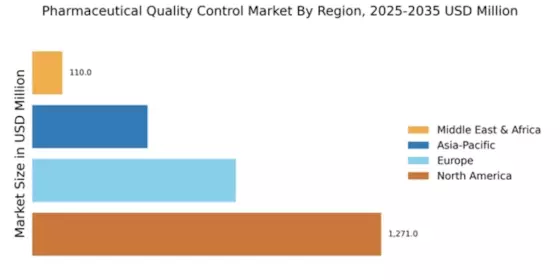

Pharmaceutical Quality Control Market Regional Image

Key Players and Competitive Insights

The Pharmaceutical Quality Control Market is characterized by a dynamic competitive landscape, driven by the increasing demand for high-quality pharmaceuticals and stringent regulatory requirements. Key players such as Thermo Fisher Scientific (US), Abbott Laboratories (US), and Roche Holding AG (CH) are at the forefront, employing diverse strategies to enhance their market positions. For instance, Thermo Fisher Scientific (US) focuses on innovation and digital transformation, investing heavily in advanced analytical technologies to streamline quality control processes.
 
Meanwhile, Abbott Laboratories (US) emphasizes strategic partnerships and collaborations to expand its product offerings and enhance its service capabilities, thereby strengthening its competitive edge. Roche Holding AG (CH) is also notable for its commitment to sustainability and operational efficiency, which aligns with the growing emphasis on environmentally responsible practices in the pharmaceutical sector.
 
The business tactics employed by these companies reflect a concerted effort to optimize supply chains and localize manufacturing. The market appears moderately fragmented, with a mix of established players and emerging companies vying for market share. This competitive structure allows for a diverse range of offerings, although the influence of key players remains substantial, shaping industry standards and practices.

 
In November Danaher Corporation (US) announced the acquisition of a leading quality control technology firm, a move that is likely to enhance its capabilities in providing integrated solutions for pharmaceutical quality assurance. This acquisition not only expands Danaher’s technological portfolio but also positions the company to better meet the evolving needs of its clients in a rapidly changing regulatory environment. The strategic importance of this action lies in its potential to drive innovation and improve operational efficiencies across the board.
 
In October Agilent Technologies (US) launched a new suite of quality control solutions designed to leverage artificial intelligence for enhanced data analysis and decision-making. This initiative underscores Agilent's commitment to integrating cutting-edge technology into its offerings, which may significantly improve the accuracy and speed of quality assessments. The introduction of AI-driven solutions is indicative of a broader trend towards digitalization within the industry, suggesting that companies that embrace such technologies could gain a competitive advantage.
 
In September Lonza Group AG (CH) entered into a strategic partnership with a prominent biotech firm to co-develop innovative quality control methodologies. This collaboration is expected to foster the development of next-generation quality assurance processes, reflecting a growing trend towards collaborative innovation in the sector. Such partnerships may not only enhance product quality but also accelerate time-to-market for new pharmaceuticals, thereby benefiting both companies involved.
 
As of December the competitive trends within the market are increasingly defined by digitalization, sustainability, and the integration of AI technologies. Strategic alliances are becoming more prevalent, as companies recognize the value of collaboration in driving innovation and enhancing operational capabilities. Looking ahead, it is anticipated that competitive differentiation will increasingly pivot from price-based strategies to a focus on technological advancement, innovation, and supply chain reliability, thereby reshaping the market landscape.

Key Companies in the Pharmaceutical Quality Control Market include

Industry Developments

May 2019: The extension of the Milbourn location of Intertek Group Plc's pharmaceutical services laboratory was announced.

Future Outlook

Pharmaceutical Quality Control Market Future Outlook

The Pharmaceutical Quality Control Market size is projected to reach USD 6319.67 Million by 2035, growing at a CAGR of 8.59%, driven by technological advancements, regulatory compliance, and increasing demand for quality assurance.

New opportunities lie in:

  • Integration of AI-driven analytics for real-time quality monitoring Development of portable quality testing devices for field use Expansion of contract quality control services for emerging biotech firms

By 2035, the market is expected to be robust, driven by innovation and increased regulatory demands.

Market Segmentation

Pharmaceutical Quality Control Market End Use Outlook

  • Pharmaceutical Manufacturers
  • Contract Research Organizations
  • Research Laboratories
  • Biotechnology Companies

Pharmaceutical Quality Control Market Application Outlook

  • Quality Assurance
  • Quality Control
  • Regulatory Compliance
  • Process Validation

Pharmaceutical Quality Control Market Product Type Outlook

  • Instruments
  • Reagents
  • Consumables
  • Software

Pharmaceutical Quality Control Market Service Type Outlook

  • Consulting Services
  • Training Services
  • Maintenance Services
  • Validation Services

Pharmaceutical Quality Control Market Testing Type Outlook

  • Chemical Testing
  • Microbiological Testing
  • Stability Testing
  • Physical Testing

Report Scope

MARKET SIZE 2024 2541.92(USD Million)
MARKET SIZE 2025 2789.4(USD Million)
MARKET SIZE 2035 6319.67(USD Million)
COMPOUND ANNUAL GROWTH RATE (CAGR) 8.59% (2025 - 2035)
REPORT COVERAGE Revenue Forecast, Competitive Landscape, Growth Factors, and Trends
BASE YEAR 2024
Market Forecast Period 2025 - 2035
Historical Data 2019 - 2024
Market Forecast Units USD Million
Key Companies Profiled Thermo Fisher Scientific (US), Abbott Laboratories (US), Roche Holding AG (CH), Merck KGaA (DE), Danaher Corporation (US), Agilent Technologies (US), Lonza Group AG (CH), Charles River Laboratories (US), SGS SA (CH)
Segments Covered Application, End Use, Testing Type, Product Type, Service Type
Key Market Opportunities Integration of advanced analytics and automation enhances efficiency in the Pharmaceutical Quality Control Market.
Key Market Dynamics Rising regulatory scrutiny and technological advancements drive innovation in the Pharmaceutical Quality Control Market.
Countries Covered North America, Europe, APAC, South America, MEA

FAQs

What is the projected market valuation of the Pharmaceutical Quality Control Market by 2035?

The projected market valuation for the Pharmaceutical Quality Control Market is expected to reach 6319.67 USD Million by 2035.

What was the market valuation of the Pharmaceutical Quality Control Market in 2024?

The overall market valuation of the Pharmaceutical Quality Control Market was 2541.92 USD Million in 2024.

What is the expected CAGR for the Pharmaceutical Quality Control Market during the forecast period 2025 - 2035?

The expected CAGR for the Pharmaceutical Quality Control Market during the forecast period 2025 - 2035 is 8.59%.

Which companies are considered key players in the Pharmaceutical Quality Control Market?

Key players in the Pharmaceutical Quality Control Market include Thermo Fisher Scientific, Abbott Laboratories, Roche Holding AG, and Merck KGaA.

What are the main applications of the Pharmaceutical Quality Control Market?

The main applications include Quality Assurance, Quality Control, Regulatory Compliance, and Process Validation, with valuations ranging from 500.0 to 2000.0 USD Million.

How do the end-use segments of the Pharmaceutical Quality Control Market break down?

End-use segments include Pharmaceutical Manufacturers, Contract Research Organizations, Academic Research Institutions, and Biotechnology Companies, with valuations from 382.15 to 2485.0 USD Million.

What types of testing are prevalent in the Pharmaceutical Quality Control Market?

Prevalent testing types include Chemical Testing, Microbiological Testing, Stability Testing, and Physical Testing, with valuations between 600.0 and 1800.0 USD Million.

What product types are included in the Pharmaceutical Quality Control Market?

Product types encompass Laboratory Equipment, Consumables, Software Solutions, and Services, with valuations ranging from 500.0 to 2000.0 USD Million.

Which technologies are utilized in the Pharmaceutical Quality Control Market?

Technologies utilized include Chromatography, Spectroscopy, Mass Spectrometry, and Microbial Testing, with valuations from 441.92 to 2000.0 USD Million.

What does the growth trend of the Pharmaceutical Quality Control Market indicate for future investments?

The growth trend suggests that the Pharmaceutical Quality Control Market may present lucrative investment opportunities, particularly given the projected CAGR of 8.59% from 2025 to 2035.
Author
Author
Author Profile
Vikita Thakur LinkedIn
Senior Research Analyst
She holds an experience of about 5+ years in market research and business consulting projects for sectors such as life sciences, medical devices, and healthcare IT. She possesses a robust background in data analysis, market estimation, competitive intelligence, pipeline analysis market trend identification, and consumer behavior insights. Her expertise lies in technical Sales support, client interaction and project management, designing and implementing market research studies, conducting competitive analysis, and synthesizing complex data into actionable recommendations that drive business growth.
Co-Author
Co-Author Profile
Kinjoll Dey LinkedIn
Senior Research Analyst
He is an extremely curious individual currently working in Healthcare and Medical Devices Domain. Kinjoll is comfortably versed in data centric research backed by healthcare educational background. He leverages extensive data mining and analytics tools such as Primary and Secondary Research, Statistical Analysis, Machine Learning, Data Modelling. His key role also involves Technical Sales Support, Client Interaction and Project management within the Healthcare team. Lastly, he showcases extensive affinity towards learning new skills and remain fascinated in implementing them.
Leave a Comment

Research Approach


Secondary Research

The secondary research process involved comprehensive analysis of regulatory databases, peer-reviewed pharmaceutical journals, scientific publications, and authoritative health and quality assurance organizations. Key sources included the US Food & Drug Administration (FDA), European Medicines Agency (EMA), International Council for Harmonisation of Technical Requirements for Pharmaceuticals for Human Use (ICH), United States Pharmacopeia (USP), European Pharmacopoeia (EP), Pharmaceutical Inspection Co-operation Scheme (PIC/S), World Health Organization (WHO) Prequalification Programme, International Organization for Standardization (ISO) technical committees, National Institute of Standards and Technology (NIST), National Center for Biotechnology Information (NCBI/PubMed), Centers for Disease Control and Prevention (CDC), European Centre for Disease Prevention and Control (ECDC), and national regulatory authority reports from key markets including China NMPA, Japan PMDA, and India CDSCO. These sources were used to collect regulatory compliance data, analytical testing standards, equipment validation protocols, market landscape analysis for consumables, instruments, and services, as well as sterility testing, bioburden testing, endotoxin testing, and stability testing methodologies across vaccines, plasma products, and drug categories.


Primary Research

Qualitative and quantitative insights were obtained by interviewing supply-side and demand-side stakeholders during the primary research process. CEOs, VPs of Product Development, regulatory affairs chiefs, quality assurance directors, and commercial directors from pharmaceutical quality control equipment manufacturers, consumables suppliers, analytical service providers, and contract testing organizations comprised the supply-side sources. Demand-side sources included procurement leads from pharmaceutical manufacturers, biotechnology companies, contract research organizations (CROs), academic research institutions, and specialty testing laboratories, as well as quality control directors, regulatory compliance officers, and laboratory managers. Primary research confirmed technology adoption patterns, pricing strategies, and regulatory compliance dynamics, while also validating market segmentation across product types (consumables, instruments, services), analysis types (sterility testing, bioburden testing, endotoxin testing, stability testing, extractable & leachable testing, raw material testing), and products tested (vaccines, plasma products, drugs).

Primary Respondent Breakdown:

By Designation: C-level Primaries (32%), Director Level (31%), Others (37%)

By Region: North America (33%), Europe (29%), Asia-Pacific (28%), Rest of World (10%)


Market Size Estimation

Global market valuation was derived through revenue mapping and testing volume analysis. The methodology included:

Identification of 50+ key manufacturers and service providers across North America, Europe, Asia-Pacific, and Latin America

Product mapping across consumables (reagents, kits, media), instruments (chromatography systems, spectrometers, microbial detection systems), and services (contract testing, validation, consulting)

Analysis of reported and modeled annual revenues specific to pharmaceutical quality control portfolios

Coverage of manufacturers and service providers representing 72-78% of global market share in 2024

Extrapolation using bottom-up (testing volume × ASP by country/region) and top-down (manufacturer revenue validation) approaches to derive segment-specific valuations for sterility testing, bioburden testing, endotoxin testing, stability testing, and raw material testing segments

Download Free Sample

Kindly complete the form below to receive a free sample of this Report

Download PDF ×

We do not share your information with anyone. However, we may send you emails based on your report interest from time to time. You may contact us at any time to opt-out.