Request Free Sample ×

Kindly complete the form below to receive a free sample of this Report

* Please use a valid business email

Leading companies partner with us for data-driven Insights

clients tt-cursor
Hero Background

Philippines Data Center Market

ID: MRFR/ICT/22646-HCR
100 Pages
Apoorva Priyadarshi
Last Updated: May 25, 2026
Philippines Data Center Market Size, Share and Trends Analysis Report By Deployment Type (Colocation, Managed services, Cloud services), By Size (Small (5MW), Medium (5-10MW), Large (10MW+)), By Industry (IT and telecom, Financial Services, Healthcare, Government, Manufacturing), By Power Source (Diesel generators, Solar power, Wind power) and By Regional (North America, Europe, South America, Asia Pacific, Middle East and Africa) - Forecast to 2035
Download PDF ×

We do not share your information with anyone. However, we may send you emails based on your report interest from time to time. You may contact us at any time to opt-out.

  1. 1 Market Overview |
    1. 1.1 Study Assumptions & Market Definition |
    2. 1.2 Scope of the Study |
    3. 1.3 Research Methodology
  2. 2 Market Summary & Key Takeaways
  3. 3 Market Dynamics |
    1. 3.1 Market Drivers Analysis | |
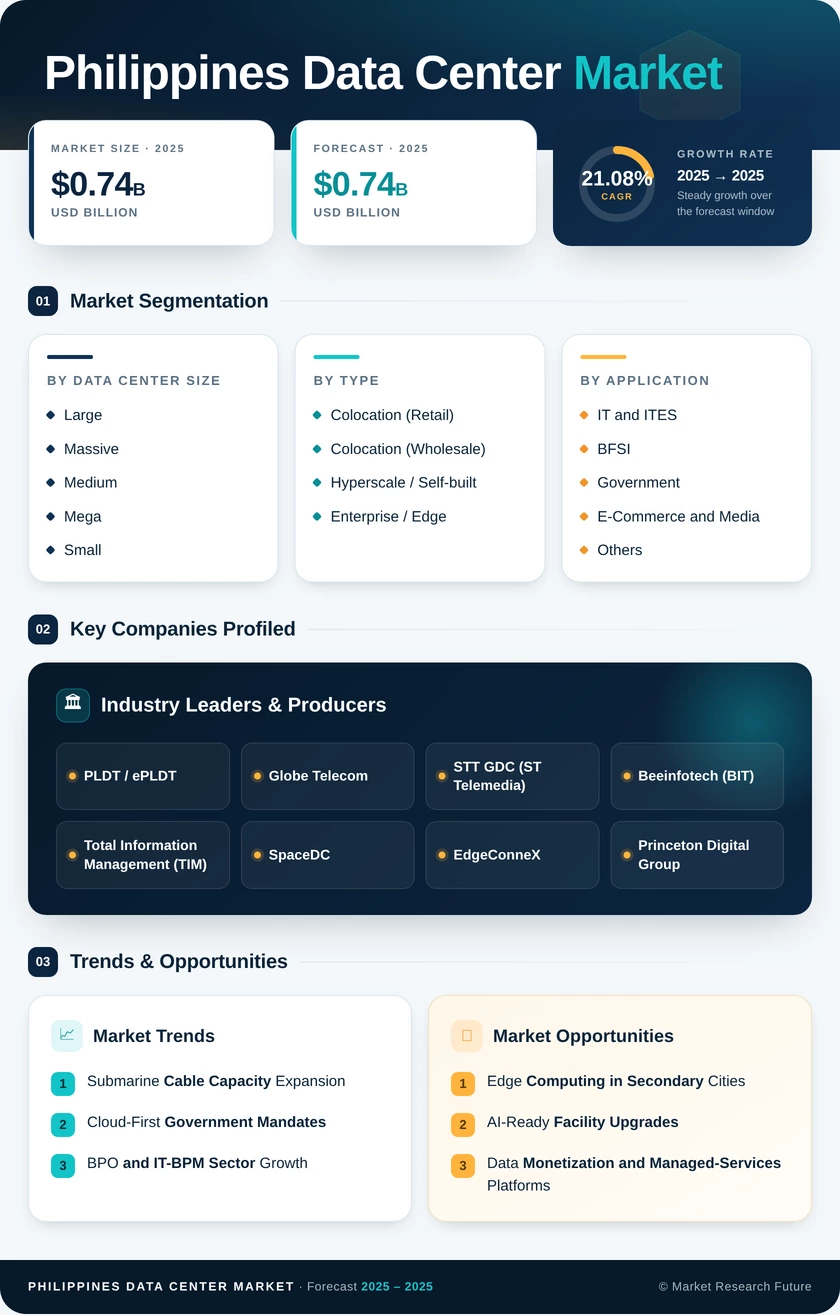
      1. 3.1.1 Submarine Cable Capacity Expansion | |
      2. 3.1.2 Cloud-First Government Mandates | |
      3. 3.1.3 BPO and IT-BPM Sector Growth | |
      4. 3.1.4 Hyperscaler Campus Investments | |
      5. 3.1.5 Digital Banking and Open-Finance Regulations | |
      6. 3.1.6 Renewable Energy Procurement Mandates | |
      7. 3.1.7 5G and Edge Computing Rollouts |
    2. 3.2 Market Restraints Analysis | |
      1. 3.2.1 Power Grid Reliability and Supply Gaps | |
      2. 3.2.2 Land Scarcity and Zoning Restrictions in Metro Manila | |
      3. 3.2.3 Skilled Workforce Shortages | |
      4. 3.2.4 Regulatory Fragmentation Across LGUs | |
      5. 3.2.5 Foreign Ownership Limitations |
    3. 3.3 Market Opportunity Analysis | |
      1. 3.3.1 Edge Computing in Secondary Cities | |
      2. 3.3.2 AI-Ready Facility Upgrades | |
      3. 3.3.3 Data Monetization and Managed-Services Platforms | |
      4. 3.3.4 Green Energy Procurement and Carbon Credits | |
      5. 3.3.5 Disaster-Recovery Hub for ASEAN |
    4. 3.4 Industry Value Chain Analysis |
    5. 3.5 Porter's Five Forces Analysis
  4. 4 Philippines Data Center Market Size & Forecast (2021–2035) |
    1. 4.1 Historical Market Size (2021–2025) |
    2. 4.2 Current & Forecast Market Size (2026–2035) |
    3. 4.3 Market Size by Revenue (USD Billion) |
    4. 4.4 Year-over-Year Growth Analysis
  5. 5 Segmentation Analysis |
    1. 5.1 By Data Center Size | |
      1. 5.1.1 Large | |
      2. 5.1.2 Massive | |
      3. 5.1.3 Medium | |
      4. 5.1.4 Mega | |
      5. 5.1.5 Small |
    2. 5.2 By Tier Type | |
      1. 5.2.1 Tier 1 and 2 | |
      2. 5.2.2 Tier 3 | |
      3. 5.2.3 Tier 4 |
    3. 5.3 By Data Center Type | |
      1. 5.3.1 Colocation — Retail Colocation | |
      2. 5.3.2 Colocation — Wholesale Colocation | |
      3. 5.3.3 Hyperscale / Self-built | |
      4. 5.3.4 Enterprise / Edge |
    4. 5.4 By End User | |
      1. 5.4.1 IT and ITES | |
      2. 5.4.2 BFSI | |
      3. 5.4.3 Government | |
      4. 5.4.4 E-Commerce and Media | |
      5. 5.4.5 Others (Healthcare, Education, Manufacturing)
  6. 6 Hotspot-Level Analysis |
    1. 6.1 Metro Manila |
    2. 6.2 Clark, Pampanga |
    3. 6.3 Bamban, Tarlac |
    4. 6.4 Laguna & Cavite |
    5. 6.5 Cebu & Visayas |
    6. 6.6 Other Emerging Hotspots (Davao, Iloilo, Batangas)
  7. 7 Competitive Landscape |
    1. 7.1 Market Share Analysis (2025) |
    2. 7.2 Competitive Benchmarking Matrix |
    3. 7.3 Company Profiles | |
      1. 7.3.1 PLDT / ePLDT | |
      2. 7.3.2 Globe Telecom | |
      3. 7.3.3 STT GDC (ST Telemedia) | |
      4. 7.3.4 Beeinfotech (BIT) | |
      5. 7.3.5 Total Information Management (TIM) | |
      6. 7.3.6 SpaceDC | |
      7. 7.3.7 EdgeConneX | |
      8. 7.3.8 Princeton Digital Group | |
      9. 7.3.9 Nayatel Philippines | |
      10. 7.3.10 YonduTech / Yondu
  8. 8 Future Outlook & Strategic Recommendations (2026–2035) |
    1. 8.1 AI and Autonomous Facility Operations |
    2. 8.2 Platform Economics and Interconnection Ecosystems |
    3. 8.3 Sustainability and ESG Reporting Integration |
    4. 8.4 Sovereign Cloud and Data-Residency Mandates
  9. 9 Recent Developments & News
  10. 10 Frequently Asked Questions (FAQs)
  11. 11 Report Scope & Methodology |
    1. 11.1 Study Period & Base Year |
    2. 11.2 Data Sources & Citations |
    3. 11.3 Abbreviations
  12. 12 LIST OF TABLES |
  13. TABLE 1 Philippines Data Center Market Size & Forecast, by Revenue (USD Billion), 2021–2035 |
  14. TABLE 2 Philippines Data Center Market — Year-over-Year Growth Analysis, 2021–2035 |
  15. TABLE 3 Philippines Data Center Market — Driver Impact Analysis |
  16. TABLE 4 Philippines Data Center Market — Restraint Impact Analysis |
  17. TABLE 5 Philippines Data Center Market Size, by Data Center Size, 2021–2035 |
  18. TABLE 6 Philippines Data Center Market Size, by Tier Type, 2021–2035 |
  19. TABLE 7 Philippines Data Center Market Size, by Data Center Type, 2021–2035 |
  20. TABLE 8 Philippines Data Center Market Size, by End User, 2021–2035 |
  21. TABLE 9 Philippines Data Center Market Size, by Hotspot, 2021–2035 |
  22. TABLE 10 Metro Manila Data Center Market Size, by Segment, 2021–2035 |
  23. TABLE 11 Clark, Pampanga Data Center Market Size, by Segment, 2021–2035 |
  24. TABLE 12 Bamban, Tarlac Data Center Market Size, by Segment, 2021–2035 |
  25. TABLE 13 Cebu & Visayas Data Center Market Size, by Segment, 2021–2035 |
  26. TABLE 14 Other Emerging Hotspots Data Center Market Size, by Segment, 2021–2035 |
  27. TABLE 15 Competitive Benchmarking Matrix — Philippines Data Center Market, 2025 |
  28. TABLE 16 Company Profiles — Key Players, Philippines Data Center Market |
  29. TABLE 17 Recent Developments & Strategic Announcements, 2023–2025 |
  30. TABLE 18 Report Scope & Methodology Summary |
  31. TABLE 19 Detailed Sources and Citations
  32. 13 LIST OF FIGURES |
  33. FIGURE 1 Philippines Data Center Market Dynamics — Drivers, Restraints, and Opportunities |
  34. FIGURE 2 Industry Value Chain Analysis — Philippines Data Center Market |
  35. FIGURE 3 Porter's Five Forces Analysis — Philippines Data Center Market |
  36. FIGURE 4 Philippines Data Center Market Size Trend (USD Billion), 2021–2035 |
  37. FIGURE 5 Philippines Data Center Market Share, by Data Center Size, 2025 |
  38. FIGURE 6 Philippines Data Center Market Share, by Tier Type, 2025 |
  39. FIGURE 7 Philippines Data Center Market Share, by Data Center Type, 2025 |
  40. FIGURE 8 Philippines Data Center Market Share, by End User, 2025 |
  41. FIGURE 9 Philippines Data Center Market Share, by Hotspot, 2025 |
  42. FIGURE 10 Philippines Data Center Market — Competitive Landscape Heat Map, 2025 |
  43. FIGURE 11 Philippines Data Center Market — Revenue Share of Top 5 Players, 2025

SEGMENTATION QUICK REFERENCE

Dimension Sub-Segments Dominant Segment Fastest Growing Segment
Data Center Size Large, Massive, Medium, Mega, Small Large (49.2% share, 2025) Medium (4.7% CAGR, 2026–2035)
Tier Type Tier 1 and 2, Tier 3, Tier 4 Tier 3 (76.2% share, 2025) Tier 4 (5.3% CAGR, 2026–2035)
Data Center Type Colocation (Retail, Wholesale), Hyperscale/Self-built, Enterprise/Edge Colocation — Retail (55.8% share, 2025) Hyperscale/Self-built (8.9% CAGR, 2026–2035)
End User IT and ITES, BFSI, Government, E-Commerce and Media, Others IT and ITES (50.3% share, 2025) BFSI (6.6% CAGR, 2026–2035)
Hotspot Metro Manila, Clark, Bamban, Laguna & Cavite, Cebu & Visayas, Others Metro Manila (25.3% share, 2025) Bamban, Tarlac (3.6% CAGR, 2026–2035)


MARKET SEGMENTATION OVERVIEW

By Data Center Size

Sub-Segment Key Trend
Large Consolidation of BPO workloads into 10–30 MW campuses
Massive Hyperscaler pre-lease activity in Clark and Bamban corridors
Medium Edge expansion into secondary cities (Cebu, Davao, Iloilo)
Mega Early-stage sovereign cloud and AI training campus planning
Small SME and startup hosting in Metro Manila coworking-adjacent sites


Large data centers continue to anchor the Philippines Data Center Market as BPO operators consolidate distributed server rooms into centralized colocation facilities, while medium-sized builds are gaining momentum in provincial hubs where digital infrastructure growth in the Philippines is opening new connectivity corridors.

By Tier Type

Sub-Segment Key Trend
Tier 1 and 2 Budget hosting for development, testing, and non-critical workloads
Tier 3 Standard for enterprise and BPO mission-critical applications
Tier 4 Mandated by BSP and DICT for financial and government data


Tier 3 remains the default specification across the Philippines Data Center Market because concurrent maintainability satisfies the uptime expectations of most colocation tenants. Tier 4 adoption is accelerating as regulatory pressure from BSP and the National Privacy Commission pushes BFSI and government clients toward fault-tolerant facility designs.

By Data Center Type

Sub-Segment Key Trend
Colocation — Retail Flexible per-rack contracts for mid-size BPOs and fintechs
Colocation — Wholesale Large-floor-plate leases for managed-service providers
Hyperscale / Self-built Global cloud provider campus builds in Clark and Bamban
Enterprise / Edge On-premises hybrid-cloud nodes in financial districts


Colocation and hyperscale data centers in Philippines collectively define the supply structure. Retail colocation leads on revenue share while hyperscale self-builds are the fastest-growing type, reflecting the arrival of global cloud providers seeking 50–100 MW campus footprints.

By End User

Sub-Segment Key Trend
IT and ITES Hybrid-cloud migration of 1.8 million BPO seats
BFSI Digital banking and open-finance data-residency compliance
Government Sovereign-cloud mandates under DICT e-Government plan
E-Commerce and Media Video streaming, gaming, and online retail workload growth
Others Healthcare digitization, edtech, smart manufacturing


BPO-driven data center demand in Philippines sustains IT and ITES as the largest end-user segment, while BFSI is forecast to grow fastest as Bangko Sentral ng Pilipinas regulations channel digital banking workloads into certified Tier 3+ colocation environments.

By Hotspot

Sub-Segment Key Trend
Metro Manila Established hub facing land and power constraints
Clark, Pampanga PEZA-incentivized hyperscaler corridor
Bamban, Tarlac Greenfield renewable-powered campus zone
Laguna & Cavite Electronics manufacturing and enterprise edge
Cebu & Visayas BPO satellite and geothermal power access
Others (Davao, Iloilo, Batangas) Nascent DR and edge nodes


Metro Manila retains dominance, but Clark and Bamban are absorbing the majority of new capacity additions as land availability and green data center investments in Philippines steer operators toward Central Luzon.