Request Free Sample ×

Kindly complete the form below to receive a free sample of this Report

* Please use a valid business email

Leading companies partner with us for data-driven Insights

clients tt-cursor
Hero Background

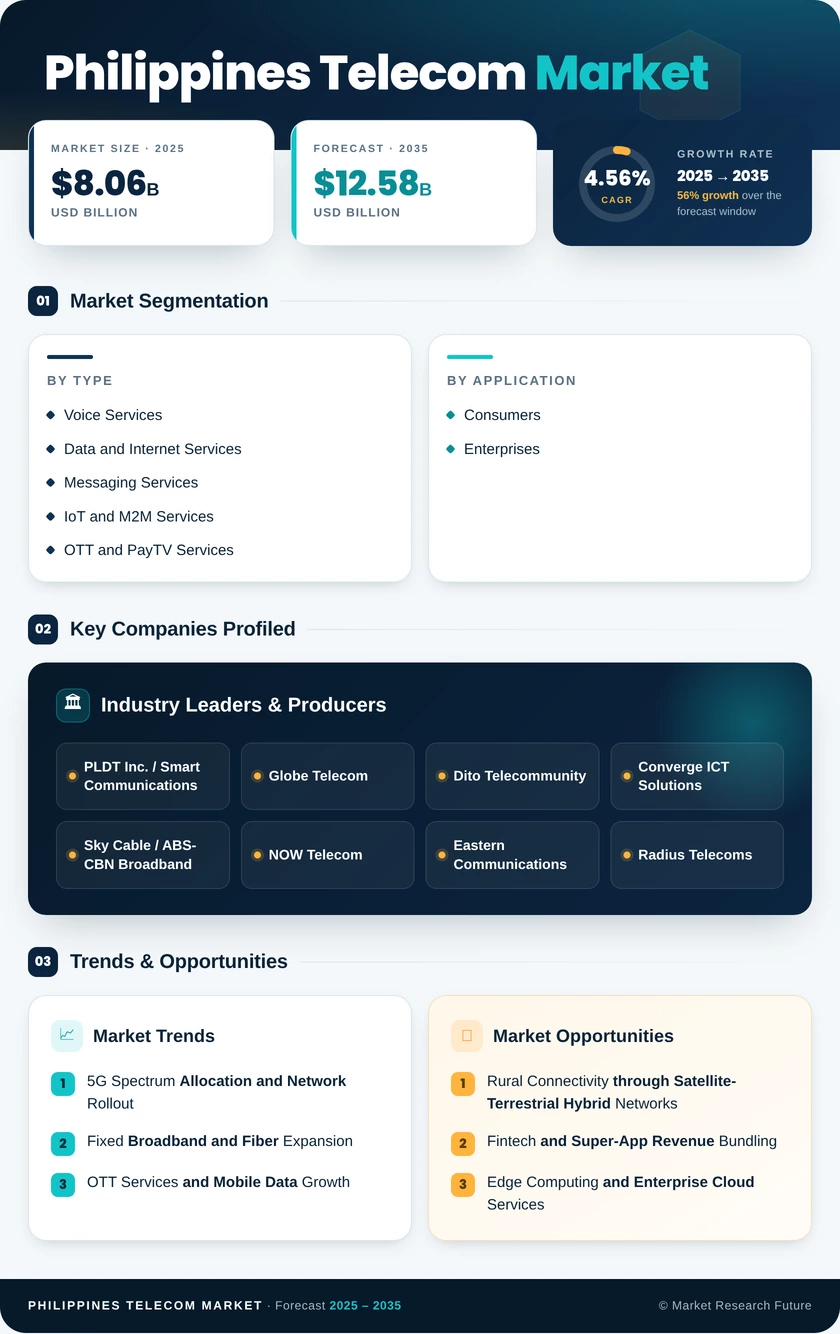
Philippines Telecom Market

ID: MRFR/ICT/22660-HCR
100 Pages
Apoorva Priyadarshi
Last Updated: May 27, 2026
Philippines Telecom Market Research Report: By Service Type (Mobile Services, Fixed Broadband Services, Pay TV Services), By Technology (4G, 5G, Fiber Optic, Satellite), By Subscriber Type (Prepaid, Postpaid), By Application (Voice, Data, Messaging), By Market Dynamics (Competition, Regulation, Technology Adoption, Economic Growth) and By Regional (North America, Europe, South America, Asia Pacific, Middle East and Africa) - Forecast to 2035.
Download PDF ×

We do not share your information with anyone. However, we may send you emails based on your report interest from time to time. You may contact us at any time to opt-out.

  1. 1 Market Overview |
    1. 1.1 Study Assumptions & Market Definition |
    2. 1.2 Scope of the Study |
    3. 1.3 Research Methodology
  2. 2 Market Summary & Key Takeaways
  3. 3 Market Dynamics |
    1. 3.1 Market Drivers Analysis | |
      1. 3.1.1 5G Spectrum Allocation and Network Rollout | |
      2. 3.1.2 Fixed Broadband and Fiber Expansion | |
      3. 3.1.3 OTT Services and Mobile Data Growth | |
      4. 3.1.4 Enterprise Digital Transformation and BPO Demand | |
      5. 3.1.5 Fintech Super-App Revenue Bundling | |
      6. 3.1.6 IoT and Smart City Deployments | |
      7. 3.1.7 Tower-Sharing and Infrastructure Reform |
    2. 3.2 Market Restraints Analysis | |
      1. 3.2.1 Typhoon Vulnerability and Network Resilience Costs | |
      2. 3.2.2 Permitting Complexity and Right-of-Way Challenges | |
      3. 3.2.3 Archipelagic Geography and Submarine Cable Dependency | |
      4. 3.2.4 Price Competition Compressing ARPU | |
      5. 3.2.5 Digital Literacy Gaps in Rural Communities |
    3. 3.3 Market Opportunity Analysis | |
      1. 3.3.1 Rural Connectivity through Satellite-Terrestrial Hybrid Networks | |
      2. 3.3.2 Fintech and Super-App Revenue Bundling | |
      3. 3.3.3 Edge Computing and Enterprise Cloud Services | |
      4. 3.3.4 OTT Content Localization and Co-Investment | |
      5. 3.3.5 Green Telecom and ESG-Linked Infrastructure Financing |
    4. 3.4 Industry Value Chain Analysis |
    5. 3.5 Porter's Five Forces Analysis
  4. 4 Philippines Telecom Market Size & Forecast (2021–2035) |
    1. 4.1 Historical Market Size (2021–2025) |
    2. 4.2 Current & Forecast Market Size (2026–2035) |
    3. 4.3 Market Size by Revenue (USD Billion) |
    4. 4.4 Year-over-Year Growth Analysis
  5. 5 Segmentation Analysis |
    1. 5.1 By Service Type | |
      1. 5.1.1 Voice Services | |
      2. 5.1.2 Data and Internet Services | |
      3. 5.1.3 Messaging Services | |
      4. 5.1.4 IoT and M2M Services | |
      5. 5.1.5 OTT and PayTV Services | |
      6. 5.1.6 Other Services |
    2. 5.2 By End User | |
      1. 5.2.1 Consumers | |
      2. 5.2.2 Enterprises
  6. 6 Regional Analysis |
    1. 6.1 National Capital Region (Metro Manila) | |
      1. 6.1.1 Makati–BGC Corridor | |
      2. 6.1.2 Quezon City | |
      3. 6.1.3 Manila Bay Area | |
      4. 6.1.4 Pasig–Mandaluyong |
    2. 6.2 Luzon (Excluding NCR) | |
      1. 6.2.1 Central Luzon (Clark–Subic) | |
      2. 6.2.2 CALABARZON | |
      3. 6.2.3 Ilocos–Cordillera | |
      4. 6.2.4 Bicol Region |
    3. 6.3 Visayas | |
      1. 6.3.1 Cebu | |
      2. 6.3.2 Iloilo | |
      3. 6.3.3 Bacolod–Negros |
    4. 6.4 Mindanao | |
      1. 6.4.1 Davao Region | |
      2. 6.4.2 Cagayan de Oro–Bukidnon | |
      3. 6.4.3 BARMM
  7. 7 Competitive Landscape |
    1. 7.1 Market Share Analysis (2025) |
    2. 7.2 Competitive Benchmarking Matrix |
    3. 7.3 Company Profiles | |
      1. 7.3.1 PLDT Inc. / Smart Communications | |
      2. 7.3.2 Globe Telecom | |
      3. 7.3.3 Dito Telecommunity | |
      4. 7.3.4 Converge ICT Solutions | |
      5. 7.3.5 Sky Cable / ABS-CBN Broadband | |
      6. 7.3.6 NOW Telecom | |
      7. 7.3.7 Eastern Communications | |
      8. 7.3.8 Radius Telecoms | |
      9. 7.3.9 InfiniVAN | |
      10. 7.3.10 Philippine Telegraph & Telephone (PT&T)
  8. 8 Future Outlook & Strategic Recommendations (2026–2035) |
    1. 8.1 AI-Driven Network Orchestration |
    2. 8.2 Platform Economics and Super-App Convergence |
    3. 8.3 Fixed-Wireless Access and Last-Mile Alternatives |
    4. 8.4 ESG Reporting and Green Infrastructure Mandates
  9. 9 Recent Developments & News
  10. 10 Frequently Asked Questions (FAQs)
  11. 11 Report Scope & Methodology |
    1. 11.1 Study Period & Base Year |
    2. 11.2 Data Sources & Citations |
    3. 11.3 Abbreviations
  12. 12 LIST OF TABLES |
  13. TABLE 1 Philippines Telecom Market Size & Forecast, by Revenue (USD Billion), 2021–2035 |
  14. TABLE 2 Philippines Telecom Market – Year-over-Year Growth Analysis, 2021–2035 |
  15. TABLE 3 Philippines Telecom Market – Driver Impact Analysis, 2026–2035 |
  16. TABLE 4 Philippines Telecom Market – Restraint Impact Analysis, 2026–2035 |
  17. TABLE 5 Philippines Telecom Market Size, by Service Type, 2021–2035 (USD Billion) |
  18. TABLE 6 Philippines Telecom Market Size, by End User, 2021–2035 (USD Billion) |
  19. TABLE 7 Philippines Telecom Market Size, by Region (NCR, Luzon, Visayas, Mindanao), 2021–2035 (USD Billion) |
  20. TABLE 8 NCR Telecom Market Size, by Sub-Area, 2021–2035 (USD Billion) |
  21. TABLE 9 Luzon (excl. NCR) Telecom Market Size, by Province/Area, 2021–2035 (USD Billion) |
  22. TABLE 10 Visayas Telecom Market Size, by Province/Area, 2021–2035 (USD Billion) |
  23. TABLE 11 Mindanao Telecom Market Size, by Province/Area, 2021–2035 (USD Billion) |
  24. TABLE 12 Competitive Benchmarking Matrix – Philippines Telecom Market, 2025 |
  25. TABLE 13 Company Profiles – Key Players, Philippines Telecom Market |
  26. TABLE 14 Recent Developments & Strategic Announcements, 2023–2025 |
  27. TABLE 15 Report Scope and Methodology Summary |
  28. TABLE 16 Detailed Sources and Citations
  29. 13 LIST OF FIGURES |
  30. FIGURE 1 Philippines Telecom Market Dynamics – Drivers, Restraints, Opportunities |
  31. FIGURE 2 Value Chain Analysis – Philippines Telecom Industry |
  32. FIGURE 3 Porter's Five Forces Analysis – Philippines Telecom Market |
  33. FIGURE 4 Philippines Telecom Market Size Trend (USD Billion), 2021–2035 |
  34. FIGURE 5 Philippines Telecom Market Share, by Service Type (%), 2025 |
  35. FIGURE 6 Philippines Telecom Market Share, by End User (%), 2025 |
  36. FIGURE 7 Philippines Telecom Market Revenue Share, by Region (%), 2025 |
  37. FIGURE 8 Philippines Telecom Market Revenue, by Region (USD Billion), 2025 vs 2035 |
  38. FIGURE 9 Competitive Landscape – Market Share Distribution, 2025 |
  39. FIGURE 10 Key Player Positioning Map – Philippines Telecom Market

Segmentation Quick Reference

DimensionSub-SegmentsDominant SegmentFastest Growing Segment
By Service TypeVoice Services, Data and Internet Services, Messaging Services, IoT and M2M Services, OTT and PayTV Services, Other ServicesData and Internet ServicesIoT and M2M Services
By End UserConsumers, EnterprisesConsumersEnterprises


Market Segmentation Overview

By Service Type

Sub-SegmentKey Trend
Voice ServicesDeclining share as VoIP and OTT voice substitution accelerates
Data and Internet ServicesDominant and growing, driven by video streaming and mobile-first internet usage
Messaging ServicesShrinking due to OTT messaging app dominance (Messenger, Viber)
IoT and M2M ServicesFastest-growing segment; smart city pilots and industrial IoT expanding addressable base
OTT and PayTV ServicesRapid subscriber additions from Netflix, Viu, and local Filipino content platforms
Other ServicesIncludes VAS, premium content, and enterprise managed services


Data and internet services account for the largest portion of telecom operator revenue in the Philippines, reflecting the population's mobile-first digital behavior and rising smartphone penetration. IoT and M2M services are gaining traction through government-backed smart city initiatives and private-sector agricultural monitoring deployments across Mindanao.

By End User

Sub-SegmentKey Trend
ConsumersPrepaid mobile dominance with growing fiber broadband adoption in urban areas
EnterprisesBPO and fintech-driven demand for dedicated bandwidth, SD-WAN, and cloud connectivity


The consumer segment's overwhelming share reflects the Philippines' large, young, mobile-connected population. Enterprise connectivity is the primary growth vector, propelled by the BPO sector's need for resilient, low-latency infrastructure and the broader migration toward cloud-native business operations across the ASEAN region.