×
Request Free Sample ×

Kindly complete the form below to receive a free sample of this Report

* Please use a valid business email

Leading companies partner with us for data-driven Insights

clients tt-cursor
Hero Background

Plastic Pigments Market

ID: MRFR/CnM/5757-HCR
140 Pages
Anshula Mandaokar
October 2025

Plastic Pigments Market Research Report Information by Type (Organic Pigments, Inorganic Pigments, and Specialty Pigments), Application (Packaging, Automotive, Construction, Healthcare, Consumer Goods), and Region (Asia-Pacific, North America) — Forecast till 2035

Share:
Download PDF ×

We do not share your information with anyone. However, we may send you emails based on your report interest from time to time. You may contact us at any time to opt-out.

Plastic Pigments Market Infographic
Purchase Options

Plastic Pigments Market Summary

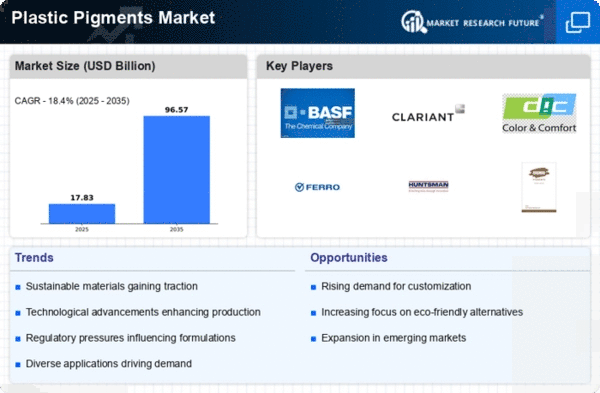
As per MRFR analysis, the Plastic Pigments Market Size was estimated at 15.06 USD Billion in 2024. The Plastic Pigments industry is projected to grow from 17.83 USD Billion in 2025 to 96.57 USD Billion by 2035, exhibiting a compound annual growth rate (CAGR) of 18.4 during the forecast period 2025 - 2035.

Key Market Trends & Highlights

The Plastic Pigments Market is experiencing a dynamic shift towards sustainability and innovation.

  • North America remains the largest market for plastic pigments, driven by robust demand across various industries.
  • Asia-Pacific is identified as the fastest-growing region, reflecting increasing industrialization and urbanization.
  • The plastics segment continues to dominate the market, while the coatings segment is witnessing rapid growth due to evolving consumer preferences.
  • Sustainability initiatives and technological innovations are key drivers propelling market expansion and diversification.

Market Size & Forecast

2024 Market Size 15.06 (USD Billion)
2035 Market Size 96.57 (USD Billion)
CAGR (2025 - 2035) 18.4%

Major Players

BASF SE (DE), Clariant AG (CH), DIC Corporation (JP), Huntsman Corporation (US), Lanxess AG (DE), SABIC (SA), Sun Chemical Corporation (US), Tosoh Corporation (JP), Kraton Corporation (US)

Plastic Pigments Market Trends

The Plastic Pigments Market is currently experiencing a dynamic evolution, driven by various factors that influence demand and supply. The increasing emphasis on sustainability and eco-friendly products appears to be reshaping the landscape of this market. Manufacturers are increasingly focusing on developing pigments that are not only vibrant but also environmentally benign. This shift towards sustainable practices may lead to a rise in the adoption of natural pigments, which could potentially alter traditional production methods. Furthermore, the growing application of plastic pigments across diverse industries, including automotive, packaging, and textiles, suggests a broadening scope for market expansion. As industries seek to enhance aesthetic appeal and functionality, the demand for innovative pigment solutions is likely to intensify. In addition, advancements in technology are playing a crucial role in the evolution of the Plastic Pigments Market. Innovations in production techniques and formulations may enhance the performance characteristics of pigments, making them more appealing to manufacturers. The trend towards customization, where clients seek specific colors and properties, indicates a shift in consumer preferences. This could lead to a more tailored approach in pigment production, fostering closer collaboration between suppliers and end-users. Overall, the Plastic Pigments Market appears poised for growth, with sustainability and technological advancements at the forefront of its development.

Sustainability Focus

The emphasis on eco-friendly products is reshaping the Plastic Pigments Market. Manufacturers are increasingly developing sustainable pigments, which may lead to a rise in natural alternatives and a shift in production practices.

Technological Advancements

Innovations in production techniques are enhancing pigment performance. This trend suggests that manufacturers may offer more customized solutions, aligning with the specific needs of various industries.

Diverse Applications

The expanding use of plastic pigments across multiple sectors, such as automotive and packaging, indicates a growing market. This diversification may drive demand for innovative pigment solutions that enhance both aesthetics and functionality.

Plastic Pigments Market Drivers

Growth of the E-commerce Sector

The rise of the e-commerce sector is significantly influencing the Global Plastic Pigments Market Industry. Online platforms provide manufacturers with a broader reach, enabling them to market their products to a global audience. This shift in consumer purchasing behavior is driving demand for a variety of pigments, as businesses seek to enhance their product packaging and branding. The convenience of online shopping allows consumers to access a wider range of pigment options, further stimulating market growth. As e-commerce continues to expand, it is likely to play a crucial role in shaping the future landscape of the plastic pigments market.

Rising Demand for Sustainable Solutions

The Global Plastic Pigments Market Industry is witnessing a surge in demand for sustainable and eco-friendly products. As consumers become increasingly aware of environmental issues, manufacturers are compelled to adopt sustainable practices. This shift is evident in the growing preference for bio-based pigments and recyclable materials. For instance, companies are investing in research to develop pigments derived from natural sources, which aligns with global sustainability goals. This trend is expected to contribute to the market's growth, with projections indicating a market value of 11.3 USD Billion in 2024, reflecting the industry's adaptation to consumer preferences.

Expanding Applications in Various Industries

The versatility of plastic pigments is a key driver in the Global Plastic Pigments Market Industry. These pigments find applications across diverse sectors, including packaging, automotive, and construction. The packaging industry, in particular, is experiencing significant growth, as colorful and visually appealing packaging enhances product appeal. Additionally, the automotive sector is increasingly utilizing pigments for aesthetic and functional purposes, such as UV protection. This broad range of applications is expected to propel the market forward, with a compound annual growth rate of 5.58% projected from 2025 to 2035.

Regulatory Support for Colorants and Pigments

Regulatory frameworks are increasingly supporting the use of safe and compliant colorants in the Global Plastic Pigments Market Industry. Governments worldwide are implementing stringent regulations to ensure that pigments meet safety and environmental standards. This regulatory support encourages manufacturers to invest in high-quality, compliant pigments, fostering innovation and enhancing product offerings. As a result, the market is likely to benefit from increased consumer trust and demand for compliant products. This trend is expected to contribute to the overall growth of the market, aligning with global sustainability initiatives.

Technological Advancements in Pigment Production

Technological innovations play a pivotal role in shaping the Global Plastic Pigments Market Industry. Advances in production techniques, such as nanotechnology and digital printing, enhance the quality and performance of pigments. These innovations allow for the creation of pigments with superior properties, such as increased durability and colorfastness. Furthermore, the integration of automation in manufacturing processes leads to cost reductions and improved efficiency. As a result, the market is likely to experience substantial growth, with a projected value of 20.5 USD Billion by 2035, driven by these technological advancements.

Market Segment Insights

By Application: Plastics (Largest) vs. Coatings (Fastest-Growing)

In the Plastic Pigments Market, the application segments showcase a diverse distribution of market share. Plastics hold the largest share due to the extensive use of pigments in various plastic products, enhancing their aesthetics and functional properties. Coatings also represent a significant portion of the market, benefiting from the growing demand for protective and decorative finishes across industries. Inks, textiles, and construction, while valuable segments, follow behind in contribution yet play essential roles in niche markets.

Plastics (Dominant) vs. Coatings (Emerging)

The plastics segment dominates the Plastic Pigments Market, characterized by its vast applications across consumer goods, packaging, and automotive sectors. As plastics continue to evolve with advancements in technology, pigments are essential for defining colors and improving product durability. On the other hand, coatings are emerging quickly, driven by rapid developments in the construction and automotive industries. These coatings require specialized pigments to achieve desired functional traits, such as UV stability and corrosion resistance, making this segment increasingly significant in market growth.

By End Use Industry: Packaging (Largest) vs. Automotive (Fastest-Growing)

The Plastic Pigments Market is characterized by distinct usage across various end-use industries, with Packaging leading the way. This sector is pivotal due to its essential role in product visibility and branding, resulting in a significant market share. Following close behind are the Automotive and Consumer Goods industries, which collectively contribute to the diverse applications of plastic pigments. Electronics and Construction industries, while participating in the market, hold smaller shares compared to the leading segments. Overall, the distribution underscores a reliance on vibrant pigments for consumer appeal and product differentiation across multiple channels.

Packaging (Dominant) vs. Automotive (Emerging)

The Packaging industry stands out as a dominant force within the Plastic Pigments Market, driven by ever-increasing demand for visually appealing, sustainable, and functional packaging solutions. It leverages a wide range of pigments to enhance aesthetic appeal and brand identity, meeting consumer preferences for colorful and innovative designs. In contrast, the Automotive sector is emerging as a significant player, driven by technological advancements and the industry's push for lightweight materials and energy-efficient, durable solutions. As automotive manufacturers integrate pigments into innovative designs that enhance vehicle aesthetics and performance, the sector is projected to grow rapidly, adopting new shades and environmentally friendly options.

By Type: Organic Pigments (Largest) vs. Specialty Pigments (Fastest-Growing)

In the Plastic Pigments Market, the distribution of market share among various pigment types shows organic pigments holding the largest share due to their widespread use in applications requiring high-performance color solutions. Inorganic pigments also play a significant role, focusing on cost-effectiveness and durability, while specialty pigments capture niche markets with unique properties. Fluorescent and metallic pigments, though smaller, contribute to specialized applications like safety markings and decorative coatings. Growth trends indicate that the demand for organic pigments remains robust, driven by their eco-friendliness and versatility across industries such as automotive and packaging. Specialty pigments are witnessing rapid growth, led by innovations in technology and increased demand for custom colors and special effects in plastic products.

Organic Pigments (Dominant) vs. Specialty Pigments (Emerging)

Organic pigments are recognized for their vibrancy and high-performance characteristics, making them the dominant choice in the Plastic Pigments Market. They are primarily derived from natural sources or synthesized and are preferred for applications where color fidelity and environmental sustainability are key. Specialty pigments, on the other hand, are emerging as a significant force, catering to specific market needs such as enhanced durability, temperature resistance, and unique aesthetic qualities. Their ability to provide tailored solutions to manufacturers enhances their appeal, making them an important area of growth within the market.

By Form: Powder (Largest) vs. Liquid (Fastest-Growing)

In the Plastic Pigments Market, the segmentation by form reveals a dynamic range of options, with powder pigments currently holding the largest market share due to their widespread application in various plastic manufacturing processes. Granules and concentrates also contribute significantly to this sector, providing essential properties needed for diverse applications. The liquid form, while traditionally less dominant, is gaining traction and is projected to capture an increasing share as technological advancements cater to the demand for more versatile pigment solutions.

Powder (Dominant) vs. Liquid (Emerging)

Powder pigments remain the dominant force in the Plastic Pigments Market, characterized by their versatility and compatibility with multiple plastic types, including thermoplastics and thermosetting plastics. Their ability to deliver vibrant colors while maintaining stability during processing makes them indispensable for manufacturers. On the other hand, liquid pigments are emerging as a preferred choice for certain applications due to their ease of use and quick dispersion in plastics, making them suitable for specialty products. As consumers demand more sustainable and efficient manufacturing processes, liquid pigments are increasingly gaining attention, signifying an evolving preference in the market.

By Color: Red (Largest) vs. Blue (Fastest-Growing)

The Plastic Pigments Market showcases a distinctive division in its 'Color' segment. Red is currently the largest player, commanding a significant share of the market while maintaining its popularity across various applications ranging from construction materials to consumer products. Blue follows closely, offering vibrant hues that are particularly favored in the automotive and packaging industries, contributing to its growing presence within the segment.

Red (Dominant) vs. Blue (Emerging)

Red pigments are recognized for their versatility and vibrant appearance, dominating the Plastic Pigments Market due to their extensive use in construction, toys, and consumer goods. This segment benefits from a diverse range of applications, enabling it to sustain its leading position. In contrast, Blue pigments have emerged as a dynamic force within the market, especially driven by innovations in formulation and environmentally-friendly alternatives. Their increased use in packaging and automotive sectors reflects broader sustainability trends, positioning Blue as an increasingly important color choice, particularly among manufacturers aiming to attract environmentally conscious consumers.

Get more detailed insights about Plastic Pigments Market

Regional Insights

North America : Stable Growth Environment

The North American plastic pigments market is projected to reach $3.5 billion by 2025, driven by increasing demand in the packaging and automotive sectors. Regulatory support for sustainable practices is also a key growth driver, as companies seek eco-friendly pigment solutions. The region's focus on innovation and technology further enhances market dynamics, with a growing emphasis on high-performance pigments that meet stringent environmental standards. Leading countries in this region include the US and Canada, where major players like BASF SE and Huntsman Corporation are actively expanding their product portfolios. The competitive landscape is characterized by strategic partnerships and mergers, aimed at enhancing market share and technological capabilities. The presence of established companies ensures a robust supply chain, catering to diverse applications across various industries.

Europe : Innovation and Sustainability Focus

Europe's plastic pigments market is valued at $3.0 billion, with a strong emphasis on sustainability and innovation. The region is witnessing a shift towards eco-friendly pigments, driven by stringent regulations and consumer demand for sustainable products. The European Union's Green Deal and REACH regulations are pivotal in shaping market dynamics, encouraging manufacturers to adopt greener practices and materials. Germany, France, and Italy are the leading countries in this market, hosting key players like Clariant AG and Lanxess AG. The competitive landscape is marked by a focus on R&D, with companies investing heavily in developing advanced pigments that meet both performance and environmental standards. This innovation-driven approach positions Europe as a leader in The Plastic Pigments.

Asia-Pacific : Dominant Market Leader

Asia-Pacific is the largest market for plastic pigments, with a valuation of $8.0 billion in 2024. The region's rapid industrialization and urbanization are key growth drivers, leading to increased demand in sectors such as packaging, automotive, and construction. Additionally, favorable government policies and investments in infrastructure are catalyzing market expansion, making it a focal point for global manufacturers. China, Japan, and India are the leading countries in this region, with significant contributions from companies like DIC Corporation and Tosoh Corporation. The competitive landscape is characterized by a mix of local and international players, all vying for market share. The presence of established manufacturers and a growing number of startups are fostering innovation and enhancing product offerings in the plastic pigments market.

Middle East and Africa : Emerging Market Potential

The Middle East and Africa (MEA) plastic pigments market is valued at $0.56 billion, showcasing significant growth potential. The region is experiencing increased demand for plastic pigments driven by expanding manufacturing sectors and rising consumer goods production. Government initiatives aimed at diversifying economies and boosting local manufacturing are also contributing to market growth, creating opportunities for both local and international players. Countries like South Africa and the UAE are leading the market, with a growing presence of key players such as SABIC and Kraton Corporation. The competitive landscape is evolving, with new entrants and established companies focusing on innovation and sustainability. As the region continues to develop, the demand for high-quality plastic pigments is expected to rise, further enhancing market dynamics.

Key Players and Competitive Insights

The Plastic Pigments Market is characterized by a dynamic competitive landscape, driven by increasing demand for high-performance pigments across various applications, including packaging, automotive, and consumer goods. Key players such as BASF SE (DE), Clariant AG (CH), and DIC Corporation (JP) are strategically positioned to leverage innovation and sustainability initiatives. These companies are focusing on enhancing their product portfolios through research and development, while also pursuing strategic partnerships to expand their market reach. The collective efforts of these firms contribute to a moderately fragmented market structure, where competition is intensifying as companies seek to differentiate themselves through advanced technologies and sustainable practices.

In terms of business tactics, companies are increasingly localizing manufacturing to reduce lead times and optimize supply chains. This approach not only enhances operational efficiency but also allows for better responsiveness to regional market demands. The competitive structure of the market remains moderately fragmented, with several key players exerting influence over pricing and product offerings. The interplay between these companies shapes the overall market dynamics, as they navigate challenges such as raw material costs and regulatory compliance.

In November 2025, Clariant AG (CH) announced the launch of a new line of sustainable pigments derived from renewable resources. This strategic move underscores Clariant's commitment to sustainability and positions the company to meet the growing demand for eco-friendly products. By focusing on renewable materials, Clariant aims to capture a larger share of the market, appealing to environmentally conscious consumers and businesses alike.

In October 2025, BASF SE (DE) expanded its production capacity for high-performance pigments in Asia. This expansion is significant as it not only enhances BASF's ability to meet increasing regional demand but also strengthens its competitive position in the global market. The investment reflects BASF's strategy to capitalize on growth opportunities in emerging markets, where demand for advanced pigments is on the rise.

In September 2025, DIC Corporation (JP) entered into a strategic partnership with a leading technology firm to develop AI-driven solutions for pigment formulation. This collaboration is poised to revolutionize the way pigments are developed and tailored for specific applications, potentially leading to enhanced product performance and reduced time-to-market. DIC's focus on integrating technology into its operations indicates a forward-thinking approach that may set new industry standards.

As of December 2025, current trends in the Plastic Pigments Market are increasingly defined by digitalization, sustainability, and the integration of advanced technologies such as AI. Strategic alliances are becoming more prevalent, enabling companies to pool resources and expertise to drive innovation. The competitive landscape is shifting from traditional price-based competition to a focus on technological advancements and supply chain reliability. This evolution suggests that companies that prioritize innovation and sustainability will likely emerge as leaders in the market, shaping the future of the industry.

Key Companies in the Plastic Pigments Market market include

Industry Developments

In June 2023, BASF announced the launch of its new range of high-performance plastic pigments for use in automotive applications. The pigments are said to offer excellent weatherability, heat resistance, and chemical resistance.

In July 2023, Clariant announced the acquisition of the pigments business of Evonik. The acquisition is expected to strengthen Clariant's position in the plastic pigments market.

In August 2023, Lanxess announced the launch of its new range of sustainable plastic pigments. The pigments are said to be made from renewable raw materials and are designed to meet the growing demand for sustainable plastics.

Intended Audience

    • Traders and distributors of Plastic Pigments Market
    • Research and development institutes
    • Potential investors
    • Raw material suppliers
    • Nationalized laboratories

Future Outlook

Plastic Pigments Market Future Outlook

The Plastic Pigments Market is projected to grow at an 18.4% CAGR from 2024 to 2035, driven by increasing demand for sustainable and vibrant color solutions across various industries.

New opportunities lie in:

  • Development of bio-based plastic pigments to meet sustainability goals.
  • Expansion into emerging markets with tailored pigment solutions.
  • Investment in advanced manufacturing technologies for cost efficiency.

By 2035, the Plastic Pigments Market is expected to achieve substantial growth, reflecting evolving consumer preferences and technological advancements.

Market Segmentation

Plastic Pigments Market Form Outlook

  • Powder
  • Granules
  • Liquid
  • Paste
  • Concentrate

Plastic Pigments Market Type Outlook

  • Organic Pigments
  • Inorganic Pigments
  • Specialty Pigments
  • Fluorescent Pigments
  • Metallic Pigments

Plastic Pigments Market Color Outlook

  • Red
  • Blue
  • Green
  • Yellow
  • Black

Plastic Pigments Market Application Outlook

  • Plastics
  • Coatings
  • Inks
  • Textiles
  • Construction

Plastic Pigments Market End Use Industry Outlook

  • Automotive
  • Consumer Goods
  • Packaging
  • Electronics
  • Construction

Report Scope

MARKET SIZE 202415.06(USD Billion)
MARKET SIZE 202517.83(USD Billion)
MARKET SIZE 203596.57(USD Billion)
COMPOUND ANNUAL GROWTH RATE (CAGR)18.4% (2024 - 2035)
REPORT COVERAGERevenue Forecast, Competitive Landscape, Growth Factors, and Trends
BASE YEAR2024
Market Forecast Period2025 - 2035
Historical Data2019 - 2024
Market Forecast UnitsUSD Billion
Key Companies ProfiledBASF SE (DE), Clariant AG (CH), DIC Corporation (JP), Huntsman Corporation (US), Lanxess AG (DE), SABIC (SA), Sun Chemical Corporation (US), Tosoh Corporation (JP), Kraton Corporation (US)
Segments CoveredApplication, End Use Industry, Type, Form, Color
Key Market OpportunitiesGrowing demand for eco-friendly pigments drives innovation in the Plastic Pigments Market.
Key Market DynamicsRising demand for eco-friendly plastic pigments drives innovation and regulatory compliance in the industry.
Countries CoveredNorth America, Europe, APAC, South America, MEA

Market Highlights

Author
Anshula Mandaokar
Team Lead - Research

Anshula Mandaokar holds an academic degree in Chemical Engineering and has been contributing to the field for more than 5 years. She has expertise in Market Research and Business Consulting and serves as a Team Lead for a reputed Market Research firm under the Chemicals and Materials domain spectrum. She has worked on multiple projects, generating explicit results in a quick turnaround time. Her understanding of data interpretation justifies her role as a leader.

Leave a Comment

FAQs

What are the main types of plastic pigments?

Organic, Inorganic, and Specialty Pigments are the main types of plastic pigments.

What are the major applications of plastic pigments?

Packaging, construction, automotive, healthcare, and consumer goods are the major applications of plastic pigments.

Which are the leading segments in the global plastic pigments market?

Based on type, the inorganic pigments segment and based on application, the packaging segment account for leading shares in the global plastic pigments market.

Which region holds the largest share in the global Plastic pigments market?

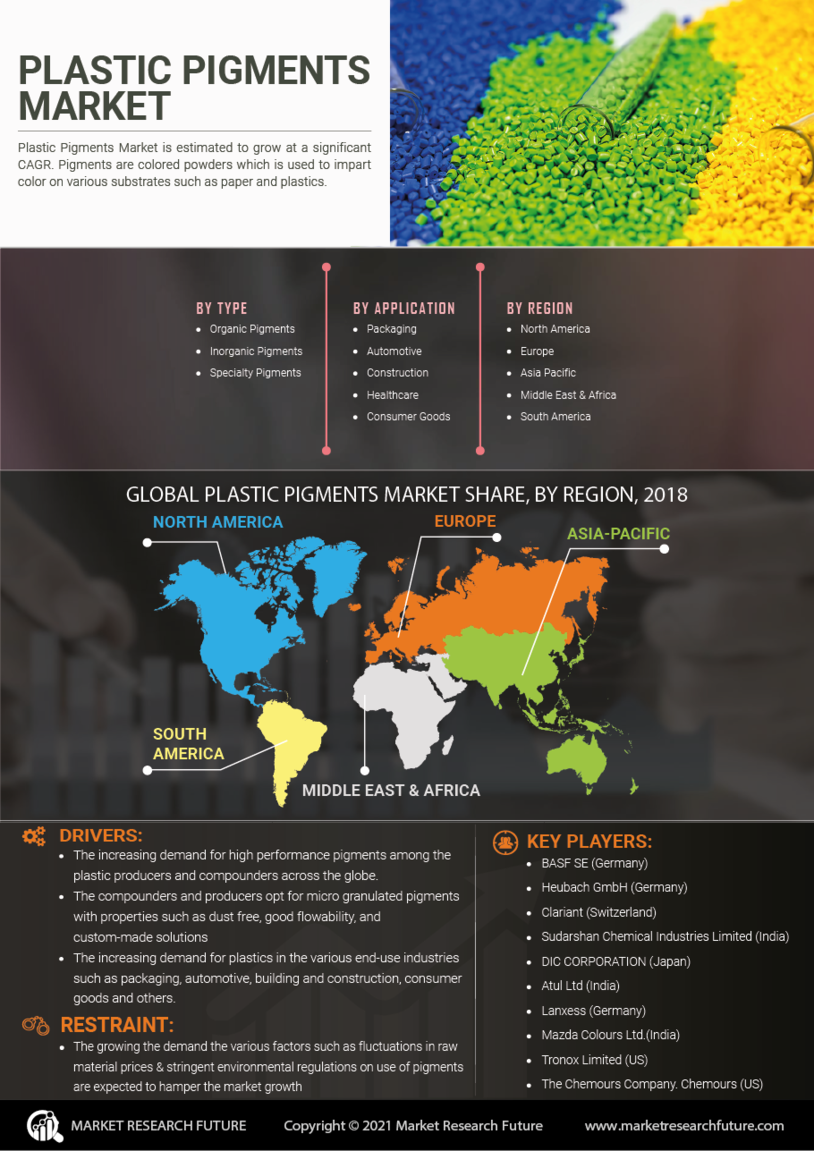
Asia Pacific holds the largest share in the global Plastic pigments market, followed by North America and Europe, respectively.

Who are the top players in the global plastic pigments market?

Heubach GmbH (Germany), BASF SE (Germany), Clariant (Switzerland), DIC CORPORATION (Japan), Sudarshan Chemical Industries Limited (India), Atul Ltd (India), Mazda Colours Ltd.(India), Lanxess (Germany), Tronox Limited (US), and The Chemours Company (US), are some of the major players operating in the plastic pigments market.

Download Free Sample

Kindly complete the form below to receive a free sample of this Report

Compare Licence

×
Features License Type
Single User Multiuser License Enterprise User
Price $4,950 $5,950 $7,250
Maximum User Access Limit 1 User Upto 10 Users Unrestricted Access Throughout the Organization
Free Customization
Direct Access to Analyst
Deliverable Format
Platform Access
Discount on Next Purchase 10% 15% 15%
Printable Versions