Download Free Sample
Kindly complete the form below to receive a free sample of this Report
Plumbing Services Market Size, Share and Trends Analysis Research Report Information By End User (Residential, Commercial, Industrial, Institutional), By Technology (Traditional, Smart, Eco-Friendly), By Service Type (Installation, Repair, Maintenance, Emergency Services), By Service Model (On-Demand, Contractual, Subscription Services), By Market Segment (New Construction, Renovation, Retrofit), And By Region – Market Forecast Till 2035.
As per MRFR analysis, the Plumbing Services Market was estimated at 120.0 USD Billion in 2024. The plumbing industry is projected to grow from 123.18 USD Billion in 2025 to 160.0 USD Billion by 2035, exhibiting a compound annual growth rate (CAGR) of 2.65% during the forecast period 2025 - 2035.
The Plumbing Services Market is experiencing a dynamic shift driven by technological advancements and changing consumer preferences.
| 2024 Market Size | 120.0 (USD Billion) |
| 2035 Market Size | 160.0 (USD Billion) |
| CAGR (2025 - 2035) | 2.65% |
Roto-Rooter (US), Mr. Rooter (US), Benjamin Franklin Plumbing (US), ARS Rescue Rooter (US), Bluefrog Plumbing + Drain (US), Rooter-Man (US), Hoffman Plumbing (US), Plumbing Solutions (US)
Our Impact
Enabled $4.3B Revenue Impact for Fortune 500 and Leading Multinationals
Partnering with 2000+ Global Organizations Each Year
30K+ Citations by Top-Tier Firms in the Industry
The Plumbing Services Market is currently experiencing a dynamic evolution, driven by various factors that influence consumer behavior and industry practices. As urbanization continues to expand, the demand for reliable plumbing services is likely to increase, particularly in densely populated areas. This trend appears to be fueled by the growing need for infrastructure development, which necessitates the installation and maintenance of plumbing systems. Additionally, advancements in technology are reshaping service delivery, enabling providers to offer more efficient and effective solutions. The integration of smart technologies into plumbing systems may enhance operational efficiency and customer satisfaction, suggesting a shift towards more innovative service offerings. Moreover, environmental concerns are prompting a shift towards sustainable practices within the Plumbing Services Market. Consumers are increasingly aware of the importance of water conservation and energy efficiency, which may lead to a higher demand for eco-friendly plumbing solutions. This trend indicates a potential for growth in services that focus on green technologies and sustainable materials. As the market adapts to these evolving demands, it is essential for service providers to remain agile and responsive to the changing landscape, ensuring they meet the expectations of a more environmentally conscious clientele.
The Plumbing Services Market is witnessing a notable trend towards the integration of advanced technologies. This includes the adoption of smart plumbing systems that utilize IoT devices for monitoring and maintenance. Such innovations not only enhance efficiency but also provide real-time data to both service providers and consumers, potentially leading to improved service delivery.
There is a growing emphasis on sustainability within the Plumbing Services Market. Consumers are increasingly seeking eco-friendly solutions that promote water conservation and energy efficiency. This trend suggests a shift towards the use of sustainable materials and practices, which may influence service offerings and customer preferences.
The ongoing trend of urbanization is significantly impacting the Plumbing Services Market. As more individuals migrate to urban areas, the demand for reliable plumbing services is likely to rise. This shift may necessitate the expansion of infrastructure and the development of new plumbing solutions to accommodate the needs of densely populated regions.
The Plumbing Services Market is experiencing a notable increase in demand due to aging infrastructure in residential and commercial buildings. Many regions are grappling with outdated plumbing systems that require urgent repairs and replacements. According to recent estimates, a significant portion of plumbing systems in developed areas is over 50 years old, leading to frequent leaks and failures. This situation compels property owners to seek professional plumbing services to ensure safety and compliance with modern standards. As municipalities allocate funds for infrastructure upgrades, the Plumbing Services Market stands to benefit from increased contracts and service requests, thereby driving growth in this sector.
The Plumbing Services Market is increasingly shaped by stringent environmental regulations aimed at promoting sustainability. Governments are implementing policies that encourage water conservation and the use of eco-friendly plumbing materials. This shift is prompting consumers to seek plumbing services that align with these regulations, such as the installation of low-flow fixtures and water-efficient systems. Recent reports suggest that the demand for green plumbing solutions is on the rise, as consumers become more environmentally conscious. Consequently, the Plumbing Services Market is likely to benefit from this trend, as service providers adapt their offerings to meet the evolving preferences of eco-aware customers.
The Plumbing Services Market is likely to see a surge in demand as property ownership rates continue to rise. With more individuals investing in homes, the need for plumbing installations, maintenance, and emergency repairs becomes paramount. Recent data indicates that homeownership rates have increased, particularly among younger demographics, who are more inclined to purchase properties. This trend creates a robust market for plumbing services, as new homeowners often require comprehensive plumbing inspections and upgrades to meet their needs. Consequently, the Plumbing Services Market is positioned to capitalize on this growing customer base, enhancing its service offerings to cater to diverse property types.
The Plumbing Services Market is undergoing a transformation due to technological advancements that enhance service delivery. Innovations such as smart plumbing systems, leak detection sensors, and advanced diagnostic tools are becoming more prevalent. These technologies not only improve efficiency but also reduce costs for both service providers and consumers. For instance, the integration of IoT devices allows for real-time monitoring of plumbing systems, enabling proactive maintenance. As these technologies gain traction, the Plumbing Services Market is expected to expand, attracting tech-savvy consumers who seek modern solutions for their plumbing needs.
The Plumbing Services Market is influenced by heightened awareness of health and safety standards among consumers. As public health concerns become more pronounced, the demand for reliable plumbing services has escalated. Proper plumbing systems are essential for maintaining hygiene and preventing waterborne diseases. Recent surveys indicate that consumers are increasingly prioritizing plumbing inspections and upgrades to ensure compliance with health regulations. This trend is particularly evident in commercial establishments, where adherence to health codes is critical. As a result, the Plumbing Services Market is likely to experience growth driven by the necessity for safe and efficient plumbing solutions.
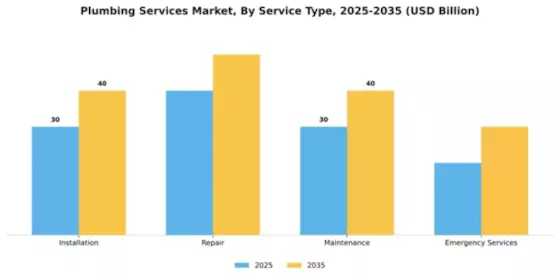
Within the Plumbing Services Market, the Installation segment holds the largest share, reflecting a steady demand driven by new constructions and renovations. Conversely, the Repair and Maintenance segments also show significant contributions but are overshadowed by the sheer volume of installations. Emergency Services, though smaller in market share, are rapidly gaining traction, highlighting the dynamic nature of consumer needs in the plumbing sector. These shifts in service preferences indicate a nuanced understanding of market demands, with Installation remaining a cornerstone of the industry. As urban development continues and environmental standards evolve, the growth of Emergency Services is driven by increasing awareness of plumbing issues and the necessity for immediate solutions. Homeowners are becoming more proactive in addressing potential plumbing crises, leading to a burgeoning demand for rapid-response services. This trend is indicative of a broader inclination towards comprehensive home care, where timely interventions are prioritized to prevent extensive damage and maintain property value.
Installation (Dominant) vs. Maintenance (Emerging)
The Installation segment in the Plumbing Services Market is characterized by its foundational role in new building projects and major renovations. With a wide range of applications, from residential to commercial establishments, this segment enjoys unyielding demand as new infrastructure continues to rise. On the other hand, the Maintenance segment is seen as emerging due to the growing emphasis on sustainable plumbing operations and efficient upkeep of existing systems. Customers are increasingly investing in maintenance to extend the lifespan of their plumbing infrastructure, which speaks to a shift in consumer behavior towards preventive measures, ultimately protecting their investments and enhancing service reliability.
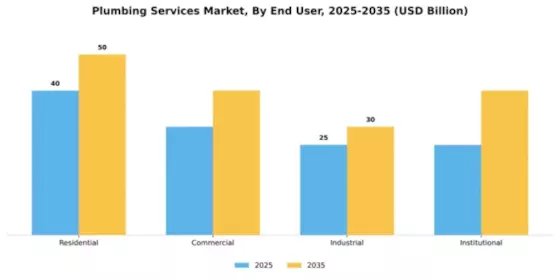
The plumbing services market is characterized by a diverse distribution of end users, with the residential segment commanding the largest share due to the continual need for home maintenance and plumbing upgrades. The commercial segment, while smaller in comparison, is rapidly expanding as businesses invest in infrastructure improvements and remodeling projects necessitating advanced plumbing solutions. This trend indicates a healthy balance between established demand in residential areas and emerging opportunities in commercial markets, which are increasingly tailored to meet specific business requirements.
Residential (Dominant) vs. Commercial (Emerging)
The residential plumbing segment is the dominant force in the market, with a solid grounding in routine maintenance, repair services, and the installation of plumbing systems in new homes. This segment benefits from a stable customer base, comprised primarily of homeowners who seek reliability and quality in services. Meanwhile, the commercial segment is viewed as an emerging opportunity, driven by the growing demand from businesses for comprehensive plumbing solutions. These include innovative systems catering to larger, more complex installations. As commercial establishments continue to flourish, their demand for specialized plumbing services, including energy-efficient systems, will likely soar, enhancing their market position.
In the Plumbing Services Market, the distribution of service model segments reveals that On-Demand Services hold the largest market share, largely due to their convenience and immediate availability. These services cater effectively to urgent plumbing needs, making them the first choice for many consumers. Meanwhile, Subscription Services, although currently smaller in market share, are experiencing rapid growth as more homeowners turn toward regular maintenance plans to avoid unforeseen issues. Contractual Services also play a significant role, providing stable revenue for service providers, but they have not seen the same level of consumer preference as the top two segments. Recent trends indicate a shift towards Subscription Services as consumers recognize the long-term benefits of preventive maintenance. The increasing desire for hassle-free solutions encourages providers to innovate their subscription models, often incorporating technology for ease of management. On-Demand Services are not losing traction, as emergencies will always require swift response times. However, the evolving nature of consumer preferences favors flexible, subscription-based options that accommodate regular servicing needs while ensuring prompt attention to urgent repairs. Together, these trends are reshaping the Plumbing Services Market towards enhanced consumer engagement and satisfaction.
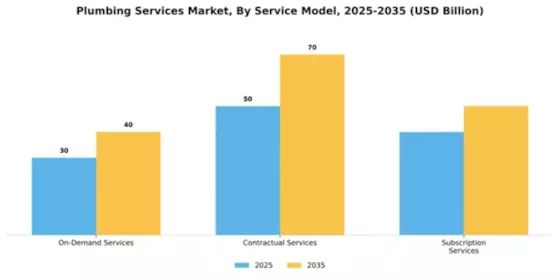
On-Demand Services (Dominant) vs. Subscription Services (Emerging)
On-Demand Services are currently the dominant segment in the Plumbing Services Market, characterized by their immediacy and ability to solve urgent issues quickly. These services appeal particularly to residential customers facing unexpected plumbing challenges, resulting in a robust demand that supports their leading position. Conversely, Subscription Services are seen as an emerging segment with increasing popularity among consumers who prefer a proactive approach to plumbing maintenance. By offering regular inspections and convenient scheduling, Subscription Services foster customer loyalty and trust, addressing common plumbing concerns before they escalate. Although distinct, both segments are essential to the market, with On-Demand Services providing responsiveness and Subscription Services ensuring long-term system reliability.
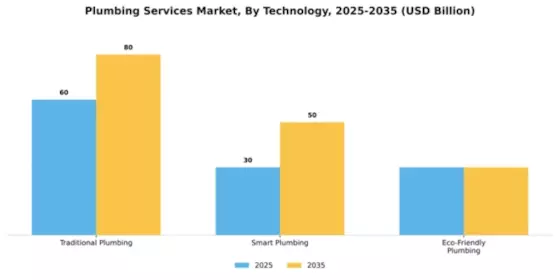
The plumbing services market is predominantly led by the traditional plumbing segment, which has established a strong presence rooted in time-tested techniques and reliable service. Traditional plumbing continues to account for a significant share due to its essential nature in both residential and commercial spaces, catering to basic plumbing needs such as installation and repairs of pipes, faucets, and fixtures. In contrast, the smart plumbing segment, while smaller, is rapidly gaining traction, powered by advancements in technology and increased consumer interest in innovative solutions. Growth trends within the plumbing services market show a notable shift towards smart plumbing solutions, with consumers seeking automated systems that enhance efficiency and reduce water waste. The rising awareness of environmental sustainability further propels the eco-friendly plumbing segment as homeowners aim to integrate water-saving technologies and sustainable materials in their plumbing systems. These trends reflect broader movements towards smart homes and eco-conscious living, promising to reshape the market landscape in the coming years.
Traditional Plumbing (Dominant) vs. Smart Plumbing (Emerging)
Traditional plumbing remains the cornerstone of plumbing services, thriving on its foundational approach to essential plumbing needs. This segment is characterized by its reliance on conventional equipment, skilled labor, and time-honored methods to ensure reliability and performance. Conversely, smart plumbing is carving out an emerging niche through technological innovation, offering solutions like smart faucets, leak detection systems, and automated water management that cater to the needs of the modern consumer. As technology becomes more integrated into daily life, smart plumbing is highlighting its potential to optimize water use and enhance user convenience. These two segments complement each other, with traditional plumbing providing the necessary groundwork while smart plumbing represents the future of the industry.
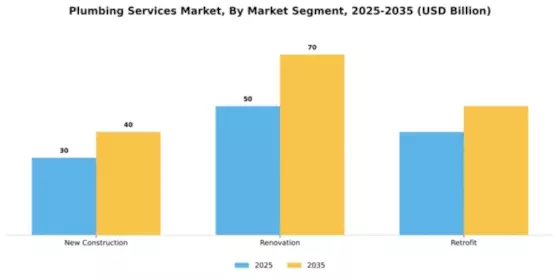
The Plumbing Services Market is currently dominated by the New Construction segment, which holds a significant share of the market. This segment includes installations for new residential buildings, commercial properties, and public infrastructure. Despite its large footprint, it faces competition from the Renovation and Retrofit segments, which are also gaining traction as existing structures are remodeled and updated to meet contemporary needs. The Retrofit segment, driven by increasing demand for energy-efficient systems and sustainability in plumbing solutions, is the fastest-growing segment within the Plumbing Services Market. Homeowners and businesses are increasingly opting for retrofitting old plumbing systems rather than full replacements, as this approach often proves to be more cost-effective and less disruptive while meeting modern standards for efficiency and compliance.
New Construction: Dominant vs. Retrofit: Emerging
In the Plumbing Services Market, New Construction is recognized as the dominant segment, underpinned by ongoing developments in residential and commercial properties. This segment thrives on large-scale construction projects, necessitating robust plumbing infrastructure from the outset. Its established position benefits from contractor relationships and consistent flow of projects. Conversely, Retrofit is emerging as a significant market player, propelled by social shifts towards sustainable living and energy conservation. Retrofits not only enhance plumbing systems to be more efficient but also adapt them to modern regulations. This adaptability makes Retrofit an appealing choice for consumers looking to limit costs and environmental impact, thus gradually shifting market dynamics.
Get more detailed insights about Plumbing Services Market Request Free Sample
North America holds a commanding 50.0% share of the plumbing services market, driven by a robust construction sector and increasing demand for residential and commercial plumbing solutions. Regulatory support for infrastructure development and environmental standards further catalyze market growth. The rising trend of smart home technologies also boosts demand for advanced plumbing solutions, ensuring a steady market expansion. The United States is the primary player in this region, with key companies like Roto-Rooter, Mr. Rooter, and Benjamin Franklin Plumbing leading the competitive landscape. The presence of established firms ensures a high level of service quality and innovation. Additionally, the market is characterized by a mix of large corporations and local service providers, creating a dynamic environment that caters to diverse consumer needs.
Europe accounts for a significant 30.0% of the plumbing services market, driven by increasing urbanization and stringent building regulations. The demand for eco-friendly plumbing solutions is on the rise, supported by government initiatives aimed at sustainability. The region's focus on energy-efficient systems and water conservation measures is expected to further propel market growth in the coming years. Leading countries such as Germany, France, and the UK dominate the European market, with a mix of established players and innovative startups. Companies are increasingly investing in technology to enhance service delivery and customer satisfaction. The competitive landscape is marked by a focus on quality and compliance with regulatory standards, ensuring a reliable service environment for consumers.
The Asia-Pacific region holds a 30.0% share of the plumbing services market, fueled by rapid urbanization and infrastructure development. Countries like China and India are experiencing significant growth in construction activities, leading to increased demand for plumbing services. Government initiatives aimed at improving sanitation and water supply further enhance market prospects, making this region a key player in the global plumbing landscape. China and India are the leading countries in this market, with a mix of local and international players competing for market share. The competitive landscape is characterized by a focus on affordability and accessibility, catering to a diverse consumer base. Key players are increasingly adopting innovative technologies to improve service efficiency and customer engagement, ensuring sustained growth in this dynamic market.
The Middle East and Africa represent a smaller segment of the plumbing services market, with a 10.0% share. However, the region is witnessing growth driven by urbanization and infrastructure projects. Governments are investing in water management and sanitation systems, which are crucial for public health and economic development. Regulatory frameworks are evolving to support sustainable practices in plumbing services, enhancing market potential. Countries like South Africa and the UAE are at the forefront of this market, with a mix of local and international companies providing services. The competitive landscape is shaped by the need for quality and reliability, as consumers increasingly demand efficient plumbing solutions. Key players are focusing on innovation and customer service to differentiate themselves in this emerging market.
The Plumbing Services Market is characterized by a competitive landscape that is increasingly shaped by innovation, digital transformation, and strategic partnerships. Key players such as Roto-Rooter (US), Mr. Rooter (US), and Benjamin Franklin Plumbing (US) are actively pursuing strategies that enhance their operational efficiency and customer engagement. Roto-Rooter (US) has focused on expanding its service offerings through technological advancements, while Mr. Rooter (US) emphasizes customer service excellence and local market penetration. Benjamin Franklin Plumbing (US) appears to be leveraging its brand reputation to foster customer loyalty, which collectively influences the competitive dynamics of the market.The business tactics employed by these companies include optimizing supply chains and localizing service delivery to meet regional demands. The market structure is moderately fragmented, with a mix of large national players and smaller local firms. This fragmentation allows for diverse service offerings, yet the collective influence of major players like ARS Rescue Rooter (US) and Bluefrog Plumbing + Drain (US) is significant, as they set benchmarks for service quality and operational standards.In November Roto-Rooter (US) announced the launch of a new mobile app designed to streamline customer service interactions and enhance scheduling efficiency. This strategic move is likely to improve customer satisfaction and operational efficiency, positioning Roto-Rooter (US) as a leader in digital service delivery within the market. The app's features, which include real-time tracking and service history, may also serve to attract a tech-savvy customer base.In October Mr. Rooter (US) expanded its franchise network by entering into a partnership with a regional plumbing supplier, aiming to enhance its supply chain capabilities. This partnership is expected to reduce operational costs and improve service delivery times, thereby strengthening Mr. Rooter’s (US) competitive position in the market. The collaboration may also facilitate better access to innovative plumbing solutions, further enhancing service offerings.In September Benjamin Franklin Plumbing (US) launched a sustainability initiative aimed at reducing water waste through advanced plumbing technologies. This initiative not only aligns with growing consumer demand for environmentally friendly services but also positions the company as a responsible market player. By focusing on sustainability, Benjamin Franklin Plumbing (US) is likely to attract environmentally conscious customers, thereby differentiating itself in a crowded marketplace.As of December the Plumbing Services Market is witnessing trends that emphasize digitalization, sustainability, and the integration of AI technologies. Strategic alliances among key players are increasingly shaping the competitive landscape, fostering innovation and enhancing service delivery. The shift from price-based competition to a focus on technological advancement and supply chain reliability is evident. Companies that prioritize these aspects are likely to gain a competitive edge, as the market evolves towards a more sophisticated and customer-centric approach.



The Plumbing Services Market is projected to grow at a 2.65% CAGR from 2025 to 2035, driven by urbanization, technological advancements, and increasing demand for sustainable solutions.
New opportunities lie in:
By 2035, the Plumbing Services Market is expected to be robust, driven by innovation and sustainability.
| MARKET SIZE 2024 | 120.0(USD Billion) |
| MARKET SIZE 2025 | 123.18(USD Billion) |
| MARKET SIZE 2035 | 160.0(USD Billion) |
| COMPOUND ANNUAL GROWTH RATE (CAGR) | 2.65% (2025 - 2035) |
| REPORT COVERAGE | Revenue Forecast, Competitive Landscape, Growth Factors, and Trends |
| BASE YEAR | 2024 |
| Market Forecast Period | 2025 - 2035 |
| Historical Data | 2019 - 2024 |
| Market Forecast Units | USD Billion |
| Key Companies Profiled | Roto-Rooter (US), Mr. Rooter (US), Benjamin Franklin Plumbing (US), ARS Rescue Rooter (US), Bluefrog Plumbing + Drain (US), Rooter-Man (US), Hoffman Plumbing (US), Plumbing Solutions (US) |
| Segments Covered | Service Type, End User, Service Model, Technology, Market Segment |
| Key Market Opportunities | Integration of smart home technology in Plumbing Services Market enhances efficiency and customer engagement. |
| Key Market Dynamics | Rising demand for eco-friendly plumbing solutions drives innovation and competition among service providers. |
| Countries Covered | North America, Europe, APAC, South America, MEA |
The Plumbing Services Market was valued at 120.0 USD Billion in 2024.
The market is projected to reach 160.0 USD Billion by 2035.
The expected CAGR for the Plumbing Services Market during 2025 - 2035 is 2.65%.
Repair services generated the highest revenue, with valuations between 40.0 and 50.0 USD Billion.
Residential plumbing services generated between 40.0 and 50.0 USD Billion, while commercial services generated between 30.0 and 40.0 USD Billion.
Emergency services are projected to generate between 20.0 and 30.0 USD Billion by 2035.
Key players include Roto-Rooter, Mr. Rooter, and Benjamin Franklin Plumbing, among others.
Smart plumbing technology is expected to generate between 30.0 and 50.0 USD Billion by 2035.
Contractual services are projected to generate between 50.0 and 70.0 USD Billion, surpassing on-demand services, which are expected to generate between 30.0 and 40.0 USD Billion.
Renovation plumbing services are anticipated to generate between 50.0 and 70.0 USD Billion by 2035.


Kindly complete the form below to receive a free sample of this Report

“This is really good guys. Excellent work on a tight deadline. I will continue to use you going forward and recommend you to others. Nice job”


“Thanks. It’s been a pleasure working with you, please use me as reference with any other Intel employees.”


“Thanks for sending the report it gives us a good global view of the Betaïne market.”


“Thank you, this will be very helpful for OQS.”


“We found the report very insightful! we found your research firm very helpful. I'm sending this email to secure our future business.”


“I am very pleased with how market segments have been defined in a relevant way for my purposes (such as "Portable Freezers & refrigerators" and "last-mile"). In general the report is well structured. Thanks very much for your efforts.”


“I have been reading the first document or the study, ,the Global HVAC and FP market report 2021 till 2026. Must say, good info! I have not gone in depth at all parts, but got a good indication of the data inside!”


“We got the report in time, we really thank you for your support in this process. I also thank to all of your team as they did a great job.”


“The Automotive 48V ECU Components Procurement Intelligence Study” was a complex project, but the Market Research Future (MRFR) team handled it with quality, agility, and customer-centricity. They delivered all requested data on time and within the agreed scope. The team, including Shubhendra Anand and Rahul Gotadki, was always readily available to clarify questions and swiftly implement necessary adjustments, driving the project to a successful conclusion within a very demanding timeframe.
I would also like to specifically commend Akshay Agarwal for his responsiveness and support at every stage—from our initial inquiry on May 6th through to final delivery on June 18th. His dedication made the entire process seamless.”



