×
Request Free Sample ×

Kindly complete the form below to receive a free sample of this Report

* Please use a valid business email

Leading companies partner with us for data-driven Insights

clients tt-cursor
Hero Background

Police Law Enforcement Equipment Market

ID: MRFR/AD/4842-HCR
100 Pages
Sejal Akre
February 2026

Police and Law Enforcement Equipment Market Size, Share, Industry Trend & Analysis Research Report by Product Type (Surveillance System, Communication system, Weapon Systems, and Personal Protective Equipment (PPE)), by Weapon Type (Lethal and Non-Lethal), by Equipment Type (Hand Gun, Batons, Body Armor, and Others), and by Region (North America, Europe, Asia-Pacific, Middle East & Africa, and Latin America) - Forecast till 2030

Share:
Download PDF ×

We do not share your information with anyone. However, we may send you emails based on your report interest from time to time. You may contact us at any time to opt-out.

Police Law Enforcement Equipment Market Infographic
Purchase Options

Police Law Enforcement Equipment Market Summary

As per Market Research Future analysis, the Police and Law Enforcement Equipment Market was estimated at 2.056 USD Billion in 2024. The market is projected to grow from 2.224 USD Billion in 2025 to 4.892 USD Billion by 2035, exhibiting a compound annual growth rate (CAGR) of 8.2% during the forecast period 2025 - 2035

Key Market Trends & Highlights

The Police and Law Enforcement Equipment Market is experiencing a dynamic shift towards technological integration and community engagement.

  • Technological integration is reshaping the landscape of police equipment, enhancing operational efficiency and effectiveness.
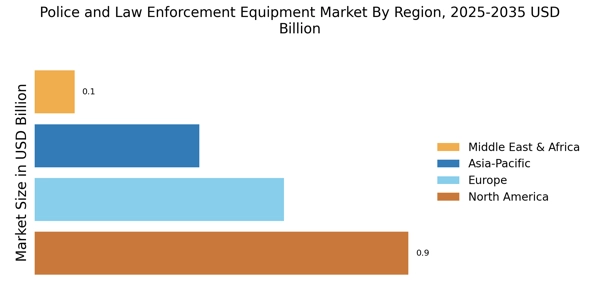
  • North America remains the largest market, driven by substantial government funding and a focus on public safety concerns.
  • The Asia-Pacific region is emerging as the fastest-growing market, propelled by rising crime rates and increasing urbanization.
  • The communication systems segment leads the market, while non-lethal equipment is gaining traction due to heightened public safety concerns and technological advancements.

Market Size & Forecast

2024 Market Size 2.056 (USD Billion)
2035 Market Size 4.892 (USD Billion)
CAGR (2025 - 2035) 8.2%

Major Players

Axon (US), Harris Corporation (US), Motorola Solutions (US), Smith & Wesson (US), Taser International (US), Safariland (US), Galls (US), 3M (US), Honeywell (US), Ballistic Body Armor (US)

Our Impact
Enabled $4.3B Revenue Impact for Fortune 500 and Leading Multinationals
Partnering with 2000+ Global Organizations Each Year
30K+ Citations by Top-Tier Firms in the Industry

Police Law Enforcement Equipment Market Trends

The Police and Law Enforcement Equipment Market is currently experiencing a dynamic evolution, driven by advancements in technology and changing societal needs. As law enforcement agencies seek to enhance their operational efficiency and effectiveness, there is a noticeable shift towards the adoption of innovative tools and equipment. This includes the integration of smart technologies, such as body-worn cameras and advanced communication systems, which aim to improve transparency and accountability within policing practices. Furthermore, the increasing emphasis on public safety and crime prevention is prompting agencies to invest in modernized gear that not only meets operational demands but also addresses community concerns regarding safety and security. In addition to technological advancements, the market is also influenced by regulatory changes and funding initiatives aimed at supporting law enforcement agencies. Governments are recognizing the importance of equipping their police forces with the necessary resources to combat evolving threats. This has led to a more collaborative approach between public and private sectors, fostering innovation and ensuring that law enforcement personnel are adequately prepared to handle diverse challenges. As the landscape continues to shift, the Police and Law Enforcement Equipment Market is poised for further growth, reflecting the ongoing commitment to enhancing public safety and law enforcement capabilities.

Technological Integration

The Police and Law Enforcement Equipment Market is witnessing a trend towards the integration of advanced technologies. This includes the use of artificial intelligence, drones, and biometric systems, which enhance operational capabilities and improve situational awareness for law enforcement agencies.

Focus on Community Engagement

There is a growing emphasis on community-oriented policing strategies, which encourages law enforcement agencies to invest in equipment that fosters positive interactions with the public. This trend reflects a shift towards building trust and collaboration between police forces and the communities they serve.

Sustainability Initiatives

The market is increasingly influenced by sustainability considerations, prompting law enforcement agencies to seek eco-friendly equipment and practices. This trend indicates a broader commitment to environmental responsibility while maintaining operational effectiveness.

Police Law Enforcement Equipment Market Drivers

Increased Crime Rates

The persistent rise in crime rates across various regions appears to be a primary driver for the Police and Law Enforcement Equipment Market. As law enforcement agencies face escalating challenges, the demand for advanced equipment, such as body cameras, surveillance systems, and non-lethal weapons, is likely to surge. According to recent statistics, violent crime rates have shown an upward trend, prompting governments to allocate more resources towards enhancing police capabilities. This trend indicates a potential growth trajectory for the market, as agencies seek to equip their personnel with the necessary tools to effectively combat crime and ensure public safety. The urgency to address these issues may lead to increased investments in innovative technologies, thereby fostering a robust market environment.

Public Safety Concerns

Public safety concerns are increasingly influencing the dynamics of the Police and Law Enforcement Equipment Market. As communities demand greater accountability and effectiveness from law enforcement, agencies are compelled to invest in equipment that enhances their operational capabilities. The heightened focus on public safety has led to a surge in demand for tools such as drones, advanced communication systems, and crowd control equipment. Market analysis suggests that this trend is likely to continue, as citizens expect law enforcement to respond effectively to emergencies and maintain order. The pressure to ensure safety in public spaces may drive agencies to seek out innovative solutions, thereby fostering growth within the market. This evolving landscape underscores the importance of addressing public safety needs through strategic investments in law enforcement equipment.

Rising Terrorism Threats

The rising threats of terrorism are significantly impacting the Police and Law Enforcement Equipment Market. As incidents of terrorism become more frequent and sophisticated, law enforcement agencies are under increasing pressure to enhance their preparedness and response capabilities. This has led to a heightened demand for specialized equipment, including bomb disposal units, surveillance technologies, and tactical gear. Recent assessments indicate that governments are prioritizing counter-terrorism measures, which may result in increased funding for law enforcement agencies. The urgency to address these threats suggests that the market for police and law enforcement equipment could experience substantial growth in the coming years. As agencies adapt to evolving threats, the need for advanced equipment will likely remain a critical focus.

Technological Advancements

Technological advancements are reshaping the landscape of the Police and Law Enforcement Equipment Market. Innovations in areas such as artificial intelligence, data analytics, and mobile technology are enabling law enforcement agencies to operate more efficiently and effectively. For instance, the integration of AI in predictive policing tools allows for better resource allocation and crime prevention strategies. Furthermore, the market for body-worn cameras is projected to grow significantly, driven by the need for transparency and accountability in policing. As agencies increasingly adopt these technologies, the demand for sophisticated equipment is expected to rise, potentially leading to a more competitive market. This trend suggests that staying abreast of technological developments will be crucial for manufacturers and suppliers in the industry.

Government Funding and Support

Government funding and support play a pivotal role in shaping the Police and Law Enforcement Equipment Market. Many governments are recognizing the necessity of equipping law enforcement agencies with modern tools to enhance public safety. Increased budget allocations for police departments often translate into higher expenditures on equipment such as firearms, protective gear, and communication systems. Recent reports indicate that several countries have initiated programs aimed at upgrading police equipment, which could lead to a substantial increase in market demand. This financial backing not only facilitates the procurement of advanced technologies but also encourages research and development within the industry. Consequently, the interplay between government initiatives and market growth appears to be a significant driver.

Market Segment Insights

By Product Type: Communication Systems (Largest) vs. Surveillance Systems (Fastest-Growing)

In the Police and Law Enforcement Equipment Market, Communication Systems hold the largest market share, owing to their critical role in enhancing operational effectiveness and coordination among law enforcement personnel. With advancements in technology, these systems have evolved to incorporate features such as encrypted communication, GPS tracking, and real-time data transmission, making them indispensable for modern policing. Surveillance Systems, while currently the fastest-growing segment, have gained traction due to the increasing focus on crime prevention and public safety. The demand for advanced surveillance technology, such as AI-powered cameras and integrated monitoring systems, is rising rapidly as law enforcement agencies seek to leverage data-driven approaches for effective crime management.

Communication Systems (Dominant) vs. Surveillance Systems (Emerging)

Communication Systems represent a dominant force in the Police and Law Enforcement Equipment Market, providing essential tools for effective communication and coordination among officers in the field. Their robust features enable real-time communication in high-pressure situations, enhancing responsiveness and reducing the likelihood of errors during operations. Surveillance Systems are emerging rapidly in this sector, driven by technological advancements and the growing emphasis on security. These systems not only encompass traditional CCTV solutions but also include sophisticated software and analytics that improve situational awareness and enable proactive policing measures. Both segments play vital roles, yet they cater to different aspects of law enforcement requirements.

By Weapon Type: Lethal (Largest) vs. Non-Lethal (Fastest-Growing)

In the Police and Law Enforcement Equipment Market, the weapon type segment is primarily divided into lethal and non-lethal options, with lethal weapons holding the largest market share. This dominance is attributed to the traditional reliance on firearms and other lethal methods for law enforcement agencies worldwide. However, non-lethal weapons are rapidly gaining traction, appealing to departments focusing on de-escalation and community safety. As awareness of the benefits of non-lethal options increases, their share in the market is expected to see significant growth.

Weapon Type: Lethal (Dominant) vs. Non-Lethal (Emerging)

Lethal weapons remain the dominant force in the police and law enforcement equipment market, characterized by firearms, ammunition, and tactical accessories that ensure high effectiveness in dangerous situations. On the other hand, non-lethal weapons, such as tasers, bean bag rounds, and pepper sprays, represent an emerging segment catering to law enforcement agencies aiming for safer engagement strategies. The growing emphasis on minimizing fatalities and injury during confrontations drives the increased acceptance and development of non-lethal alternatives. These two segments are now increasingly intertwined as departments recognize the need for a balanced approach to uphold public safety while maintaining operational effectiveness.

By Equipment: Hand Gun (Largest) vs. Body Armor (Fastest-Growing)

In the Police and Law Enforcement Equipment Market, the distribution of market share among various equipment segments highlights the significance of hand guns as the largest segment. Hand guns dominate the market due to their essential role in police operations and self-defense. In contrast, body armor is emerging rapidly as the fastest-growing segment, reflecting growing awareness regarding officer safety and protective gear requirements. Batons and other equipment types, while important, hold relatively smaller shares in the market landscape.

Hand Gun (Dominant) vs. Body Armor (Emerging)

Hand guns have established themselves as the dominant segment within the Police and Law Enforcement Equipment Market, recognized for their critical role in law enforcement and self-protection. Their extensive use in various police operations underscores their necessity, leading to stable demand. On the other hand, body armor, categorized as an emerging segment, is witnessing a robust surge in growth, driven by increasing concerns about officer safety and legislative changes promoting protective measures. This trend has led to innovative advancements in body armor technology, enhancing comfort, mobility, and protection, thus attracting significant interest from law enforcement agencies.

Get more detailed insights about Police Law Enforcement Equipment Market

Regional Insights

ammunition
Police Law Enforcement Equipment Market Regional Image

Key Players and Competitive Insights

In the competitive landscape of police and law enforcement equipment, leading market players are heavily investing in research and development to expand their product portfolios, driving further growth in the industry. These companies are actively pursuing strategic initiatives to enhance their global presence, including new product launches, partnerships, acquisitions, and increased investments. To remain competitive in this expanding market, cost-effectiveness is paramount. Manufacturers are adopting strategies such as localized production to reduce operational expenses while meeting the diverse needs of law enforcement agencies worldwide.

Key Companies in the Police Law Enforcement Equipment Market include

Industry Developments

  • Q2 2024: Axon Enterprise wins $100 million contract to supply body cameras to UK police forces Axon Enterprise secured a major contract in April 2024 to provide body-worn cameras and digital evidence management systems to several UK police departments, marking one of the largest deployments of police technology in Europe.
  • Q2 2024: Motorola Solutions acquires video analytics firm Calipsa to expand law enforcement AI capabilities Motorola Solutions announced the acquisition of Calipsa in May 2024, aiming to enhance its portfolio of AI-powered video analytics for police and law enforcement agencies globally.
  • Q2 2024: Safariland launches new generation of ballistic vests for law enforcement Safariland introduced its latest line of lightweight ballistic vests in June 2024, featuring advanced materials and improved comfort for police officers.
  • Q3 2024: Digital Ally secures multi-year contract with Los Angeles Police Department for in-car video systems Digital Ally announced in July 2024 that it won a multi-year contract to supply in-car video recording systems to the LAPD, supporting transparency and evidence collection.
  • Q3 2024: Avon Protection receives regulatory approval for new police respirator in Europe Avon Protection obtained CE certification for its latest police respirator in August 2024, enabling sales to law enforcement agencies across the European Union.
  • Q3 2024: Axon Enterprise opens new manufacturing facility in Texas to meet rising demand Axon Enterprise inaugurated a new production facility in September 2024, increasing its capacity to manufacture body cameras and TASER devices for police agencies.
  • Q4 2024: Honeywell launches advanced police drone for surveillance operations Honeywell unveiled a new drone platform in October 2024 designed specifically for law enforcement surveillance, featuring enhanced night vision and real-time data transmission.
  • Q4 2024: OBERON ALPHA announces partnership with French National Police for smart riot shields OBERON ALPHA entered into a partnership in November 2024 to supply smart riot shields equipped with sensors and communication systems to the French National Police.
  • Q4 2024: Motorola Solutions wins contract to upgrade communication systems for Toronto Police Service Motorola Solutions secured a contract in December 2024 to modernize the Toronto Police Service's radio and dispatch systems, improving reliability and officer safety.
  • Q1 2025: Safariland acquires tactical gear manufacturer Haven Gear Safariland announced the acquisition of Haven Gear in January 2025, expanding its portfolio of riot control and tactical equipment for law enforcement.
  • Q1 2025: XION Protective Gear secures funding round to accelerate development of next-gen police body armor XION Protective Gear raised new funding in February 2025 to support R&D and commercialization of advanced body armor technologies for police and law enforcement agencies.
  • Q2 2025: Digital Ally launches cloud-based evidence management platform for police agencies Digital Ally introduced a new cloud platform in May 2025, enabling police departments to securely store, manage, and share digital evidence from body cameras and in-car systems.

Future Outlook

Police Law Enforcement Equipment Market Future Outlook

The Police and Law Enforcement Equipment Market is projected to grow at an 8.2% CAGR from 2025 to 2035, driven by technological advancements, increased public safety funding, and evolving law enforcement needs.

New opportunities lie in:

  • Integration of AI-driven analytics for crime prediction
  • Development of advanced body-worn cameras with real-time streaming
  • Expansion of non-lethal weaponry for crowd control applications

By 2035, the market is expected to be robust, reflecting substantial growth and innovation.

Market Segmentation

Police Law Enforcement Equipment Market Equipment Outlook

  • Batons
  • Hand Gun
  • Body Armor
  • Others

Police Law Enforcement Equipment Market Weapon Type Outlook

  • Lethal
  • Non-Lethal

Police Law Enforcement Equipment Market Product Type Outlook

  • Communication Systems
  • Surveillance Systems
  • Weapon Systems

Report Scope

MARKET SIZE 20242.056(USD Billion)
MARKET SIZE 20252.224(USD Billion)
MARKET SIZE 20354.892(USD Billion)
COMPOUND ANNUAL GROWTH RATE (CAGR)8.2% (2025 - 2035)
REPORT COVERAGERevenue Forecast, Competitive Landscape, Growth Factors, and Trends
BASE YEAR2024
Market Forecast Period2025 - 2035
Historical Data2019 - 2024
Market Forecast UnitsUSD Billion
Key Companies ProfiledAxon (US), Harris Corporation (US), Motorola Solutions (US), Smith & Wesson (US), Taser International (US), Safariland (US), Galls (US), 3M (US), Honeywell (US), Ballistic Body Armor (US)
Segments CoveredProduct Type, Weapon Type, Equipment Type, Region
Key Market OpportunitiesIntegration of advanced surveillance technologies enhances operational efficiency in the Police and Law Enforcement Equipment Market.
Key Market DynamicsTechnological advancements drive innovation in police equipment, enhancing operational efficiency and public safety measures.
Countries CoveredNorth America, Europe, APAC, South America, MEA

Market Highlights

Author
Sejal Akre
Senior Research Analyst

She has over 5 years of rich experience, in market research and consulting providing valuable market insights to client. Hands on expertise in management consulting, and extensive knowledge in domain including ICT, Automotive & Transportation and Aerospace & Defense. She is skilled in Go-to market strategy, industry analysis, market sizing, in depth company profiling, competitive intelligence & benchmarking and value chain amongst others.

Leave a Comment

FAQs

What is the projected market valuation for the Police and Law Enforcement Equipment Market in 2035?

The projected market valuation for the Police and Law Enforcement Equipment Market in 2035 is 4.892 USD Billion.

What was the overall market valuation for the Police and Law Enforcement Equipment Market in 2024?

The overall market valuation for the Police and Law Enforcement Equipment Market in 2024 was 2.056 USD Billion.

What is the expected CAGR for the Police and Law Enforcement Equipment Market from 2025 to 2035?

The expected CAGR for the Police and Law Enforcement Equipment Market during the forecast period 2025 - 2035 is 8.2%.

Which companies are considered key players in the Police and Law Enforcement Equipment Market?

Key players in the market include Axon, Harris Corporation, Motorola Solutions, Smith & Wesson, Taser International, Safariland, Galls, 3M, Honeywell, and Ballistic Body Armor.

What are the projected values for Communication Systems in the Police and Law Enforcement Equipment Market by 2035?

The projected value for Communication Systems in the Police and Law Enforcement Equipment Market is expected to reach 1.469 USD Billion by 2035.

Research Approach

Research Methodology on Police Law Enforcement Equipment Market

Introduction

This study aims to analyze the global market for Police and Law Enforcement Equipment. The analysis includes market size, competitive landscape, product segmentation, consumer demand and trends, and market growth opportunities. The information presented in this report will provide an insight into the competitive landscape of the police and law enforcement equipment market, enabling the market players to make informed strategic decisions.

Research Methodology

The research methodology adopted for the market analysis of Police and Law Enforcement Equipment is a combination of primary and secondary research. Primary research includes interviews, surveys, and focus groups conducted with key stakeholder groups such as industry experts and opinion leaders. Qualitative and quantitative interviews were carried out with selected participants to assess their perspective on the market trends and the competitive landscape. Secondary research includes an extensive review of market publications such as press releases, white papers, research reports, journals, and company financials documents. Additionally, existing market database sources and the company’s internal database were also used to supplement the primary and secondary research activities.

Additionally, a market analysis survey was conducted using online surveys and questionnaires distributed to the target audience. Data collected through the surveys were analyzed to obtain insights into the current and future trends in the Police and Law Enforcement Equipment market.

The research process was carried out in four phases:

Phase 1: Identification of key players and stakeholders in the Police and Law Enforcement Equipment market

The first step was to identify the key players and stakeholders in the police and law enforcement equipment industry. This was done through extensive primary and secondary research to gain an understanding of the market structure, competitive landscape, and respective segmental growth dimensions.

Phase 2: Identification of executive insights

The next step is to obtain insights on the industry through industry professionals, experts, and opinion leaders. Qualitative and quantitative interviews were conducted with industry experts from both the supply and demand sides. This step enables us to identify key issues and trends in the market.

Phase 3: Market survey

The research process was complemented with an online survey, which was conducted through an online survey platform. The survey distributed to a target audience, including industry professionals, sought responses on the trends, drivers, and restraints impacting the market.

Phase 4: Data Evaluation

All the secondary and primary research data were evaluated and synthesized. This was done to generate data and insights on the size of the overall police and law enforcement equipment market and its various segments.

Data Analysis

The data analysis included both qualitative and quantitative approaches. Qualitative data analysis was conducted to understand the prevailing trends and drivers in the Police and Law Enforcement Equipment market. Qualitative analysis included statistical analysis, exploratory factor analysis, and hypothesis testing, used to draw conclusions on the study findings. Primary data obtained through the survey and interviews was also quantified to assess the current state of the Police and Law Enforcement Equipment market.

Results and Findings

Data synthesized during the research process was consolidated and presented in the form of tabulated data, charts, diagrams, and other graphical representations. The results were further analyzed to draw conclusions about the current and future status of the police and law enforcement equipment market.

Conclusion

This research used a research methodology which included primary and secondary research to obtain a comprehensive understanding of the Police and Law Enforcement Equipment market. Through the data-driven approach and analysis of market trends, key findings were identified which include market size, competitive landscape, product segmentation, consumer demand and trends, and market growth opportunities. The research results concluded that the Police and Law Enforcement Equipment market holds immense growth potential in terms of both market size and product segmentation. The research results are expected to help players in the market make informed strategic decisions.

Download Free Sample

Kindly complete the form below to receive a free sample of this Report

Compare Licence

×
Features License Type
Single User Multiuser License Enterprise User
Price $4,950 $5,950 $7,250
Maximum User Access Limit 1 User Upto 10 Users Unrestricted Access Throughout the Organization
Free Customization
Direct Access to Analyst
Deliverable Format
Platform Access
Discount on Next Purchase 10% 15% 15%
Printable Versions