Polyacrylamide Market

Key Players: SNF Group, Kemira Oyj, BASF SE, Solenis LLC, Anhui Jucheng Fine Chemicals, Beijing Hengju Chemical Group, Shandong Polymer Bio-chemicals, Ashland Global Holdings

Polyacrylamide Market

Polyacrylamide Market Research Report Information by Product Type (Anionic, Cationic, Non-Ionic),by type (Thermal, Acoustic, Electric, Others) by Application (Water Treatment, Pulp and Paper, Mineral Processing, Enhanced Oil Recovery, Others) And by Region (North America, Europe, Asia-Pacific, Latin America, and Middle east & Africa) - Forecast Till 2035
ID: MRFR/CnM/6438-CR
140 Pages
Priya Nagrale
Last Updated: June 16, 2026
 

Polyacrylamide Market Summary

The global Polyacrylamide Market reached an estimated USD 5,480 million in 2025 and is projected to grow from USD 5,820 million in 2026 to approximately USD 10,010 million by 2035, registering a CAGR of 6.2% during the forecast period. Two catalysts are reshaping demand trajectories: the EU Urban Wastewater Treatment Directive 2024/3019, which mandates quaternary nutrient-removal stages across member states by 2030, and tightening EPA residual-monomer caps in the United States that are pushing municipal operators toward certified, high-purity acrylamide polymers [2][3].

A decisive shift is underway from commodity-grade polymer flocculants toward specialty formulations. Enhanced oil recovery programs in North American shale basins now require salt-tolerant, ultra-high-molecular-weight grades that commodity products cannot deliver. Simultaneously, semiconductor fabs across Taiwan, South Korea, and Japan are adopting precision-dosed water treatment polymers to meet sub-ppb purity thresholds, a specification level that has attracted over USD 1.2 billion in combined R&D investment from leading producers since 2023 [4][5].

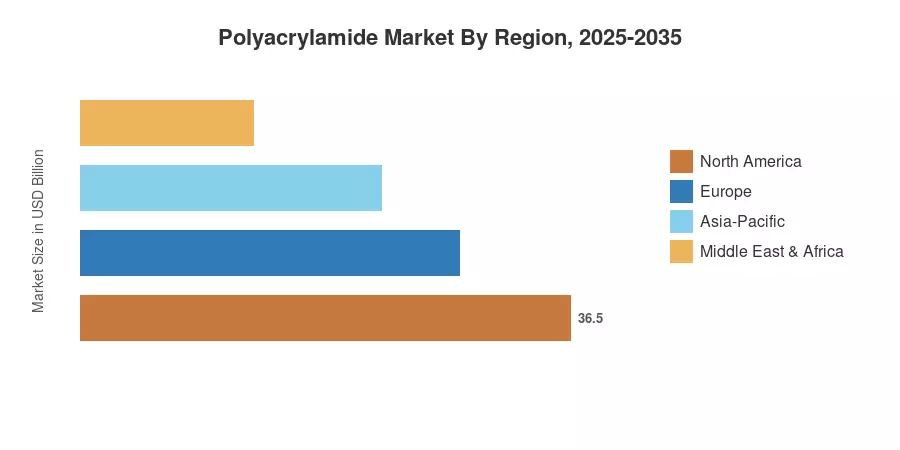
Asia-Pacific anchors the Polyacrylamide Market with roughly 53.4% of global revenue in 2025, driven by China's sludge treatment chemicals mandates and India's Jal Jeevan Mission water infrastructure program. North America follows with approximately 20% share, supported by oilfield chemicals demand across the Permian Basin. Europe accounts for about 17% share, led by nutrient-removal retrofit projects under the revised Urban Wastewater Directive. Through 2035, intensifying regulatory standards and the pivot toward bio-based flocculant chemicals will continue reshaping competitive dynamics across every region

Key Report Takeaways

• By Physical Form

  • Powder formulations commanded the leading position in the Polyacrylamide Market in 2025, capturing 46.8% of global revenue share
  • Emulsion/dispersion products are forecast to expand at a 6.6% CAGR through 2035, driven by automated dosing compatibility and ease of handling for wastewater treatment additives

• By Application

  • Flocculants for water treatment held 44.4% of the Polyacrylamide Market revenue in 2025, reflecting municipal infrastructure expansion across developing economies
  • Enhanced oil recovery applications are projected to grow at a 6.7% CAGR to 2035 as tertiary recovery programs intensify in mature shale formations

• By End-User Industry

  • Water treatment accounted for 44.2% of the Polyacrylamide Market size in 2025, underscoring the dominance of industrial treatment chemicals in municipal and industrial settings
  • Oil and gas end users are advancing at a 6.6% CAGR through 2035, fueled by rising oilfield chemicals consumption for heavy crude extraction

• By Region

  • Asia-Pacific led the Polyacrylamide Market in 2025 with 53.4% share and is expanding at a 6.7% CAGR through 2035
  • North America's shale-driven demand for polymer flocculants positions the region as a key growth contributor at a 5.9% CAGR

Market Size and Forecast (2021–2035)

MRFR's market sizing combines bottom-up revenue modeling from over 120 producer and distributor interviews with top-down validation using trade-flow data from UN Comtrade and regional chemical industry associations. Historical values are calibrated against audited company filings, while forecast projections apply segment-weighted CAGR analysis anchored to regulatory implementation timelines and capital expenditure plans disclosed by major end users.
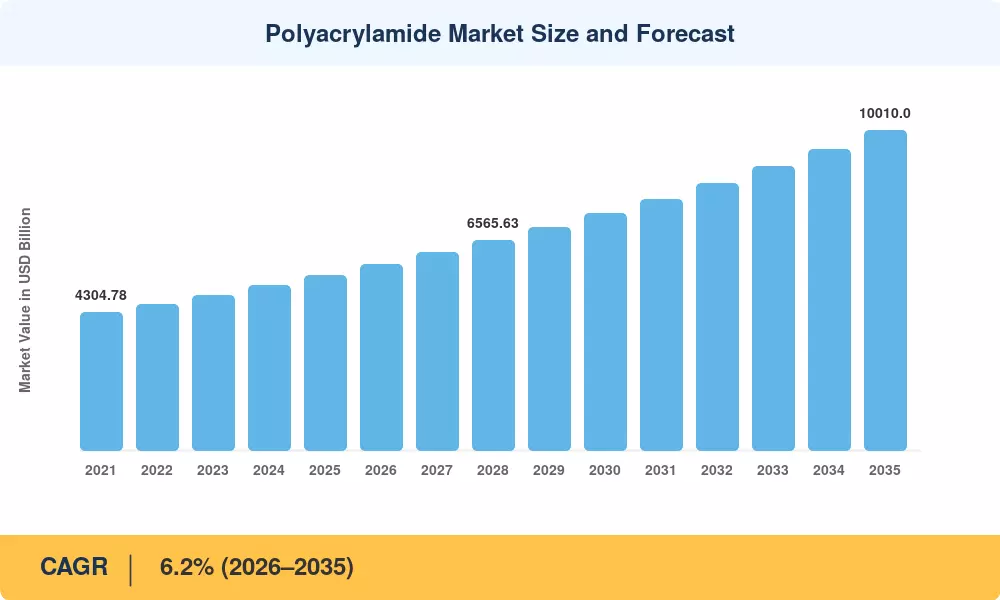
Polyacrylamide Market Size and Forecast
Our Impact
Enabled $4.3B Revenue Impact for Fortune 500 and Leading Multinationals
Partnering with 2000+ Global Organizations Each Year
30K+ Citations by Top-Tier Firms in the Industry
 

Driver Impact Analysis

Driver ~% Impact on CAGR Geographic Relevance Impact Timeline
Municipal wastewater infrastructure expansion ~1.4% Asia-Pacific, South America Long-term (≥4 yr)
Enhanced oil recovery program acceleration ~1.2% North America, the Middle East Medium-term (2–4 yr)
EU Urban Wastewater Treatment Directive 2024/3019 ~0.8% Europe Short-term (≤2 yr)
EPA residual-monomer cap tightening ~0.6% North America Short-term (≤2 yr)
Battery-metal tailings treatment mandates ~0.5% Asia-Pacific, South America Medium-term (2–4 yr)
Semiconductor fab wastewater purity requirements ~0.4% Asia-Pacific, North America Long-term (≥4 yr)
Sludge dewatering automation and closed-loop dosing ~0.3% Global Long-term (≥4 yr)


Municipal Wastewater Infrastructure Expansion

Global capital expenditure on water treatment polymers for municipal systems exceeded USD 48 billion in 2024, with Asia-Pacific accounting for nearly 55% of new project commitments. India's Jal Jeevan Mission, which targets piped drinking water connections for 190 million rural households by 2028, is generating unprecedented demand for polymer flocculants used in clarification and sludge treatment chemicals for dewatering. China's 14th Five-Year Plan allocated CNY 580 billion to urban sewage treatment upgrades, mandating Class 1A effluent discharge across all prefecture-level cities — a standard that effectively requires polyacrylamide-based flocculation at every facility [9][7].

Enhanced Oil Recovery Program Acceleration

Polyacrylamide accounted for almost 40% of the over 185,000 metric tons of oilfield chemicals used in tertiary recovery operations in the Bakken, Eagle Ford, and Permian Basin formations in 2024. When reservoir pressure drops in mature wells, operators switch to polymer flooding, which can increase recovery factors from 30% to over 55%. This directly helps the polyacrylamide market. Middle Eastern demand for salt-tolerant acrylamide polymers is being anchored by Saudi Aramco's enlarged polymer-flood pilot at the Ghawar field, which has a budget of USD 320 million through 2027 [8][13].


EU Urban Wastewater Treatment Directive

The revised EU Directive 2024/3019 requires member states to retrofit 12,000+ treatment facilities with quaternary phosphorus and nitrogen removal stages by 2032. This mandate directly increases consumption of industrial treatment chemicals, as polyacrylamide-based coagulant aids are the primary reagent class for achieving sub-0.5 mg/L total phosphorus limits. Germany alone has earmarked EUR 4.2 billion in federal-state co-funding for treatment plant upgrades during 2025–2029 [2].

EPA Residual-Monomer Cap Tightening

Globally, regulatory agencies are gradually raising the bar for the amount of residual monomer in polyacrylamide drinking water products. The market is clearly experiencing a consolidation impact as safety standards tighten: manufacturers who can reliably develop ultra-low-monomer formulations are gaining market share. High-purity, conforming grades are becoming more expensive as a result of this change, which helps premium polymer producers increase their profit margins.


Restraints Impact Analysis

Restraint ~% Impact on CAGR Geographic Relevance Impact Timeline
Acrylamide monomer price volatility –0.5% Global Short-term (≤2 yr)
Regulatory pressure on acrylamide toxicity –0.4% Europe, North America Medium-term (2–4 yr)
Bio-based flocculant substitution risk –0.3% Europe Long-term (≥4 yr)
Overcapacity in Chinese commodity grades –0.3% Asia-Pacific Short-term (≤2 yr)
Water recycling reduces net chemical consumption –0.2% Global Long-term (≥4 yr)


Acrylamide Monomer Price Volatility

Acrylonitrile — the primary feedstock for acrylamide polymers — experienced a 28% price swing between Q1 and Q3 2024, driven by propylene supply disruptions in Southeast Asia and maintenance shutdowns at key European crackers. These cost fluctuations compress margins for flocculant chemicals producers operating on fixed-price municipal contracts, which represent roughly 35% of the global Polyacrylamide Market by revenue. Smaller manufacturers lacking backward integration into monomer production are disproportionately affected, with three mid-size Chinese producers exiting the market in 2024 alone [6].

Regulatory Pressure on Acrylamide Toxicity

Acrylamide monomer is still a vital component of high-performance flocculants, although it is subject to strict safety and health regulations. The industry is witnessing a shift toward tighter restrictions on residual monomer content in completed polymers, especially for drinking-water applications, as opposed to a complete ban. Top-tier manufacturers are being forced to invest in cutting-edge purifying technology as a result. In the premium municipal segment, businesses that don't receive "ultra-low monomer" grades are becoming more and more ostracized, thereby establishing a "two-tier" market structure.


Bio-Based Flocculant Substitution

In markets that care about sustainability, like the Nordic region, renewable substitutes like chitosan and starch-grafted polymers are making a name for themselves. Bio-flocculants are showing promise in pilot programs and specialized municipal sectors, while synthetic polyacrylamides continue to be the industry standard for performance-critical applications. Long-term adoption of these materials is increasingly dependent on "green procurement" regulations rather than just cost-performance parity, and they are an essential buffer against the unpredictability of synthetic feedstocks.[12].


Polyacrylamide Market Opportunities

Semiconductor-Grade Ultra-Pure Formulations

Global semiconductor fab capacity is projected to increase 42% by 2030, and each advanced fab generates 5,000–10,000 m³/day of chemical-mechanical planarization wastewater requiring polymer flocculants with monomer content below 10 ppm. This niche within the Polyacrylamide Market commands 3–4× the pricing of commodity grades and remains underserved by existing suppliers [4].

Bio-Grafted Polymer Derivatives

Grafting polyacrylamide onto renewable backbones — cassava starch, cellulose nanofibers, or chitosan — addresses both performance and sustainability mandates. The European Green Deal's extended producer responsibility framework incentivizes sludge treatment chemicals with verified biodegradability, opening an estimated USD 420 million addressable segment by 2032 for certified bio-derivative water treatment polymers [12]

Closed-Loop Dosing and Digital Chemical Management

Automated real-time dosing systems using inline turbidity sensors and AI-driven feed optimization can reduce polymer flocculants consumption by 15–25% while improving effluent quality. The digital dosing platform segment across the Polyacrylamide Market is growing at twice the base CAGR as utilities adopt chemical-as-a-service models that bundle acrylamide polymers with monitoring hardware and analytics [5]

Lithium and Battery-Metal Tailings Treatment

The lithium extraction boom across Chile, Argentina, and Western Australia is generating millions of tons of fine clay tailings that require ultra-high-molecular-weight mining chemical additives for solid-liquid separation. This emerging end use could contribute USD 350 million in incremental demand to the Polyacrylamide Market by 2033, particularly for producers that develop brine-tolerant formulations [10]

African and South Asian Municipal Buildout

Sub-Saharan Africa treats less than 15% of its municipal wastewater, while South Asian economies are investing USD 22 billion annually in urban water infrastructure. These regions represent greenfield territory for industrial treatment chemicals suppliers, with local formulation partnerships offering first-mover advantages [9].


Polyacrylamide Market Future Outlook

AI-Optimized Chemical Dosing and Smart Water Networks

Artificial intelligence is transforming how utilities manage water treatment polymer consumption. Machine-learning algorithms trained on real-time turbidity, pH, and flow data can optimize polyacrylamide dosing within 2% of theoretical minimums, reducing chemical waste by up to 25%. The IEA estimates that digitalization of water infrastructure could save USD 50 billion globally by 2030, with chemical optimization representing a significant share of those savings. Within the Polyacrylamide Market, suppliers that bundle digital dosing platforms with their products will capture higher margins and stickier customer relationships [5][15].

Circular Economy and Sludge Valorization

The transition from sludge disposal to sludge valorization — recovering phosphorus, biogas, and biochar — changes the performance requirements for sludge treatment chemicals. Polyacrylamide formulations must now facilitate downstream nutrient recovery rather than simply achieving dewatering targets. The EU's proposed Critical Raw Materials Act designates phosphorus as strategic, incentivizing recovery-compatible polymer flocculants. This shift creates a differentiated product tier within the Polyacrylamide Market that rewards R&D-intensive producers [2][12].

ESG Reporting and Sustainable Chemistry Mandates

Corporate sustainability disclosure requirements — CSRD in Europe, SEC climate rules in the US — are compelling industrial water users to document their chemical supply chains. Demand for third-party-verified, low-carbon-footprint acrylamide polymers is rising among mining, pulp-and-paper, and food-processing buyers who must report Scope 3 emissions. Producers that achieve EcoVadis Gold or Cradle-to-Cradle certification for their industrial treatment chemicals are commanding 10–15% price premiums in tender processes [14].

Electrification Supercycle and Critical Mineral Processing

The global push toward electrification — EVs, grid storage, renewable generation — is driving massive expansion of lithium, cobalt, and rare-earth mining. Each of these extraction processes generates fine-particle tailings and brines that require specialized mining chemical additives for solid-liquid separation. By 2032, battery-metal-related consumption of polyacrylamide could represent 8–10% of the total Polyacrylamide Market, up from under 3% in 2025 [10][11].


Polyacrylamide Market Segmentation

By Physical Form

Segment Key Metric Primary Demand Driver
Powder 46.8% share (2025) Cost efficiency, bulk handling for municipal wastewater treatment additives
Liquid USD 1,040 Million (2025) Direct-feed convenience for smaller treatment facilities
Emulsion/Dispersions 6.6% CAGR (2026–2035) Automated dosing systems, rapid dissolution


Powder remains the dominant physical form in the Polyacrylamide Market because municipal and industrial buyers prioritize unit economics in high-volume applications. Large treatment plants processing over 100 MLD rely heavily on powder-grade flocculant chemicals for primary clarification and sludge conditioning, where the 15–20% cost advantage over emulsions justifies the additional dissolution equipment required. China and India together consume over 65% of global powder-form output.

Emulsion and dispersion formats are the fastest-growing segment, gaining share as utilities automate their chemical feed systems. These ready-to-use formulations eliminate the need for aging tanks and mechanical mixers, reducing on-site labor and enabling precision dosing of water treatment polymers. Semiconductor fabs and pharmaceutical water systems particularly favor emulsions for their consistency and low residual-monomer profiles [4][5].

By Application

Segment Key Metric Primary Demand Driver
Flocculants for Water Treatment 44.4% share (2025) Municipal and industrial wastewater treatment additives growth
Enhanced Oil Recovery 6.7% CAGR (2026–2035) Tertiary recovery in mature oilfields
Soil Conditioner USD 320 Million (2025) Agricultural runoff control, dryland irrigation
Other Applications 5.4% CAGR (2026–2035) Paper processing additives, mineral processing, and textile sizing


Flocculation applications anchor the Polyacrylamide Market and will retain the largest revenue share through 2035. Municipal wastewater treatment plants worldwide consume over 900,000 metric tons annually of polymer flocculants for clarification, thickening, and dewatering — volumes that scale directly with urbanization rates and tightening discharge standards. The EU Directive and Asian sludge mandates are the primary regulatory tailwinds for this segment [2][7].

Enhanced oil recovery is the fastest-expanding application, with North American shale operators and Middle Eastern national oil companies deploying high-viscosity oilfield chemicals to sweep residual crude from depleted formations. A single polymer-flood project can consume 5,000–15,000 metric tons per year of specialized acrylamide polymers, making individual project awards significant demand events for the Polyacrylamide Market [8][13].

By End-User Industry

Segment Key Metric Primary Demand Driver
Water Treatment 44.2% share (2025) Regulatory mandates, urbanization
Oil and Gas 6.6% CAGR (2026–2035) EOR program scaling
Pulp and Paper USD 385 Million (2025) Retention and drainage aid demand for paper processing additives
Mining 6.4% CAGR (2026–2035) Battery-metal tailings, mining chemical additives, and growth
Other Industries USD 290 Million (2025) Textile sizing, construction, and food processing


Water treatment end users dominate the Polyacrylamide Market across both municipal and industrial sub-segments. Global municipal wastewater treatment capacity additions exceeded 25 million m³/day in 2024, each incremental unit requiring an ongoing supply of industrial treatment chemicals for flocculation and sludge handling. Oil and gas end users represent the most dynamic growth vector, with tertiary recovery investments expanding polymer consumption at rates that outpace the broader market [8][9].


Regional Market Share Analysis

Region Key Metric Primary Investment Themes
Asia-Pacific 53.4% share (2025) Municipal buildout, mining chemical additives, and sludge mandates
North America 6.1% CAGR (2026–2035) Shale EOR, EPA compliance, semiconductor wastewater
Europe USD 930 Million (2025) EU Directive retrofits, bio-derivative R&D
South America 5.8% CAGR (2026–2035) Lithium tailings, municipal expansion
Middle East & Africa USD 275 Million (2025) Desalination pre-treatment, oilfield chemicals
Total USD 5,480 Million (2025)

The Polyacrylamide Market spans five major regions, each shaped by distinct regulatory, industrial, and infrastructural dynamics. Asia-Pacific continues to dominate global consumption of water treatment polymers and oilfield chemicals, while regulatory tightening in North America and Europe is accelerating the shift toward premium-grade acrylamide polymers.


North America

Country Key Metric Key Driver
US 78% of regional share Permian Basin EOR, EPA monomer regulation
Canada 5.4% CAGR Oil sands tailings ponds remediation
Mexico USD 52 Million (2025) Municipal wastewater modernization


North American Polyacrylamide Market growth is anchored by enhanced oil recovery operations, where polymer flooding has become standard practice in depleted shale reservoirs. The EPA's tighter monomer limits are consolidating supply toward certified producers, raising average prices for compliant flocculant chemicals. Canada's regulatory push to remediate legacy oil sands tailings ponds — with mandated completion timelines under Alberta's Tailings Management Framework — adds a unique demand layer for ultra-high-molecular-weight sludge treatment chemicals [3][8].

Europe

Country Key Metric Key Driver
Germany 24% of regional share Quaternary treatment retrofits
UK 5.5% CAGR Thames Tideway and AMP8 cycle
France USD 125 Million (2025) Agence de l'Eau nutrient standards
Italy 4.8% CAGR Southern Italy sewage network upgrades
Spain USD 62 Million (2025) Drought-driven reuse plant construction
Nordic Countries 5.6% CAGR Bio-flocculant adoption and green procurement
Russia USD 58 Million (2025) Industrial wastewater and oilfield applications
Rest of Europe 4.7% CAGR CEE infrastructure co-financing


The EU Directive 2024/3019 is the defining catalyst for the European Polyacrylamide Market, creating a decade-long retrofit cycle that favors suppliers of premium industrial treatment chemicals. The UK's AMP8 investment cycle (2025–2030) allocates GBP 96 billion to water utility infrastructure, with polymer flocculants consumption expected to rise 18% over the period. Nordic countries are pioneering bio-grafted paper processing additives, setting a regulatory precedent that could spread across the continent [2].

Asia-Pacific

Country Key Metric Key Driver
China 58% of regional share 14th Five-Year Plan sewage mandates
India 7.4% CAGR Jal Jeevan Mission, Namami Gange
Japan USD 210 Million (2025) Semiconductor wastewater, aging infrastructure
South Korea 5.9% CAGR Semiconductor fab expansion
ASEAN USD 185 Million (2025) Urbanization, palm oil mill effluent treatment
Rest of Asia-Pacific 6.3% CAGR Mining, municipal buildout


Asia-Pacific dominates the Polyacrylamide Market largely because of China's enormous municipal and industrial wastewater treatment infrastructure, which consumes over 1.1 million metric tons of acrylamide polymers annually. India's growth trajectory is steeper, propelled by the Jal Jeevan Mission's piped-water targets and the Namami Gange program's sewage treatment plant construction along the Ganges basin. Japan and South Korea contribute disproportionately to high-value demand for semiconductor-grade water treatment polymers [7][9].

South America

Country Key Metric Key Driver
Brazil 62% of regional share Pre-salt EOR, SABESP privatization
Argentina 5.9% CAGR Vaca Muerta shale, lithium extraction
Rest of South America USD 48 Million (2025) Chilean copper and lithium tailings


Brazil's SABESP privatization is unlocking billions in wastewater treatment investment across São Paulo state, directly increasing consumption of polymer flocculants and sludge treatment chemicals. Argentina's Vaca Muerta shale development and lithium triangle operations in the Salta-Jujuy corridor are generating demand for specialized mining chemical additives capable of performing in high-salinity brines [10].

Middle East & Africa

Country Key Metric Key Driver
Saudi Arabia 35% of regional share Vision 2030 water reuse, Aramco EOR
UAE 6.0% CAGR Desalination pre-treatment expansion
South Africa USD 42 Million (2025) AMD mine water treatment
Egypt 5.3% CAGR Nile basin irrigation infrastructure
Rest of MEA USD 68 Million (2025) Municipal buildout, oilfield chemicals


Saudi Arabia's Vision 2030 framework targets 70% wastewater reuse by 2030, tripling the current rate and creating sustained demand for high-performance flocculant chemicals across new mega-scale treatment facilities. South Africa's acid mine drainage remediation program, funded at ZAR 12 billion through 2029, represents a concentrated demand pocket for specialized acrylamide polymers [13].

Polyacrylamide Market By Region, 2025-2035
 

Competitive Benchmarking

The Polyacrylamide Market exhibits medium concentration, with the top five producers holding an estimated 45–52% of global revenue. SNF Group commands the largest individual share, followed by a cluster of diversified chemical companies and specialized Asian manufacturers. The Herfindahl-Hirschman Index (HHI) for the market sits in the 850–1,100 range, indicating moderate fragmentation with regional concentration pockets — particularly in China, where domestic producers collectively control over 60% of Asia-Pacific volume[6].

Company Est. Revenue Share Range Key Offerings for the Polyacrylamide Market Strategic Positioning
SNF Group ~14–18% Full-range anionic/cationic/nonionic polymer flocculants Global scale leader with backward-integrated monomer production
Kemira Oyj ~7–10% Water treatment polymers, pulp and paper retention aids Nordic-anchored sustainability leader in flocculant chemicals
BASF SE ~6–9% Oilfield chemicals, mining flocculants Diversified portfolio with EOR specialty focus
Solenis LLC ~5–8% Paper processing additives, industrial treatment chemicals Process-integrated solutions for pulp and tissue
Anhui Jucheng Fine Chemicals ~4–7% Commodity and specialty acrylamide polymers China-based cost leader with export growth
Beijing Hengju Chemical Group ~3–6% EOR-grade polymers, oilfield chemicals PetroChina is affiliated with upstream integration
Shandong Polymer Bio-chemicals ~3–5% Water treatment polymers, mining chemical additives Regional cost competitor with expanding capacity
Ashland Global Holdings ~2–4% Specialty flocculant chemicals, personal care grades Niche specialty positioning
Nouryon ~2–4% Colloidal silica and polymer flocculants for paper Cross-portfolio synergies in paper processing additives
Ecolab Inc. ~2–3% Integrated wastewater treatment additives and service contracts Chemical-as-a-service model for industrial users


Recent News & Developments

  • SNF Group (March 2025): Commissioned a 120,000-ton/year acrylamide polymers production line at its Andrezieux facility in France, increasing European capacity by 18% to meet EU Directive-driven demand for water treatment polymers [6].
  • Kemira Oyj (January 2025): Launched FENNOPOL® Green, a bio-based flocculant chemicals range with 40% renewable carbon content, targeting Nordic and Central European municipal sludge treatment chemicals applications [12].
  • BASF SE (October 2024): Signed a USD 280 million five-year supply agreement with Saudi Aramco for salt-tolerant oilfield chemicals used in Ghawar polymer-flood expansion [13].


  • European Commission (November 2023): Published the final text of the Urban Wastewater Treatment Directive 2024/3019, establishing binding timelines for quaternary nutrient removal and confirming the regulatory foundation for sustained polymer flocculants demand growth across the Polyacrylamide Market [2].
 

Polyacrylamide Market Report Scope

Parameter Details
Market Scope Global Polyacrylamide Market covering production, consumption, and trade by physical form, application, end-user industry, and geography
Study Period 2021–2035
CAGR 6.2% (2026–2035)
Market Size (2025) USD 5,480 Million
Market Size (2035) USD 10,010 Million
Fastest Growing Segment Emulsion/Dispersions (by physical form); Enhanced Oil Recovery (by application)
Companies Profiled SNF Group, Kemira, BASF, Solenis, Anhui Jucheng, Beijing Hengju, Shandong Polymer Bio-chemicals, Ashland, Nouryon, Ecolab
Valuation Currency USD Million


FAQs

How does residual acrylamide monomer content affect procurement decisions for drinking-water-grade polyacrylamide?

Utilities require monomer content below 0.025% under updated EPA rules, and non-compliant products are disqualified from municipal tenders. This standard concentrates purchasing among fewer certified water treatment polymer suppliers [3].

What differentiates polymer flooding from surfactant flooding in enhanced oil recovery economics?

Polymer flooding costs USD 3–6 per incremental barrel versus USD 8–14 for surfactant-polymer combinations. Operators in the Polyacrylamide Market favor standalone polymer floods for reservoirs above 20°API gravity [8].

How do closed-loop dosing systems change the supplier-customer relationship for flocculant chemicals?

These systems shift procurement from bulk chemical sales to performance-based contracts, where suppliers guarantee effluent quality. The model favors integrated providers of acrylamide polymers with real-time monitoring capabilities [5].

What is the typical shelf life and storage limitation for emulsion-form polyacrylamide products?

Emulsion products maintain efficacy for 6–9 months under controlled temperatures below 35°C. Tropical climates in Asia-Pacific require cold-chain logistics, adding 8–12% to the delivered cost for polymer flocculants.

How are mining companies in the Polyacrylamide Market adapting to tailings dam safety regulations post-Brumadinho?

Post-2019 regulations mandate filtered dry-stack tailings at new operations, increasing consumption of ultra-high-molecular-weight mining chemical additives by 30–40% per ton of ore processed [10][11].

What role does charge density play in selecting cationic versus anionic polyacrylamide for sludge dewatering?

High-charge-density cationic grades suit organic-rich municipal biosolids, while anionic grades perform better on mineral-heavy industrial sludge treatment chemicals. Jar testing remains the standard selection protocol.

How is the Polyacrylamide Market affected by the shift from linear to circular water management in European industry?

Circular systems reduce total flocculant chemicals volume per m³ treated but increase demand for high-performance grades compatible with downstream nutrient recovery. Net value per customer rises despite lower tonnage [2][15].


Author
Author
Author Profile
Priya Nagrale LinkedIn
Senior Research Analyst
With an experience of over five years in market research industry (Chemicals & Materials domain), I gather and analyze market data from diverse sources to produce results, which are then presented back to a client. Also, provide recommendations based on the findings. As a Senior Research Analyst, I perform quality checks (QC) for market estimations, QC for reports, and handle queries and work extensively on client customizations. Also, handle the responsibilities of client proposals, report planning, report finalization, and execution

Research Approach


Secondary Research

The secondary research process involved comprehensive analysis of regulatory databases, industry publications, chemical manufacturing journals, environmental compliance reports, and authoritative industrial organizations. Key sources included the US Environmental Protection Agency (EPA), European Chemicals Agency (ECHA), US Geological Survey (USGS), International Energy Agency (IEA), Organization of Petroleum Exporting Countries (OPEC), International Association of Oil & Gas Producers (IOGP), American Petroleum Institute (API), International Water Association (IWA), National Association of Clean Water Agencies (NACWA), China Ministry of Environmental Protection, India Central Pollution Control Board (CPCB), EU Water Framework Directive Database, World Bank Water & Sanitation Program, United Nations Environment Programme (UNEP), OECD Environmental Data, and national oil & gas regulatory authority reports from key markets.

These sources were used to obtain production statistics, environmental compliance data, increased oil recovery metrics, wastewater treatment infrastructure data, and market landscape analysis for anionic, cationic, and non-ionic polyacrylamide segments.


Primary Research

In order to gather both qualitative and quantitative insights, supply-side and demand-side stakeholders were interviewed during the primary research phase. Supply-side sources included CEOs, VPs of Manufacturing, R&D heads, regulatory compliance officers, and commercial directors from polyacrylamide manufacturers, chemical conglomerates, and specialty polymer producers. Demand-side sources comprised water treatment plant managers, oilfield services engineers, mining operations directors, pulp & paper procurement leads, and environmental compliance officers from municipal utilities, E&P businesses, mining conglomerates, and industrial processing facilities. Market segmentation, capacity growth schedules, and information on industrial adoption trends, price volatility, and regulatory compliance dynamics were all corroborated by primary research.

Primary Respondent Breakdown:

By Designation: C-level Primaries (32%), Director Level (31%), Others (37%)

By Region: North America (32%), Europe (30%), Asia-Pacific (33%), Rest of World (5%)


Market Size Estimation

Global market valuation was established by manufacturing capacity analysis and application volume assessment. The methods included:

Identification of 50+ significant manufacturers in North America, Europe, Asia-Pacific, Latin America, and Middle East & Africa

Product mapping for cationic, non-ionic, and anionic polyacrylamide types

Analysis of reported and modeled yearly revenues specific to polyacrylamide portfolios

Coverage of manufacturers with 75-80% of global market share in 2024

Extrapolation employing bottom-up (application volume × ASP by area) and top-down (manufacturer revenue validation) methodologies to establish segment-specific valuations for water treatment, improved oil recovery, pulp & paper, and mineral processing applications

Download Free Sample

Kindly complete the form below to receive a free sample of this Report

Download PDF ×

We do not share your information with anyone. However, we may send you emails based on your report interest from time to time. You may contact us at any time to opt-out.
















