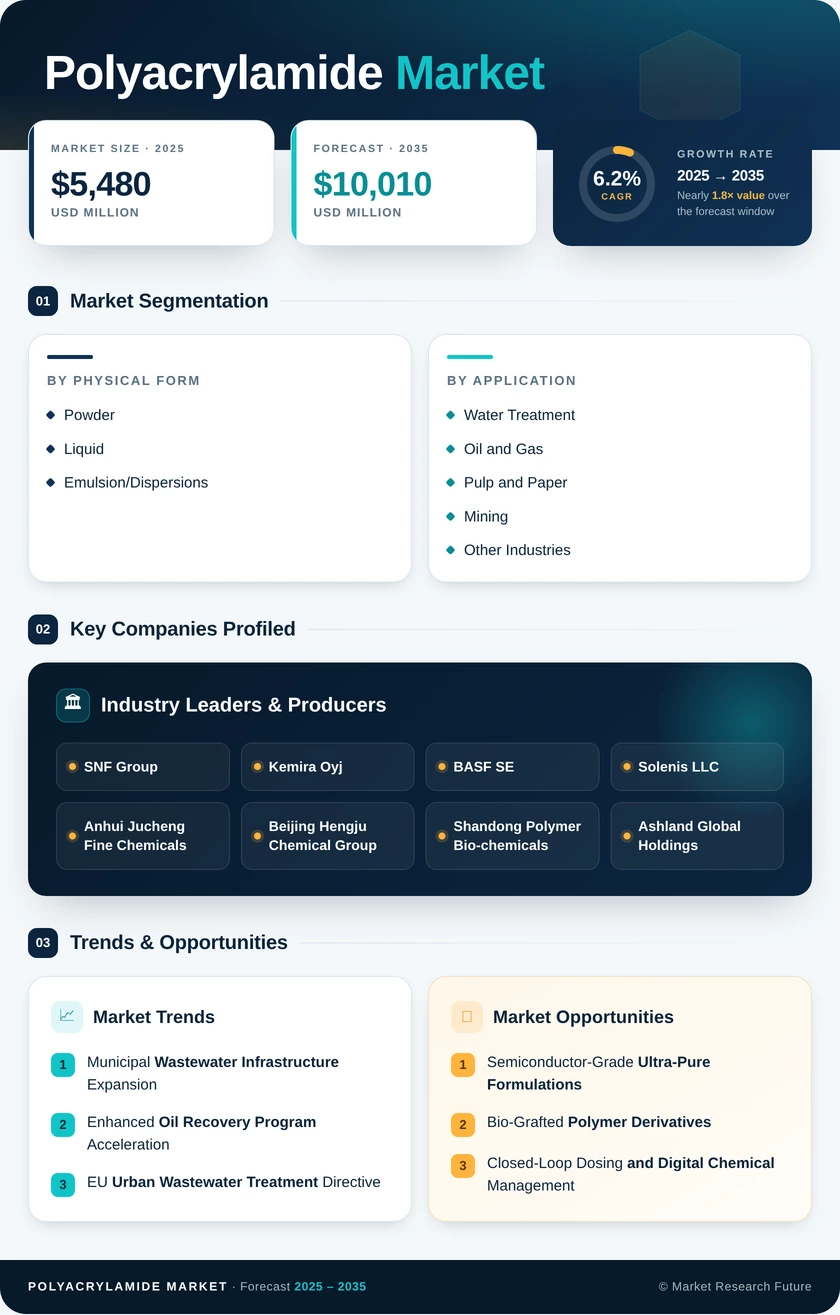
Segmentation Quick Reference
| Dimension | Sub-Segments | Dominant Segment | Fastest Growing Segment |
| Physical Form | Powder, Liquid, Emulsion/Dispersions | Powder (46.8% share, 2025) | Emulsion/Dispersions (6.6% CAGR) |
| Application | Flocculants for Water Treatment, Enhanced Oil Recovery, Soil Conditioner, Other | Flocculants for Water Treatment (44.4% share, 2025) | Enhanced Oil Recovery (6.7% CAGR) |
| End-User Industry | Water Treatment, Oil and Gas, Pulp and Paper, Polyacrylamide Market, Other | Water Treatment (44.2% share, 2025) | Oil and Gas (6.6% CAGR) |
| Geography | Asia-Pacific, North America, Europe, South America, the Middle East & Africa | Asia-Pacific (53.4% share, 2025) | Asia-Pacific (6.7% CAGR) |
Market Segmentation Overview
By Physical Form
| Sub-Segment | Key Trend |
| Powder | Dominant in bulk municipal and industrial applications due to cost-per-ton advantage; China and India drive over 65% of global powder consumption |
| Liquid | Growing in small-to-mid-size facilities seeking ready-to-feed convenience without emulsion-grade pricing |
| Emulsion/Dispersions | Fastest-growing format driven by automated dosing system adoption and superior performance in semiconductor and pharmaceutical water treatment |
Powder formulations continue to anchor global consumption, but the steady migration toward emulsion-based products reflects a broader industry shift toward automation, precision dosing, and reduced operator handling of dry chemicals. Producers investing in emulsion polymer capacity are positioning for the next decade of the Polyacrylamide Market growth trajectory.
By Application
| Sub-Segment | Key Trend |
| Flocculants for Water Treatment | Largest application driven by municipal and industrial wastewater infrastructure expansion globally |
| Enhanced Oil Recovery | Fastest-growing application as operators adopt polymer flooding to improve recovery factors in mature reservoirs |
| Soil Conditioner | Steady demand from agricultural markets for erosion control and irrigation efficiency |
| Other Applications | Includes paper processing, mineral processing, and textile sizing with stable incremental growth |
Water treatment flocculation remains the volume anchor for polyacrylamide demand globally, while enhanced oil recovery represents the most dynamic growth vector. Soil conditioning and specialty applications contribute niche but stable revenue streams with differentiated product requirements.
By End-User Industry
| Sub-Segment | Key Trend |
| Water Treatment | Regulatory mandates in all regions are sustaining high-volume demand for polymer flocculants and sludge chemicals |
| Oil and Gas | Tertiary recovery expansion in North America, the Middle East, and South America is accelerating consumption |
| Pulp and Paper | Retention aids and drainage improvement chemicals maintain a steady demand from paper mills |
| Polyacrylamide Market | Battery-metal tailings and critical mineral processing are emerging as a high-growth demand pocket |
| Other Industries | Textile sizing, construction, and food processing applications contribute incremental volumes |
Water treatment remains the bedrock end-user segment, but the oil-and-gas and mining sectors are emerging as the growth engines of the next decade. Polyacrylamide Market's share of total polyacrylamide consumption is expected to roughly double by 2035 as battery-metal extraction scales globally.
By Geography
| Sub-Segment | Key Trend |
| Asia-Pacific | Volume anchor driven by Chinese municipal mandates, Indian infrastructure programs, and semiconductor fab expansion |
| North America | Shale EOR and EPA compliance driving premiumization of polymer supply |
| Europe | EU Directive 2024/3019 creates a decade-long retrofit cycle for municipal treatment plants |
| South America | Lithium extraction and Brazilian water privatization are opening new demand corridors |
| Middle East & Africa | Vision 2030 water reuse targets and oilfield polymer flooding, sustaining regional growth |
Asia-Pacific will maintain its dominant position through 2035, but the fastest absolute-value growth increments will come from regulatory-driven demand in Europe and EOR-driven consumption in North America and the Middle East.