Polymeric Adsorbents Market Summary
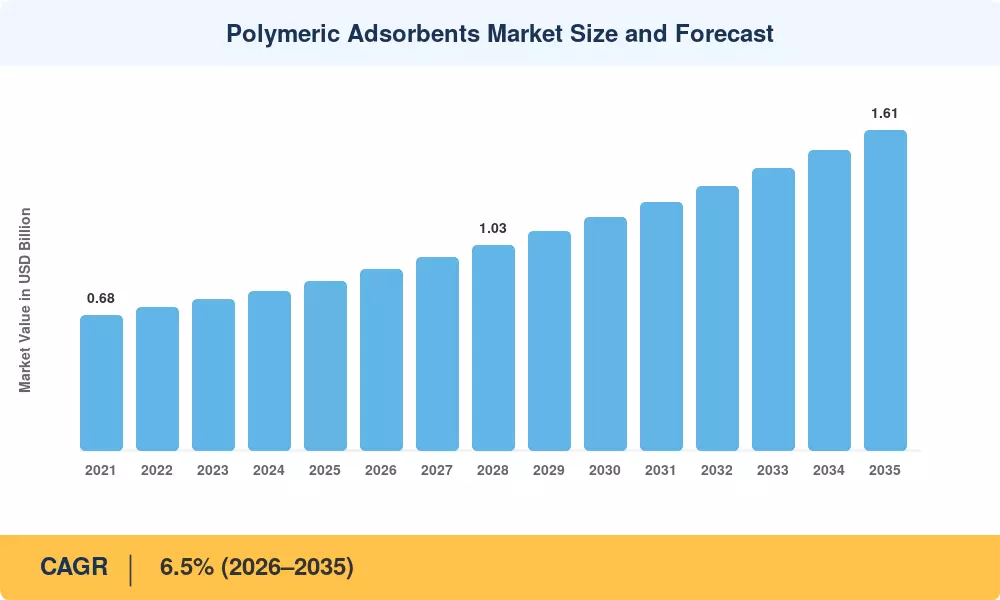
The global Polymeric Adsorbents Market reached an estimated USD 0.85 billion in 2025, with the forecast period commencing at USD 0.91 billion in 2026 and projected to climb to USD 1.61 billion by 2035, reflecting a compound annual growth rate of 6.5%. Tightening discharge regulations across pharmaceutical and food processing facilities have become the primary demand catalyst, as manufacturers face mandatory effluent purity thresholds that conventional activated carbon struggles to meet consistently [1]. Parallel investment in water reuse infrastructure—driven by the UN Sustainable Development Goal 6 on clean water—has further expanded the addressable market for high-selectivity polymeric sorbent technologies [2].
A broader technology shift is underway. Legacy granular activated carbon beds and silica-gel columns, while still widely deployed, are increasingly replaced by engineered styrenic and methacrylic copolymer matrices that offer tunable pore structures, higher regeneration efficiency, and longer operational lifetimes. Capital commitments from specialty chemical producers exceed USD 1.2 billion globally since 2022, targeting next-generation resin manufacturing capacity [3]. Regulatory mandates such as the EU Drinking Water Directive recast and the US EPA's PFAS rulemaking have accelerated adoption timelines across municipal and industrial end users alike [4].
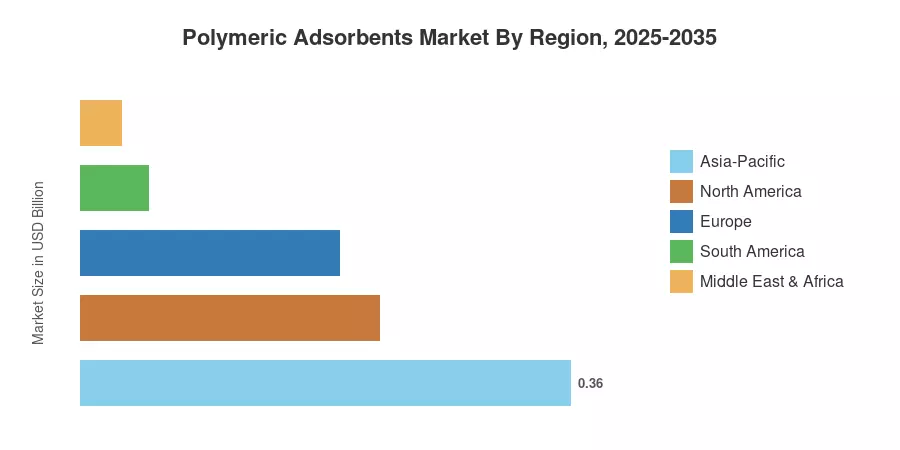
Asia-Pacific commands approximately 42% of the Polymeric Adsorbents Market in revenue terms, anchored by pharmaceutical production clusters in China and India alongside Japan's advanced food-grade purification sector. The region also stands as the fastest-growing geography, recording a projected CAGR of 7.4% through 2035. North America holds the second-largest share at roughly 26%, driven by stringent EPA water-quality standards and expanding biopharmaceutical manufacturing. As circular-economy pressures intensify and end users demand resins that can be regenerated dozens of times without performance decay, the Polymeric Adsorbents Market is positioned for sustained, regulation-driven expansion across the coming decade.
Key Report Takeaways
• By Type
- Methacrylic adsorbents account for approximately 34% of the Polymeric Adsorbents Market by value, reflecting broad pharmaceutical and food-processing adoption.
- Aromatic-type resins are projected to grow at a CAGR of 7.1% during 2026–2035, fueled by demand in industrial solvent-recovery applications.
• By End-User Industry
- The pharmaceutical segment leads the Polymeric Adsorbents Market with an estimated 31% revenue share, driven by antibiotic and protein purification workflows.
- Food and beverage applications represent USD 0.22 billion in 2025, propelled by sugar decolorization and natural-extract purification.
• By Region
- Asia-Pacific dominates the Polymeric Adsorbents Market with a 42% share, reflecting concentrated production in China, India, and Japan.
- North America captures roughly 26% of the global market, underpinned by EPA regulatory compliance spending.
- Europe's Polymeric Adsorbents Market is estimated at USD 0.19 billion in 2025, with growth centered on REACH-compliant processing upgrades.
Polymeric Adsorbents Market Size and Forecast (2021–2035)
Market sizing relies on a triangulated methodology combining manufacturer revenue disclosures, trade-flow data from UN Comtrade, and downstream consumption modeling across pharmaceutical, food-processing, and industrial segments. Historical figures reflect actual shipment volumes; forecast projections apply a calibrated CAGR with scenario adjustments for regulatory acceleration and raw-material cost fluctuations.