POS Software Market (2026 - 2035)

ID: MRFR/ICT/6912-HCR
100 Pages
Apoorva Priyadarshi
Last Updated: August 04, 2026
POS Software Market Size, Share and Research Report By Deployment (Cloud, On-Premise), By Application (Inventory Management & Purchasing Management, Payment Processing & Checkout, Customer Relationship Management, Reporting & Analytics, Other Applications), By End-User Enterprise Size (Large Enterprises, Small and Medium Enterprises (SMEs)), By End-User Industry (Retail, Hospitality, Healthcare, Other Industries) and By Regional (North America, Europe, South America, Asia Pacific, Middle East and Africa) - Industry Forecast to 2035
POS Software Market
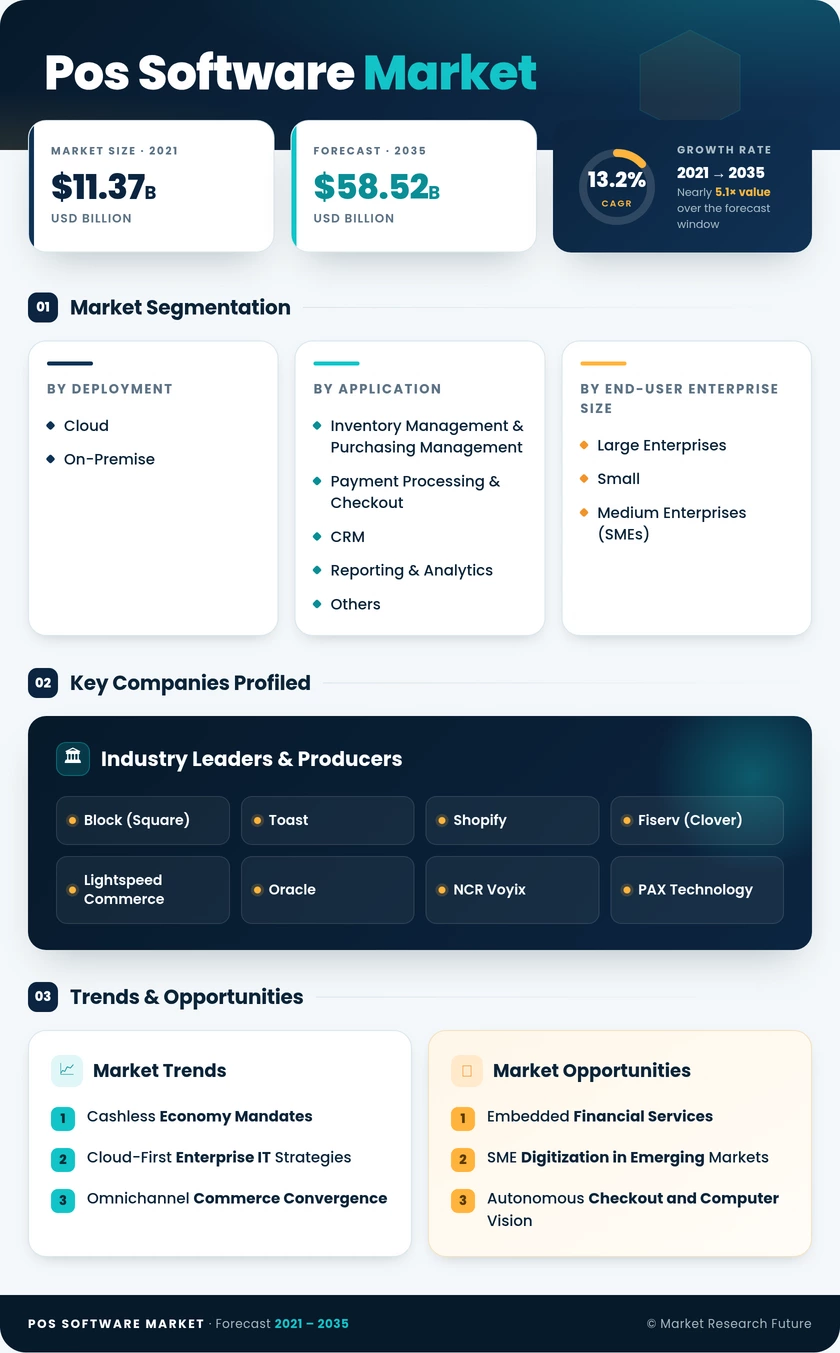
Market Size
Forecast Period2026-2035
CAGR (2026-2035)13.2%
2025 Market SizeUSD 16.94 Billion
2035 Market SizeUSD 58.52 Billion
Key Players
Block
Toast
Shopify
Fiserv
Lightspeed Commerce
Oracle
Opportunities
  • Embedded Financial Services
  • SME Digitization in Emerging Markets
  • Autonomous Checkout and Computer Vision
  1. 1 Market Overview |
    1. 1.1 Study Assumptions & Market Definition |
    2. 1.2 Scope of the Study |
    3. 1.3 Research Methodology
  2. 2 Market Summary & Key Takeaways
  3. 3 Market Dynamics |
    1. 3.1 Market Drivers Analysis | |
      1. 3.1.1 Cashless Economy Mandates and Digital Payment Regulation | |
      2. 3.1.2 Cloud-First Enterprise IT Strategies | |
      3. 3.1.3 Omnichannel Commerce Convergence | |
      4. 3.1.4 AI and Predictive Analytics Integration | |
      5. 3.1.5 SME Digitization in Emerging Markets | |
      6. 3.1.6 Embedded Finance and BNPL Integration | |
      7. 3.1.7 Self-Checkout and Autonomous Store Expansion |
    2. 3.2 Market Restraints Analysis | |
      1. 3.2.1 Data Privacy and PCI-DSS Compliance Costs | |
      2. 3.2.2 Integration Complexity with Legacy ERP/Back-Office Systems | |
      3. 3.2.3 Cybersecurity Threats and Breach Liability | |
      4. 3.2.4 Price Sensitivity Among Micro-Merchants | |
      5. 3.2.5 Vendor Lock-In and Switching Costs |
    3. 3.3 Market Opportunity Analysis | |
      1. 3.3.1 Embedded Financial Services | |
      2. 3.3.2 SME Digitization in Emerging Markets | |
      3. 3.3.3 Autonomous Checkout and Computer Vision | |
      4. 3.3.4 Data Monetization and Loyalty Ecosystems | |
      5. 3.3.5 Healthcare and Non-Traditional Verticals |
    4. 3.4 Industry Value Chain Analysis |
    5. 3.5 Porter's Five Forces Analysis
  4. 4 Global POS Software Market Size & Forecast (2021–2035) |
    1. 4.1 Historical Market Size (2021–2025) |
    2. 4.2 Current & Forecast Market Size (2026–2035) |
    3. 4.3 Market Size by Revenue (USD Billion) |
    4. 4.4 Year-over-Year Growth Analysis
  5. 5 Segmentation Analysis |
    1. 5.1 By Deployment | |
      1. 5.1.1 Cloud | |
      2. 5.1.2 On-Premise |
    2. 5.2 By Application | |
      1. 5.2.1 Inventory Management & Purchasing Management | |
      2. 5.2.2 Payment Processing & Checkout | |
      3. 5.2.3 Customer Relationship Management | |
      4. 5.2.4 Reporting & Analytics | |
      5. 5.2.5 Other Applications |
    3. 5.3 By End-User Enterprise Size | |
      1. 5.3.1 Large Enterprises | |
      2. 5.3.2 Small and Medium Enterprises (SMEs) |
    4. 5.4 By End-User Industry | |
      1. 5.4.1 Retail | |
      2. 5.4.2 Hospitality | |
      3. 5.4.3 Healthcare | |
      4. 5.4.4 Other Industries
  6. 6 Regional Analysis |
    1. 6.1 North America | |
      1. 6.1.1 United States | |
      2. 6.1.2 Canada | |
      3. 6.1.3 Mexico |
    2. 6.2 Europe | |
      1. 6.2.1 Germany | |
      2. 6.2.2 United Kingdom | |
      3. 6.2.3 France | |
      4. 6.2.4 Italy | |
      5. 6.2.5 Spain | |
      6. 6.2.6 Nordic Countries | |
      7. 6.2.7 Russia | |
      8. 6.2.8 Rest of Europe |
    3. 6.3 Asia-Pacific | |
      1. 6.3.1 China | |
      2. 6.3.2 India | |
      3. 6.3.3 Japan | |
      4. 6.3.4 South Korea | |
      5. 6.3.5 ASEAN | |
      6. 6.3.6 Rest of Asia-Pacific |
    4. 6.4 South America | |
      1. 6.4.1 Brazil | |
      2. 6.4.2 Argentina | |
      3. 6.4.3 Rest of South America |
    5. 6.5 Middle East & Africa | |
      1. 6.5.1 Saudi Arabia | |
      2. 6.5.2 UAE | |
      3. 6.5.3 South Africa | |
      4. 6.5.4 Egypt | |
      5. 6.5.5 Rest of MEA
  7. 7 Competitive Landscape |
    1. 7.1 Market Share Analysis (2025) |
    2. 7.2 Competitive Benchmarking Matrix |
    3. 7.3 Company Profiles | |
      1. 7.3.1 Block (Square) | |
      2. 7.3.2 Toast | |
      3. 7.3.3 Shopify | |
      4. 7.3.4 Fiserv (Clover) | |
      5. 7.3.5 Lightspeed Commerce | |
      6. 7.3.6 Oracle | |
      7. 7.3.7 NCR Voyix | |
      8. 7.3.8 PAX Technology | |
      9. 7.3.9 TouchBistro | |
      10. 7.3.10 Revel Systems
  8. 8 Future Outlook & Strategic Recommendations (2026–2035) |
    1. 8.1 AI-Native POS Platforms |
    2. 8.2 Platform Consolidation and Super-App Dynamics |
    3. 8.3 Sustainability and ESG-Linked Commerce |
    4. 8.4 Decentralized Payment Rails and Blockchain Settlement
  9. 9 Recent Developments & News
  10. 10 Frequently Asked Questions (FAQs)
  11. 11 Report Scope & Methodology |
    1. 11.1 Study Period & Base Year |
    2. 11.2 Data Sources & Citations |
    3. 11.3 Abbreviations
  12. 12 LIST OF TABLES |
  13. TABLE 1 Global POS Software Market Size & Forecast, by Revenue (USD Billion), 2021–2035 |
  14. TABLE 2 Global POS Software Market — Year-over-Year Growth Analysis, 2021–2035 |
  15. TABLE 3 Global POS Software Market — Driver Impact Analysis |
  16. TABLE 4 Global POS Software Market — Restraints Impact Analysis |
  17. TABLE 5 Global POS Software Market Size, by Deployment, 2021–2035 |
  18. TABLE 6 Global POS Software Market Size, by Application, 2021–2035 |
  19. TABLE 7 Global POS Software Market Size, by End-User Enterprise Size, 2021–2035 |
  20. TABLE 8 Global POS Software Market Size, by End-User Industry, 2021–2035 |
  21. TABLE 9 Global POS Software Market Size, by Region, 2021–2035 (USD Billion) |
  22. TABLE 10 North America POS Software Market Size, by Country, 2021–2035 |
  23. TABLE 11 Europe POS Software Market Size, by Country, 2021–2035 |
  24. TABLE 12 Asia-Pacific POS Software Market Size, by Country, 2021–2035 |
  25. TABLE 13 South America POS Software Market Size, by Country, 2021–2035 |
  26. TABLE 14 Middle East & Africa POS Software Market Size, by Country, 2021–2035 |
  27. TABLE 15 Competitive Benchmarking Matrix — Global POS Software Market, 2025 |
  28. TABLE 16 Company Profiles — Key Players, Global POS Software Market |
  29. TABLE 17 Recent Developments & Strategic Announcements, 2024–2025 |
  30. TABLE 18 Report Scope & Methodology Summary |
  31. TABLE 19 Detailed Sources and Citations |
  32. TABLE 20 North America POS Software Market Size, by Deployment, 2021–2035 |
  33. TABLE 21 North America POS Software Market Size, by Application, 2021–2035 |
  34. TABLE 22 North America POS Software Market Size, by End-User Enterprise Size, 2021–2035 |
  35. TABLE 23 North America POS Software Market Size, by End-User Industry, 2021–2035 |
  36. TABLE 24 Europe POS Software Market Size, by Deployment, 2021–2035 |
  37. TABLE 25 Europe POS Software Market Size, by Application, 2021–2035 |
  38. TABLE 26 Europe POS Software Market Size, by End-User Enterprise Size, 2021–2035 |
  39. TABLE 27 Europe POS Software Market Size, by End-User Industry, 2021–2035 |
  40. TABLE 28 Asia-Pacific POS Software Market Size, by Deployment, 2021–2035 |
  41. TABLE 29 Asia-Pacific POS Software Market Size, by Application, 2021–2035 |
  42. TABLE 30 Asia-Pacific POS Software Market Size, by End-User Enterprise Size, 2021–2035 |
  43. TABLE 31 Asia-Pacific POS Software Market Size, by End-User Industry, 2021–2035 |
  44. TABLE 32 South America POS Software Market Size, by Deployment, 2021–2035 |
  45. TABLE 33 South America POS Software Market Size, by Application, 2021–2035 |
  46. TABLE 34 South America POS Software Market Size, by End-User Enterprise Size, 2021–2035 |
  47. TABLE 35 South America POS Software Market Size, by End-User Industry, 2021–2035 |
  48. TABLE 36 Middle East & Africa POS Software Market Size, by Deployment, 2021–2035 |
  49. TABLE 37 Middle East & Africa POS Software Market Size, by Application, 2021–2035 |
  50. TABLE 38 Middle East & Africa POS Software Market Size, by End-User Enterprise Size, 2021–2035 |
  51. TABLE 39 Middle East & Africa POS Software Market Size, by End-User Industry, 2021–2035
  52. 13 LIST OF FIGURES |
  53. FIGURE 1 POS Software Market Dynamics — Drivers, Restraints, Opportunities |
  54. FIGURE 2 Industry Value Chain Analysis — POS Software Market |
  55. FIGURE 3 Porter's Five Forces Analysis — POS Software Market |
  56. FIGURE 4 Global POS Software Market Size Trend (USD Billion), 2021–2035 |
  57. FIGURE 5 POS Software Market Share, by Deployment, 2025 |
  58. FIGURE 6 POS Software Market Share, by Application, 2025 |
  59. FIGURE 7 POS Software Market Share, by End-User Enterprise Size, 2025 |
  60. FIGURE 8 POS Software Market Share, by End-User Industry, 2025 |
  61. FIGURE 9 POS Software Market Share, by Region, 2025 |
  62. FIGURE 10 North America POS Software Market Size Trend, 2021–2035 |
  63. FIGURE 11 Europe POS Software Market Size Trend, 2021–2035 |
  64. FIGURE 12 Asia-Pacific POS Software Market Size Trend, 2021–2035 |
  65. FIGURE 13 South America POS Software Market Size Trend, 2021–2035 |
  66. FIGURE 14 Middle East & Africa POS Software Market Size Trend, 2021–2035 |
  67. FIGURE 15 Competitive Landscape — POS Software Market Revenue Share, 2025

Segmentation Quick Reference

DimensionSub-SegmentsDominant SegmentFastest Growing Segment
By DeploymentCloud, On-PremiseCloud (62% share)Cloud
By ApplicationInventory Management & Purchasing Management, Payment Processing & Checkout, CRM, Reporting & Analytics, OthersInventory Management & Purchasing ManagementPayment Processing & Checkout
By End-User Enterprise SizeLarge Enterprises, Small and Medium Enterprises (SMEs)Large Enterprises (54% share)SMEs
By End-User IndustryRetail, Hospitality, Healthcare, OthersRetail (43% share)Hospitality


Market Segmentation Overview

By Deployment

Sub-SegmentKey Trend
CloudMulti-tenant SaaS platforms with real-time updates and remote management capabilities
On-PremisePersistent demand in regulated verticals requiring local data residency and low-latency processing


Cloud deployment is the default choice for new POS installations across retail and hospitality, driven by subscription pricing that converts capital expenditure into predictable operating costs. On-premise solutions maintain relevance where network reliability is inconsistent or regulatory data-residency rules preclude public cloud architectures.

By Application

Sub-SegmentKey Trend
Inventory Management & Purchasing ManagementAI-powered demand forecasting and automated purchase-order generation
Payment Processing & CheckoutMulti-rail acceptance spanning NFC, QR, biometric, and BNPL methods
Customer Relationship ManagementPOS-linked loyalty programs serving as first-party data engines
Reporting & AnalyticsReal-time dashboards with predictive insights for store-level decision-making
Other ApplicationsEmployee scheduling, kitchen display systems, and table management integrations


Inventory management functionality anchors the core value proposition, as retailers and restaurateurs prioritize shrinkage reduction and stock optimization. Payment processing is evolving fastest because each new payment method requires software-layer adaptation rather than hardware replacement.

By End-User Enterprise Size

Sub-SegmentKey Trend
Large EnterprisesERP-integrated multi-location platforms with centralized analytics and compliance tools
Small and Medium Enterprises (SMEs)Low-cost mobile-first solutions with bundled payments and lending features


Large enterprises drive the majority of revenue through complex, high-value deployments. SMEs represent the faster-growing segment as affordable cloud subscriptions lower the adoption threshold for single-store operators and micro-merchants in emerging economies.

By End-User Industry

Sub-SegmentKey Trend
RetailOmnichannel unification linking in-store POS with e-commerce and marketplace channels
HospitalityIntegrated ordering, table management, and kitchen display within a single platform
HealthcareCo-pay collection, patient check-in, and pharmacy dispensing via compliant POS terminals
Other IndustriesEntertainment ticketing, transportation fare collection, and government service counters


Retail remains the largest industry vertical due to sheer merchant volume and transaction throughput. Hospitality is growing fastest as full-service restaurants, hotels, and event venues adopt platforms that manage the entire guest experience from reservation to payment.




Download PDF ×

We do not share your information with anyone. However, we may send you emails based on your report interest from time to time. You may contact us at any time to opt-out.