×
Request Free Sample ×

Kindly complete the form below to receive a free sample of this Report

* Please use a valid business email

Leading companies partner with us for data-driven Insights

clients tt-cursor
Hero Background

Power Bender Market

ID: MRFR/Equip/35883-HCR
128 Pages
Snehal Singh
October 2025

Power Bender Market Research Report By Application (Construction, Manufacturing, Automotive, Aerospace), By Type (Hydraulic Power Bender, Electric Power Bender, Mechanical Power Bender), By Material (Steel, Aluminum, Copper, Plastic), By End Use Industry (Construction Industry, Automotive Industry, Electronics Industry, Energy Sector) and By Regional (North America, Europe, South America, Asia-Pacific, Middle East and Africa) - Forecast to 2035

Share:
Download PDF ×

We do not share your information with anyone. However, we may send you emails based on your report interest from time to time. You may contact us at any time to opt-out.

Power Bender Market Infographic
Purchase Options

Power Bender Market Summary

As per MRFR analysis, the Power Bender Market Size was estimated at 4.397 USD Billion in 2024. The Power Bender industry is projected to grow from 4.504 USD Billion in 2025 to 5.733 USD Billion by 2035, exhibiting a compound annual growth rate (CAGR) of 2.44 during the forecast period 2025 - 2035.

Key Market Trends & Highlights

The Power Bender Market is experiencing a dynamic shift driven by technological advancements and customization demands.

  • Technological advancements are reshaping the Power Bender Market, enhancing efficiency and precision.
  • Customization trends are increasingly influencing consumer preferences, particularly in the construction segment.
  • North America remains the largest market, while Asia-Pacific is emerging as the fastest-growing region for power benders.
  • Rising demand for automation and the expansion of renewable energy projects are key drivers propelling market growth.

Market Size & Forecast

2024 Market Size 4.397 (USD Billion)
2035 Market Size 5.733 (USD Billion)
CAGR (2025 - 2035) 2.44%

Major Players

Schneider Electric (FR), Siemens (DE), General Electric (US), Eaton (US), Mitsubishi Electric (JP), Rockwell Automation (US), ABB (CH), Honeywell (US), Emerson Electric (US)

Power Bender Market Trends

The Power Bender Market is currently experiencing a dynamic evolution, driven by advancements in technology and increasing demand for energy-efficient solutions. As industries seek to optimize their operations, the integration of power bending technologies is becoming more prevalent. This trend is particularly evident in sectors such as construction, automotive, and manufacturing, where precision and efficiency are paramount. The market appears to be influenced by a growing emphasis on sustainability, prompting companies to adopt innovative practices that reduce waste and enhance productivity. Furthermore, the rise of smart technologies is likely to reshape the landscape, as automation and data analytics play a crucial role in enhancing operational capabilities. In addition to technological advancements, the Power Bender Market is also witnessing shifts in consumer preferences. There seems to be a notable inclination towards customized solutions that cater to specific industry needs. This trend suggests that manufacturers are increasingly focusing on developing tailored products that align with the unique requirements of their clients. Moreover, the competitive landscape is evolving, with new entrants emerging alongside established players, intensifying the drive for innovation and quality. As the market continues to mature, it is expected that collaboration and partnerships will become more common, fostering a collaborative environment that encourages knowledge sharing and resource optimization.

Technological Advancements

The Power Bender Market is significantly influenced by ongoing technological innovations. Enhanced automation and smart technologies are reshaping operational processes, leading to improved efficiency and precision in power bending applications.

Customization Trends

There is a growing demand for customized solutions within the Power Bender Market. Manufacturers are increasingly focusing on developing products tailored to meet the specific needs of various industries, enhancing customer satisfaction.

Sustainability Focus

Sustainability is becoming a central theme in the Power Bender Market. Companies are adopting eco-friendly practices and technologies, aiming to reduce waste and energy consumption while improving overall operational efficiency.

Power Bender Market Drivers

Rising Demand for Automation

The Power Bender Market experiences a notable increase in demand for automation across various sectors. Industries such as manufacturing and construction are increasingly adopting automated solutions to enhance efficiency and reduce labor costs. This trend is driven by the need for precision and speed in bending operations, which automated power benders can provide. According to recent data, the automation segment within the Power Bender Market is projected to grow at a compound annual growth rate of approximately 8% over the next five years. As companies seek to optimize their production processes, the integration of advanced technologies into power bending equipment becomes essential, thereby propelling the market forward.

Increased Focus on Customization

The Power Bender Market is witnessing an increased focus on customization, as clients seek tailored solutions to meet specific project requirements. This trend is particularly evident in sectors such as automotive and aerospace, where unique bending specifications are crucial. Manufacturers are responding by offering customizable power benders that can adapt to various materials and bending angles. Market analysis indicates that the customization segment is expected to grow by 10% annually, driven by the need for specialized applications. As businesses strive to differentiate themselves in competitive markets, the ability to provide customized bending solutions will likely enhance the appeal of power benders, thereby fostering market growth.

Growth in Construction Activities

The Power Bender Market is poised for growth due to the resurgence of construction activities worldwide. With urbanization and infrastructure development gaining momentum, the demand for power benders is likely to increase. Construction projects often require the bending of various materials, including steel and aluminum, to create structural components. Data suggests that the construction sector is projected to grow at a rate of 5% annually, which directly correlates with the demand for power bending solutions. As builders seek to enhance the quality and durability of their structures, the role of power benders becomes increasingly critical, thereby driving market expansion.

Expansion of Renewable Energy Projects

The Power Bender Market is significantly influenced by the expansion of renewable energy projects, particularly in the wind and solar sectors. As the world shifts towards sustainable energy sources, the demand for power benders that can efficiently handle the materials used in these projects is on the rise. For instance, the installation of wind turbines requires precise bending of metal components, which power benders facilitate. Recent statistics indicate that investments in renewable energy are expected to reach trillions of dollars in the coming years, thereby creating a substantial opportunity for the Power Bender Market. This trend not only supports environmental goals but also drives technological advancements in bending machinery.

Technological Innovations in Bending Equipment

The Power Bender Market is significantly shaped by ongoing technological innovations in bending equipment. Manufacturers are investing in research and development to create more efficient, user-friendly, and versatile power benders. Innovations such as CNC (Computer Numerical Control) technology and advanced software integration are enhancing the capabilities of power benders, allowing for more complex designs and faster production times. This trend is reflected in the market, where the introduction of smart bending solutions is expected to increase market share by approximately 15% over the next few years. As industries demand higher precision and flexibility, the Power Bender Market is likely to benefit from these advancements.
Market Segment Insights

By Application: Construction (Largest) vs. Automotive (Fastest-Growing)

In the Power Bender Market, the application segment reflects varied distribution among key sectors, notably construction, manufacturing, automotive, and aerospace. The construction sector holds a significant share, driven by infrastructure development and rising building projects globally. Each industry has unique demands, and the construction market remains the largest contributor, largely due to its ongoing projects and large-scale investments in civil engineering.

Manufacturing: Construction (Dominant) vs. Aerospace (Emerging)

The construction sector is currently dominant in the Power Bender Market, characterized by strong demand for robust bending solutions essential for structural steel processing and fabrication. On the other hand, the aerospace sector is emerging, showcasing a trend towards advanced materials and complex geometries. Aerospace applications require precision and reliability, leading to increased innovations in power bending technologies. While construction benefits from well-established practices, aerospace is adapting quickly to meet the needs of modern aviation, thus indicating potential growth opportunities.

By Type: Hydraulic Power Bender Market (Largest) vs. Electric Power Bender Market (Fastest-Growing)

In the Power Bender Market, the segment of Hydraulic Power Benders holds a significant market share, dominating due to their robust performance and reliability in heavy-duty applications. These benders are widely preferred in industries such as construction and manufacturing, where precision and efficiency are paramount. Meanwhile, Electric Power Benders, while currently smaller in market share, are rapidly gaining traction among consumers looking for energy-efficient and eco-friendly options. This dual dynamic between hydraulic and electric technologies is shaping the overall market landscape.

Hydraulic Power Bender Market (Dominant) vs. Electric Power Bender Market (Emerging)

Hydraulic Power Benders are recognized for their strength and capability to handle a variety of materials, making them the dominant choice for large-scale applications. Their design allows for high degrees of flexibility and precision, essential for complex bending tasks. On the other hand, Electric Power Benders are emerging as a favorite in settings where sustainability and energy savings are prioritized. They offer advantages such as lower operational costs and reduced noise levels. As advancements in technology continue, Electric Power Benders are expected to further evolve, with enhancements in automation and ease of use, positioning them as a compelling alternative in an increasingly eco-conscious market.

By Material: Steel (Largest) vs. Aluminum (Fastest-Growing)

In the Power Bender Market, the material segment is primarily dominated by Steel, which has a significant share due to its strength and durability, making it a preferred choice for heavy-duty applications. Aluminum follows as a notable option, offering a lightweight alternative with excellent corrosion resistance, which is increasingly favored in various sectors, especially as manufacturers seek to reduce overall weight and improve efficiency.

Steel (Dominant) vs. Aluminum (Emerging)

Steel maintains its position as the dominant material in the Power Bender Market. Its mechanical properties lend themselves well to bending processes, catering to industries that require sturdiness and reliability. On the other hand, Aluminum is emerging rapidly, spurred by technological advancements that enhance its bending capabilities and lower production costs. This material is becoming increasingly popular in automotive and aerospace applications due to its lightweight nature, offering improved fuel efficiency. As sustainability becomes a focal point, both materials are being examined for their recyclability and eco-friendliness, further influencing market dynamics.

By End Use Industry: Construction Industry (Largest) vs. Automotive Industry (Fastest-Growing)

The Power Bender Market has diverse application segments, with the construction industry holding the largest share due to its extensive usage in structural and decorative applications. The growing investments in infrastructure development globally have solidified this industry's dominant position. Meanwhile, the automotive industry, noted for its rapid technological advancements, is emerging as a significant contender, expanding its share at an impressive pace. As electric vehicles become increasingly popular, the need for innovative bending solutions has also surged, augmenting this segment's market influence.

Construction Industry: Dominant vs. Automotive Industry: Emerging

The construction industry is a dominant segment in the Power Bender Market, driven by a robust demand for customized components and architectural innovations. Its reliance on precise bending technologies for both aesthetic and structural applications underlines its importance. Conversely, the automotive industry is becoming an emerging segment characterized by the shift towards electric vehicles and advanced manufacturing processes. This rapid evolution necessitates efficient bending solutions to support lightweight designs and enhanced performance. As these industries develop synergistically, the power bender technologies will cater more to the demands of modern production and sustainability.

Get more detailed insights about Power Bender Market

Regional Insights

North America : Innovation and Demand Surge

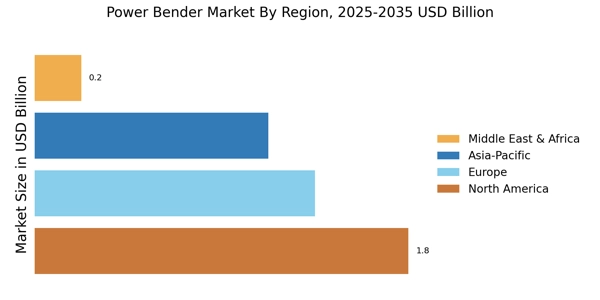
North America is the largest market for power benders, holding approximately 40% of the global market share. The region's growth is driven by increasing investments in renewable energy, stringent regulatory frameworks, and a shift towards automation in manufacturing processes. The demand for energy-efficient solutions is also on the rise, spurred by government incentives and sustainability initiatives. The United States leads the North American market, followed by Canada. Key players such as General Electric, Eaton, and Rockwell Automation dominate the landscape, leveraging advanced technologies to enhance product offerings. The competitive environment is characterized by continuous innovation and strategic partnerships aimed at expanding market reach and improving service delivery.

Europe : Regulatory Frameworks Drive Growth

Europe is the second-largest market for power benders, accounting for around 30% of the global share. The region's growth is propelled by stringent environmental regulations and a strong push towards energy efficiency. The European Union's Green Deal and various national policies are catalysts for increased adoption of advanced power management solutions, driving demand across multiple sectors. Germany and France are the leading countries in this market, with significant contributions from Siemens and Schneider Electric. The competitive landscape is marked by a focus on innovation and sustainability, with companies investing heavily in R&D to meet regulatory requirements and consumer expectations. The presence of established players ensures a robust market environment, fostering healthy competition and technological advancements.

Asia-Pacific : Emerging Markets and Opportunities

Asia-Pacific is rapidly emerging as a significant player in the power bender market, holding approximately 25% of the global share. The region's growth is driven by industrialization, urbanization, and increasing energy demands. Countries like China and India are investing heavily in infrastructure and renewable energy projects, creating a favorable environment for power bender adoption and innovation. China is the largest market in the region, followed by India and Japan. The competitive landscape features key players such as Mitsubishi Electric and ABB, who are focusing on expanding their product lines and enhancing service capabilities. The presence of a growing number of local manufacturers is also intensifying competition, leading to more affordable and innovative solutions for end-users.

Middle East and Africa : Resource-Rich Markets Evolving

The Middle East and Africa region is gradually developing its power bender market, currently holding about 5% of the global share. The growth is primarily driven by increasing investments in infrastructure and energy projects, particularly in the Gulf Cooperation Council (GCC) countries. Government initiatives aimed at diversifying economies and enhancing energy efficiency are also contributing to market expansion. Leading countries in this region include the UAE and South Africa, where key players like Honeywell and Emerson Electric are establishing a strong presence. The competitive landscape is evolving, with both international and local companies vying for market share. As the region continues to invest in modernization and sustainability, the demand for advanced power management solutions is expected to rise significantly.

Power Bender Market Regional Image

Key Players and Competitive Insights

The Power Bender Market showcases a dynamic landscape characterized by intense competition and a range of innovative solutions that cater to diverse consumer needs. As industries increasingly recognize the efficiency and flexibility provided by power-bending technologies, companies in this space are competing through advanced product offerings, strategic partnerships, and expanding service capabilities. Factors such as technological advancements, sustainability initiatives, and an increasing push for automation are shaping the market, leading players to innovate continually and outperform their rivals.

Companies are focusing not only on enhancing product quality but also on optimizing operational processes and improving customer service, which are crucial for gaining a competitive edge in this evolving sector. The market environment is marked by the presence of established leaders and emerging players who are keen on capturing market share through disruptive innovations and tailored solutions.Schneider Electric stands out in the Power Bender Market owing to its comprehensive range of integrated solutions that enhance energy management and efficiency. The company's extensive portfolio includes cutting-edge power-bending technologies designed to meet the unique requirements of various industries.

Schneider Electric's strong market presence is further supported by its commitment to sustainability and innovation, which resonate well with current market trends. The company's focus on providing end-to-end solutions, coupled with robust customer support and training programs, empowers clients to utilize power-bending technologies effectively, leading to optimized performance and reduced operational costs.

Mitsubishi Electric has made significant strides in the Power Bender Market, leveraging its advanced technologies and engineering expertise to deliver high-quality, reliable power-bending solutions. The company is known for its commitment to innovation, consistently introducing new products that incorporate the latest technological advancements to maximize efficiency and performance. Mitsubishi Electric's strong emphasis on research and development allows it to respond promptly to emerging trends and customer requirements, further solidifying its position in the market. The company's established reputation for quality and reliability ensures a loyal customer base while attracting new clients looking for sustainable and efficient solutions.

Key Companies in the Power Bender Market market include

Industry Developments

The Power Bender Market has recently seen several important developments, particularly surrounding leading companies such as Schneider Electric, Mitsubishi Electric, Panasonic, Emerson Electric, Nidec Corporation, and Toshiba. These firms are investing heavily in innovative power-bending technologies to enhance efficiency and reduce energy consumption. Notably, significant mergers and acquisitions have reshaped the competitive landscape, with companies aiming to enhance their market share and technological capabilities. Siemens and ABB have both made headlines with strategic partnerships aimed at expanding their operational reach and product offerings.

Furthermore, the ongoing demand for advanced automated systems in manufacturing continues to drive growth, leading to an increase in market valuation for entities like Rockwell Automation and Honeywell. The integration of smart technology in production processes is also creating new opportunities and challenges within the Power Bender Market. As companies strive to meet increasing energy demands and regulatory standards, the landscape will likely evolve, leading to sustained interest and investment in this sector, demonstrating its vital role in modern industrial operations.

Future Outlook

Power Bender Market Future Outlook

The Power Bender Market is projected to grow at a 2.44% CAGR from 2024 to 2035, driven by technological advancements and increasing demand for energy efficiency.

New opportunities lie in:

  • Expansion into renewable energy integration solutions.
  • Development of smart power bender systems for real-time monitoring.
  • Partnerships with electric vehicle manufacturers for charging infrastructure.

By 2035, the Power Bender Market is expected to achieve robust growth, reflecting evolving energy needs.

Market Segmentation

Power Bender Market Type Outlook

  • Hydraulic Power Bender
  • Electric Power Bender
  • Mechanical Power Bender

Power Bender Market Material Outlook

  • Steel
  • Aluminum
  • Copper
  • Plastic

Power Bender Market Application Outlook

  • Construction
  • Manufacturing
  • Automotive
  • Aerospace

Power Bender Market End Use Industry Outlook

  • Construction Industry
  • Automotive Industry
  • Electronics Industry
  • Energy Sector

Report Scope

MARKET SIZE 20244.397(USD Billion)
MARKET SIZE 20254.504(USD Billion)
MARKET SIZE 20355.733(USD Billion)
COMPOUND ANNUAL GROWTH RATE (CAGR)2.44% (2024 - 2035)
REPORT COVERAGERevenue Forecast, Competitive Landscape, Growth Factors, and Trends
BASE YEAR2024
Market Forecast Period2025 - 2035
Historical Data2019 - 2024
Market Forecast UnitsUSD Billion
Key Companies ProfiledMarket analysis in progress
Segments CoveredMarket segmentation analysis in progress
Key Market OpportunitiesIntegration of advanced automation technologies enhances efficiency in the Power Bender Market.
Key Market DynamicsRising demand for energy-efficient solutions drives innovation and competition in the Power Bender Market.
Countries CoveredNorth America, Europe, APAC, South America, MEA

Leave a Comment

FAQs

What is the projected market valuation of the Power Bender Market by 2035?

The Power Bender Market is projected to reach a valuation of 5.733 USD Billion by 2035.

What was the overall market valuation of the Power Bender Market in 2024?

In 2024, the overall market valuation of the Power Bender Market was 4.397 USD Billion.

What is the expected CAGR for the Power Bender Market during the forecast period 2025 - 2035?

The expected CAGR for the Power Bender Market during the forecast period 2025 - 2035 is 2.44%.

Which companies are considered key players in the Power Bender Market?

Key players in the Power Bender Market include Schneider Electric, Siemens, General Electric, Eaton, Mitsubishi Electric, Rockwell Automation, ABB, Honeywell, and Emerson Electric.

What are the projected valuations for the Hydraulic Power Bender segment by 2035?

The Hydraulic Power Bender segment is projected to reach valuations between 1.5 and 1.9 USD Billion by 2035.

How does the Electric Power Bender segment compare in valuation to the Mechanical Power Bender segment by 2035?

By 2035, the Electric Power Bender segment is expected to have a higher valuation, ranging from 1.7 to 2.2 USD Billion, compared to the Mechanical Power Bender segment, which is projected to be between 1.2 and 1.6 USD Billion.

What is the expected valuation range for the Automotive segment in the Power Bender Market by 2035?

The Automotive segment in the Power Bender Market is expected to reach valuations between 1.319 and 1.688 USD Billion by 2035.

Which material segment is projected to have the highest valuation by 2035?

The Steel material segment is projected to have the highest valuation, ranging from 1.5 to 1.9 USD Billion by 2035.

What is the expected valuation for the Construction Industry segment by 2035?

The Construction Industry segment is expected to reach valuations between 1.5 and 1.9 USD Billion by 2035.

How does the Electronics Industry segment's valuation compare to the Energy Sector segment by 2035?

By 2035, the Electronics Industry segment is projected to have a higher valuation, ranging from 1.0 to 1.3 USD Billion, compared to the Energy Sector segment, which is expected to be between 0.7 and 1.1 USD Billion.

Download Free Sample

Kindly complete the form below to receive a free sample of this Report

Compare Licence

×
Features License Type
Single User Multiuser License Enterprise User
Price $4,950 $5,950 $7,250
Maximum User Access Limit 1 User Upto 10 Users Unrestricted Access Throughout the Organization
Free Customization
Direct Access to Analyst
Deliverable Format
Platform Access
Discount on Next Purchase 10% 15% 15%
Printable Versions