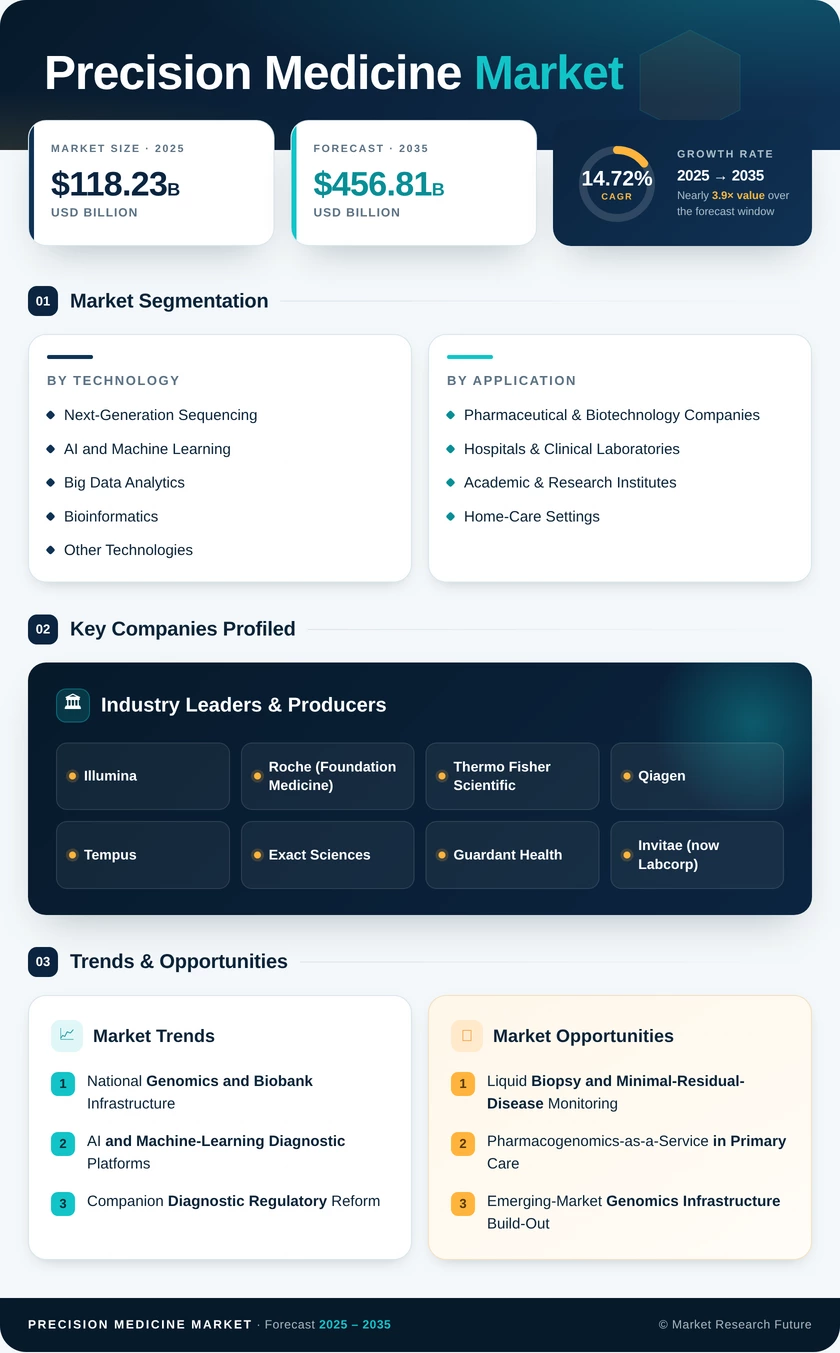
Segmentation Quick Reference
| Dimension | Sub-Segments | Dominant Segment | Fastest Growing Segment |
| Precision Medicine Market | Next-Generation Sequencing, AI and Machine Learning, Big Data Analytics, Bioinformatics, Other Technologies | Next-Generation Sequencing (~38% share, 2025) | AI and Machine Learning (19.3% CAGR) |
| Application | Oncology, Rare and Genetic Disorders, Neurology, Cardiology, Infectious Diseases, Immunology | Oncology (~43.5% share, 2025) | Rare and Genetic Disorders (17.1% CAGR) |
| End User | Precision Medicine Market & Biotechnology Companies, Hospitals & Clinical Laboratories, Academic & Research Institutes, Home-Care Settings | Precision Medicine Market & Biotechnology Companies (~48% share, 2025) | Home-Care Settings (17.0% CAGR) |
Market Segmentation Overview
By Precision Medicine Market
| Sub-Segment | Key Trend |
| Next-Generation Sequencing | Sub-USD 200 per-genome costs driving clinical adoption across oncology and rare diseases |
| AI and Machine Learning | Rapid FDA clearance of AI/ML diagnostic devices is accelerating clinical decision support |
| Big Data Analytics | Real-world evidence platforms integrating multi-source data for drug development |
| Bioinformatics | Cloud-native bioinformatics is reducing computational infrastructure costs by 40–50% |
| Other Technologies | CRISPR-based diagnostics and proteomics are emerging as complementary precision tools |
Next-generation sequencing continues to anchor precision medicine diagnostics, with whole-genome and whole-exome sequencing now embedded in clinical workflows for oncology, cardiology, and rare disease evaluation. AI and machine-learning platforms are rapidly displacing manual variant interpretation, enabling faster and more reproducible biomarker identification at a clinical scale.
By Application
| Sub-Segment | Key Trend |
| Oncology | Liquid biopsy and comprehensive tumor profiling are expanding the standard of care |
| Rare and Genetic Disorders | Orphan drug incentives and newborn screening mandates are driving diagnostic demand |
| Neurology | Alzheimer's blood-based biomarkers entering clinical practice |
| Cardiology | Pharmacogenomics-guided anticoagulant and statin dosing reduces adverse events |
| Infectious Diseases | Pathogen whole-genome sequencing aiding antimicrobial resistance surveillance |
| Immunology | Targeted biologic therapies for autoimmune conditions informed by molecular profiling |
Oncology remains the dominant application, with tumor-agnostic therapies and expanding liquid biopsy use cases reinforcing its share. Rare and genetic disorders are growing fastest, as regulatory incentives and improved genomic screening programs create new diagnostic and therapeutic pathways across diverse patient populations.
By End User
| Sub-Segment | Key Trend |
| Precision Medicine Market & Biotechnology Companies | Biomarker-stratified trial design reducing Phase III failure rates |
| Hospitals & Clinical Laboratories | Point-of-care genomic testing enabling same-day therapy decisions |
| Academic & Research Institutes | Federally funded translational research accelerating bench-to-bedside pipelines |
| Home-Care Settings | At-home sample collection kits and telehealth integration are expanding access |
Precision Medicine Market and biotechnology companies dominate end-user spending, leveraging precision diagnostics to improve clinical-trial success rates and reduce late-stage attrition costs. Home-care settings are growing fastest as direct-to-consumer genetic testing and remote-monitoring technologies bring precision medicine closer to patient homes.