Download Free Sample
Kindly complete the form below to receive a free sample of this Report
Prescription-delivery-service-market Size, Share and Trends Analysis Research Report Information By End User (Patients, Healthcare Providers, Pharmacies, Insurance Companies, Caregivers), By Application (Chronic Disease Management, Acute Care, Preventive Care, Medication Adherence, Post-Surgical Care), By Delivery Method (Home Delivery), And By Region (North America, Europe, Asia-Pacific, And Rest Of The World) – Market Forecast Till 2035.
As per MRFR analysis, the Prescription Delivery Service Market Size was estimated at 18.0 USD Billion in 2024. The Prescription Delivery Service industry is projected to grow from 18.97 USD Billion in 2025 to 32.0 USD Billion by 2035, exhibiting a compound annual growth rate (CAGR) of 5.37% during the forecast period 2025 - 2035.
The Prescription Delivery Service Market is experiencing robust growth driven by technological advancements and changing consumer preferences.
| 2024 Market Size | 18.0 (USD Billion) |
| 2035 Market Size | 32.0 (USD Billion) |
| CAGR (2025 - 2035) | 5.37% |
CVS Health (US), Walgreens Boots Alliance (US), Express Scripts (US), OptumRx (US), Amazon Pharmacy (US), Rite Aid (US), PillPack (US), HealthWarehouse.com (US)
Our Impact
Enabled $4.3B Revenue Impact for Fortune 500 and Leading Multinationals
Partnering with 2000+ Global Organizations Each Year
30K+ Citations by Top-Tier Firms in the Industry
The Prescription Delivery Service Market is currently experiencing a notable transformation, driven by advancements in technology and changing consumer preferences. As patients increasingly seek convenience and efficiency in managing their healthcare needs, the demand for prescription delivery services has surged. This market appears to be evolving rapidly, with various stakeholders, including pharmacies, healthcare providers, and technology firms, striving to enhance their service offerings. The integration of mobile applications and online platforms facilitates seamless ordering and tracking, thereby improving the overall customer experience. Furthermore, the growing emphasis on personalized healthcare solutions suggests that companies are likely to tailor their services to meet individual patient requirements, potentially leading to increased customer loyalty and satisfaction. In addition to technological advancements, regulatory changes and a heightened focus on patient safety are influencing the dynamics of the Prescription Delivery Service Market. Governments and health authorities are implementing stricter guidelines to ensure the safe handling and delivery of medications. This regulatory environment may encourage companies to adopt more robust operational practices, thereby enhancing trust among consumers. As the market continues to expand, it is essential for stakeholders to remain agile and responsive to emerging trends, ensuring they can effectively navigate the complexities of this evolving landscape. Overall, the Prescription Delivery Service Market appears poised for sustained growth, driven by innovation and a commitment to improving patient outcomes.
The Prescription Delivery Service Market is witnessing a significant shift towards the integration of advanced technologies. Mobile applications and online platforms are becoming essential tools for pharmacies and healthcare providers, enabling patients to order and track their medications with ease. This trend not only enhances convenience but also fosters a more engaging user experience, potentially leading to increased customer retention.
As the Prescription Delivery Service Market expands, regulatory compliance is becoming increasingly critical. Stricter guidelines are being established to ensure the safe handling and delivery of medications. This focus on safety may compel companies to adopt more rigorous operational standards, thereby enhancing consumer trust and confidence in these services.
The demand for personalized healthcare solutions is shaping the Prescription Delivery Service Market. Companies are likely to tailor their offerings to meet the unique needs of individual patients, which could lead to improved satisfaction and loyalty. This trend reflects a broader shift towards patient-centered care, emphasizing the importance of understanding and addressing specific health requirements.
The Prescription Delivery Service Market is significantly influenced by the aging population, which is projected to increase in the coming years. Older adults often require multiple medications, leading to a higher demand for prescription services. Data suggests that by 2030, nearly 20 percent of the population will be over the age of 65, creating a substantial market for prescription delivery services. This demographic shift necessitates tailored solutions that cater to the unique needs of elderly patients, such as medication management and adherence support. Consequently, the Prescription Delivery Service Market is poised to expand as it addresses the complexities associated with an aging population.
Technological advancements play a crucial role in shaping the Prescription Delivery Service Market. Innovations such as mobile applications, telehealth services, and automated dispensing systems enhance the efficiency and accessibility of prescription delivery. For instance, the integration of artificial intelligence in medication management systems can streamline the ordering process and improve patient outcomes. Furthermore, data indicates that the adoption of telehealth services has increased by over 30 percent in recent years, suggesting a growing acceptance of technology in healthcare. As these advancements continue to evolve, they are likely to propel the Prescription Delivery Service Market into new territories of growth.
The Prescription Delivery Service Market experiences a notable increase in demand for convenience among consumers. As lifestyles become busier, individuals seek efficient solutions for managing their healthcare needs. This trend is reflected in the growing preference for home delivery services, which allow patients to receive medications without the need to visit pharmacies. According to recent data, approximately 60 percent of consumers express a preference for home delivery options, indicating a shift in consumer behavior. This demand for convenience is likely to drive the Prescription Delivery Service Market forward, as companies adapt their offerings to meet these evolving expectations.
Regulatory support and policy changes are pivotal in shaping the Prescription Delivery Service Market. Governments are increasingly recognizing the importance of accessible healthcare solutions, leading to the implementation of policies that facilitate prescription delivery services. For example, recent legislative changes have streamlined the approval processes for telehealth and delivery services, making it easier for companies to enter the market. This regulatory environment fosters innovation and competition, ultimately benefiting consumers. As these supportive policies continue to evolve, they are likely to enhance the growth prospects of the Prescription Delivery Service Market, encouraging more players to participate in this expanding sector.
The Prescription Delivery Service Market is witnessing a heightened focus on health and wellness among consumers. As individuals become more health-conscious, there is a growing emphasis on preventive care and medication adherence. This trend is reflected in the increasing demand for services that facilitate easy access to medications, thereby promoting better health outcomes. Research indicates that nearly 70 percent of consumers are willing to utilize delivery services that support their health goals. This shift towards proactive health management is expected to drive the Prescription Delivery Service Market, as companies align their offerings with the evolving preferences of health-oriented consumers.
The Prescription Delivery Service Market is characterized by a diverse range of applications, with Chronic Disease Management holding the largest share. This segment is vital as it caters to a substantial patient demographic, supporting continuous medication delivery to individuals with long-term health conditions like diabetes, hypertension, and other chronic illnesses. In contrast, Medication Adherence, which aids patients in following their prescribed medication regimen effectively, is emerging as the fastest-growing application segment, driven by the increasing focus on improving treatment outcomes and patient engagement.
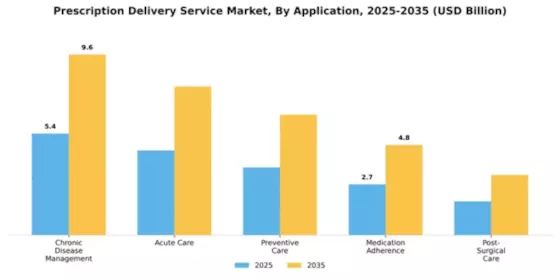
Chronic Disease Management (Dominant) vs. Medication Adherence (Emerging)
Chronic Disease Management stands as the dominant application in the Prescription Delivery Service Market due to its critical role in enhancing the quality of life for patients with ongoing health issues. It encompasses a comprehensive framework that includes personalized medication delivery, monitoring systems, and support services to ensure adherence to treatment plans. Conversely, Medication Adherence is an emerging segment gaining traction, propelled by technological advancements in mobile health (mHealth) solutions and digital platforms designed to remind and engage patients in their treatment plans. Both segments address key aspects of patient care but do so through different methodologies, focusing on long-term management versus short-term compliance.
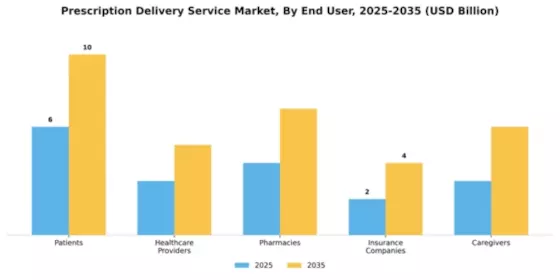
In the Prescription Delivery Service Market, patients represent the largest segment, holding substantial market share due to their increasingly demanding need for convenience and accessibility in medication delivery. This shift towards patient-centered services is driving investment in technology and infrastructure, catering to a growing population that relies on prescription delivery services for their healthcare needs. Healthcare providers are fast becoming the fastest-growing segment, leveraging prescription delivery to enhance patient care and streamline operations. As telehealth gains traction, healthcare providers are integrating delivery services to ensure seamless access to medications, elevating their market influence.
Patients (Dominant) vs. Healthcare Providers (Emerging)
Patients have established themselves as a dominant force in the Prescription Delivery Service Market, primarily due to their need for convenience, particularly in the wake of the COVID-19 pandemic. They seek quick and reliable access to medications, often preferring home delivery over visiting pharmacies. On the other hand, healthcare providers are emerging as a critical segment, increasingly adopting prescription delivery services to improve patient outcomes and operational efficiency. This dual focus on patient care and service quality is driving innovation and competition among providers, positioning them as influential players in shaping the future of prescription delivery.
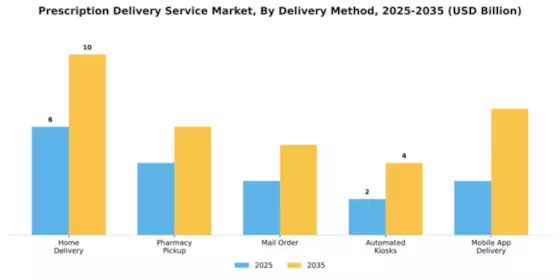
In the Prescription Delivery Service Market, Home Delivery stands out as the largest segment, capturing a significant portion of the market share. This method is preferred by consumers seeking convenience and the comfort of receiving their medications right at their doorstep. Pharmacy Pickup and Mail Order also hold notable shares, primarily due to their established presence and reliability. Meanwhile, Automated Kiosks and Mobile App Delivery, while trailing in terms of market share, are gaining traction as innovative alternatives for patients. Current trends indicate a strong growth trajectory for Mobile App Delivery, driven by advancements in technology and increased smartphone penetration. As consumers become more accustomed to on-demand services across various sectors, the demand for efficient, user-friendly prescription delivery solutions is on the rise. Automated Kiosks are also emerging as a convenient option for patients who may prefer to pick up their medications without entering a pharmacy, further expanding the market landscape.
Home Delivery (Dominant) vs. Mobile App Delivery (Emerging)
Home Delivery is recognized as the dominant force within the Prescription Delivery Service Market, driven by its ability to provide unparalleled convenience and personalized service. This method appeals particularly to elderly patients and those with mobility constraints, allowing them to manage their prescriptions without the hassle of travel. In contrast, Mobile App Delivery represents the emerging trend, leveraging technology to enhance user experience and engagement. With the rise of health and wellness apps, patients are increasingly inclined to use their smartphones to order prescriptions, track medications, and set reminders. The integration of features such as real-time tracking and notifications positions Mobile App Delivery as a forward-thinking solution that complements the traditional delivery methods, ensuring that it captures a growing segment of tech-savvy consumers.
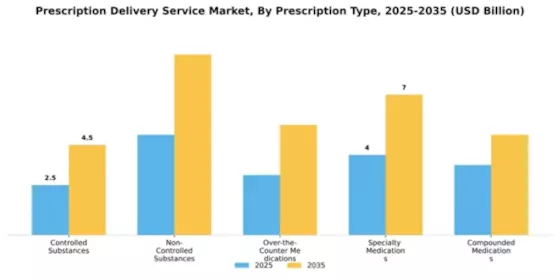
The Prescription Delivery Service Market showcases a diverse distribution across various prescription types. Among these, Controlled Substances holds the largest market share, significantly influenced by the ongoing need for regulated medications. Non-Controlled Substances and Over-the-Counter Medications also contribute sizably, catering to a wide audience. Specialty Medications, despite a smaller share, illustrate a strong rise in demand, often addressing unique patient needs and chronic conditions, thereby gaining traction in the evolving market landscape.
Controlled Substances: Dominant vs. Specialty Medications: Emerging
Controlled Substances remain the dominant segment in the Prescription Delivery Service Market, driven by regulatory frameworks and strict control mechanisms that ensure patient safety. These medications are often essential for managing severe conditions and require careful handling during delivery. On the other hand, Specialty Medications are emerging as a significant player, characterized by complex treatment regimens that often cater to chronic illnesses, such as cancer or autoimmune disorders. The growing reliance on specialized therapies and the rise of personalized medicine contribute to the increasing demand for Specialty Medications, making them one of the fastest-growing segments within the market.
Get more detailed insights about Prescription Delivery Service Market Request Free Sample
North America is poised to maintain its leadership in the Prescription Delivery Service Market, holding a significant market share of 9.0 in 2025. The growth is driven by increasing consumer demand for convenience, coupled with advancements in technology that streamline the delivery process. Regulatory support, including telehealth expansions and e-prescribing initiatives, further catalyzes market growth, making prescription access easier for patients. The competitive landscape is robust, featuring key players such as CVS Health, Walgreens Boots Alliance, and Amazon Pharmacy. These companies leverage their extensive networks and technological innovations to enhance service delivery. The U.S. remains the dominant country, with a well-established infrastructure and a high adoption rate of online pharmacy services, ensuring a strong foothold in the market.
Europe's Prescription Delivery Service Market is on an upward trajectory, with a market size of 4.5 in 2025. The growth is fueled by an aging population, increasing chronic diseases, and a shift towards digital health solutions. Regulatory frameworks across various countries are evolving to support telemedicine and online prescriptions, enhancing accessibility and convenience for patients. Leading countries in this region include Germany, France, and the UK, where established healthcare systems are integrating delivery services. Key players like Boots and DocMorris are expanding their offerings, capitalizing on the growing demand. The competitive landscape is characterized by a mix of traditional pharmacies and new entrants, all vying for market share in this dynamic environment.
The Asia-Pacific region is witnessing rapid growth in the Prescription Delivery Service Market, projected to reach a size of 3.0 in 2025. Factors driving this growth include increasing urbanization, rising disposable incomes, and a growing preference for online healthcare services. Regulatory bodies are also promoting digital health initiatives, which are crucial for enhancing service delivery and patient engagement. Countries like China, India, and Japan are leading the charge, with a burgeoning number of startups and established players entering the market. Companies such as PharmEasy and 1mg are innovating to meet the rising demand for convenient prescription services. The competitive landscape is diverse, with a mix of local and international players striving to capture market share in this evolving sector.
The Middle East and Africa (MEA) region presents a unique opportunity in the Prescription Delivery Service Market, with a market size of 1.5 in 2025. The growth is driven by increasing healthcare investments, a rising population, and a growing awareness of health services. Regulatory frameworks are gradually adapting to support e-pharmacy initiatives, which are essential for improving access to medications in remote areas. Leading countries in this region include South Africa, UAE, and Saudi Arabia, where healthcare systems are evolving to incorporate digital solutions. The competitive landscape is still developing, with local players and international companies exploring opportunities to establish a presence. As the market matures, the potential for growth remains significant, attracting investments and innovations.
The Prescription Delivery Service Market is currently characterized by a dynamic competitive landscape, driven by technological advancements and evolving consumer preferences. Major players such as CVS Health (US), Walgreens Boots Alliance (US), and Amazon Pharmacy (US) are at the forefront, each adopting distinct strategies to enhance their market positioning. CVS Health (US) has focused on integrating digital health solutions into its delivery services, thereby improving customer engagement and operational efficiency. Meanwhile, Walgreens Boots Alliance (US) has emphasized partnerships with local pharmacies to expand its delivery network, enhancing accessibility for patients. Amazon Pharmacy (US), leveraging its vast logistics capabilities, appears to be concentrating on streamlining its delivery processes to ensure rapid service, which is increasingly becoming a critical factor in consumer choice.The business tactics employed by these companies reflect a moderately fragmented market structure, where competition is not solely based on pricing but also on service quality and delivery speed. Key players are optimizing their supply chains and localizing their operations to better meet regional demands. This strategic focus on efficiency and customer satisfaction is reshaping the competitive dynamics, as companies strive to differentiate themselves in a crowded marketplace.In November CVS Health (US) announced a partnership with a leading telehealth provider to enhance its prescription delivery service. This collaboration is expected to facilitate a more integrated healthcare experience for patients, allowing for seamless transitions from virtual consultations to medication delivery. The strategic importance of this move lies in its potential to attract a broader customer base, particularly among tech-savvy consumers seeking convenience in their healthcare journeys.In October Walgreens Boots Alliance (US) launched a new initiative aimed at expanding its same-day delivery service in urban areas. This initiative is significant as it positions the company to compete more effectively against Amazon Pharmacy (US), which has been rapidly gaining market share through its efficient logistics. By enhancing its delivery capabilities, Walgreens Boots Alliance (US) is likely to improve customer retention and attract new clients who prioritize speed and convenience in their prescription services.In September Amazon Pharmacy (US) introduced a subscription model for its delivery service, allowing customers to receive regular medication deliveries at a discounted rate. This strategic move not only incentivizes customer loyalty but also aligns with the growing trend of subscription-based services across various industries. The potential for increased customer retention and predictable revenue streams makes this initiative a noteworthy development in the competitive landscape.As of December the Prescription Delivery Service Market is witnessing trends such as digitalization, sustainability, and the integration of artificial intelligence (AI) into operations. Companies are increasingly forming strategic alliances to enhance their service offerings and improve operational efficiencies. Looking ahead, competitive differentiation is likely to evolve from traditional price-based competition to a focus on innovation, technology, and supply chain reliability. This shift suggests that companies that can effectively leverage technology and streamline their operations will be better positioned to thrive in this rapidly changing market.






The Prescription Delivery Service Market is projected to grow at a 5.37% CAGR from 2025 to 2035, driven by technological advancements, increasing consumer demand, and regulatory support.
New opportunities lie in:
By 2035, the market is expected to be robust, reflecting substantial growth and innovation.
| MARKET SIZE 2024 | 18.0(USD Billion) |
| MARKET SIZE 2025 | 18.97(USD Billion) |
| MARKET SIZE 2035 | 32.0(USD Billion) |
| COMPOUND ANNUAL GROWTH RATE (CAGR) | 5.37% (2025 - 2035) |
| REPORT COVERAGE | Revenue Forecast, Competitive Landscape, Growth Factors, and Trends |
| BASE YEAR | 2024 |
| Market Forecast Period | 2025 - 2035 |
| Historical Data | 2019 - 2024 |
| Market Forecast Units | USD Billion |
| Key Companies Profiled | CVS Health (US), Walgreens Boots Alliance (US), Express Scripts (US), OptumRx (US), Amazon Pharmacy (US), Rite Aid (US), PillPack (US), HealthWarehouse.com (US) |
| Segments Covered | Application, End User, Delivery Method, Prescription Type |
| Key Market Opportunities | Integration of telehealth services enhances accessibility in the Prescription Delivery Service Market. |
| Key Market Dynamics | Rising consumer demand for convenience drives innovation and competition in the Prescription Delivery Service Market. |
| Countries Covered | North America, Europe, APAC, South America, MEA |
The market valuation reached 18.0 USD Billion in 2024.
The market is expected to grow to 32.0 USD Billion by 2035.
The market is projected to experience a CAGR of 5.37% from 2025 to 2035.
Key players include CVS Health, Walgreens Boots Alliance, Express Scripts, OptumRx, Amazon Pharmacy, Rite Aid, PillPack, and HealthWarehouse.com.
The main applications include Chronic Disease Management, Acute Care, Preventive Care, Medication Adherence, and Post-Surgical Care.
In 2024, the end user segments were valued as follows: Patients at 6.0 USD Billion, Healthcare Providers at 3.0 USD Billion, Pharmacies at 4.0 USD Billion, Insurance Companies at 2.0 USD Billion, and Caregivers at 3.0 USD Billion.
The market segments by delivery method include Home Delivery, Pharmacy Pickup, Mail Order, Automated Kiosks, and Mobile App Delivery.
In 2024, controlled substances were valued at 2.5 USD Billion, while non-controlled substances reached 5.0 USD Billion.
Specialty medications are projected to grow from 4.0 USD Billion in 2024 to 7.0 USD Billion by 2035.
The market segments by prescription type show growth potential, with non-controlled substances expected to rise from 5.0 USD Billion to 9.0 USD Billion by 2035.


Kindly complete the form below to receive a free sample of this Report

“This is really good guys. Excellent work on a tight deadline. I will continue to use you going forward and recommend you to others. Nice job”


“Thanks. It’s been a pleasure working with you, please use me as reference with any other Intel employees.”


“Thanks for sending the report it gives us a good global view of the Betaïne market.”


“Thank you, this will be very helpful for OQS.”


“We found the report very insightful! we found your research firm very helpful. I'm sending this email to secure our future business.”


“I am very pleased with how market segments have been defined in a relevant way for my purposes (such as "Portable Freezers & refrigerators" and "last-mile"). In general the report is well structured. Thanks very much for your efforts.”


“I have been reading the first document or the study, ,the Global HVAC and FP market report 2021 till 2026. Must say, good info! I have not gone in depth at all parts, but got a good indication of the data inside!”


“We got the report in time, we really thank you for your support in this process. I also thank to all of your team as they did a great job.”


“The Automotive 48V ECU Components Procurement Intelligence Study” was a complex project, but the Market Research Future (MRFR) team handled it with quality, agility, and customer-centricity. They delivered all requested data on time and within the agreed scope. The team, including Shubhendra Anand and Rahul Gotadki, was always readily available to clarify questions and swiftly implement necessary adjustments, driving the project to a successful conclusion within a very demanding timeframe.
I would also like to specifically commend Akshay Agarwal for his responsiveness and support at every stage—from our initial inquiry on May 6th through to final delivery on June 18th. His dedication made the entire process seamless.”



