Segmentation Quick Reference
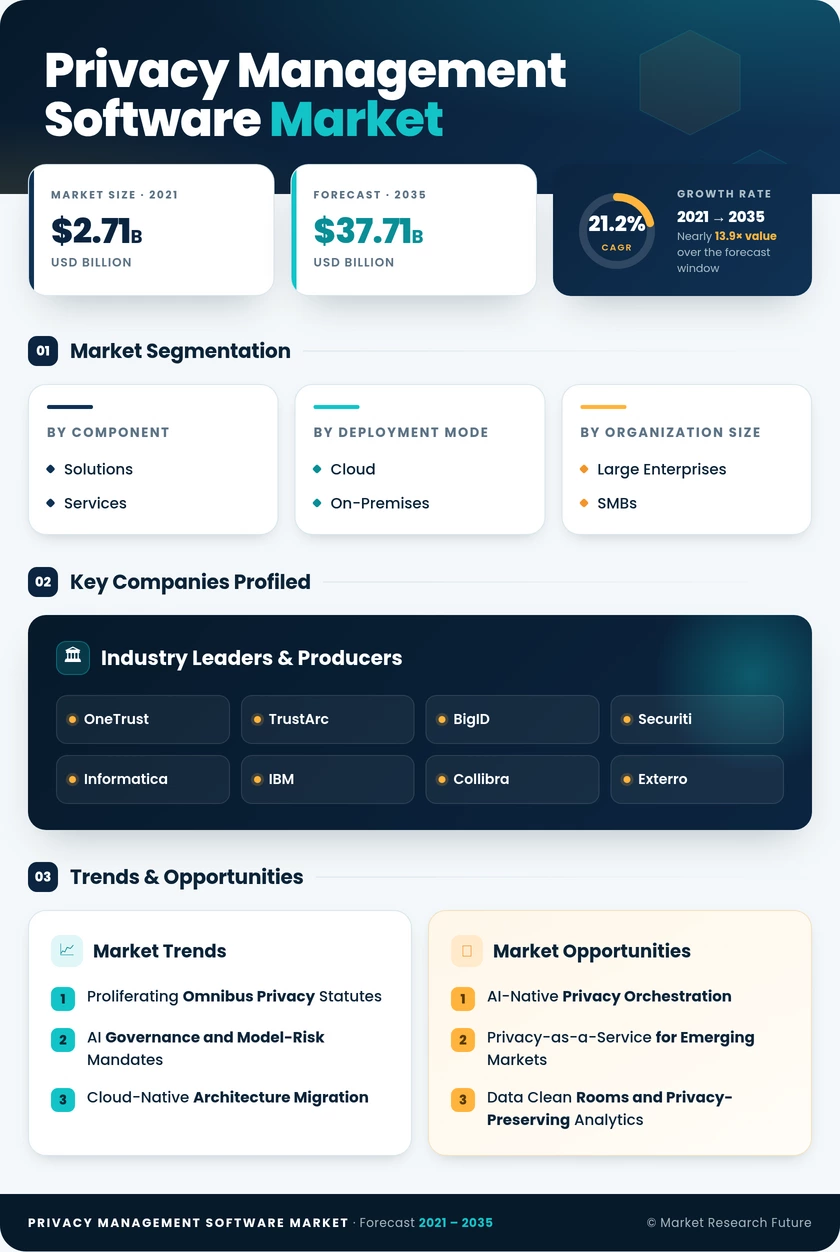
| Dimension | Sub-Segments | Dominant Segment | Fastest Growing Segment |
| Component | Solutions, Services | Solutions | Services |
| Deployment Mode | Cloud, On-Premises | Cloud | Cloud |
| Organization Size | Large Enterprises, SMBs | Large Enterprises | SMBs |
| Functionality | Consent & Preference Management, Data Mapping & Discovery, DSAR Automation, Privacy Impact Assessment, Incident & Breach Management | Consent & Preference Management | DSAR Automation |
| End-User Vertical | BFSI, Healthcare & Privacy Management Software Market, IT & Telecom, Retail & E-Commerce, Government, Others | BFSI | Healthcare & Privacy Management Software Market |
| Region | North America, Europe, Asia-Pacific, South America, Middle East & Africa | North America | Asia-Pacific |
Market Segmentation Overview
By Component
| Sub-Segment | Key Trend |
| Solutions | Platform consolidation driving integrated suite adoption; AI-native modules becoming table stakes |
| Services | Managed privacy operations and advisory engagements, growing as regulatory complexity outpaces in-house capacity |
Solutions dominate revenue as enterprises prioritize single-vendor platforms that consolidate consent management, data mapping, and breach response. Services are gaining momentum as implementation complexity and ongoing regulatory change drive demand for external expertise.
By Deployment Mode
| Sub-Segment | Key Trend |
| Cloud | SaaS-first procurement policies and real-time regulatory-library updates accelerating adoption |
| On-Premises | Persistent demand from defense, intelligence, and highly regulated financial institutions requiring sovereign data control |
Cloud deployment leads due to rapid provisioning, lower upfront costs, and the ability for vendors to push continuous compliance updates. On-premises retains relevance in sectors with strict data-residency requirements.
By Organization Size
| Sub-Segment | Key Trend |
| Large Enterprises | Multi-jurisdictional operations demanding complex orchestration layers with enterprise-grade SLAs |
| SMBs | Self-service starter tiers and per-domain pricing unlocking a previously underserved buyer cohort |
Large enterprises account for the majority of current spend, but SMBs are closing the gap as affordable tools and escalating regulatory obligations make privacy software non-optional regardless of company size.
By Functionality
| Sub-Segment | Key Trend |
| Consent & Preference Management | Cookie-law expansion and opt-in mandates fueling sustained demand globally |
| Data Mapping & Discovery | AI-powered classification engines replacing manual data inventories |
| DSAR Automation | Rising consumer awareness driving double-digit growth in request volumes |
| Privacy Impact Assessment | EU AI Act and high-risk processing rules expanding PIA requirements |
| Incident & Breach Management | Shortened notification windows (e.g., 72-hour GDPR rule) demanding automated workflows |
Consent management remains the entry point for most organizations, while data mapping and DSAR automation represent the fastest-expanding functional categories as data volumes and consumers exercising their rights continue to surge.
By End-User Vertical
| Sub-Segment | Key Trend |
| BFSI | Layered regulatory obligations (GDPR, GLBA, PCI-DSS) driving the highest per-enterprise spend |
| Healthcare & Privacy Management Software Market | Cross-border clinical-trial consent and HIPAA-GDPR harmonization fueling rapid adoption |
| IT & Telecom | SaaS vendors and telecom operators building privacy compliance into product-delivery pipelines |
| Retail & E-Commerce | Cookie-consent walls and loyalty-data monetization strategies requiring robust consent tooling |
| Government | Citizen-data protection mandates and open-data governance driving public-sector procurement |
| Others | Education, manufacturing, and energy verticals entering the compliance arena as data-processing footprints expand |
BFSI remains the largest vertical buyer, but healthcare and retail are experiencing the steepest adoption curves as regulatory frameworks increasingly target health data and consumer-facing digital interactions.