Download Free Sample
Kindly complete the form below to receive a free sample of this Report
Product Launch Marketing Services Market Research Report By End User (Consumer Goods, Technology, Healthcare, Automotive, Retail), By Application (Product Launch Strategy, Market Research Future, Brand Positioning, Promotional Campaigns, Sales Enablement), By Service Type (Consulting Services, Creative Services, Digital Marketing Services, Public Relations Services, Event Management Services) And By Region (North America, Europe, Asia-Pacific, And Rest Of The World) – Market Forecast Till 2035.
As per MRFR analysis, the Product Launch Marketing Services Market was estimated at 12.0 USD Billion in 2024. The Product Launch Marketing Services industry is projected to grow from 12.83 USD Billion in 2025 to 25.0 USD Billion by 2035, exhibiting a compound annual growth rate (CAGR) of 6.9% during the forecast period 2025 - 2035.
The Product Launch Marketing Services Market is experiencing dynamic growth driven by technological advancements and evolving consumer preferences.
| 2024 Market Size | 12.0 (USD Billion) |
| 2035 Market Size | 25.0 (USD Billion) |
| CAGR (2025 - 2035) | 6.9% |
WPP (GB), Omnicom Group (US), Publicis Groupe (FR), Interpublic Group (US), Dentsu (JP), Havas Group (FR), Edelman (US), Mediacom (GB), BBDO (US)
Our Impact
Enabled $4.3B Revenue Impact for Fortune 500 and Leading Multinationals
Partnering with 2000+ Global Organizations Each Year
30K+ Citations by Top-Tier Firms in the Industry
The Product Launch Marketing Services Market is currently experiencing a dynamic evolution, driven by the increasing complexity of consumer behavior and the rapid advancement of digital technologies. Companies are increasingly recognizing the necessity of tailored marketing strategies that resonate with target audiences. This shift is prompting a greater emphasis on data-driven decision-making, where insights gleaned from consumer interactions inform marketing tactics. As a result, businesses are investing in innovative tools and platforms that facilitate more effective engagement with potential customers, thereby enhancing the overall launch experience. Moreover, the competitive landscape within the Product Launch Marketing Services Market is intensifying, as organizations strive to differentiate their offerings in a crowded marketplace. This environment fosters collaboration between marketing agencies and brands, leading to the development of integrated campaigns that leverage multiple channels. The focus on creating cohesive narratives across various platforms appears to be a key strategy for maximizing reach and impact. In this context, the role of social media and influencer partnerships is becoming increasingly prominent, as brands seek to harness the power of authentic voices to amplify their messages and connect with consumers on a deeper level.
The Product Launch Marketing Services Market is witnessing a heightened emphasis on data analytics. Companies are leveraging advanced analytics tools to gain insights into consumer preferences and behaviors. This trend enables marketers to craft more personalized and targeted campaigns, ultimately enhancing the effectiveness of product launches.
There is a growing trend towards the integration of multi-channel marketing strategies within the Product Launch Marketing Services Market. Brands are recognizing the importance of delivering consistent messaging across various platforms, including social media, email, and traditional advertising. This approach aims to create a seamless experience for consumers, thereby increasing engagement and brand loyalty.
Sustainability and ethical considerations are becoming increasingly relevant in the Product Launch Marketing Services Market. Consumers are more inclined to support brands that demonstrate a commitment to social responsibility and environmental stewardship. As a result, companies are adapting their marketing strategies to highlight sustainable practices and ethical sourcing, appealing to the values of their target audience.
The expansion of e-commerce platforms significantly influences the Product Launch Marketing Services Market Industry. With the rise of online shopping, businesses are increasingly launching products through digital channels. This shift necessitates tailored marketing strategies that cater to the unique dynamics of e-commerce. Data suggests that e-commerce sales are projected to reach over 6 trillion dollars by 2024, indicating a substantial market opportunity for product launches. Companies are investing in digital marketing services that enhance visibility and drive traffic to their online stores. As e-commerce continues to grow, the demand for specialized marketing services that can effectively navigate this landscape is likely to rise, shaping the future of product launches.
An increased focus on brand storytelling is reshaping the Product Launch Marketing Services Market Industry. Companies are recognizing that consumers are more likely to connect with brands that convey authentic narratives. This trend is evident in the rise of content marketing strategies that prioritize storytelling as a means to engage audiences. Research indicates that storytelling can enhance brand recall by up to 22 times, making it a powerful tool for product launches. As businesses strive to create emotional connections with their customers, the demand for marketing services that specialize in crafting compelling narratives is likely to grow. This focus on storytelling is expected to play a crucial role in the success of future product launches.
Consumer engagement has emerged as a critical driver in the Product Launch Marketing Services Market Industry. Companies are increasingly focusing on building relationships with their customers through interactive and engaging marketing strategies. This shift is evident in the rise of social media campaigns, influencer partnerships, and experiential marketing initiatives. Research indicates that brands that prioritize consumer engagement can achieve up to 60 percent higher customer retention rates. As businesses recognize the value of fostering community and dialogue with their audience, the demand for marketing services that specialize in engagement strategies is likely to increase. This trend highlights the necessity for companies to adapt their product launch approaches to meet evolving consumer expectations.
The Product Launch Marketing Services Market Industry experiences a notable surge in demand for innovative product launches. Companies are increasingly recognizing the necessity of standing out in a saturated marketplace. This trend is driven by the need to capture consumer attention and foster brand loyalty. As per recent data, approximately 70 percent of new products fail due to inadequate marketing strategies. This statistic underscores the importance of effective product launch marketing services. Businesses are investing in creative campaigns that leverage storytelling and emotional engagement to resonate with their target audience. The emphasis on unique value propositions and memorable experiences is likely to shape the future of product launches, making specialized marketing services indispensable for success.
Technological advancements play a pivotal role in shaping the Product Launch Marketing Services Market Industry. The integration of artificial intelligence, machine learning, and automation tools has revolutionized how companies approach product launches. These technologies enable marketers to analyze consumer behavior, optimize campaigns, and personalize messaging at an unprecedented scale. For instance, the use of predictive analytics can enhance targeting accuracy, potentially increasing conversion rates by up to 30 percent. As businesses strive to leverage these innovations, the demand for specialized marketing services that can effectively utilize these tools is likely to grow. This trend indicates a shift towards data-driven decision-making, which is essential for successful product launches.
The Product Launch Marketing Services Market shows a diverse distribution among its key applications, with Promotional Campaigns dominating the landscape. This segment is pivotal for creating brand awareness and driving initial consumer engagement during the launch phase. In contrast, the Product Launch Strategy segment is gaining momentum as companies increasingly recognize the importance of structuring their product introductions strategically to maximize impact. This shift indicates a gradual redistribution of market share as businesses adapt to evolving consumer behaviors and competitive pressures. As the market evolves, innovative approaches within the Product Launch Strategy are promoting its rapid growth. Companies are leveraging advanced analytical tools to refine their strategies, ensuring they resonate with target demographics. Meanwhile, the rising significance of data-driven decision-making in Promotional Campaigns is fueling an increase in spending. This is reflective of a broader trend where businesses prioritize effective marketing tactics to achieve successful product launches, making it essential for service providers to stay ahead of these changes.
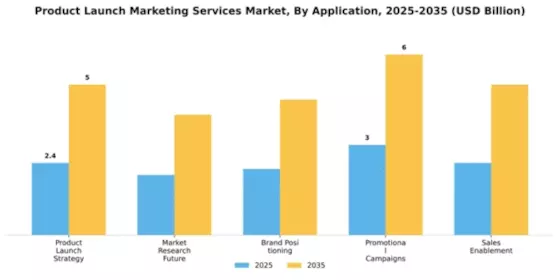
Promotional Campaigns (Dominant) vs. Market Research Future (Emerging)
Promotional Campaigns have established dominance in the Product Launch Marketing Services Market due to their direct impact on building consumer interest and driving initial sales figures. This segment is characterized by diverse tactics, including digital marketing, traditional advertising, and social media outreach, which help engage potential customers at various touchpoints. In contrast, Market Research Future is emerging as a critical component for companies aiming to understand consumer preferences and competitive landscapes. As the market becomes increasingly data-driven, businesses are prioritizing comprehensive market analysis to inform their promotional strategies. This shift highlights the growing recognition of the vital role that in-depth consumer insights play in crafting effective marketing initiatives, enabling brands to launch products that resonate with their target audience.
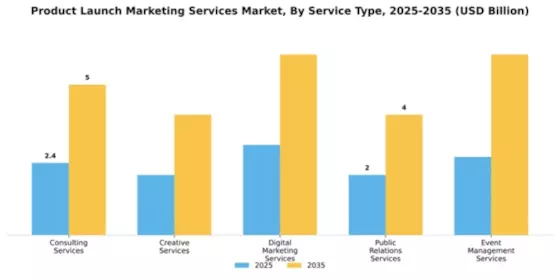
In the Product Launch Marketing Services Market, Digital Marketing Services dominate the landscape, capturing the largest share among the various service types. This segment benefits from the increasing reliance on digital channels by brands looking to launch new products. Consulting Services, while smaller in market share, shows significant growth potential, responding to the evolving needs of businesses seeking tailored strategies for their product introduction efforts. The growth trends for these service types are driven by technological advancements and shifting consumer behaviors. Digital Marketing Services are propelled by the demand for online engagement, particularly through social media and targeted advertising. Conversely, Consulting Services are emerging rapidly as companies recognize the value of expert guidance in navigating the complexities of product launches, making them a vital component in modern marketing strategies.
Digital Marketing Services: Dominant vs. Consulting Services: Emerging
Digital Marketing Services are characterized by their extensive reach and efficiency in engaging potential customers through online platforms. This service type encompasses strategies like SEO, content marketing, and social media campaigns, effectively creating awareness and generating leads for new products. On the other hand, Consulting Services offer personalized expertise and strategic insights, focusing on the unique challenges that companies face during product launches. This segment is becoming increasingly relevant as organizations seek to adapt to rapid market changes and consumer preferences, indicating a growing need for specialized support in navigating marketing complexities.
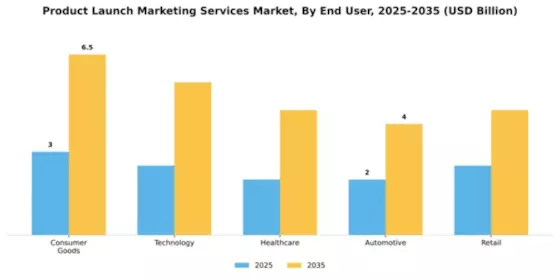
In the Product Launch Marketing Services Market, the Consumer Goods sector holds the largest share among end users. This segment benefits from a diverse array of products ranging from food and beverages to household products, driving robust demand for effective marketing strategies. Conversely, the Technology sector is rapidly expanding, with innovative products and concepts demanding tailored marketing solutions to effectively reach tech-savvy consumers. This growth is reflected in the increasing investments in technology-focused marketing services. Growth trends for the Consumer Goods sector are predominantly driven by changing consumer preferences and enhanced retail strategies, while the Technology segment is propelled by the continuous need for digital transformation. Companies are adapting to incorporate advanced marketing techniques that engage consumers through multiple channels. As technology continues to evolve, the demand for specialized marketing services within this sector will grow, creating opportunities for providers to innovate in their offerings.
Consumer Goods: Dominant vs. Technology: Emerging
Consumer Goods represents the dominant segment in the Product Launch Marketing Services Market due to its breadth and the necessity for consistent engagement with consumers. Brands in this category focus on launching new products with substantial marketing campaigns that resonate well with target audiences. The emphasis on brand loyalty and product visibility drives significant marketing activity, positioning Consumer Goods as a staple for marketing service providers. In contrast, Technology is an emerging segment characterized by rapid innovation and product lifecycle changes. Marketers in this space are focusing on cutting-edge strategies tailored to niche markets, which require agility and expertise. This segment's dynamic nature compels companies to stay ahead of trends, making it an exciting area for growth in marketing services.
Get more detailed insights about Product Launch Marketing Services Market Request Free Sample
North America continues to lead the Product Launch Marketing Services Market, holding a significant market share of 6.0 in 2024. The region's growth is driven by a robust economy, high consumer spending, and a strong emphasis on innovation. Regulatory support for digital marketing and advertising further fuels demand, as companies seek to leverage advanced technologies for product launches. The increasing trend of e-commerce and online marketing strategies also contributes to this growth. The competitive landscape in North America is characterized by the presence of major players such as WPP, Omnicom Group, and Edelman. The United States stands out as the leading country, with a well-established marketing infrastructure and a diverse range of services. Companies are increasingly focusing on integrated marketing strategies to enhance brand visibility and consumer engagement. This competitive environment fosters innovation and drives the market forward.
Europe's Product Launch Marketing Services Market is poised for growth, with a market size of 3.0 in 2024. The region benefits from a diverse consumer base and a strong emphasis on sustainability and digital transformation. Regulatory frameworks across EU countries encourage innovation and support marketing initiatives, driving demand for effective product launch strategies. The rise of social media and digital platforms is also reshaping marketing approaches, making them more interactive and consumer-focused. Leading countries in Europe include the UK, France, and Germany, where major players like Publicis Groupe and Havas Group operate. The competitive landscape is marked by a mix of traditional and digital marketing agencies, all vying for market share. As brands increasingly prioritize customer experience, the demand for tailored marketing solutions is on the rise, positioning Europe as a key player in the global market.
The Asia-Pacific region is rapidly emerging in the Product Launch Marketing Services Market, with a market size of 2.5 in 2024. Key growth drivers include a burgeoning middle class, increasing internet penetration, and a shift towards digital marketing strategies. Regulatory support for e-commerce and advertising is also enhancing market dynamics, as businesses seek innovative ways to engage consumers. The region's diverse cultures and preferences necessitate localized marketing approaches, further driving demand. Countries like China, Japan, and India are at the forefront of this growth, with significant investments in marketing technologies. Major players such as Dentsu and Interpublic Group are expanding their presence to capture market opportunities. The competitive landscape is evolving, with both global and local agencies competing to offer tailored solutions that resonate with consumers, making Asia-Pacific a vital market for product launches.
The Middle East and Africa region is gradually developing its Product Launch Marketing Services Market, currently valued at 0.5 in 2024. The growth is driven by increasing urbanization, a young population, and rising disposable incomes. Regulatory initiatives aimed at enhancing digital marketing and advertising practices are also contributing to market expansion. As businesses recognize the importance of effective product launches, demand for specialized marketing services is on the rise. Leading countries in this region include South Africa and the UAE, where local and international players are establishing a foothold. The competitive landscape is characterized by a mix of traditional and digital marketing agencies, with a focus on innovative strategies to engage consumers. As the market matures, opportunities for growth and investment are becoming more apparent, positioning the region as a potential hub for marketing services.
The Product Launch Marketing Services Market is characterized by a dynamic competitive landscape, driven by the increasing demand for innovative marketing strategies and the rapid evolution of digital platforms. Key players such as WPP (GB), Omnicom Group (US), and Publicis Groupe (FR) are at the forefront, each adopting distinct strategies to enhance their market positioning. WPP (GB) has focused on integrating advanced data analytics into its marketing services, thereby enabling clients to make data-driven decisions. Meanwhile, Omnicom Group (US) emphasizes strategic partnerships with technology firms to bolster its digital capabilities, while Publicis Groupe (FR) has pursued a robust digital transformation agenda, enhancing its service offerings through AI and machine learning technologies. Collectively, these strategies contribute to a competitive environment that is increasingly reliant on technological innovation and strategic collaborations.The market structure appears moderately fragmented, with a mix of large multinational corporations and smaller specialized firms. Key players are employing various business tactics, such as localizing services to cater to regional markets and optimizing supply chains to enhance efficiency. This collective influence of major companies shapes the competitive dynamics, as they strive to differentiate themselves through unique service offerings and innovative marketing solutions.
In November WPP (GB) announced a strategic partnership with a leading AI firm to develop predictive analytics tools aimed at enhancing customer engagement for product launches. This move is likely to position WPP as a leader in leveraging AI for marketing, potentially setting new standards for how brands approach consumer insights and engagement strategies. The integration of AI into their services may provide WPP with a competitive edge, allowing for more personalized marketing approaches that resonate with target audiences.
In October Omnicom Group (US) expanded its digital marketing capabilities by acquiring a prominent social media analytics company. This acquisition is expected to enhance Omnicom's ability to analyze consumer behavior across various platforms, thereby refining its product launch strategies. By integrating advanced analytics into its offerings, Omnicom may improve its service delivery and client satisfaction, reinforcing its position in the market.
In September Publicis Groupe (FR) launched a new suite of AI-driven marketing tools designed specifically for product launches. This initiative reflects Publicis's commitment to innovation and its understanding of the growing importance of technology in marketing. The introduction of these tools could significantly streamline the product launch process for clients, making it more efficient and effective, thus potentially increasing Publicis's market share.
As of December the competitive trends in the Product Launch Marketing Services Market are increasingly defined by digitalization, sustainability, and the integration of AI technologies. Strategic alliances among key players are shaping the landscape, fostering innovation and enhancing service offerings. Looking ahead, competitive differentiation is likely to evolve, with a pronounced shift from price-based competition to a focus on innovation, technological advancement, and supply chain reliability. This evolution suggests that companies that prioritize these aspects will be better positioned to thrive in an increasingly complex market.




The Product Launch Marketing Services Market is projected to grow at a 6.9% CAGR from 2025 to 2035, driven by digital transformation, consumer engagement strategies, and innovative marketing technologies.
New opportunities lie in:
By 2035, the market is expected to be robust, reflecting substantial growth and innovation.
| MARKET SIZE 2024 | 12.0(USD Billion) |
| MARKET SIZE 2025 | 12.83(USD Billion) |
| MARKET SIZE 2035 | 25.0(USD Billion) |
| COMPOUND ANNUAL GROWTH RATE (CAGR) | 6.9% (2025 - 2035) |
| REPORT COVERAGE | Revenue Forecast, Competitive Landscape, Growth Factors, and Trends |
| BASE YEAR | 2024 |
| Market Forecast Period | 2025 - 2035 |
| Historical Data | 2019 - 2024 |
| Market Forecast Units | USD Billion |
| Key Companies Profiled | WPP (GB), Omnicom Group (US), Publicis Groupe (FR), Interpublic Group (US), Dentsu (JP), Havas Group (FR), Edelman (US), Mediacom (GB), BBDO (US) |
| Segments Covered | Application, Service Type, End User |
| Key Market Opportunities | Integration of artificial intelligence in consumer engagement strategies enhances effectiveness in the Product Launch Marketing Services Market. |
| Key Market Dynamics | Rising demand for innovative digital strategies drives competition in the Product Launch Marketing Services Market. |
| Countries Covered | North America, Europe, APAC, South America, MEA |
The market valuation reached 12.0 USD Billion in 2024.
The market is expected to grow to 25.0 USD Billion by 2035.
The market is projected to experience a CAGR of 6.9% from 2025 to 2035.
Key players include WPP, Omnicom Group, Publicis Groupe, and Interpublic Group.
Key applications include Product Launch Strategy, Market Research Future, and Promotional Campaigns.
The Product Launch Strategy segment was valued at 2.4 USD Billion in 2024.
Digital Marketing Services is expected to reach 6.0 USD Billion by 2035.
The Consumer Goods segment is projected to grow from 3.0 USD Billion to 6.5 USD Billion by 2035.
Event Management Services is likely to increase from 2.6 USD Billion in 2024 to 6.0 USD Billion by 2035.
The Healthcare segment is projected to grow from 2.0 USD Billion to 4.5 USD Billion by 2035, indicating steady growth.


Kindly complete the form below to receive a free sample of this Report

“This is really good guys. Excellent work on a tight deadline. I will continue to use you going forward and recommend you to others. Nice job”


“Thanks. It’s been a pleasure working with you, please use me as reference with any other Intel employees.”


“Thanks for sending the report it gives us a good global view of the Betaïne market.”


“Thank you, this will be very helpful for OQS.”


“We found the report very insightful! we found your research firm very helpful. I'm sending this email to secure our future business.”


“I am very pleased with how market segments have been defined in a relevant way for my purposes (such as "Portable Freezers & refrigerators" and "last-mile"). In general the report is well structured. Thanks very much for your efforts.”


“I have been reading the first document or the study, ,the Global HVAC and FP market report 2021 till 2026. Must say, good info! I have not gone in depth at all parts, but got a good indication of the data inside!”


“We got the report in time, we really thank you for your support in this process. I also thank to all of your team as they did a great job.”


“The Automotive 48V ECU Components Procurement Intelligence Study” was a complex project, but the Market Research Future (MRFR) team handled it with quality, agility, and customer-centricity. They delivered all requested data on time and within the agreed scope. The team, including Shubhendra Anand and Rahul Gotadki, was always readily available to clarify questions and swiftly implement necessary adjustments, driving the project to a successful conclusion within a very demanding timeframe.
I would also like to specifically commend Akshay Agarwal for his responsiveness and support at every stage—from our initial inquiry on May 6th through to final delivery on June 18th. His dedication made the entire process seamless.”



