×
Request Free Sample ×

Kindly complete the form below to receive a free sample of this Report

Leading companies partner with us for data-driven Insights

clients tt-cursor
Hero Background

Professional Hand Tools Market

ID: MRFR/Equip/57722-CR
153 Pages
Snehal Singh
July 2025

Professional Hand Tools Market Research Report Information By product type (Wrenches & Spanner, Pliers & Cutting Tools, Screwdrivers & Fastening Tools, Hammers & Striking Tools, Measuring & Layout Tools, Sockets & Ratchets, Cutting & Sawing Tools, and Others), By end-user industry (Automotive & Transportation, Construction & Infrastructure, Manufacturing & Engineering, Electrical & Electronics, Plumbing & HVAC, Woodworking & Carpentry, and Others), By distribution channel (Direct Sales (B2B... read more

Share:
Download PDF ×

We do not share your information with anyone. However, we may send you emails based on your report interest from time to time. You may contact us at any time to opt-out.

Professional Hand Tools Market  Infographic
Purchase Options

Professional Hand Tools Market Summary

As per MRFR analysis, the Professional Hand Tools Market was estimated at 19.72 USD Billion in 2024. The Professional Hand Tools industry is projected to grow from 20.57 USD Billion in 2025 to 31.34 USD Billion by 2035, exhibiting a compound annual growth rate (CAGR) of 4.3 during the forecast period 2025 - 2035.

Key Market Trends & Highlights

The Professional Hand Tools Market is experiencing a transformative shift towards innovation and sustainability.

  • The rise of smart tools is reshaping the landscape of the Professional Hand Tools Market, particularly in North America.
  • Ergonomics is becoming a focal point in tool design, enhancing user comfort and efficiency across various segments.
  • Sustainability initiatives are gaining traction, influencing consumer preferences and manufacturing practices in the industry.
  • Technological advancements and the growing construction sector are driving demand, especially in the Wrenches and Spanner segment.

Market Size & Forecast

2024 Market Size 19.72 (USD Billion)
2035 Market Size 31.34 (USD Billion)
CAGR (2025 - 2035) 4.3%

Major Players

Stanley Black & Decker (US), DeWalt (US), Makita (JP), Bosch (DE), Snap-on (US), Hilti (LI), Irwin Tools (US), Klein Tools (US), Milwaukee Tool (US), Festool (DE)

Professional Hand Tools Market Trends

The Professional Hand Tools Market is currently experiencing a dynamic evolution, driven by various factors that influence consumer preferences and technological advancements. The increasing demand for high-quality, durable tools among professionals in sectors such as construction, automotive, and manufacturing appears to be a primary driver. Additionally, the rise of DIY culture and home improvement projects has further expanded the market's reach, as more individuals seek reliable tools for personal use. This trend suggests a growing appreciation for craftsmanship and quality, which may lead to a shift in purchasing behaviors towards premium products. Moreover, sustainability is becoming a focal point within the Professional Hand Tools Market. Manufacturers are increasingly adopting eco-friendly practices, utilizing recyclable materials, and implementing energy-efficient production processes. This shift not only caters to environmentally conscious consumers but also aligns with global efforts to reduce carbon footprints. As the market continues to adapt to these evolving demands, it is likely that innovation will play a crucial role in shaping future offerings, ensuring that tools are not only functional but also sustainable and user-friendly.

Rise of Smart Tools

The integration of technology into hand tools is becoming more prevalent, with smart tools offering enhanced functionality and connectivity. These innovations may include features such as Bluetooth connectivity, built-in sensors, and app compatibility, allowing users to monitor performance and receive real-time feedback. This trend indicates a shift towards more intelligent solutions that improve efficiency and precision in various applications.

Focus on Ergonomics

There is a growing emphasis on ergonomic design within the Professional Hand Tools Market. Tools that prioritize user comfort and reduce strain are increasingly favored, as they contribute to improved productivity and safety. This trend suggests that manufacturers are recognizing the importance of user experience, leading to the development of tools that are not only effective but also comfortable to use over extended periods.

Sustainability Initiatives

Sustainability is becoming a key consideration for consumers and manufacturers alike. The Professional Hand Tools Market is witnessing a shift towards eco-friendly materials and production methods. Companies are exploring ways to minimize waste and enhance the recyclability of their products, reflecting a broader commitment to environmental responsibility. This trend indicates that sustainability is likely to influence purchasing decisions and brand loyalty in the future.

Professional Hand Tools Market Drivers

Increased DIY Culture

The Professional Hand Tools Market is witnessing a surge in demand driven by the increasing popularity of the DIY culture. More individuals are engaging in home improvement projects, leading to a heightened need for quality hand tools. This trend is particularly evident among millennials and younger generations who prefer to undertake their own repairs and renovations. Market data suggests that the DIY segment is expected to grow significantly, with a projected increase in sales of hand tools by approximately 7% annually. As consumers become more skilled and confident in their abilities, the Professional Hand Tools Market is likely to see sustained growth in this segment.

Sustainability Trends

The Professional Hand Tools Market is also being influenced by sustainability trends. As environmental concerns become more prominent, manufacturers are increasingly focusing on producing eco-friendly tools. This includes using sustainable materials and implementing energy-efficient production processes. The demand for tools that are not only effective but also environmentally responsible is on the rise. Market Research Future indicates that consumers are willing to pay a premium for tools that align with their values regarding sustainability. Consequently, the Professional Hand Tools Market is likely to see a shift towards greener products, which could reshape the competitive landscape in the coming years.

Focus on Safety Standards

The Professional Hand Tools Market is increasingly shaped by a heightened focus on safety standards. Regulatory bodies are implementing stricter guidelines to ensure that hand tools meet safety requirements, thereby protecting users from potential hazards. Manufacturers are responding by designing tools that incorporate safety features, such as non-slip grips and protective casings. This emphasis on safety not only enhances user confidence but also drives demand for compliant tools. As professionals prioritize safety in their work environments, the Professional Hand Tools Market is expected to experience growth as more users seek tools that adhere to these enhanced safety standards.

Technological Advancements

The Professional Hand Tools Market is experiencing a notable transformation due to rapid technological advancements. Innovations such as smart tools equipped with IoT capabilities are becoming increasingly prevalent. These tools not only enhance efficiency but also improve accuracy in various applications. The integration of advanced materials, such as carbon fiber and high-strength alloys, is also contributing to the durability and performance of hand tools. As a result, manufacturers are investing heavily in research and development to create tools that meet the evolving needs of professionals. This trend is expected to drive market growth, as professionals seek tools that offer enhanced functionality and longevity.

Growing Construction Sector

The Professional Hand Tools Market is significantly influenced by the expansion of the construction sector. As urbanization continues to rise, the demand for construction activities is increasing, leading to a higher requirement for hand tools. According to recent data, the construction industry is projected to grow at a compound annual growth rate of approximately 5% over the next few years. This growth is likely to spur demand for various hand tools, including wrenches, pliers, and screwdrivers, as construction professionals seek reliable and efficient tools to complete their projects. Consequently, the Professional Hand Tools Market stands to benefit from this upward trend.

Market Segment Insights

By Product Type: Wrenches & Spanner (Largest) vs. Power Tool (Fastest-Growing)

In the Professional Hand Tools Market, the segment of wrenches and spanners holds the largest market share, primarily due to their versatility and use across various applications. This segment is widely regarded as a staple for both professional and DIY enthusiasts. On the other hand, power tools are emerging as the fastest-growing segment, propelled by advancements in battery technology and a surge in home improvement projects that demand effective and efficient tools for various tasks.

Wrenches & Spanner (Dominant) vs. Power Tool (Emerging)

Wrenches and spanners are critical tools that dominate the Professional Hand Tools Market. Their extensive use in construction, automotive repair, and general maintenance makes them a crucial component for professionals. The versatility of these tools, offering numerous sizes and designs, allows for adaptability in diverse applications. In contrast, power tools are rapidly emerging as a significant growth segment. Innovations in cordless technology and a rising trend toward automation are driving this surge. Power tools provide enhanced efficiency and ease of use, appealing to professionals seeking to optimize productivity on job sites.

By End-User Industry: Construction & Infrastructure (Largest) vs. Automotive & Transportation (Fastest-Growing)

The Professional Hand Tools Market exhibits a diverse distribution across various end-user industries. Leading the market is the Construction & Infrastructure sector, which holds the largest share due to ongoing urbanization and infrastructure projects globally. Followed closely is the Automotive & Transportation segment, which, while not the largest, shows significant growth potential as the automotive sector evolves with innovations in electric and hybrid vehicles requiring advanced hand tools.

Construction & Infrastructure: Dominant vs. Automotive & Transportation: Emerging

The Construction & Infrastructure segment dominates the Professional Hand Tools Market, driven by a continuous demand for durable and versatile tools essential for building and infrastructure projects. This segment benefits from a steady inflow of investments in construction activities, emphasizing quality and reliability of tools. Conversely, the Automotive & Transportation sector is increasingly emerging as a growth leader, particularly with advancements in technology and sustainability. As electric vehicles take the forefront, the need for specialized hand tools has escalated, reshaping customer preferences and driving innovation in this segment.

By Distribution Channel: Direct Sales (Largest) vs. Online Marketplaces (Fastest-Growing)

In the Professional Hand Tools Market, the distribution channel landscape is predominantly led by Direct Sales channels, which account for a significant share of the total market. This segment benefits from strong relationships between manufacturers and businesses, fostering loyalty and repeat purchases. Physical Stores continue to hold a substantial presence, catering to consumers who prefer hands-on shopping experiences. Online Marketplaces, while currently a smaller segment, are gaining traction as more customers shift towards digital purchasing solutions.

Direct Sales (Dominant) vs. Online Marketplaces (Emerging)

Direct Sales in the Professional Hand Tools Market are characterized by B2B transactions that rely on classic sales techniques such as personal selling and long-term partnerships. This channel primarily serves professional tradespeople and businesses looking for reliable tools tailored to their specific needs. In contrast, Online Marketplaces represent the emerging segment, capitalizing on increasing consumer demand for convenience and broader selections. These platforms provide easy access to a wide range of professional hand tools, often featuring competitive pricing and user reviews that assist buyers in making informed decisions.

Get more detailed insights about Professional Hand Tools Market

Regional Insights

North America : Market Leader in Hand Tools

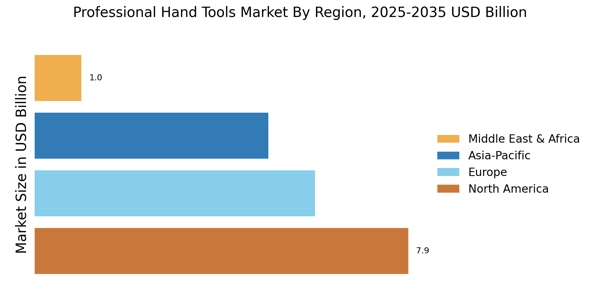
North America is the largest market for professional hand tools, accounting for approximately 40% of the global market share. The growth is driven by a robust construction sector, increasing DIY activities, and a rising demand for high-quality tools. Regulatory support for manufacturing and safety standards further catalyzes market expansion. The U.S. is the primary contributor, followed by Canada, which holds around 10% of the market share. The competitive landscape in North America is characterized by the presence of major players such as Stanley Black & Decker, DeWalt, and Milwaukee Tool. These companies leverage advanced technology and innovation to enhance product offerings. The market is also witnessing a trend towards sustainability, with manufacturers focusing on eco-friendly materials and practices. This competitive environment fosters continuous improvement and customer satisfaction.

Europe : Emerging Market Dynamics

Europe is witnessing significant growth in the professional hand tools market, holding approximately 30% of the global share. The demand is fueled by a strong manufacturing base, increasing construction activities, and a growing emphasis on quality and durability. Regulatory frameworks promoting safety and environmental standards are also pivotal in shaping market dynamics. Germany and the UK are the largest markets, contributing around 12% and 8% respectively to the overall market share. Leading countries in Europe are characterized by a competitive landscape with key players like Bosch and Festool. The market is increasingly focusing on innovation, with companies investing in research and development to meet evolving consumer needs. Additionally, the presence of various trade associations supports industry growth by promoting best practices and standards. This competitive environment encourages collaboration and technological advancements.

Asia-Pacific : Rapidly Growing Market

Asia-Pacific is emerging as a powerhouse in the professional hand tools market, accounting for approximately 25% of the global share. The region's growth is driven by rapid industrialization, urbanization, and a booming construction sector. Countries like China and India are at the forefront, with China alone holding about 15% of the market share. Regulatory initiatives aimed at enhancing manufacturing capabilities and safety standards are also contributing to market expansion. The competitive landscape in Asia-Pacific is marked by a mix of local and international players, including Makita and Hilti. The market is characterized by increasing investments in technology and innovation, with companies focusing on product differentiation and quality. Additionally, the rise of e-commerce platforms is transforming distribution channels, making professional hand tools more accessible to consumers across the region. This dynamic environment fosters healthy competition and growth opportunities.

Middle East and Africa : Untapped Market Potential

The Middle East and Africa (MEA) region is gradually emerging in the professional hand tools market, holding about 5% of the global share. The growth is primarily driven by increasing infrastructure projects, urban development, and a rising demand for quality tools. Regulatory frameworks are evolving to support manufacturing and safety standards, which are crucial for market growth. Countries like South Africa and the UAE are leading the market, contributing significantly to the overall share. The competitive landscape in MEA is characterized by a mix of local and international players, with companies focusing on expanding their presence in the region. The market is witnessing a trend towards innovation, with manufacturers investing in advanced technologies to enhance product offerings. Additionally, the growing DIY culture and increased awareness of tool quality are driving demand, creating opportunities for growth in this untapped market.

Professional Hand Tools Market  Regional Image

Key Players and Competitive Insights

The Professional Hand Tools Market is currently characterized by a dynamic competitive landscape, driven by innovation, technological advancements, and a growing emphasis on sustainability. Key players such as Stanley Black & Decker (US), DeWalt (US), and Bosch (DE) are strategically positioned to leverage these trends. Stanley Black & Decker (US) has focused on expanding its product portfolio through innovative designs and smart technology integration, while DeWalt (US) emphasizes durability and performance, catering to professional users. Bosch (DE) is enhancing its market presence through strategic partnerships and a commitment to eco-friendly products, which collectively shape a competitive environment that prioritizes quality and technological advancement.

In terms of business tactics, companies are increasingly localizing manufacturing to reduce lead times and enhance supply chain efficiency. The Professional Hand Tools Market appears moderately fragmented, with several key players exerting influence over various segments. This fragmentation allows for niche players to thrive, while larger companies optimize their operations to maintain competitive advantages. The collective influence of these key players fosters a competitive structure that encourages innovation and responsiveness to market demands.

In August 2025, Stanley Black & Decker (US) announced a significant investment in a new manufacturing facility in North Carolina, aimed at increasing production capacity for its hand tools. This strategic move not only enhances local job creation but also positions the company to better meet the growing demand for high-quality tools in the North American market. The investment underscores the company's commitment to maintaining a robust supply chain and responding swiftly to customer needs.

In September 2025, DeWalt (US) launched a new line of cordless hand tools featuring advanced battery technology that extends runtime and reduces charging time. This innovation is pivotal as it aligns with the increasing demand for efficient and reliable tools among professionals. By focusing on battery performance, DeWalt (US) strengthens its competitive edge in a market that increasingly values convenience and efficiency.

In July 2025, Bosch (DE) entered into a partnership with a leading technology firm to develop smart hand tools equipped with IoT capabilities. This collaboration aims to integrate digital solutions into traditional hand tools, enhancing user experience and operational efficiency. The strategic importance of this partnership lies in Bosch's ability to position itself at the forefront of the digital transformation within the hand tools sector, appealing to tech-savvy professionals.

As of October 2025, the Professional Hand Tools Market is witnessing trends such as digitalization, sustainability, and the integration of artificial intelligence. Strategic alliances are increasingly shaping the competitive landscape, enabling companies to pool resources and expertise. Looking ahead, competitive differentiation is likely to evolve from traditional price-based competition to a focus on innovation, technological advancements, and supply chain reliability. Companies that can effectively navigate these trends will likely secure a stronger foothold in the market.


Key Companies in the Professional Hand Tools Market market include

Future Outlook

Professional Hand Tools Market Future Outlook

The Professional Hand Tools Market is projected to grow at a 4.3% CAGR from 2024 to 2035, driven by technological advancements, increasing DIY trends, and rising construction activities.

New opportunities lie in:

  • Expansion into smart tool technologies for enhanced user experience.
  • Development of eco-friendly hand tools to meet sustainability demands.
  • Establishment of subscription-based tool rental services for cost-effective access.

By 2035, the market is expected to achieve robust growth, reflecting evolving consumer preferences and technological innovations.

Market Segmentation

Professional Hand Tools Market Product Type Outlook

  • Wrenches & Spanner
  • Pliers & Cutting Tools
  • Screwdrivers & Fastening Tools
  • Hammers & Striking Tools
  • Measuring & Layout Tools
  • Power Tool
  • Sockets & Ratchets
  • Cutting & Sawing Tools
  • Others

Professional Hand Tools Market End-User Industry Outlook

  • Automotive & Transportation
  • Construction & Infrastructure
  • Manufacturing & Engineering
  • Electrical & Electronics
  • Plumbing & HVAC
  • Woodworking & Carpentry
  • Others

Professional Hand Tools Market Distribution Channel Outlook

  • Direct Sales (B2B)
  • Physical Stores
  • Online Marketplaces

Report Scope

MARKET SIZE 202419.72(USD Billion)
MARKET SIZE 202520.57(USD Billion)
MARKET SIZE 203531.34(USD Billion)
COMPOUND ANNUAL GROWTH RATE (CAGR)4.3% (2024 - 2035)
REPORT COVERAGERevenue Forecast, Competitive Landscape, Growth Factors, and Trends
BASE YEAR2024
Market Forecast Period2025 - 2035
Historical Data2019 - 2024
Market Forecast UnitsUSD Billion
Key Companies ProfiledMarket analysis in progress
Segments CoveredMarket segmentation analysis in progress
Key Market OpportunitiesIntegration of smart technology in Professional Hand Tools Market enhances user efficiency and safety.
Key Market DynamicsRising demand for ergonomic designs drives innovation and competition in the Professional Hand Tools Market.
Countries CoveredNorth America, Europe, APAC, South America, MEA

Leave a Comment

FAQs

What is the projected market valuation of the Professional Hand Tools Market by 2035?

The Professional Hand Tools Market is projected to reach a valuation of 31.34 USD Billion by 2035.

What was the market valuation of the Professional Hand Tools Market in 2024?

In 2024, the Professional Hand Tools Market was valued at 19.72 USD Billion.

What is the expected CAGR for the Professional Hand Tools Market during the forecast period 2025 - 2035?

The expected CAGR for the Professional Hand Tools Market during the forecast period 2025 - 2035 is 4.3%.

Which product segment is projected to have the highest growth in the Professional Hand Tools Market?

The Power Tool segment is projected to grow from 3.5 USD Billion in 2024 to 5.5 USD Billion by 2035.

How do the sales channels for Professional Hand Tools break down in terms of revenue?

In 2024, Physical Stores generated 7.0 USD Billion, while Online Marketplaces accounted for 7.72 USD Billion.

Which end-user industry is expected to contribute the most to the Professional Hand Tools Market?

The Construction & Infrastructure sector is anticipated to grow from 5.0 USD Billion in 2024 to 8.0 USD Billion by 2035.

Download Free Sample

Kindly complete the form below to receive a free sample of this Report

Compare Licence

×
Features License Type
Single User Multiuser License Enterprise User
Price $4,950 $5,950 $7,250
Maximum User Access Limit 1 User Upto 10 Users Unrestricted Access Throughout the Organization
Free Customization
Direct Access to Analyst
Deliverable Format
Platform Access
Discount on Next Purchase 10% 15% 15%
Printable Versions