Project Feasibility Study and Consulting Services Market
Project Feasibility Study and Consulting Services Market Research Report By End Use (Public Sector, Private Sector, Non-Profit Organizations, Educational Institutions, Healthcare), By Industry (Infrastructure, Real Estate, Telecommunications, Environmental Services, Transportation), By Application (Construction, Manufacturing, Energy, Transportation, Information Technology), By Project Size (Small Scale, Medium Scale, Large Scale, Mega Projects), By Service Type (By Analysis, Risk Assessment, Financial Feasibility, Technical Feasibility, Regulatory Compliance) And By Region (North America, Europe, Asia-Pacific, And Rest Of The World) – Market Forecast Till 2035.
Forecast Period
2025 - 2035
CAGR
3.37%
2024 Market Size
$ 12.5 Billion
2035 Market Size
$ 18 Billion
Professional Services● Updated March 29, 2026Report ID: MRFR/PS/65828-HCR|Pages: 200|Author: Rahul Gotadki, Garvit Vyas
Project Feasibility Study and Consulting Services Market Summary
As per MRFR analysis, the Project Feasibility Study and Consulting Services Market was estimated at 12.5 USD Billion in 2024. The industry is projected to grow from 12.92 USD Billion in 2025 to 18.0 USD Billion by 2035, exhibiting a compound annual growth rate (CAGR) of 3.37% during the forecast period 2025 - 2035.
Key Market Trends & Highlights
The Project Feasibility Study and Consulting Services Market is experiencing a dynamic evolution driven by technological advancements and sustainability initiatives.
Technological integration is reshaping project feasibility methodologies, enhancing efficiency and accuracy.
The focus on sustainability is becoming increasingly prominent, influencing project assessments across various sectors.
North America remains the largest market, while the Asia-Pacific region is emerging as the fastest-growing area for consulting services.
Key market drivers include rising infrastructure investments and the increasing complexity of projects, necessitating robust feasibility studies.
Market Size & Forecast
2024 Market Size
12.5 (USD Billion)
2035 Market Size
18.0 (USD Billion)
CAGR (2025 - 2035)
3.37%
Major Players
AECOM (US), WSP Global (CA), Ramboll (DK), Golder Associates (CA), Arup Group (GB), KPMG (GB), Deloitte (GB), Ernst & Young (GB), McKinsey & Company (US)
Our Impact
Enabled $4.3B Revenue Impact for Fortune 500 and Leading Multinationals
Partnering with 2000+ Global Organizations Each Year
30K+ Citations by Top-Tier Firms in the Industry
Project Feasibility Study and Consulting Services Market Trends
The Project Feasibility Study and Consulting Services Market is currently experiencing a dynamic evolution, driven by the increasing complexity of projects across various sectors. Organizations are increasingly recognizing the necessity of thorough feasibility studies to mitigate risks and enhance decision-making processes. This trend appears to be fueled by the growing demand for strategic insights that can guide investments and resource allocation. As businesses navigate an ever-changing landscape, the role of consulting services in providing expert analysis and recommendations becomes more pronounced. Furthermore, the integration of advanced technologies into feasibility studies is likely to enhance the accuracy and efficiency of assessments, thereby attracting more clients seeking reliable data-driven insights. In addition, the Project Feasibility Study and Consulting Services Market seems to be influenced by a heightened focus on sustainability and environmental considerations. Stakeholders are increasingly prioritizing projects that align with sustainable practices, which necessitates comprehensive evaluations of potential environmental impacts. This shift may lead to a greater emphasis on consulting services that specialize in sustainability assessments. Overall, the market appears poised for growth as organizations seek to navigate complexities and ensure the viability of their projects through informed consulting services.
Technological Integration
The incorporation of advanced technologies, such as artificial intelligence and data analytics, is transforming the way feasibility studies are conducted. These tools enhance the precision of assessments and streamline the decision-making process, making consulting services more appealing to clients.
Sustainability Focus
There is a growing emphasis on sustainability within project evaluations. Organizations are increasingly seeking consulting services that can provide insights into environmental impacts, aligning projects with eco-friendly practices and regulatory requirements.
Globalization of Services
As businesses expand internationally, the demand for feasibility studies that consider diverse market conditions is rising. Consulting services are adapting to provide insights that cater to various cultural, economic, and regulatory environments.
Project Feasibility Study and Consulting Services Market Drivers
Technological Advancements
Technological advancements are reshaping the Project Feasibility Study and Consulting Services Market, as innovative tools and methodologies enhance the accuracy and efficiency of feasibility assessments. The integration of data analytics, artificial intelligence, and simulation technologies allows consultants to provide more precise evaluations of project viability. These advancements not only streamline the feasibility study process but also enable stakeholders to make informed decisions based on real-time data. As organizations increasingly recognize the value of leveraging technology in project planning, the demand for consulting services that incorporate these innovations is likely to grow, further propelling the market.
Rising Complexity of Projects
The complexity of modern projects is escalating, which is driving the need for specialized consulting services within the Project Feasibility Study and Consulting Services Market. Projects are increasingly multifaceted, often involving advanced technologies, regulatory compliance, and diverse stakeholder interests. This complexity necessitates thorough feasibility assessments to navigate potential challenges and ensure alignment with strategic objectives. According to recent data, the number of multi-disciplinary projects has increased significantly, leading to a heightened demand for expert consulting services that can provide insights into project feasibility, risk management, and strategic planning.
Focus on Sustainable Development
The Project Feasibility Study and Consulting Services Market is witnessing a pronounced shift towards sustainable development practices. As environmental concerns gain prominence, stakeholders are increasingly prioritizing projects that align with sustainability goals. This trend necessitates comprehensive feasibility studies that evaluate the environmental impact, resource efficiency, and long-term sustainability of projects. Recent studies indicate that projects with a sustainability focus are more likely to secure funding and support from investors. Consequently, consulting services that specialize in sustainability assessments and feasibility studies are becoming essential for organizations aiming to align their projects with global sustainability objectives.
Increasing Infrastructure Investments
The Project Feasibility Study and Consulting Services Market is experiencing a surge in demand due to increasing investments in infrastructure projects. Governments and private entities are allocating substantial budgets for the development of transportation, energy, and urban infrastructure. For instance, in recent years, infrastructure spending has been projected to reach trillions of dollars, indicating a robust growth trajectory. This influx of capital necessitates comprehensive feasibility studies to assess project viability, financial implications, and potential risks. As a result, consulting services that specialize in project feasibility are becoming indispensable for stakeholders aiming to ensure successful project execution and optimal resource allocation.
Regulatory Compliance and Risk Management
The Project Feasibility Study and Consulting Services Market is significantly influenced by the growing emphasis on regulatory compliance and risk management. As industries face stricter regulations and heightened scrutiny, organizations are compelled to conduct detailed feasibility studies to ensure adherence to legal and environmental standards. This trend is particularly evident in sectors such as construction, energy, and healthcare, where compliance failures can result in substantial financial penalties. Consequently, consulting services that offer expertise in navigating regulatory landscapes and assessing project risks are increasingly sought after, thereby bolstering the demand for feasibility studies.
Market Segment Insights
By Application: Construction (Largest) vs. Information Technology (Fastest-Growing)
In the Project Feasibility Study and Consulting Services Market, the Application segment encompasses various industries, each contributing uniquely to the overall landscape. Construction represents the largest share, driven by significant infrastructure development and urbanization trends, which necessitate extensive consulting services. On the other hand, Information Technology, while currently smaller in market share, is emerging rapidly due to digital transformation efforts across sectors, demanding specialized feasibility studies to assess innovative project implementations.
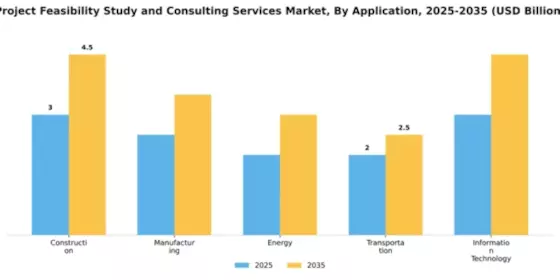
Construction (Dominant) vs. Information Technology (Emerging)
Within the Application segment, the Construction industry remains dominant due to its consistent demand for feasibility studies linked to urban development, infrastructure expansion, and industry regulations. As construction projects grow in complexity, consulting services have evolved to incorporate advanced analytics, risk assessment, and compliance checks. Conversely, the Information Technology sector, as an emerging player, showcases increasing investment in tech-driven projects that require comprehensive feasibility analysis. The rise of startups and digital initiatives drives demand for consulting services, emphasizing adaptability in project feasibility studies to accommodate rapid technological changes.
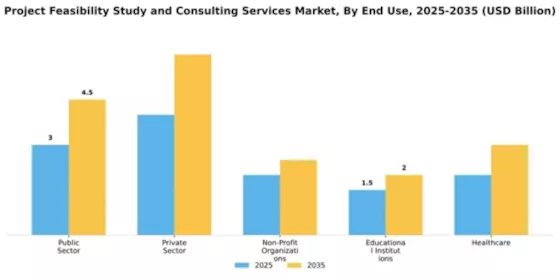
By End Use: Public Sector (Largest) vs. Private Sector (Fastest-Growing)
In the Project Feasibility Study and Consulting Services Market, the Public Sector accounts for the largest share, reflecting its significant reliance on consulting services for infrastructure development and government projects. This sector benefits from substantial public funding and a steady pipeline of projects, which ensures a consistent demand for feasibility studies and consulting services. Meanwhile, the Private Sector is gaining momentum, driven by increasing investments in innovation and project expansion. As businesses seek to optimize operations and assess new ventures, the demand for expert consulting support is on the rise.
Public Sector: Dominant vs. Private Sector: Emerging
The Public Sector maintains its dominant position within the Project Feasibility Study and Consulting Services Market due to its extensive requirements for planning, regulatory compliance, and project execution. Government agencies leverage consulting firms to navigate complex project scopes, ensuring effective utilization of taxpayer money. Conversely, the Private Sector is emerging rapidly, characterized by its dynamic nature and diverse demands. As companies face growing competition and seek competitive advantages, they increasingly engage consulting services to assess project viability, manage risk, and implement strategic initiatives. This sector's growth is fueled by innovation, market responsiveness, and the need for specialized expertise.
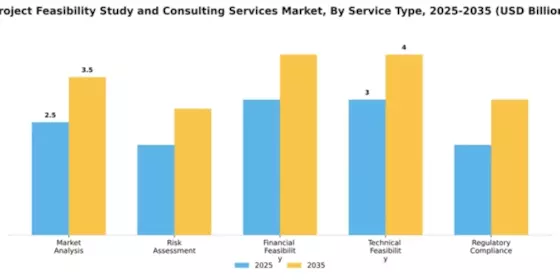
By Service Type: Market Analysis (Largest) vs. Risk Assessment (Fastest-Growing)
Within the Project Feasibility Study and Consulting Services Market, the service type segment is diverse, showcasing distinct roles in project development. Market analysis emerges as the largest segment, holding a significant share due to its essential function of assessing potential opportunities and challenges in the project lifecycle. Meanwhile, risk assessment is rapidly gaining traction as organizations increasingly recognize the importance of proactive strategies to identify and mitigate risks associated with projects, making it the fastest-growing segment in this space.
Market Analysis (Dominant) vs. Risk Assessment (Emerging)
Market analysis plays a dominant role within the Project Feasibility Study and Consulting Services Market by providing crucial insights that shape project planning and execution. This service helps organizations identify market conditions, competition, and consumer behavior, enabling informed decision-making. In contrast, risk assessment is an emerging force, expanding swiftly as firms prioritize the identification of potential project risks and their impacts. With an increasing emphasis on comprehensive risk management frameworks, this segment's growth reflects a paradigm shift towards more resilient planning and execution processes in project management.
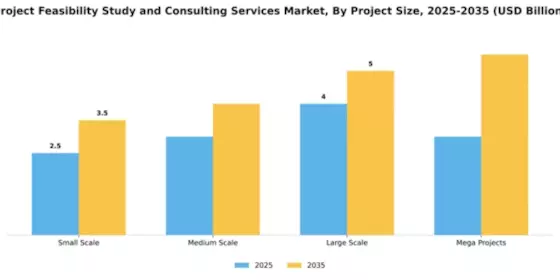
By Project Size: Large Scale (Largest) vs. Medium Scale (Fastest-Growing)
In the Project Feasibility Study and Consulting Services Market, the distribution of market share among project sizes reveals that Large Scale projects hold the significant share due to their extensive requirements and complex nature. These projects often involve substantial funding and a thorough feasibility analysis to mitigate risks, contributing to their dominance in the market. Conversely, Medium Scale projects are gaining traction as businesses increasingly recognize the potential for growth with lower investment risks, poised for a notable share increase in the coming years. The growth trend within the Project Size segment is characterized by the rising demand for Medium Scale projects, which cater to a broader range of businesses looking for feasible yet impactful investment opportunities. As economic conditions fluctuate, stakeholders are inclined to embrace Medium Scale ventures, allowing for agility in market adjustments. Additionally, government support and funding for infrastructure initiatives are accelerating the development of Large Scale projects, with companies adapting their strategies to accommodate both segments effectively.
Large Scale (Dominant) vs. Medium Scale (Emerging)
The Large Scale segment in the Project Feasibility Study and Consulting Services Market is characterized by projects that require significant investment and comprehensive planning. These projects typically involve extensive consultations and multi-disciplinary approaches, ensuring thorough risk mitigation and feasibility assessments. Large Scale projects often include infrastructure, commercial development, and other capital-intensive initiatives that demand high-level expertise and meticulous planning. On the other hand, the Medium Scale segment is emerging rapidly, attracting businesses seeking feasible project execution with manageable budgets. This segment addresses niche markets and project types that allow for flexibility and quicker returns, driving an increasing number of clients to seek specialized consultancy services tailored to their unique requirements, facilitating a competitive edge in a dynamic environment.
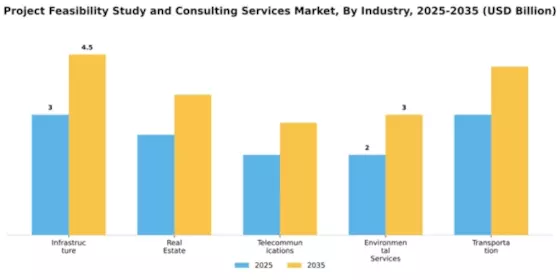
By Industry: Infrastructure (Largest) vs. Environmental Services (Fastest-Growing)
The Project Feasibility Study and Consulting Services Market is significantly influenced by various industries, with Infrastructure leading the way. This segment captures the largest share of the market, reflecting the essential role it plays in the development and implementation of projects in various sectors. Meanwhile, the Environmental Services segment is emerging rapidly, driven by increasing regulatory pressures and the rising demand for sustainable practices across industries.
Infrastructure (Dominant) vs. Environmental Services (Emerging)
Infrastructure continues to be the dominant segment within the Project Feasibility Study and Consulting Services Market. Its strength lies in comprehensive project planning, risk assessment, and feasibility analysis that cater to large-scale developments in urban settings, transportation networks, and public utilities. On the other hand, Environmental Services represents an emerging value, reflecting a growing focus on sustainability and compliance with environmental regulations. This segment emphasizes ecological impact assessments, resource management, and environmental engineering, appealing to organizations aiming to incorporate sustainability into their projects.
Get more detailed insights about Project Feasibility Study and Consulting Services MarketRequest Free Sample
Key Players and Competitive Insights
The Project Feasibility Study and Consulting Services Market is characterized by a dynamic competitive landscape, driven by increasing demand for strategic insights and risk management in project execution. Key players such as AECOM (US), WSP Global (CA), and Deloitte (GB) are strategically positioned to leverage their extensive expertise and global reach. AECOM (US) focuses on integrating advanced technologies into its consulting services, enhancing project delivery efficiency. WSP Global (CA) emphasizes sustainability and resilience in its project feasibility studies, aligning with global environmental goals. Deloitte (GB) adopts a data-driven approach, utilizing analytics to inform decision-making processes, thereby shaping a competitive environment that prioritizes innovation and strategic foresight.The market structure appears moderately fragmented, with a mix of large multinational firms and specialized local players. Key business tactics include localizing services to meet regional demands and optimizing supply chains to enhance service delivery. The collective influence of these major players fosters a competitive atmosphere where collaboration and strategic partnerships are increasingly vital for success.In November AECOM (US) announced a partnership with a leading technology firm to develop AI-driven tools for project feasibility assessments. This strategic move is likely to enhance AECOM's capabilities in predictive analytics, allowing for more accurate project evaluations and risk assessments. Such innovations may position AECOM as a frontrunner in the integration of technology within consulting services.In October WSP Global (CA) launched a new initiative aimed at promoting sustainable infrastructure development in emerging markets. This initiative underscores WSP's commitment to addressing climate change and could potentially open new revenue streams while enhancing its reputation as a leader in sustainable consulting practices. The focus on sustainability aligns with global trends and may attract clients seeking environmentally responsible solutions.In September Deloitte (GB) expanded its consulting services by acquiring a niche firm specializing in digital transformation for the construction sector. This acquisition is indicative of Deloitte's strategy to bolster its service offerings and enhance its competitive edge in a rapidly evolving market. By integrating digital solutions into its consulting framework, Deloitte is likely to provide clients with comprehensive strategies that address both traditional and modern project challenges.As of December current competitive trends in the Project Feasibility Study and Consulting Services Market are heavily influenced by digitalization, sustainability, and the integration of AI technologies. Strategic alliances are becoming increasingly important, as firms seek to combine expertise and resources to address complex project demands. The competitive differentiation is expected to evolve, shifting from price-based competition to a focus on innovation, technological advancement, and supply chain reliability. This transition may redefine how firms position themselves in the market, emphasizing the need for agility and forward-thinking strategies.

Key Companies in the Project Feasibility Study and Consulting Services Market include
Future Outlook
Project Feasibility Study and Consulting Services Market Future Outlook
The Project Feasibility Study and Consulting Services Market is projected to grow at a 3.37% CAGR from 2025 to 2035, driven by technological advancements and increasing project complexities.
New opportunities lie in:
Integration of AI-driven analytics for project risk assessment Expansion into emerging markets with tailored consulting solutions Development of sustainability-focused feasibility frameworks for green projects
By 2035, the market is expected to be robust, reflecting adaptive strategies and innovative service offerings.
Market Segmentation
Project Feasibility Study and Consulting Services Market End Use Outlook
Public Sector
Private Sector
Non-Profit Organizations
Educational Institutions
Healthcare
Project Feasibility Study and Consulting Services Market Industry Outlook
Infrastructure
Real Estate
Telecommunications
Environmental Services
Transportation
Project Feasibility Study and Consulting Services Market Application Outlook
Construction
Manufacturing
Energy
Transportation
Information Technology
Project Feasibility Study and Consulting Services Market Project Size Outlook
Small Scale
Medium Scale
Large Scale
Mega Projects
Project Feasibility Study and Consulting Services Market Service Type Outlook
Market Analysis
Risk Assessment
Financial Feasibility
Technical Feasibility
Regulatory Compliance
Report Scope
MARKET SIZE 2024
12.5(USD Billion)
MARKET SIZE 2025
12.92(USD Billion)
MARKET SIZE 2035
18.0(USD Billion)
COMPOUND ANNUAL GROWTH RATE (CAGR)
3.37% (2025 - 2035)
REPORT COVERAGE
Revenue Forecast, Competitive Landscape, Growth Factors, and Trends
BASE YEAR
2024
Market Forecast Period
2025 - 2035
Historical Data
2019 - 2024
Market Forecast Units
USD Billion
Key Companies Profiled
AECOM (US), WSP Global (CA), Ramboll (DK), Golder Associates (CA), Arup Group (GB), KPMG (GB), Deloitte (GB), Ernst & Young (GB), McKinsey & Company (US)
Segments Covered
Application, End Use, Service Type, Project Size, Industry
Key Market Opportunities
Integration of advanced analytics and artificial intelligence in Project Feasibility Study and Consulting Services Market.
Key Market Dynamics
Rising demand for sustainable practices drives innovation in project feasibility studies and consulting services.
Countries Covered
North America, Europe, APAC, South America, MEA
Table of Contents
1 SECTION I: EXECUTIVE SUMMARY AND KEY HIGHLIGHTS
1.1 EXECUTIVE SUMMARY
1.1.1 Market Overview
1.1.2 Key Findings
1.1.3 Market Segmentation
1.1.4 Competitive Landscape
1.1.5 Challenges and Opportunities
1.1.6 Future Outlook
2 SECTION II: SCOPING, METHODOLOGY AND MARKET STRUCTURE
2.1 MARKET INTRODUCTION
2.1.1 Definition
2.1.2 Scope of the study
2.1.2.1 Research Objective
2.1.2.2 Assumption
2.1.2.3 Limitations
2.2 RESEARCH METHODOLOGY
2.2.1 Overview
2.2.2 Data Mining
2.2.3 Secondary Research
2.2.4 Primary Research
2.2.4.1 Primary Interviews and Information Gathering Process
2.2.4.2 Breakdown of Primary Respondents
2.2.5 Forecasting Model
2.2.6 Market Size Estimation
2.2.6.1 Bottom-Up Approach
2.2.6.2 Top-Down Approach
2.2.7 Data Triangulation
2.2.8 Validation
3 SECTION III: QUALITATIVE ANALYSIS
3.1 MARKET DYNAMICS
3.1.1 Overview
3.1.2 Drivers
3.1.3 Restraints
3.1.4 Opportunities
3.2 MARKET FACTOR ANALYSIS
3.2.1 Value chain Analysis
3.2.2 Porter's Five Forces Analysis
3.2.2.1 Bargaining Power of Suppliers
3.2.2.2 Bargaining Power of Buyers
3.2.2.3 Threat of New Entrants
3.2.2.4 Threat of Substitutes
3.2.2.5 Intensity of Rivalry
3.2.3 COVID-19 Impact Analysis
3.2.3.1 Market Impact Analysis
3.2.3.2 Regional Impact
3.2.3.3 Opportunity and Threat Analysis
4 SECTION IV: QUANTITATIVE ANALYSIS
4.1 Pharmaceutical, BY Application (USD Billion)
4.1.1 Construction
4.1.2 Manufacturing
4.1.3 Energy
4.1.4 Transportation
4.1.5 Information Technology
4.2 Pharmaceutical, BY End Use (USD Billion)
4.2.1 Public Sector
4.2.2 Private Sector
4.2.3 Non-Profit Organizations
4.2.4 Educational Institutions
4.2.5 Healthcare
4.3 Pharmaceutical, BY Service Type (USD Billion)
4.3.1 Market Analysis
4.3.2 Risk Assessment
4.3.3 Financial Feasibility
4.3.4 Technical Feasibility
4.3.5 Regulatory Compliance
4.4 Pharmaceutical, BY Project Size (USD Billion)
4.4.1 Small Scale
4.4.2 Medium Scale
4.4.3 Large Scale
4.4.4 Mega Projects
4.5 Pharmaceutical, BY Industry (USD Billion)
4.5.1 Infrastructure
4.5.2 Real Estate
4.5.3 Telecommunications
4.5.4 Environmental Services
4.5.5 Transportation
4.6 Pharmaceutical, BY Region (USD Billion)
4.6.1 North America
4.6.1.1 US
4.6.1.2 Canada
4.6.2 Europe
4.6.2.1 Germany
4.6.2.2 UK
4.6.2.3 France
4.6.2.4 Russia
4.6.2.5 Italy
4.6.2.6 Spain
4.6.2.7 Rest of Europe
4.6.3 APAC
4.6.3.1 China
4.6.3.2 India
4.6.3.3 Japan
4.6.3.4 South Korea
4.6.3.5 Malaysia
4.6.3.6 Thailand
4.6.3.7 Indonesia
4.6.3.8 Rest of APAC
4.6.4 South America
4.6.4.1 Brazil
4.6.4.2 Mexico
4.6.4.3 Argentina
4.6.4.4 Rest of South America
4.6.5 MEA
4.6.5.1 GCC Countries
4.6.5.2 South Africa
4.6.5.3 Rest of MEA
5 SECTION V: COMPETITIVE ANALYSIS
5.1 Competitive Landscape
5.1.1 Overview
5.1.2 Competitive Analysis
5.1.3 Market share Analysis
5.1.4 Major Growth Strategy in the Pharmaceutical
5.1.5 Competitive Benchmarking
5.1.6 Leading Players in Terms of Number of Developments in the Pharmaceutical
5.1.7 Key developments and growth strategies
5.1.7.1 New Product Launch/Service Deployment
5.1.7.2 Merger & Acquisitions
5.1.7.3 Joint Ventures
5.1.8 Major Players Financial Matrix
5.1.8.1 Sales and Operating Income
5.1.8.2 Major Players R&D Expenditure. 2023
5.2 Company Profiles
5.2.1 AECOM (US)
5.2.1.1 Financial Overview
5.2.1.2 Products Offered
5.2.1.3 Key Developments
5.2.1.4 SWOT Analysis
5.2.1.5 Key Strategies
5.2.2 WSP Global (CA)
5.2.2.1 Financial Overview
5.2.2.2 Products Offered
5.2.2.3 Key Developments
5.2.2.4 SWOT Analysis
5.2.2.5 Key Strategies
5.2.3 Ramboll (DK)
5.2.3.1 Financial Overview
5.2.3.2 Products Offered
5.2.3.3 Key Developments
5.2.3.4 SWOT Analysis
5.2.3.5 Key Strategies
5.2.4 Golder Associates (CA)
5.2.4.1 Financial Overview
5.2.4.2 Products Offered
5.2.4.3 Key Developments
5.2.4.4 SWOT Analysis
5.2.4.5 Key Strategies
5.2.5 Arup Group (GB)
5.2.5.1 Financial Overview
5.2.5.2 Products Offered
5.2.5.3 Key Developments
5.2.5.4 SWOT Analysis
5.2.5.5 Key Strategies
5.2.6 KPMG (GB)
5.2.6.1 Financial Overview
5.2.6.2 Products Offered
5.2.6.3 Key Developments
5.2.6.4 SWOT Analysis
5.2.6.5 Key Strategies
5.2.7 Deloitte (GB)
5.2.7.1 Financial Overview
5.2.7.2 Products Offered
5.2.7.3 Key Developments
5.2.7.4 SWOT Analysis
5.2.7.5 Key Strategies
5.2.8 Ernst & Young (GB)
5.2.8.1 Financial Overview
5.2.8.2 Products Offered
5.2.8.3 Key Developments
5.2.8.4 SWOT Analysis
5.2.8.5 Key Strategies
5.2.9 McKinsey & Company (US)
5.2.9.1 Financial Overview
5.2.9.2 Products Offered
5.2.9.3 Key Developments
5.2.9.4 SWOT Analysis
5.2.9.5 Key Strategies
5.3 Appendix
5.3.1 References
5.3.2 Related Reports
6 LIST OF FIGURES
6.1 MARKET SYNOPSIS
6.2 NORTH AMERICA MARKET ANALYSIS
6.3 US MARKET ANALYSIS BY APPLICATION
6.4 US MARKET ANALYSIS BY END USE
6.5 US MARKET ANALYSIS BY SERVICE TYPE
6.6 US MARKET ANALYSIS BY PROJECT SIZE
6.7 US MARKET ANALYSIS BY INDUSTRY
6.8 CANADA MARKET ANALYSIS BY APPLICATION
6.9 CANADA MARKET ANALYSIS BY END USE
6.10 CANADA MARKET ANALYSIS BY SERVICE TYPE
6.11 CANADA MARKET ANALYSIS BY PROJECT SIZE
6.12 CANADA MARKET ANALYSIS BY INDUSTRY
6.13 EUROPE MARKET ANALYSIS
6.14 GERMANY MARKET ANALYSIS BY APPLICATION
6.15 GERMANY MARKET ANALYSIS BY END USE
6.16 GERMANY MARKET ANALYSIS BY SERVICE TYPE
6.17 GERMANY MARKET ANALYSIS BY PROJECT SIZE
6.18 GERMANY MARKET ANALYSIS BY INDUSTRY
6.19 UK MARKET ANALYSIS BY APPLICATION
6.20 UK MARKET ANALYSIS BY END USE
6.21 UK MARKET ANALYSIS BY SERVICE TYPE
6.22 UK MARKET ANALYSIS BY PROJECT SIZE
6.23 UK MARKET ANALYSIS BY INDUSTRY
6.24 FRANCE MARKET ANALYSIS BY APPLICATION
6.25 FRANCE MARKET ANALYSIS BY END USE
6.26 FRANCE MARKET ANALYSIS BY SERVICE TYPE
6.27 FRANCE MARKET ANALYSIS BY PROJECT SIZE
6.28 FRANCE MARKET ANALYSIS BY INDUSTRY
6.29 RUSSIA MARKET ANALYSIS BY APPLICATION
6.30 RUSSIA MARKET ANALYSIS BY END USE
6.31 RUSSIA MARKET ANALYSIS BY SERVICE TYPE
6.32 RUSSIA MARKET ANALYSIS BY PROJECT SIZE
6.33 RUSSIA MARKET ANALYSIS BY INDUSTRY
6.34 ITALY MARKET ANALYSIS BY APPLICATION
6.35 ITALY MARKET ANALYSIS BY END USE
6.36 ITALY MARKET ANALYSIS BY SERVICE TYPE
6.37 ITALY MARKET ANALYSIS BY PROJECT SIZE
6.38 ITALY MARKET ANALYSIS BY INDUSTRY
6.39 SPAIN MARKET ANALYSIS BY APPLICATION
6.40 SPAIN MARKET ANALYSIS BY END USE
6.41 SPAIN MARKET ANALYSIS BY SERVICE TYPE
6.42 SPAIN MARKET ANALYSIS BY PROJECT SIZE
6.43 SPAIN MARKET ANALYSIS BY INDUSTRY
6.44 REST OF EUROPE MARKET ANALYSIS BY APPLICATION
6.45 REST OF EUROPE MARKET ANALYSIS BY END USE
6.46 REST OF EUROPE MARKET ANALYSIS BY SERVICE TYPE
6.47 REST OF EUROPE MARKET ANALYSIS BY PROJECT SIZE
6.48 REST OF EUROPE MARKET ANALYSIS BY INDUSTRY
6.49 APAC MARKET ANALYSIS
6.50 CHINA MARKET ANALYSIS BY APPLICATION
6.51 CHINA MARKET ANALYSIS BY END USE
6.52 CHINA MARKET ANALYSIS BY SERVICE TYPE
6.53 CHINA MARKET ANALYSIS BY PROJECT SIZE
6.54 CHINA MARKET ANALYSIS BY INDUSTRY
6.55 INDIA MARKET ANALYSIS BY APPLICATION
6.56 INDIA MARKET ANALYSIS BY END USE
6.57 INDIA MARKET ANALYSIS BY SERVICE TYPE
6.58 INDIA MARKET ANALYSIS BY PROJECT SIZE
6.59 INDIA MARKET ANALYSIS BY INDUSTRY
6.60 JAPAN MARKET ANALYSIS BY APPLICATION
6.61 JAPAN MARKET ANALYSIS BY END USE
6.62 JAPAN MARKET ANALYSIS BY SERVICE TYPE
6.63 JAPAN MARKET ANALYSIS BY PROJECT SIZE
6.64 JAPAN MARKET ANALYSIS BY INDUSTRY
6.65 SOUTH KOREA MARKET ANALYSIS BY APPLICATION
6.66 SOUTH KOREA MARKET ANALYSIS BY END USE
6.67 SOUTH KOREA MARKET ANALYSIS BY SERVICE TYPE
6.68 SOUTH KOREA MARKET ANALYSIS BY PROJECT SIZE
6.69 SOUTH KOREA MARKET ANALYSIS BY INDUSTRY
6.70 MALAYSIA MARKET ANALYSIS BY APPLICATION
6.71 MALAYSIA MARKET ANALYSIS BY END USE
6.72 MALAYSIA MARKET ANALYSIS BY SERVICE TYPE
6.73 MALAYSIA MARKET ANALYSIS BY PROJECT SIZE
6.74 MALAYSIA MARKET ANALYSIS BY INDUSTRY
6.75 THAILAND MARKET ANALYSIS BY APPLICATION
6.76 THAILAND MARKET ANALYSIS BY END USE
6.77 THAILAND MARKET ANALYSIS BY SERVICE TYPE
6.78 THAILAND MARKET ANALYSIS BY PROJECT SIZE
6.79 THAILAND MARKET ANALYSIS BY INDUSTRY
6.80 INDONESIA MARKET ANALYSIS BY APPLICATION
6.81 INDONESIA MARKET ANALYSIS BY END USE
6.82 INDONESIA MARKET ANALYSIS BY SERVICE TYPE
6.83 INDONESIA MARKET ANALYSIS BY PROJECT SIZE
6.84 INDONESIA MARKET ANALYSIS BY INDUSTRY
6.85 REST OF APAC MARKET ANALYSIS BY APPLICATION
6.86 REST OF APAC MARKET ANALYSIS BY END USE
6.87 REST OF APAC MARKET ANALYSIS BY SERVICE TYPE
6.88 REST OF APAC MARKET ANALYSIS BY PROJECT SIZE
6.89 REST OF APAC MARKET ANALYSIS BY INDUSTRY
6.90 SOUTH AMERICA MARKET ANALYSIS
6.91 BRAZIL MARKET ANALYSIS BY APPLICATION
6.92 BRAZIL MARKET ANALYSIS BY END USE
6.93 BRAZIL MARKET ANALYSIS BY SERVICE TYPE
6.94 BRAZIL MARKET ANALYSIS BY PROJECT SIZE
6.95 BRAZIL MARKET ANALYSIS BY INDUSTRY
6.96 MEXICO MARKET ANALYSIS BY APPLICATION
6.97 MEXICO MARKET ANALYSIS BY END USE
6.98 MEXICO MARKET ANALYSIS BY SERVICE TYPE
6.99 MEXICO MARKET ANALYSIS BY PROJECT SIZE
6.100 MEXICO MARKET ANALYSIS BY INDUSTRY
6.101 ARGENTINA MARKET ANALYSIS BY APPLICATION
6.102 ARGENTINA MARKET ANALYSIS BY END USE
6.103 ARGENTINA MARKET ANALYSIS BY SERVICE TYPE
6.104 ARGENTINA MARKET ANALYSIS BY PROJECT SIZE
6.105 ARGENTINA MARKET ANALYSIS BY INDUSTRY
6.106 REST OF SOUTH AMERICA MARKET ANALYSIS BY APPLICATION
6.107 REST OF SOUTH AMERICA MARKET ANALYSIS BY END USE
6.108 REST OF SOUTH AMERICA MARKET ANALYSIS BY SERVICE TYPE
6.109 REST OF SOUTH AMERICA MARKET ANALYSIS BY PROJECT SIZE
6.110 REST OF SOUTH AMERICA MARKET ANALYSIS BY INDUSTRY
6.111 MEA MARKET ANALYSIS
6.112 GCC COUNTRIES MARKET ANALYSIS BY APPLICATION
6.113 GCC COUNTRIES MARKET ANALYSIS BY END USE
6.114 GCC COUNTRIES MARKET ANALYSIS BY SERVICE TYPE
6.115 GCC COUNTRIES MARKET ANALYSIS BY PROJECT SIZE
6.116 GCC COUNTRIES MARKET ANALYSIS BY INDUSTRY
6.117 SOUTH AFRICA MARKET ANALYSIS BY APPLICATION
6.118 SOUTH AFRICA MARKET ANALYSIS BY END USE
6.119 SOUTH AFRICA MARKET ANALYSIS BY SERVICE TYPE
6.120 SOUTH AFRICA MARKET ANALYSIS BY PROJECT SIZE
6.121 SOUTH AFRICA MARKET ANALYSIS BY INDUSTRY
6.122 REST OF MEA MARKET ANALYSIS BY APPLICATION
6.123 REST OF MEA MARKET ANALYSIS BY END USE
6.124 REST OF MEA MARKET ANALYSIS BY SERVICE TYPE
6.125 REST OF MEA MARKET ANALYSIS BY PROJECT SIZE
6.126 REST OF MEA MARKET ANALYSIS BY INDUSTRY
6.127 KEY BUYING CRITERIA OF PHARMACEUTICAL
6.128 RESEARCH PROCESS OF MRFR
6.129 DRO ANALYSIS OF PHARMACEUTICAL
6.130 DRIVERS IMPACT ANALYSIS: PHARMACEUTICAL
6.131 RESTRAINTS IMPACT ANALYSIS: PHARMACEUTICAL
6.132 SUPPLY / VALUE CHAIN: PHARMACEUTICAL
6.133 PHARMACEUTICAL, BY APPLICATION, 2024 (% SHARE)
6.134 PHARMACEUTICAL, BY APPLICATION, 2024 TO 2035 (USD Billion)
6.135 PHARMACEUTICAL, BY END USE, 2024 (% SHARE)
6.136 PHARMACEUTICAL, BY END USE, 2024 TO 2035 (USD Billion)
6.137 PHARMACEUTICAL, BY SERVICE TYPE, 2024 (% SHARE)
6.138 PHARMACEUTICAL, BY SERVICE TYPE, 2024 TO 2035 (USD Billion)
6.139 PHARMACEUTICAL, BY PROJECT SIZE, 2024 (% SHARE)
6.140 PHARMACEUTICAL, BY PROJECT SIZE, 2024 TO 2035 (USD Billion)
6.141 PHARMACEUTICAL, BY INDUSTRY, 2024 (% SHARE)
6.142 PHARMACEUTICAL, BY INDUSTRY, 2024 TO 2035 (USD Billion)
6.143 BENCHMARKING OF MAJOR COMPETITORS
7 LIST OF TABLES
7.1 LIST OF ASSUMPTIONS
7.1.1
7.2 North America MARKET SIZE ESTIMATES; FORECAST
7.2.1 BY APPLICATION, 2025-2035 (USD Billion)
7.2.2 BY END USE, 2025-2035 (USD Billion)
7.2.3 BY SERVICE TYPE, 2025-2035 (USD Billion)
7.2.4 BY PROJECT SIZE, 2025-2035 (USD Billion)
7.2.5 BY INDUSTRY, 2025-2035 (USD Billion)
7.3 US MARKET SIZE ESTIMATES; FORECAST
7.3.1 BY APPLICATION, 2025-2035 (USD Billion)
7.3.2 BY END USE, 2025-2035 (USD Billion)
7.3.3 BY SERVICE TYPE, 2025-2035 (USD Billion)
7.3.4 BY PROJECT SIZE, 2025-2035 (USD Billion)
7.3.5 BY INDUSTRY, 2025-2035 (USD Billion)
7.4 Canada MARKET SIZE ESTIMATES; FORECAST
7.4.1 BY APPLICATION, 2025-2035 (USD Billion)
7.4.2 BY END USE, 2025-2035 (USD Billion)
7.4.3 BY SERVICE TYPE, 2025-2035 (USD Billion)
7.4.4 BY PROJECT SIZE, 2025-2035 (USD Billion)
7.4.5 BY INDUSTRY, 2025-2035 (USD Billion)
7.5 Europe MARKET SIZE ESTIMATES; FORECAST
7.5.1 BY APPLICATION, 2025-2035 (USD Billion)
7.5.2 BY END USE, 2025-2035 (USD Billion)
7.5.3 BY SERVICE TYPE, 2025-2035 (USD Billion)
7.5.4 BY PROJECT SIZE, 2025-2035 (USD Billion)
7.5.5 BY INDUSTRY, 2025-2035 (USD Billion)
7.6 Germany MARKET SIZE ESTIMATES; FORECAST
7.6.1 BY APPLICATION, 2025-2035 (USD Billion)
7.6.2 BY END USE, 2025-2035 (USD Billion)
7.6.3 BY SERVICE TYPE, 2025-2035 (USD Billion)
7.6.4 BY PROJECT SIZE, 2025-2035 (USD Billion)
7.6.5 BY INDUSTRY, 2025-2035 (USD Billion)
7.7 UK MARKET SIZE ESTIMATES; FORECAST
7.7.1 BY APPLICATION, 2025-2035 (USD Billion)
7.7.2 BY END USE, 2025-2035 (USD Billion)
7.7.3 BY SERVICE TYPE, 2025-2035 (USD Billion)
7.7.4 BY PROJECT SIZE, 2025-2035 (USD Billion)
7.7.5 BY INDUSTRY, 2025-2035 (USD Billion)
7.8 France MARKET SIZE ESTIMATES; FORECAST
7.8.1 BY APPLICATION, 2025-2035 (USD Billion)
7.8.2 BY END USE, 2025-2035 (USD Billion)
7.8.3 BY SERVICE TYPE, 2025-2035 (USD Billion)
7.8.4 BY PROJECT SIZE, 2025-2035 (USD Billion)
7.8.5 BY INDUSTRY, 2025-2035 (USD Billion)
7.9 Russia MARKET SIZE ESTIMATES; FORECAST
7.9.1 BY APPLICATION, 2025-2035 (USD Billion)
7.9.2 BY END USE, 2025-2035 (USD Billion)
7.9.3 BY SERVICE TYPE, 2025-2035 (USD Billion)
7.9.4 BY PROJECT SIZE, 2025-2035 (USD Billion)
7.9.5 BY INDUSTRY, 2025-2035 (USD Billion)
7.10 Italy MARKET SIZE ESTIMATES; FORECAST
7.10.1 BY APPLICATION, 2025-2035 (USD Billion)
7.10.2 BY END USE, 2025-2035 (USD Billion)
7.10.3 BY SERVICE TYPE, 2025-2035 (USD Billion)
7.10.4 BY PROJECT SIZE, 2025-2035 (USD Billion)
7.10.5 BY INDUSTRY, 2025-2035 (USD Billion)
7.11 Spain MARKET SIZE ESTIMATES; FORECAST
7.11.1 BY APPLICATION, 2025-2035 (USD Billion)
7.11.2 BY END USE, 2025-2035 (USD Billion)
7.11.3 BY SERVICE TYPE, 2025-2035 (USD Billion)
7.11.4 BY PROJECT SIZE, 2025-2035 (USD Billion)
7.11.5 BY INDUSTRY, 2025-2035 (USD Billion)
7.12 Rest of Europe MARKET SIZE ESTIMATES; FORECAST
7.12.1 BY APPLICATION, 2025-2035 (USD Billion)
7.12.2 BY END USE, 2025-2035 (USD Billion)
7.12.3 BY SERVICE TYPE, 2025-2035 (USD Billion)
7.12.4 BY PROJECT SIZE, 2025-2035 (USD Billion)
7.12.5 BY INDUSTRY, 2025-2035 (USD Billion)
7.13 APAC MARKET SIZE ESTIMATES; FORECAST
7.13.1 BY APPLICATION, 2025-2035 (USD Billion)
7.13.2 BY END USE, 2025-2035 (USD Billion)
7.13.3 BY SERVICE TYPE, 2025-2035 (USD Billion)
7.13.4 BY PROJECT SIZE, 2025-2035 (USD Billion)
7.13.5 BY INDUSTRY, 2025-2035 (USD Billion)
7.14 China MARKET SIZE ESTIMATES; FORECAST
7.14.1 BY APPLICATION, 2025-2035 (USD Billion)
7.14.2 BY END USE, 2025-2035 (USD Billion)
7.14.3 BY SERVICE TYPE, 2025-2035 (USD Billion)
7.14.4 BY PROJECT SIZE, 2025-2035 (USD Billion)
7.14.5 BY INDUSTRY, 2025-2035 (USD Billion)
7.15 India MARKET SIZE ESTIMATES; FORECAST
7.15.1 BY APPLICATION, 2025-2035 (USD Billion)
7.15.2 BY END USE, 2025-2035 (USD Billion)
7.15.3 BY SERVICE TYPE, 2025-2035 (USD Billion)
7.15.4 BY PROJECT SIZE, 2025-2035 (USD Billion)
7.15.5 BY INDUSTRY, 2025-2035 (USD Billion)
7.16 Japan MARKET SIZE ESTIMATES; FORECAST
7.16.1 BY APPLICATION, 2025-2035 (USD Billion)
7.16.2 BY END USE, 2025-2035 (USD Billion)
7.16.3 BY SERVICE TYPE, 2025-2035 (USD Billion)
7.16.4 BY PROJECT SIZE, 2025-2035 (USD Billion)
7.16.5 BY INDUSTRY, 2025-2035 (USD Billion)
7.17 South Korea MARKET SIZE ESTIMATES; FORECAST
7.17.1 BY APPLICATION, 2025-2035 (USD Billion)
7.17.2 BY END USE, 2025-2035 (USD Billion)
7.17.3 BY SERVICE TYPE, 2025-2035 (USD Billion)
7.17.4 BY PROJECT SIZE, 2025-2035 (USD Billion)
7.17.5 BY INDUSTRY, 2025-2035 (USD Billion)
7.18 Malaysia MARKET SIZE ESTIMATES; FORECAST
7.18.1 BY APPLICATION, 2025-2035 (USD Billion)
7.18.2 BY END USE, 2025-2035 (USD Billion)
7.18.3 BY SERVICE TYPE, 2025-2035 (USD Billion)
7.18.4 BY PROJECT SIZE, 2025-2035 (USD Billion)
7.18.5 BY INDUSTRY, 2025-2035 (USD Billion)
7.19 Thailand MARKET SIZE ESTIMATES; FORECAST
7.19.1 BY APPLICATION, 2025-2035 (USD Billion)
7.19.2 BY END USE, 2025-2035 (USD Billion)
7.19.3 BY SERVICE TYPE, 2025-2035 (USD Billion)
7.19.4 BY PROJECT SIZE, 2025-2035 (USD Billion)
7.19.5 BY INDUSTRY, 2025-2035 (USD Billion)
7.20 Indonesia MARKET SIZE ESTIMATES; FORECAST
7.20.1 BY APPLICATION, 2025-2035 (USD Billion)
7.20.2 BY END USE, 2025-2035 (USD Billion)
7.20.3 BY SERVICE TYPE, 2025-2035 (USD Billion)
7.20.4 BY PROJECT SIZE, 2025-2035 (USD Billion)
7.20.5 BY INDUSTRY, 2025-2035 (USD Billion)
7.21 Rest of APAC MARKET SIZE ESTIMATES; FORECAST
7.21.1 BY APPLICATION, 2025-2035 (USD Billion)
7.21.2 BY END USE, 2025-2035 (USD Billion)
7.21.3 BY SERVICE TYPE, 2025-2035 (USD Billion)
7.21.4 BY PROJECT SIZE, 2025-2035 (USD Billion)
7.21.5 BY INDUSTRY, 2025-2035 (USD Billion)
7.22 South America MARKET SIZE ESTIMATES; FORECAST
7.22.1 BY APPLICATION, 2025-2035 (USD Billion)
7.22.2 BY END USE, 2025-2035 (USD Billion)
7.22.3 BY SERVICE TYPE, 2025-2035 (USD Billion)
7.22.4 BY PROJECT SIZE, 2025-2035 (USD Billion)
7.22.5 BY INDUSTRY, 2025-2035 (USD Billion)
7.23 Brazil MARKET SIZE ESTIMATES; FORECAST
7.23.1 BY APPLICATION, 2025-2035 (USD Billion)
7.23.2 BY END USE, 2025-2035 (USD Billion)
7.23.3 BY SERVICE TYPE, 2025-2035 (USD Billion)
7.23.4 BY PROJECT SIZE, 2025-2035 (USD Billion)
7.23.5 BY INDUSTRY, 2025-2035 (USD Billion)
7.24 Mexico MARKET SIZE ESTIMATES; FORECAST
7.24.1 BY APPLICATION, 2025-2035 (USD Billion)
7.24.2 BY END USE, 2025-2035 (USD Billion)
7.24.3 BY SERVICE TYPE, 2025-2035 (USD Billion)
7.24.4 BY PROJECT SIZE, 2025-2035 (USD Billion)
7.24.5 BY INDUSTRY, 2025-2035 (USD Billion)
7.25 Argentina MARKET SIZE ESTIMATES; FORECAST
7.25.1 BY APPLICATION, 2025-2035 (USD Billion)
7.25.2 BY END USE, 2025-2035 (USD Billion)
7.25.3 BY SERVICE TYPE, 2025-2035 (USD Billion)
7.25.4 BY PROJECT SIZE, 2025-2035 (USD Billion)
7.25.5 BY INDUSTRY, 2025-2035 (USD Billion)
7.26 Rest of South America MARKET SIZE ESTIMATES; FORECAST
7.26.1 BY APPLICATION, 2025-2035 (USD Billion)
7.26.2 BY END USE, 2025-2035 (USD Billion)
7.26.3 BY SERVICE TYPE, 2025-2035 (USD Billion)
7.26.4 BY PROJECT SIZE, 2025-2035 (USD Billion)
7.26.5 BY INDUSTRY, 2025-2035 (USD Billion)
7.27 MEA MARKET SIZE ESTIMATES; FORECAST
7.27.1 BY APPLICATION, 2025-2035 (USD Billion)
7.27.2 BY END USE, 2025-2035 (USD Billion)
7.27.3 BY SERVICE TYPE, 2025-2035 (USD Billion)
7.27.4 BY PROJECT SIZE, 2025-2035 (USD Billion)
7.27.5 BY INDUSTRY, 2025-2035 (USD Billion)
7.28 GCC Countries MARKET SIZE ESTIMATES; FORECAST
7.28.1 BY APPLICATION, 2025-2035 (USD Billion)
7.28.2 BY END USE, 2025-2035 (USD Billion)
7.28.3 BY SERVICE TYPE, 2025-2035 (USD Billion)
7.28.4 BY PROJECT SIZE, 2025-2035 (USD Billion)
7.28.5 BY INDUSTRY, 2025-2035 (USD Billion)
7.29 South Africa MARKET SIZE ESTIMATES; FORECAST
7.29.1 BY APPLICATION, 2025-2035 (USD Billion)
7.29.2 BY END USE, 2025-2035 (USD Billion)
7.29.3 BY SERVICE TYPE, 2025-2035 (USD Billion)
7.29.4 BY PROJECT SIZE, 2025-2035 (USD Billion)
7.29.5 BY INDUSTRY, 2025-2035 (USD Billion)
7.30 Rest of MEA MARKET SIZE ESTIMATES; FORECAST
7.30.1 BY APPLICATION, 2025-2035 (USD Billion)
7.30.2 BY END USE, 2025-2035 (USD Billion)
7.30.3 BY SERVICE TYPE, 2025-2035 (USD Billion)
7.30.4 BY PROJECT SIZE, 2025-2035 (USD Billion)
7.30.5 BY INDUSTRY, 2025-2035 (USD Billion)
7.31 PRODUCT LAUNCH/PRODUCT DEVELOPMENT/APPROVAL
7.31.1
7.32 ACQUISITION/PARTNERSHIP
7.32.1
FAQs
What is the current market valuation of the Project Feasibility Study and Consulting Services Market?
The market valuation was 12.5 USD Billion in 2024.
What is the projected market size for the Project Feasibility Study and Consulting Services Market by 2035?
The projected valuation for 2035 is 18.0 USD Billion.
What is the expected CAGR for the Project Feasibility Study and Consulting Services Market during the forecast period?
The expected CAGR during the 2025 - 2035 period is 3.37%.
Which sectors are the largest contributors to the Project Feasibility Study and Consulting Services Market?
The largest contributors include the Private Sector, with a valuation range of 4.0 to 6.0 USD Billion.
How does the market size for Financial Feasibility services compare to other service types?
Financial Feasibility services are projected to range from 3.0 to 4.0 USD Billion, indicating strong demand.
What role do key players like AECOM and WSP The Project Feasibility Study and Consulting Services?
Key players such as AECOM and WSP The Project Feasibility Study and Consulting Services trends and driving innovation.
What is the anticipated growth in the Construction segment of the market?
The Construction segment is expected to grow from 3.0 to 4.5 USD Billion, reflecting robust activity.
How does the market for Mega Projects compare to Small Scale projects?
Mega Projects are projected to range from 3.0 to 5.5 USD Billion, surpassing Small Scale projects, which range from 2.5 to 3.5 USD Billion.
What is the significance of the Public Sector in the Project Feasibility Study and Consulting Services Market?
The Public Sector is projected to contribute between 3.0 and 4.5 USD Billion, highlighting its importance.
Which industries are expected to see the most growth in the Project Feasibility Study and Consulting Services Market?
Industries such as Infrastructure and Transportation are expected to see substantial growth, with valuations of 3.0 to 4.5 USD Billion and 3.0 to 4.2 USD Billion, respectively.
Author
Author
Rahul Gotadki
Research Manager
He holds an experience of about 9+ years in Market Research and Business Consulting, working under the spectrum of Life Sciences and Healthcare domains. Rahul conceptualizes and implements a scalable business strategy and provides strategic leadership to the clients. His expertise lies in market estimation, competitive intelligence, pipeline analysis, customer assessment, etc.
read more
Co-Author
Garvit Vyas
Vice President - Operations
Garvit Vyas is a Research Analyst with experience in working across multiple industry domains in the market research sector. Over the past four years, he has been actively involved in analyzing diverse markets, gathering industry insights, and contributing to the development of comprehensive research reports. His work includes studying market trends, evaluating competitive landscapes, and supporting data-driven business insights.
In the early phase of his career, Garvit worked on cross-domain research projects, which helped him build a strong foundation in market analysis, data interpretation, and industry intelligence across various sectors.
Later, he transitioned into the Quality Control (QC) function, where he focuses on reviewing and refining research reports and marketing collaterals to ensure accuracy, consistency, and high editorial standards. His responsibilities include validating research data, improving report structure, and maintaining the overall quality of published content.
Garvit is committed to maintaining strong research integrity and delivering reliable insights that support informed business decision-making.
No country-specific reports available for this market.
Customer Stories
“This is really good guys. Excellent work on a tight deadline. I will continue to use you going forward and recommend you to others. Nice job”

Noah MalgeriCo-Founder
“Thanks. It’s been a pleasure working with you, please use me as reference with any other Intel employees.”
Joseph AguayoSales Operations & Pricing Manager
“Thanks for sending the report it gives us a good global view of the Betaïne market.”
Peter Groot koerkampAccount and Business Manager
“Thank you, this will be very helpful for OQS.”

La Terria DoddProgram Support Specialist
“We found the report very insightful! we found your research firm very helpful. I'm sending this email to secure our future business.”

Younghwan ChoiSenior Retail Manager
“I am very pleased with how market segments have been defined in a relevant way for my purposes (such as "Portable Freezers & refrigerators" and "last-mile").
In general the report is well structured. Thanks very much for your efforts.”

Mark IrwinManagement Consultant
“I have been reading the first document or the study, ,the Global HVAC and FP market report 2021 till 2026. Must say, good info! I have not gone in depth at all parts, but got a good indication of the data inside!”

Rob KooikerGroup Product Manager HVAC & Fire Protection GMA
“We got the report in time, we really thank you for your support in this process. I also thank to all of your team as they did a great job.”

Akif MorogluStrategy & Business Development Director
“The Automotive 48V ECU Components Procurement Intelligence Study” was a complex project, but the Market Research Future (MRFR) team handled it with quality, agility, and customer-centricity. They delivered all requested data on time and within the agreed scope. The team, including Shubhendra Anand and Rahul Gotadki, was always readily available to clarify questions and swiftly implement necessary adjustments, driving the project to a successful conclusion within a very demanding timeframe.
I would also like to specifically commend Akshay Agarwal for his responsiveness and support at every stage—from our initial inquiry on May 6th through to final delivery on June 18th. His dedication made the entire process seamless.”

Guilherme Gomes MartinsProduct Management Director