Public Key Infrastructure Market (2026 - 2035)

Public Key Infrastructure (PKI) Market Size, Share and Research Report: By Solution (PIN Authentication, Enrollment Services, Inventory of Digital Identities, Secure Roaming, Self-Recovery, and Self-Registration), By Deployment (Cloud-Based, and On-Premise), By End-User (Aerospace & Defense, Health & Life Sciences, Human Resources, Manufacturing, Government, BFSI, Education, Retail, and Others), And By Region (Asia-Pacific, Europe, North America, And Rest Of The World) –Market Forecast Till 2035.
ID: MRFR/ICT/2438-CR
86 Pages
Aarti Dhapte
Last Updated: July 24, 2026
Public Key Infrastructure Market
Market Size
Forecast Period2026-2035
CAGR (2026-2035)19.2%
2025 Market SizeUSD 8.10 Billion
2035 Market SizeUSD 46.85 Billion
Key Players
DigiCert Inc.
Entrust Corporation
Keyfactor
GlobalSign
Sectigo Limited
Venafi
Opportunities
  • PKI-as-a-Service for SMEs
  • Automotive V2X and Connected-Mobility Identity
  • Emerging Markets: India and Southeast Asia

Public Key Infrastructure Market Summary

The Public Key Infrastructure Market reached USD 8.10 billion in 2025 and is projected to grow from USD 9.65 billion in 2026 to USD 46.85 billion by 2035, registering a 19.2% CAGR across the forecast window. Two catalysts anchor this trajectory: NIST's August 2024 finalization of three post-quantum cryptographic standards under FIPS 203, 204, and 205 compelled enterprises to begin certificate migration planning [1], and the European Union's revised eIDAS 2.0 regulation mandated qualified trust services across all member states by 2027, creating a compliance-driven procurement wave [2].

Legacy password-and-perimeter authentication models are rapidly giving way to certificate-based, zero-trust architectures. estimated that 75% of large enterprises will operate under a formal zero-trust program by 2027, up from fewer than 10% in 2021 [3]. This transformation demands automated digital certificate management at scale — spanning device identity, code signing, email encryption, and mutual TLS. Simultaneously, the explosion of IoT endpoints, forecast to surpass 30 billion connected devices globally by 2030 [4], is multiplying the number of machine identities that require cryptographic provisioning, pushing the Public Key Infrastructure Market well beyond its traditional IT perimeter.

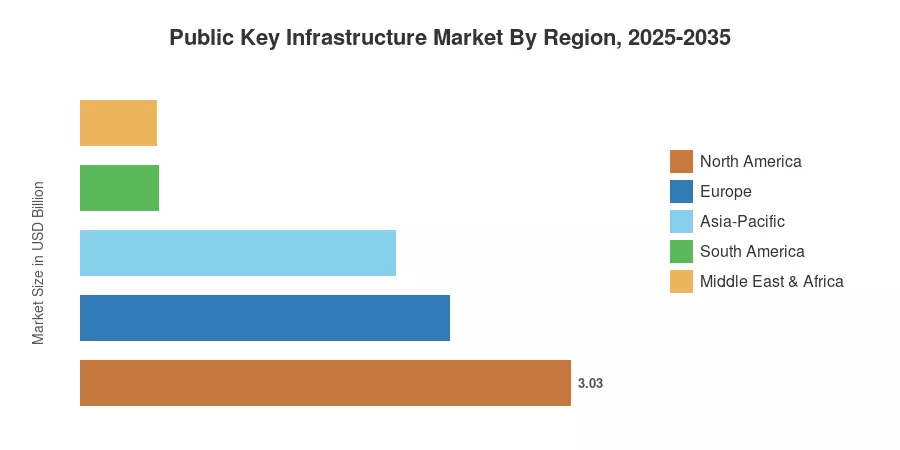
North America commanded a 37.4% share of the Public Key Infrastructure Market in 2025, anchored by federal mandates such as OMB Memorandum M-22-09 and CISA's binding operational directives [5]. Asia-Pacific is the fastest-growing region at a 24.1% CAGR through 2035, fueled by data-localization laws in India, Indonesia, and Vietnam that require locally operated certificate authorities. Europe holds the second-largest regional position with a 28.1% share, driven by eIDAS 2.0 and PSD3 compliance timelines. The convergence of quantum readiness, regulatory mandates, and IoT proliferation positions the Public Key Infrastructure Market for sustained double-digit expansion through the mid-2030s.


Key Report Takeaways

• By Component

  • Solutions captured 55.5% of the Public Key Infrastructure Market in 2025, reflecting deep enterprise investment in hardware security modules and certificate lifecycle platforms.
  • Services are projected to register the fastest growth through 2035, as managed PKI and consulting engagements scale alongside shorter certificate lifespans.

• By Deployment & Enterprise Size

  • On-premises deployment retained the majority share of the Public Key Infrastructure Market in 2025, favored by defense and financial institutions with strict data-sovereignty requirements.
  • Small and medium enterprises are advancing at a 24.1% CAGR as cloud-native PKI-as-a-service platforms lower capital barriers.

• By Application & End User

  • Authentication and access control dominated application-level revenue in 2025, while IoT identity management is set to grow at a 24.9% CAGR through 2035.
  • BFSI led end-user adoption with a 23.6% revenue share in 2025; healthcare and life sciences will post the highest sectoral CAGR to 2035.

• By Region

  • North America held the largest regional position in the Public Key Infrastructure Market in 2025, while Asia-Pacific is projected to be the fastest-growing region.


Public Key Infrastructure Market Size and Forecast (2021–2035)

Market sizing combines bottom-up revenue analysis of certificate authority platforms, hardware security modules, managed services, and professional services across 28 countries with top-down cross-referencing against enterprise IT security spending tracked by, and regional regulatory filings [6]. Historical values (2021–2024) reflect audited vendor revenues and verified procurement data; forecast estimates (2026–2035) apply a calibrated compound growth model incorporating regulatory pipeline analysis, IoT endpoint projections, and post-quantum migration timelines.
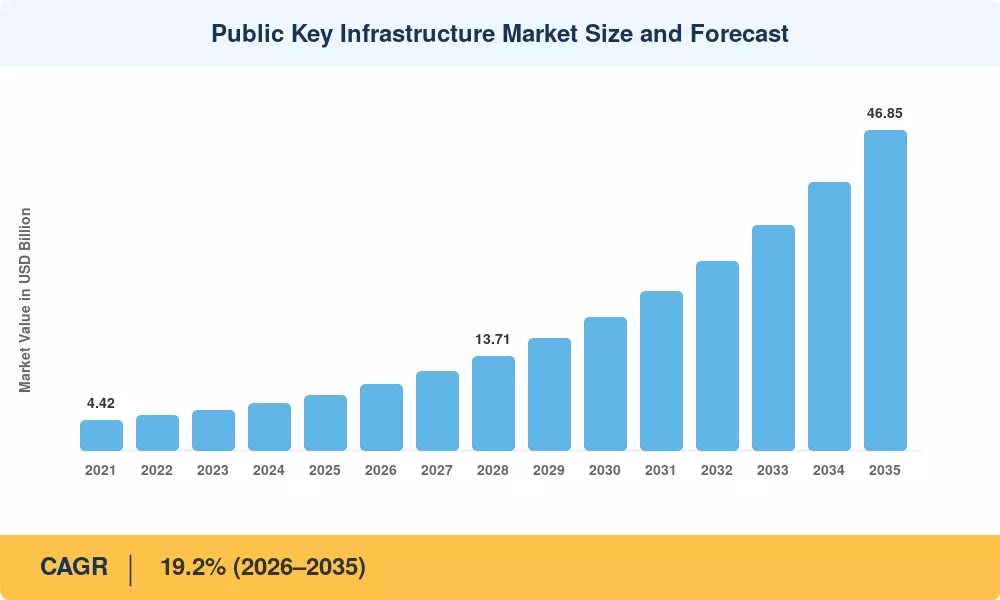
Public Key Infrastructure Market Size and Forecast
Our Impact
Enabled $4.3B Revenue Impact for Fortune 500 and Leading Multinationals
Partnering with 2000+ Global Organizations Each Year
30K+ Citations by Top-Tier Firms in the Industry

Driver Impact Analysis

Driver ~% Impact on CAGR Geographic Relevance Impact Timeline
Post-quantum cryptography migration 3.5–4.0% Global Long-term (≥4 yr)
Zero-trust architecture mandates 3.0–3.5% North America, Europe Short-term (≤2 yr)
IoT device identity proliferation 2.5–3.0% Asia-Pacific, North America Medium-term (2–4 yr)
Shortened certificate lifespans (90-day) 2.0–2.5% Global Short-term (≤2 yr)
Data-residency & sovereignty regulations 1.5–2.0% Asia-Pacific, Middle East Medium-term (2–4 yr)
DevSecOps & CI/CD pipeline signing 1.5–2.0% North America, Europe Medium-term (2–4 yr)
eIDAS 2.0 & PSD3 compliance 1.0–1.5% Europe Short-term (≤2 yr)


Post-Quantum Cryptography Migration

NIST published its first three post-quantum standards in August 2024 — ML-KEM (FIPS 203), ML-DSA (FIPS 204), and SLH-DSA (FIPS 205) — marking the formal starting gun for enterprise cryptographic transitions [1]. The U.S. National Security Agency set a 2035 deadline for all national-security systems to migrate to quantum-resistant algorithms, and the White House's National Security Memorandum NSM-10 requires federal agencies to inventory cryptographic assets by 2027 [14]. This creates a multi-year procurement cycle for hybrid PKI platforms that can issue both classical and post-quantum certificates simultaneously, directly expanding the Public Key Infrastructure Market.

Zero-Trust Architecture Mandates

Executive Order 14028 and OMB M-22-09 required U.S. federal agencies to adopt zero-trust architectures by September 2024, and compliance verification continues to drive certificate-based mutual authentication deployments across civilian and defense networks [5]. estimated that 60% of Global 2000 enterprises had active zero-trust projects underway by mid-2025, each requiring PKI-issued machine identities for micro-segmentation and lateral-movement prevention [7]. The Public Key Infrastructure Market benefits directly because zero-trust eliminates implicit trust boundaries, making certificate-based identity the default enforcement mechanism.

IoT Device Identity Proliferation

The GSMA's IoT SAFE specification and the EU Cyber Resilience Act (effective 2027) both mandate unique device identities backed by asymmetric key pairs, transforming connected-device manufacturing into a PKI consumption channel [4][15]. Ericsson projected 30.2 billion IoT connections by 2030, each requiring provisioned credentials — a scale that legacy manual certificate processes cannot support [4]. Automated enrollment protocols such as EST, SCEP, and CMP are becoming baseline procurement requirements, expanding the addressable scope of the Public Key Infrastructure Market into operational-technology environments.

Shortened Certificate Lifespans

The CA/Browser Forum's decision to reduce maximum TLS certificate validity to 90 days by 2028 (phased from 398 days) fundamentally reshapes certificate lifecycle economics [9]. Enterprises managing 50,000+ certificates will face renewal events roughly four times more frequently, driving demand for automated certificate lifecycle management platforms. Venafi's 2024 Machine Identity Report found that 83% of enterprises experienced at least one certificate-related outage in the prior year, underscoring the operational risk that accelerates investment in the Public Key Infrastructure Market [16].


Restraints Impact Analysis

The restraint percentages represent estimated directional drag on the market's CAGR potential. They capture friction factors that slow adoption velocity without negating the underlying growth trajectory. Estimates draw from enterprise surveys, vendor cost benchmarks, and workforce analyses [6][17].

Restraint ~% Impact on CAGR Geographic Relevance Impact Timeline
Cryptographic skills shortage –1.5 to –2.0% Global Medium-term (2–4 yr)
High cost of FIPS-140-3 HSMs –1.0 to –1.5% North America, Europe Short-term (≤2 yr)
Integration complexity with legacy systems –1.0 to –1.5% Global Long-term (≥4 yr)
Fragmented regulatory standards across regions –0.5 to –1.0% Asia-Pacific, MEA Medium-term (2–4 yr)
Certificate sprawl and shadow IT risks –0.5 to –1.0% Global Short-term (≤2 yr)


Cryptographic Skills Shortage

ISC2's 2024 Cybersecurity Workforce Study reported a global shortage of 4.8 million cybersecurity professionals, with PKI and cryptographic engineering roles among the hardest to fill [17]. The average time-to-hire for a senior PKI architect exceeds 120 days in North America, inflating project timelines and total cost of ownership. This talent gap constrains the pace at which enterprises can plan post-quantum migrations and deploy automated certificate infrastructure, tempering the growth velocity of the Public Key Infrastructure Market even as demand surges.

High Capital Cost of Hardware Security Modules

FIPS 140-3 Level 3 validated HSMs — required for root and issuing CA key protection in regulated industries — carry per-unit costs of USD 20,000–USD 80,000 depending on throughput and redundancy configurations [18]. For mid-market organizations, HSM procurement and ongoing maintenance can represent 30–40% of total PKI deployment budgets, creating a financial barrier that delays on-premises deployments and pushes price-sensitive buyers toward cloud-based alternatives with usage-based pricing.

Legacy System Integration Complexity

Many financial organizations and government agencies operate mainframe and SCADA infrastructures that do not support current certificate enrollment protocols such as ACME or EST [6]. Retrofitting these systems to be able to participate in automated PKI procedures requires investment in middleware and lengthy testing cycles that typically increase deployment schedules from months to years. This friction produces delay in adoption in the Public Key Infrastructure Market, especially in industries with system uptime requirements that limit fast changes in infrastructure.


Public Key Infrastructure Market Opportunities

PKI-as-a-Service for SMEs

Cloud-native PKI platforms from providers such as AWS Private CA and Google Cloud Certificate Authority Service cut the initial capital requirements by 60–70% compared to typical on-premises implementations [8]. Public Key Infrastructure Market is developing at a 24.1% CAGR growth in small and medium organizations that prefer consumption-based pricing models that combine certificate issuance, lifecycle automation, and compliance reporting.


Automotive V2X and Connected-Mobility Identity

The UNECE WP.29 cybersecurity standard and the U.S. Department of Transportation’s V2X implementation plan need digital certificates supported by PKI for vehicle-to-everything communications [11]. With a projected 500 million V2X capable vehicles on global roadways by 2035, each requiring numerous rotating pseudo-nym certificates, this vertical is a high-volume development vector for the Public Key Infrastructure Market that goes well beyond typical enterprise IT.


Emerging Markets: India and Southeast Asia

Both India’s Digital Personal Data Protection Act (2023) and Government Regulation 71/2019 of Indonesia mandate locally rooted certificate authority infrastructure for qualifying digital signatures [10]. These regulatory regimes, paired with national digital-identity initiatives like India’s Aadhaar-linked DigiLocker, create new demand for localized PKI services.


DevSecOps Code-Signing and Software Supply Chain

The aftermath of high-profile supply-chain compromises (SolarWinds, Codecov, 3CX) has driven adoption of mandatory code-signing policies within CI/CD pipelines [13]. Sigstore and The Update Framework (TUF) have established open-source signing standards, and enterprise adoption of these workflows creates recurring certificate consumption that feeds directly into the Public Key Infrastructure Market.

Managed Security Services and Certificate-Lifecycle Monetization

Managed security service providers are bundling certificate lifecycle management with SOC-as-a-service offerings, creating a recurring-revenue model that monetizes PKI operations as a managed service [8]. This business-model shift transforms certificate management from a capital expenditure into an operational subscription, broadening the buyer universe for the Public Key Infrastructure Market to include organizations that previously lacked in-house cryptographic expertise.


Public Key Infrastructure Market Future Outlook

Post-Quantum Cryptographic Transition

The decade ahead will be defined by the largest cryptographic migration in enterprise history. NIST's 2024 standards created the technical foundation, but full post-quantum PKI deployment requires hybrid certificate issuance, dual-algorithm key management, and backward-compatible trust chains [1]. The migration cost for a Fortune 500 enterprise is estimated at USD 10–50 million over five to seven years [14], creating sustained demand for the Public Key Infrastructure Market through 2035.

AI-Driven Certificate Lifecycle Automation

Machine-learning models are beginning to predict certificate expiration risks, detect misconfigurations, and automate enrollment workflows across hybrid environments [3]. By 2030, autonomous certificate orchestration platforms will manage the majority of enterprise machine identities without human intervention, reducing outage risk while enabling organizations to scale their PKI footprint in step with cloud-native and microservices architectures.

Decentralized Identity and Verifiable Credentials

W3C Verifiable Credentials and decentralized identifier (DID) frameworks are extending PKI principles beyond centralized certificate authorities into self-sovereign identity ecosystems [15]. The EU Digital Identity Wallet initiative, targeting 80% citizen adoption by 2030, will rely on PKI trust anchors for credential verification, blending centralized and decentralized models. This evolution broadens the addressable scope of the Public Key Infrastructure Market into consumer identity and credentialing.

Regulatory Convergence and Cross-Border Trust

International alignment efforts, including the OECD's Digital Security Policy Framework and APEC's Cross-Border Privacy Rules, are creating interoperability requirements for PKI trust chains [10][2]. Mutual recognition agreements between national certificate authorities will reduce friction in cross-border digital trade, expanding the serviceable market for vendors offering multi-jurisdiction compliance platforms within the Public Key Infrastructure Market.


Public Key Infrastructure Market Segmentation

By Component

Segment Key Metric Primary Demand Driver
Hardware Security Modules 22.3% share (2025) FIPS 140-3 root-of-trust requirements
Certificate Lifecycle-Management Platforms 33.2% share (2025) 90-day certificate validity automation
Services (Managed & Professional) 24.6% CAGR (2026–2035) Outsourced PKI operations for SMEs


Solutions — encompassing HSMs and certificate lifecycle-management platforms — accounted for 55.5% of the Public Key Infrastructure Market in 2025. Certificate lifecycle-management platforms are the fastest-growing solutions sub-segment as enterprises automate renewal workflows to handle compressed validity windows. HSM demand remains strong in regulated sectors where hardware key protection is non-negotiable.

Services are advancing at a 24.6% CAGR as managed PKI offerings mature. Vendors like DigiCert and Entrust now provide fully outsourced CA operations including key ceremony management, compliance auditing, and 24/7 monitoring — services that reduce the internal staffing burden and accelerate time-to-deployment for the Public Key Infrastructure Market.

By Deployment

Segment Key Metric Primary Demand Driver
On-Premises 57.3% share (2025) Defense, BFSI data-sovereignty mandates
Cloud 23.2% CAGR (2026–2035) PKI-as-a-service adoption by SMEs
Hybrid USD 1.14 Billion (2025) Multi-cloud enterprise architectures


On-premises deployments dominated the Public Key Infrastructure Market in 2025, driven by defense agencies and financial institutions that require full sovereignty over root CA key material. Cloud PKI is narrowing the gap rapidly as platforms like AWS Private CA, Azure Key Vault, and Google Cloud offer consumption-based pricing with FIPS-validated backend HSMs. Hybrid models are emerging as the pragmatic middle path for enterprises operating across multiple cloud providers.

By Enterprise Size

Segment Key Metric Primary Demand Driver
Large Enterprises 63.5% share (2025) Complex multi-domain certificate estates
Small and Medium Enterprises 24.1% CAGR (2026–2035) Cloud-native PKI-as-a-service platforms


Large enterprises dominate the Public Key Infrastructure Market because they manage hundreds of thousands of certificates across global operations, requiring sophisticated orchestration and compliance capabilities. SMEs represent the fastest-growing segment as subscription-based PKI services eliminate the need for in-house cryptographic expertise and capital-intensive HSM procurement.

By Application

Segment Key Metric Primary Demand Driver
Authentication & Access Control 34.8% share (2025) Zero-trust mutual TLS enforcement
Email Security USD 1.22 Billion (2025) S/MIME regulatory mandates
IoT Identity Management 24.9% CAGR (2026–2035) Connected-device credential provisioning
Code Signing 18.5% CAGR (2026–2035) Software supply-chain security requirements


Authentication and access control remains the anchor application of the Public Key Infrastructure Market, as zero-trust frameworks replace password-based systems with certificate-backed mutual authentication. IoT identity management is the highest-growth application as every connected sensor, gateway, and edge device requires a unique cryptographic identity — a scale that manual processes cannot sustain.

By End-User Industry

Segment Key Metric Primary Demand Driver
BFSI 23.6% share (2025) PCI DSS 4.0 & open-banking mandates
Government & Defense 21.4% share (2025) Federal zero-trust directives
Healthcare & Life Sciences 23.5% CAGR (2026–2035) HIPAA digital identity & FDA UDI
IT & Telecom USD 1.17 Billion (2025) 5G network-slicing identity
Manufacturing 19.8% CAGR (2026–2035) OT/ICS certificate provisioning


BFSI institutions are the largest end-user group in the Public Key Infrastructure Market, driven by PCI DSS 4.0 requirements for authenticated internal network communications and open-banking APIs that demand mTLS for third-party data sharing. Healthcare is the fastest-growing end-user vertical as electronic health record interoperability standards, FDA Unique Device Identification rules, and telehealth expansion all require PKI-backed identity frameworks.


Regional Market Share Analysis

Region Key Metric Primary Investment Themes
North America 37.4% share (2025) Zero-trust federal mandates, PQC migration
Europe 28.1% share (2025) eIDAS 2.0, PSD3 payment security
Asia-Pacific 24.1% CAGR (2026–2035) Data residency, national digital ID
South America USD 0.48 Billion (2025) Banking digitization, open finance
Middle East & Africa USD 0.47 Billion (2025) Smart-city programs, fintech licensing
Total USD 8.10 Billion (2025)

The Public Key Infrastructure Market exhibits distinct regional growth patterns shaped by regulatory timelines, digital-transformation maturity, and data-sovereignty legislation. North America leads in absolute spending, while Asia-Pacific drives the highest growth rates as national identity programs and localization mandates expand.


North America

Country Key Metric Key Driver
US 78.5% of regional share OMB M-22-09 & DoD CMMC [5]
Canada 13.8% of regional share CCCS zero-trust guidance [19]
Mexico 7.7% of regional share Fintech law & open banking [20]


The United States generates the vast majority of North American Public Key Infrastructure Market revenue, driven by federal procurement under binding operational directives from CISA and the DoD's Cybersecurity Maturity Model Certification program [5]. Canada's Centre for Cyber Security published updated guidance in 2024 recommending PKI-backed authentication for all critical infrastructure operators, while Mexico's fintech licensing framework requires qualified digital signatures for regulatory filings [19][20].

Europe

Country Key Metric Key Driver
Germany 22.5% of regional share BSI IT-Grundschutz & automotive PKI [2]
UK 19.8% CAGR (2026–2035) Post-Brexit digital identity framework [21]
France USD 0.38 Billion (2025) ANSSI SecNumCloud certification [22]
Italy 12.1% of regional share SPID digital identity expansion [2]
Spain 10.3% of regional share Electronic signature mandate for public services [2]
Nordic Countries 8.9% of regional share BankID cross-border interoperability [2]
Russia 4.2% of regional share Domestic CA requirements [10]
Rest of Europe 6.8% of regional share eIDAS 2.0 phased adoption [2]


Europe's Public Key Infrastructure Market is shaped by eIDAS 2.0 implementation timelines that require EU member states to recognize European Digital Identity Wallets backed by qualified trust service providers by 2027 [2]. Germany's automotive sector drives V2X certificate demand, while the UK's post-Brexit digital identity trust framework creates a parallel regulatory ecosystem requiring PKI interoperability with EU standards [21].

Asia-Pacific

Country Key Metric Key Driver
China 31.2% of regional share MLPS 2.0 & domestic cryptography law [10]
India 25.3% CAGR (2026–2035) DPDP Act & Aadhaar-linked PKI [10]
Japan USD 0.29 Billion (2025) My Number card digital identity [23]
South Korea 14.6% of regional share KISA PKI standards & fintech [23]
ASEAN 22.8% CAGR (2026–2035) Data-localization mandates [10]
Rest of Asia-Pacific 8.4% of regional share Emerging digital-government programs [10]


Asia-Pacific is the fastest-growing region in the Public Key Infrastructure Market, driven by China's Multi-Level Protection Scheme 2.0 requiring domestic certificate authorities for critical information infrastructure and India's digital public infrastructure stack that embeds PKI across payments, identity, and data exchange layers [10]. ASEAN nations including Vietnam, Thailand, and the Philippines have enacted or proposed data-residency requirements mandating in-country key storage, creating demand for locally operated CA infrastructure.

South America

Country Key Metric Key Driver
Brazil 62.5% of regional share ICP-Brasil PKI framework & Pix digital payments [20]
Argentina 19.8% of regional share Electronic signature law modernization [20]
Rest of South America 17.7% of regional share Open banking regulatory rollout [20]


Brazil's ICP-Brasil infrastructure represents one of the most mature national PKI ecosystems among emerging markets, with mandatory digital certificate usage for tax filings, electronic health records, and Pix instant-payment authentication [20]. Argentina's 2024 electronic signature law update extended qualified certificate requirements to private-sector contracts, creating incremental demand across the South American Public Key Infrastructure Market.

Middle East & Africa

Country Key Metric Key Driver
Saudi Arabia 28.4% of regional share NCSA cybersecurity framework & NEOM [24]
UAE 25.1% of regional share Smart Dubai & DDA digital-trust regulations [24]
South Africa 18.7% of regional share POPIA compliance & financial-sector PKI [24]
Egypt 15.2% of regional share National digital identity program [24]
Rest of MEA 12.6% of regional share Fintech licensing & e-government [24]


Saudi Arabia's National Cybersecurity Authority mandates PKI-based authentication for critical national infrastructure operators under Vision 2030, while the UAE's Digital Dubai Authority requires qualified electronic signatures for all government-to-business transactions [24]. These smart-city and digital-government programs create structured procurement pipelines that support steady growth of the Public Key Infrastructure Market across the region.


Public Key Infrastructure Market By Region, 2025-2035

Competitive Benchmarking

The Public Key Infrastructure Market exhibits moderate concentration, with the top five vendors collectively holding an estimated 40–48% revenue share. The Herfindahl-Hirschman Index sits in the 800–1,200 range, indicating a competitive but not fragmented structure. Vendor differentiation centers on certificate automation depth, post-quantum readiness, cloud-native platform capabilities, and managed-service breadth. Consolidation activity remains active — CyberArk's 2024 acquisition of Venafi for USD 1.54 billion signaled the strategic value of machine-identity management platforms [25].

Company Est. Revenue Share Range Key Offerings for Public Key Infrastructure Market Strategic Positioning
DigiCert Inc. ~8–11% DigiCert ONE platform, PQC-ready certificates, IoT device trust Full-stack PKI platform leader with post-quantum early-mover advantage
Entrust Corporation ~7–10% Certificate Hub, HSMs, identity-as-a-service Integrated identity and certificate management for regulated industries
Keyfactor ~5–8% EJBCA Enterprise, Signum, Command platform Open-source roots with enterprise-grade certificate automation
GlobalSign (GMO) ~4–7% Atlas platform, IoT identity, AATL-compliant signing High-volume automated issuance for IoT and DevOps
Sectigo Limited ~4–6% Certificate Manager, SCM Enterprise Cost-competitive automated lifecycle management
Venafi (CyberArk) ~4–6% TLS Protect, Machine Identity Management Machine-identity governance and policy enforcement
Microsoft Corporation ~3–5% Azure Key Vault, AD CS, Entra Verified ID Embedded PKI within enterprise cloud and identity stack
Amazon Web Services ~3–5% AWS Private CA, ACM Cloud-native PKI with pay-per-certificate pricing
Thales Group ~3–5% Luna HSMs, CipherTrust Manager Hardware security module and key-management leadership
AppViewX ~2–4% CERT+ platform, ADC automation Certificate lifecycle visibility and multi-CA orchestration


Recent News & Developments

  • DigiCert (October 2024): Launched PQC-ready hybrid certificates supporting ML-DSA alongside RSA and ECDSA, enabling enterprises to begin dual-algorithm pilot deployments ahead of NIST's migration timelines [1].
  • CyberArk (October 1, 2024 ): Completed the USD 1.54 billion acquisition of Venafi, creating an integrated machine-identity security platform spanning certificate lifecycle management and privileged access governance [25].


  • NIST (August 2024): Published FIPS 203, 204, and 205 as the first finalized post-quantum cryptographic standards, triggering enterprise cryptographic-inventory assessments and hybrid PKI planning cycles [1].
  • Keyfactor (January 2025): Released EJBCA 9.0 with native post-quantum certificate template support and Kubernetes-native deployment, targeting DevSecOps pipeline integration [13].
  • AWS (September 2024): Expanded AWS Private CA with short-lived certificate issuance support, enabling sub-24-hour certificate lifetimes for containerized microservices workloads [8].
  • European Commission (November 2024): Published implementing acts for eIDAS 2.0 specifying technical requirements for EU Digital Identity Wallet trust services, establishing PKI as the foundational trust layer [2].


Public Key Infrastructure Market Report Scope

Parameter Details
Market Scope Global Public Key Infrastructure Market covering hardware security modules, certificate lifecycle-management platforms, and services
Study Period 2021–2035
CAGR 19.2% (2026–2035)
Base Year Market Size USD 8.10 Billion (2025)
Forecast Year Market Size USD 46.85 Billion (2035)
Fastest Growing Segment Services (by component); Cloud (by deployment); IoT Identity Management (by application)
Companies Profiled DigiCert, Entrust, Keyfactor, GlobalSign, Sectigo, Venafi (CyberArk), Microsoft, AWS, Thales, AppViewX
Valuation Currency USD Billion


FAQs

What is the typical total cost of ownership for an enterprise PKI deployment?
A mid-size enterprise can expect USD 500,000–USD 2 million over five years, covering HSMs, software licenses, staffing, and compliance audits [18]. Cloud PKI-as-a-service reduces this by 50–60%.
How do certificate outages impact business operations?
A single expired certificate can cause hours of application downtime, costing large enterprises USD 300,000–USD 500,000 per incident [16]. Automated lifecycle platforms in the Public Key Infrastructure Market directly mitigate this risk.
What distinguishes a public certificate authority from a private one?
Public issue browser-trusted certificates for external-facing services, while private handle internal authentication without public audit requirements [9]. Most enterprises operate both.
How does the Public Key Infrastructure Market support DevSecOps pipelines?
PKI platforms integrate with CI/CD tools to automate code-signing and mTLS certificate provisioning, embedding identity verification directly into build-and-deploy workflows [13].
When will quantum computers pose a real threat to current PKI algorithms?
Leading estimates place cryptographically relevant quantum computers at 2030–2035, which is why NIST mandates migration planning now [1]. The Public Key Infrastructure Market is already shipping hybrid certificates.
What vendor lock-in risks exist in managed PKI services?
Proprietary certificate formats and non-standard enrollment protocols create switching costs. Buyers should prioritize vendors supporting ACME, EST, and CMP interoperability standards [6].
Are certificate transparency logs mandatory for all PKI deployments?
CT logs are mandatory only for publicly trusted TLS certificates under CA/Browser Forum rules [9]. Private CA certificates used for internal authentication are exempt from CT logging requirements.    
Author
Author
Author Profile
Aarti Dhapte LinkedIn
AVP - Research
A consulting professional focused on helping businesses navigate complex markets through structured research and strategic insights. I partner with clients to solve high-impact business problems across market entry strategy, competitive intelligence, and opportunity assessment. Over the course of my experience, I have led and contributed to 100+ market research and consulting engagements, delivering insights across multiple industries and geographies, and supporting strategic decisions linked to $500M+ market opportunities. My core expertise lies in building robust market sizing, forecasting, and commercial models (top-down and bottom-up), alongside deep-dive competitive and industry analysis. I have played a key role in shaping go-to-market strategies, investment cases, and growth roadmaps, enabling clients to make confident, data-backed decisions in dynamic markets.

Research Approach


Secondary Research

The secondary research process involved comprehensive analysis of cybersecurity standards databases, regulatory frameworks, technical protocol documentation, and authoritative IT security organizations. Key sources included the National Institute of Standards and Technology (NIST) Cybersecurity Framework and Special Publications (SP 800-57, SP 800-52), European Union Agency for Cybersecurity (ENISA) Threat Reports and PKI Guidelines, Internet Engineering Task Force (IETF) RFCs (Request for Comments) for X.509 and PKIX standards, European Telecommunications Standards Institute (ETSI) standards for electronic signatures and trust services, Cybersecurity and Infrastructure Security Agency (CISA) Zero Trust Architecture guidelines, National Security Agency (NSA) Commercial Solutions for Classified (CSfC) program specifications, ISO/IEC 27001 and 27002 Information Security Management standards, CA/Browser Forum Baseline Requirements, Payment Card Industry Security Standards Council (PCI SSC) Data Security Standard (DSS), Cloud Security Alliance (CSA) Security Guidance, U.S. Department of Homeland Security (DHS) Critical Infrastructure Cybersecurity reports, UK National Cyber Security Centre (NCSC) guidelines on certificate authorities, and national digital identity frameworks from key markets (eIDAS in EU, Aadhaar PKI in India, GovPKI in Japan).

These sources were employed to compile statistics on the adoption of encryption protocols, regulatory compliance mandates, trends in certificate lifecycle management, quantum-safe cryptography transition timelines, and market landscape analyses for hardware security modules (HSMs), certificate management platforms, digital signature solutions, and identity verification technologies.


Primary Research

In order to acquire qualitative and quantitative insights regarding cryptographic agility challenges, post-quantum cryptography migration strategies, and PKI deployment models, supply-side and demand-side stakeholders were interviewed during the primary research process. The supply-side sources that were consulted included CEOs, CTOs, Chief Information Security Officers (CISOs), VPs of Product Management, chief cryptographers, and regulatory compliance leaders from PKI solution providers, HSM manufacturers, certificate authorities (CAs), and trust service providers. Demand-side sources included Chief Information Officers (CIOs), CISOs, IT Infrastructure Directors, Identity and Access Management (IAM) managers, compliance officers, and procurement leads from banking & financial services, healthcare systems, government agencies, telecommunications operators, and large enterprises that manage IoT device ecosystems. Primary research has confirmed the timelines for quantum-resistant algorithm transitions, validated market segmentation between cloud-based and on-premise PKI deployments, and collected insights on certificate lifecycle automation, root key ceremony protocols, and compliance with evolving data sovereignty regulations.

Primary Respondent Breakdown:

• By Designation: C-level Primaries (32%), Director Level (33%), Others (35%)

• By Region: North America (38%), Europe (25%), Asia-Pacific (27%), Rest of World (10%)


Market Size Estimation

The revenue mapping and certificate volume analysis across digital identity ecosystems were employed to derive the global market valuation. The methodology comprised the following:

• The identification of over 40 key PKI vendors and certificate authorities in North America, Europe, Asia-Pacific, and Latin America

• Solution mapping for hardware security modules (HSMs), smart cards/USB tokens, certificate administration software, managed PKI services, and digital signature applications

• Examination of annual revenues that are reported and modeled for PKI portfolios, such as CA subscription revenues, HSM appliance sales, and professional services

• In 2024, the coverage of providers will account for 75-80% of the global market share.

• Segment-specific valuations across cloud PKI, on-premise infrastructure, and hybrid deployment models are derived through extrapolation using bottom-up (certificate issuance volumes × ASP by deployment type, enterprise adoption rates by vertical) and top-down (vendor revenue validation against enterprise IT security spend) approaches.

Download Free Sample

Kindly complete the form below to receive a free sample of this Report

Download PDF ×

We do not share your information with anyone. However, we may send you emails based on your report interest from time to time. You may contact us at any time to opt-out.