Download Free Sample
Kindly complete the form below to receive a free sample of this Report
Pulmonary Drug Delivery System Market Research Report: Size, Share, Trend Analysis By Device Type (Inhalers, Nebulizers, Dry Powder Inhalers, Metered-Dose Inhalers), By Distribution Channel (Online Pharmacies, Retail Pharmacies, Hospital Pharmacies), By Applications (Asthma, Chronic Obstructive Pulmonary Disease, Cystic Fibrosis, Pulmonary Arterial Hypertension), By Formulation (Solutions, Suspensions, Dry Powder) and By Regional (North America, Europe, South America, Asia-Pacific, Middle East and Africa) - Growth Outlook & Industry Forecast 2025 To 2035
As per Market Research Future analysis, the Pulmonary Drug Delivery System Market was estimated at 34.63 USD Billion in 2024. The pulmonary drug delivery industry is projected to grow from 36.18 USD Billion in 2025 to 56.14 USD Billion by 2035, exhibiting a compound annual growth rate (CAGR) of 4.49% during the forecast period 2025 - 2035
The Pulmonary Drug Delivery System Market is poised for substantial growth driven by technological advancements and increasing patient-centric approaches.
| 2024 Market Size | 34.63 (USD Billion) |
| 2035 Market Size | 56.14 (USD Billion) |
| CAGR (2025 - 2035) | 4.49% |
GlaxoSmithKline (GB), AstraZeneca (GB), Boehringer Ingelheim (DE), Novartis (CH), Teva Pharmaceutical Industries (IL), Mylan (US), Roche (CH), Pfizer(US), Merck & Co. (US)
Our Impact
Enabled $4.3B Revenue Impact for Fortune 500 and Leading Multinationals
Partnering with 2000+ Global Organizations Each Year
30K+ Citations by Top-Tier Firms in the Industry
The Pulmonary Drug Delivery System Market is currently experiencing a notable evolution, driven by advancements in technology and an increasing focus on patient-centric solutions. This market encompasses a variety of devices and formulations designed to deliver therapeutic agents directly to the lungs, thereby enhancing bioavailability and minimizing systemic side effects. The growing prevalence of respiratory diseases, coupled with a rising demand for non-invasive treatment options, appears to be propelling the development of innovative inhalation devices and formulations. Furthermore, the integration of smart technologies into these systems is likely to improve patient adherence and monitoring, thereby fostering a more effective treatment landscape. In addition, regulatory bodies are increasingly recognizing the potential of pulmonary delivery systems, which may lead to a more favorable environment for product approvals. The market landscape is characterized by a diverse range of stakeholders, including pharmaceutical companies, device manufacturers, and research institutions, all of whom are contributing to the ongoing advancements in this field. As the Pulmonary Drug Delivery System Market continues to expand, it seems poised to play a crucial role in the management of chronic respiratory conditions, offering new hope for patients worldwide.
Recent innovations in inhalation devices and drug formulations are transforming the Pulmonary Drug Delivery System Market. Enhanced aerosolization techniques and the development of smart inhalers are likely to improve drug delivery efficiency and patient compliance.
There is a growing emphasis on designing pulmonary drug delivery systems that prioritize user experience. This trend suggests that manufacturers are increasingly focusing on ease of use, portability, and personalized treatment regimens to meet patient needs.
The evolving regulatory landscape appears to be favoring the Pulmonary Drug Delivery System Market. Regulatory agencies are becoming more supportive of novel delivery systems, which may facilitate faster approvals and encourage innovation in this sector.
Supportive regulatory frameworks are playing a crucial role in the advancement of the Pulmonary Drug Delivery System Market. Regulatory bodies are increasingly recognizing the importance of innovative drug delivery systems and are streamlining approval processes to facilitate market entry. This is particularly evident in the approval of new inhalation therapies and devices that meet stringent safety and efficacy standards. The U.S. Food and Drug Administration has implemented initiatives to expedite the review of novel pulmonary drug delivery systems, which encourages pharmaceutical companies to invest in research and development. As a result, the market is witnessing a surge in new product launches, which is expected to enhance competition and drive growth within the Pulmonary Drug Delivery System Market.
The shift towards personalized medicine is reshaping the Pulmonary Drug Delivery System Market. As healthcare moves away from a one-size-fits-all approach, there is a growing emphasis on tailoring treatments to individual patient needs. This trend is particularly relevant in the context of respiratory diseases, where genetic and environmental factors can significantly influence treatment responses. The development of personalized inhalation therapies, which consider patient-specific characteristics, is gaining traction. Market analysts suggest that this focus on customization could lead to more effective management of respiratory conditions, thereby driving demand for advanced pulmonary drug delivery systems. The potential for personalized medicine to enhance therapeutic outcomes positions the Pulmonary Drug Delivery System Market for robust growth in the foreseeable future.
The increasing incidence of respiratory diseases such as asthma and chronic obstructive pulmonary disease (COPD) is a primary driver for the Pulmonary Drug Delivery System Market. According to recent data, respiratory diseases affect millions of individuals worldwide, leading to a heightened demand for effective treatment options. The World Health Organization has reported that COPD is projected to become the third leading cause of death by 2030. This alarming trend necessitates innovative drug delivery systems that can provide targeted therapy directly to the lungs, thereby improving patient outcomes. As healthcare providers seek to enhance the management of these conditions, the Pulmonary Drug Delivery System Market is likely to experience substantial growth, driven by the need for more efficient and effective therapeutic solutions.
Technological advancements in drug delivery systems are significantly influencing the Pulmonary Drug Delivery System Market. Innovations such as nebulizers, metered-dose inhalers, and dry powder inhalers have revolutionized the way medications are administered to patients with respiratory conditions. These technologies enhance the bioavailability of drugs, ensuring that a higher percentage reaches the target site in the lungs. Furthermore, the integration of smart inhalers equipped with digital health technologies is emerging as a trend, allowing for better patient adherence and monitoring. The market for smart inhalers is expected to grow substantially, with projections indicating a compound annual growth rate of over 20% in the coming years. Such advancements not only improve treatment efficacy but also contribute to the overall expansion of the Pulmonary Drug Delivery System Market.
The rising demand for home healthcare solutions is significantly impacting the Pulmonary Drug Delivery System Market. As patients increasingly prefer to manage their health conditions at home, there is a corresponding need for user-friendly and effective drug delivery systems. Devices such as portable nebulizers and inhalers are becoming essential tools for patients with chronic respiratory diseases, allowing them to administer treatments conveniently. Market Research Future indicates that the home healthcare market is projected to grow at a compound annual growth rate of over 10% in the coming years. This trend is likely to drive innovation in pulmonary drug delivery systems, as manufacturers strive to develop products that cater to the needs of home-based patients. Consequently, the Pulmonary Drug Delivery System Market is poised for growth as it adapts to this evolving landscape.
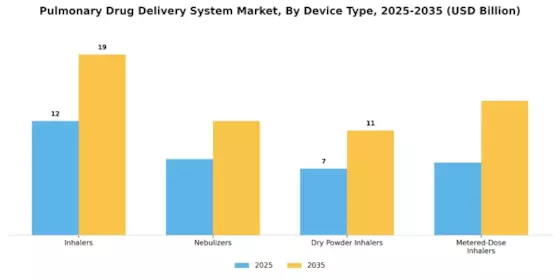
The Pulmonary Drug Delivery System Market is significantly influenced by various device types, among which inhalers hold the largest market share. Inhalers, which include metered-dose inhalers (MDIs) and dry powder inhalers (DPIs), are preferred due to their ease of use and effectiveness in delivering medication directly to the lungs. In contrast, nebulizers are gaining traction for their ability to deliver medication in mist form, catering especially to patients with severe respiratory conditions. The growth trends in this segment are indicative of an increasing preference for non-invasive drug delivery systems and advancements in inhaler technology creating more efficient devices. Additionally, the rising prevalence of respiratory diseases worldwide is boosting demand for both inhalers and nebulizers, with nebulizers emerging as the fastest-growing option due to their application in clinical settings and home healthcare environments.
Inhalers (Dominant) vs. Nebulizers (Emerging)
Inhalers are known for their dominant position in the Pulmonary Drug Delivery System Market, offering a variety of options such as MDIs and DPIs. These devices are renowned for their portability and convenience, making them the choice for many patients managing chronic respiratory conditions like asthma and COPD. On the other hand, nebulizers are emerging as essential tools, particularly in treating severe cases, as they can administer higher doses of medication and are easier to use for patients who have difficulty coordinating inhalation techniques. As new technological developments enhance the efficiency and user-friendliness of nebulizers, they are rapidly becoming popular in both hospital and home settings.
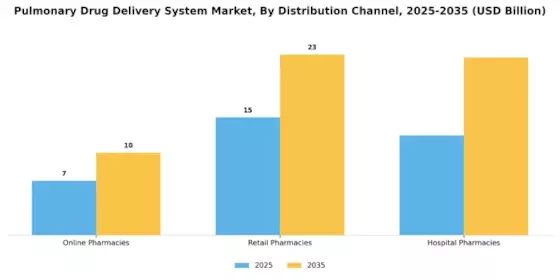
The Pulmonary Drug Delivery System Market shows a significant market share distribution among its key channels. Retail pharmacies dominate this segment, capitalizing on their established customer base and accessibility. They play a crucial role in providing immediate access to pulmonary drug delivery products. In contrast, online pharmacies are witnessing rapid growth, driven by the increasing consumer preference for convenience and the expanding digital healthcare landscape. This shift is reshaping the competitive dynamics within the market.
Retail Pharmacies (Dominant) vs. Online Pharmacies (Emerging)
Retail pharmacies are positioned as the dominant force in the Pulmonary Drug Delivery System Market due to their extensive reach and long-standing presence. They offer a trusted environment for patients to access their medications and provide personalized consultations. Meanwhile, online pharmacies are emerging as a formidable competitor, leveraging technology to enhance customer experience and streamline the purchasing process. This segment is particularly favored by tech-savvy patients seeking convenience, resulting in a faster adoption rate. The rivalry between these segments fosters innovation and ensures that both channels continue to evolve, meeting the diverse needs of patients.
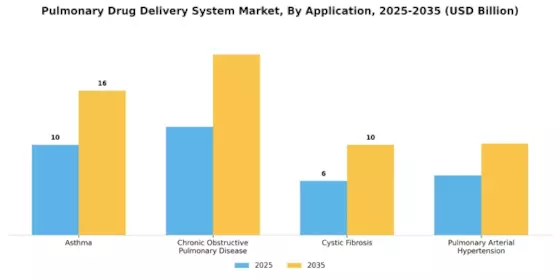
The Pulmonary Drug Delivery System Market exhibits a significant split among its application segments. Asthma remains the largest segment, attributed to the high prevalence of the disease and increased awareness of inhaler therapies. Chronic Obstructive Pulmonary Disease (COPD), while smaller, is rapidly gaining traction within the market due to a rising number of diagnosed patients and the emphasis on effective management strategies. Cystic Fibrosis and Pulmonary Arterial Hypertension present niche segments but are critical in delivering specialized therapies.
Asthma (Dominant) vs. Chronic Obstructive Pulmonary Disease (Emerging)
Asthma stands out as the dominant application segment in the Pulmonary Drug Delivery System Market, characterized by a wide range of inhalation therapies and devices tailored to manage the condition effectively. The established awareness of asthma management has paved the way for innovative drug formulations. Meanwhile, Chronic Obstructive Pulmonary Disease is emerging as a critical focus area, particularly with advancements in nebulization and enhanced patient adherence metrics. This segment is driven by a growing demand for personalized treatment approaches and a heightened recognition of the disease's impact on quality of life.
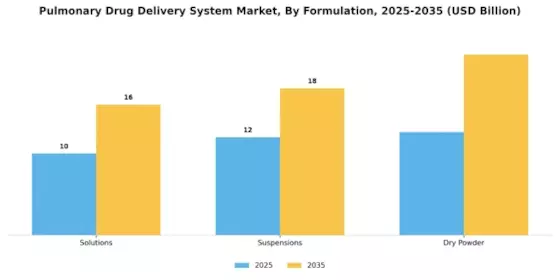
The Pulmonary Drug Delivery System Market is characterized by a diverse range of formulation types, with solutions holding the largest market share. Solutions offer effective delivery of medications, enhancing patient compliance and comfort. This segment is widely adopted due to its rapid action and ease of use, contributing significantly to the overall growth of the market. In contrast, dry powder formulations are emerging as the fastest-growing segment, appealing to manufacturers and patients seeking improved stability and shelf life.
Solutions (Dominant) vs. Dry Powder (Emerging)
Solutions dominate the formulation segment of the Pulmonary Drug Delivery System Market due to their efficiency in delivering therapeutic agents directly to the lungs. Their liquid form allows for immediate absorption, making them preferable for patients needing fast relief, particularly for conditions like asthma and COPD. On the other hand, dry powder formulations are gaining traction owing to their advantages in stability and inhaler compatibility. As the demand for portable and easy-to-use delivery systems grows, dry powders are seen as an emerging alternative to traditional solutions, promising to reshape the market dynamics.
Get more detailed insights about Pulmonary Drug Delivery System Market Request Free Sample
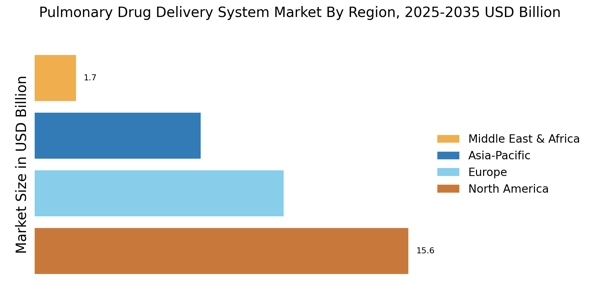
The Pulmonary Drug Delivery System Market is witnessing substantial growth across various regional segments. In 2024, North America led the market with a valuation of 17.56 USD Billion, projected to reach 28.02 USD Billion by 2035, highlighting its dominant position driven by advanced healthcare infrastructure and rising prevalence of respiratory diseases. Europe follows with a significant 9.01 USD Billion in 2024 and is expected to grow to 13.96 USD Billion by 2035, benefiting from increasing investments in research and development.
The Asia-Pacific region, valued at 5.92 USD Billion in 2024, is anticipated to expand to 9.2 USD Billion by 2035, as its burgeoning population and improving healthcare access contribute to market growth.
In contrast, South America and Middle East Africa represent the smaller segments, valued at 1.83 USD Billion and 0.31 USD Billion in 2024, respectively, but are forecasted to grow due to increasing healthcare initiatives and awareness about pulmonary diseases. Collectively, these regions depict the Pulmonary Drug Delivery System Market dynamics, showcasing varying growth opportunities aligned with regional demands and health trends.
The Pulmonary Drug Delivery System Market is characterized by a highly competitive landscape that includes a diverse range of players, from established pharmaceutical companies to innovative startups. Factors such as the increasing prevalence of respiratory diseases, advancements in inhalation technologies, and rising consumer awareness regarding effective treatment options are driving market growth. Key trends influencing market dynamics include the development of combination therapies, personalized medicine approaches, and the push toward more patient-friendly delivery mechanisms. Companies are investing heavily in research and development to enhance the efficiency and efficacy of pulmonary drug delivery systems, with a focus on improving patient compliance and overall treatment outcomes. The competitive insights reveal a landscape where both product differentiation and strategic partnerships play crucial roles in capturing market share and addressing evolving healthcare needs. Roche maintains a robust position in the Pulmonary Drug Delivery System Market, distinguished by innovative product offerings that align with its commitment to improving patient outcomes. Known for its extensive research capabilities and development of novel therapies, Roche benefits from a strong pipeline of pulmonary drug delivery solutions that cater to a variety of respiratory conditions. The company is recognized for its investment in cutting-edge inhalation technologies that enhance drug absorption and delivery precision. Roche's emphasis on collaboration with healthcare professionals and stakeholders ensures that it remains attuned to patient needs and market demands. Furthermore, Roche's strong brand reputation and existing customer base empower it to leverage its strengths in penetrating new markets while also solidifying its presence in established ones. Mylan, a significant player in the Pulmonary Drug Delivery System Market, is renowned for its focus on accessibility and affordability in healthcare. With a strong portfolio that includes generic and specialty inhaled products, Mylan has effectively positioned itself as a critical player in addressing the growing demand for cost-effective pulmonary therapies. The company's commitment to quality and compliance enables it to meet stringent regulatory standards, making its products a trusted choice among healthcare providers and patients alike. Mylan's strategic partnerships and collaborations with various stakeholders play an essential role in expanding its market presence and enhancing product availability. Additionally, Mylan is actively engaged in the development of novel formulations and delivery mechanisms that cater to the evolving needs of patients with respiratory conditions, ensuring that it remains competitive in the fast-paced pharmaceutical landscape.




Recent developments in the Pulmonary Drug Delivery System Market reflect a growing emphasis on innovation and strategic consolidation. Roche has made strides in enhancing its inhaled therapies portfolio, while Mylan and Teva Pharmaceutical are ramping up efforts towards advanced delivery mechanisms, aiming to improve patient outcomes. Johnson and Johnson, alongside Merck Co, are focusing on personalized medicine strategies, expanding their product lines to include more targeted pulmonary applications.
Pfizer and GlaxoSmithKline are increasing their RD investments into combination therapies for respiratory diseases, signaling a shift towards more comprehensive treatment options. Boehringer Ingelheim and AbbVie are also notable players, actively exploring collaborations to develop novel inhalation devices. Recent acquisition activities include AstraZeneca's move to strengthen its inhalable drug formulations through strategic partnerships. Hollaender and AptarGroup are aligning efforts on developing adaptable delivery systems. The valuation of companies in the market is witnessing growth as enhanced technologies and shifting consumer demands for efficient medication delivery systems propel market dynamics, indicating a robust future for the pulmonary drug delivery sector.
The Pulmonary Drug Delivery System Market is projected to grow at a 4.49% CAGR from 2025 to 2035, driven by technological advancements, increasing respiratory diseases, and rising demand for patient-friendly delivery methods.
New opportunities lie in:
By 2035, the market is expected to achieve substantial growth, reflecting evolving healthcare needs.
| MARKET SIZE 2024 | 34.63(USD Billion) |
| MARKET SIZE 2025 | 36.18(USD Billion) |
| MARKET SIZE 2035 | 56.14(USD Billion) |
| COMPOUND ANNUAL GROWTH RATE (CAGR) | 4.49% (2025 - 2035) |
| REPORT COVERAGE | Revenue Forecast, Competitive Landscape, Growth Factors, and Trends |
| BASE YEAR | 2024 |
| Market Forecast Period | 2025 - 2035 |
| Historical Data | 2019 - 2024 |
| Market Forecast Units | USD Billion |
| Key Companies Profiled | GlaxoSmithKline (GB), AstraZeneca (GB), Boehringer Ingelheim (DE), Novartis (CH), Teva Pharmaceutical Industries (IL), Mylan (US), Roche (CH), Pfizer (US), Merck & Co. (US) |
| Segments Covered | Device Type, Distribution Channel, Applications, Formulation, Regional |
| Key Market Opportunities | Advancements in nanotechnology enhance targeted therapies in the Pulmonary Drug Delivery System Market. |
| Key Market Dynamics | Technological advancements and regulatory changes drive innovation in the pulmonary drug delivery system market. |
| Countries Covered | North America, Europe, APAC, South America, MEA |
The Pulmonary Drug Delivery System Market is projected to reach a valuation of 56.14 USD Billion by 2035.
In 2024, the market valuation of the Pulmonary Drug Delivery System was 34.63 USD Billion.
The expected CAGR for the Pulmonary Drug Delivery System Market during the forecast period 2025 - 2035 is 4.49%.
By 2035, the Inhalers segment is projected to reach a valuation of 19.0 USD Billion.
In 2035, retail pharmacies are expected to have a market valuation of 23.0 USD Billion, compared to 10.5 USD Billion for online pharmacies.
The market size for Chronic Obstructive Pulmonary Disease applications is projected to reach 20.0 USD Billion by 2035.
Key players in the Pulmonary Drug Delivery System Market include GlaxoSmithKline, AstraZeneca, and Boehringer Ingelheim.
The expected valuation for Dry Powder formulations in the Pulmonary Drug Delivery System Market is 22.14 USD Billion by 2035.
By 2035, Hospital Pharmacies are projected to reach a valuation of 22.64 USD Billion, while Retail Pharmacies are expected to be at 23.0 USD Billion.
The projected market size for Cystic Fibrosis applications is expected to reach 10.0 USD Billion by 2035.


Kindly complete the form below to receive a free sample of this Report

“This is really good guys. Excellent work on a tight deadline. I will continue to use you going forward and recommend you to others. Nice job”


“Thanks. It’s been a pleasure working with you, please use me as reference with any other Intel employees.”


“Thanks for sending the report it gives us a good global view of the Betaïne market.”


“Thank you, this will be very helpful for OQS.”


“We found the report very insightful! we found your research firm very helpful. I'm sending this email to secure our future business.”


“I am very pleased with how market segments have been defined in a relevant way for my purposes (such as "Portable Freezers & refrigerators" and "last-mile"). In general the report is well structured. Thanks very much for your efforts.”


“I have been reading the first document or the study, ,the Global HVAC and FP market report 2021 till 2026. Must say, good info! I have not gone in depth at all parts, but got a good indication of the data inside!”


“We got the report in time, we really thank you for your support in this process. I also thank to all of your team as they did a great job.”


“The Automotive 48V ECU Components Procurement Intelligence Study” was a complex project, but the Market Research Future (MRFR) team handled it with quality, agility, and customer-centricity. They delivered all requested data on time and within the agreed scope. The team, including Shubhendra Anand and Rahul Gotadki, was always readily available to clarify questions and swiftly implement necessary adjustments, driving the project to a successful conclusion within a very demanding timeframe.
I would also like to specifically commend Akshay Agarwal for his responsiveness and support at every stage—from our initial inquiry on May 6th through to final delivery on June 18th. His dedication made the entire process seamless.”



