Railway Cybersecurity Market (2026 - 2035)

ID: MRFR/ICT/9223-HCR
100 Pages
Ankit Gupta
Last Updated: July 20, 2026
Railway Cybersecurity Market Size, Share and Trends Analysis Report By Application (Railway IT Infrastructure, Operational Technology, Passenger Information Systems, Command Control Systems), By Solution (Network Security, End-Point Security, Application Security, Data Protection), By Service (Consulting, Managed Security Services, Incident Response Services, Integration Services), By End Use (Freight Rail, Passenger Rail, Urban Rail) and By Regional (North America, Europe, South America, Asia Pacific, Middle East and Africa) - Forecast to 2035
Railway Cybersecurity Market
Market Size
Forecast Period2026-2035
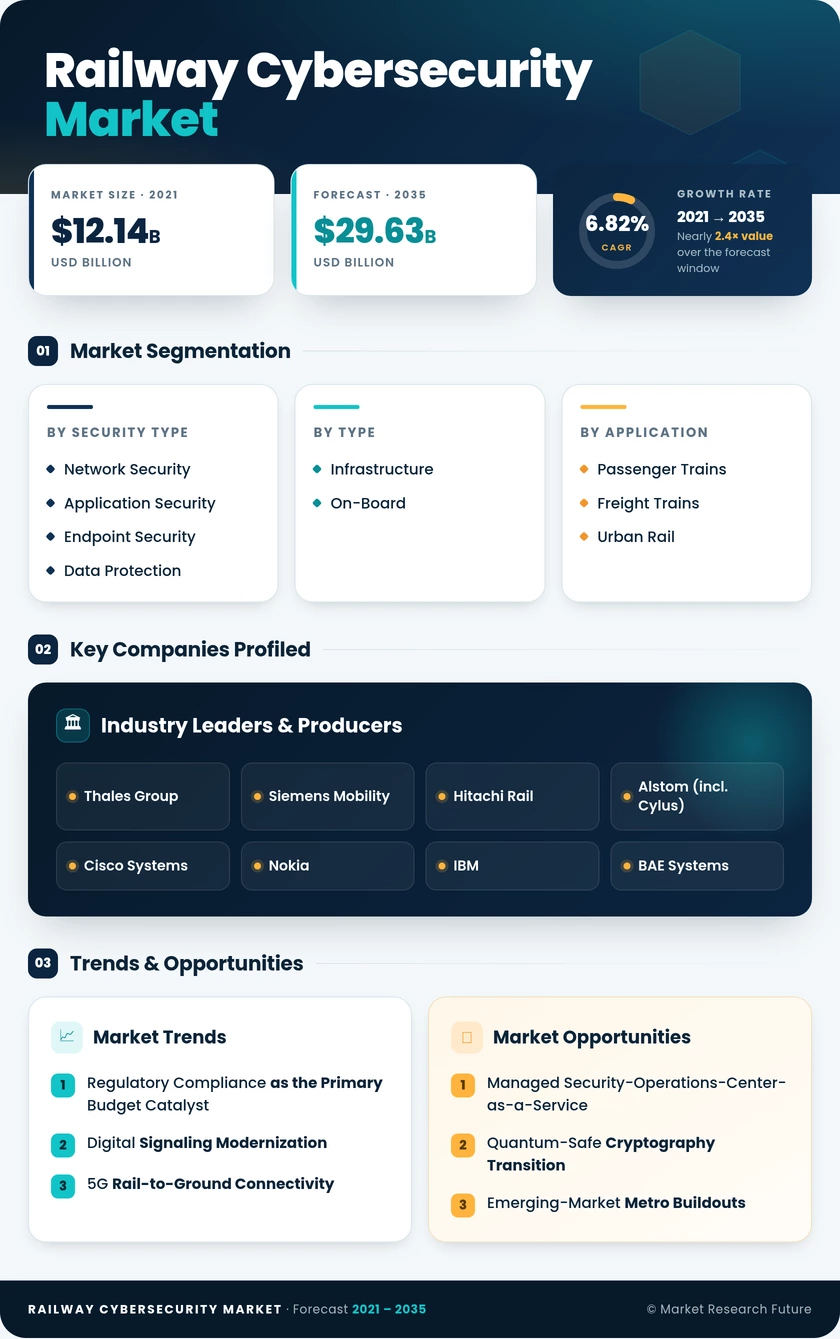
CAGR (2026-2035)6.82%
2025 Market SizeUSD 15.32 Billion
2035 Market SizeUSD 29.63 Billion
Key Players
Thales Group
Siemens Mobility
Hitachi Rail
Alstom
Cisco Systems
Nokia
Opportunities
  • Managed Security-Operations-Center-as-a-Service
  • Quantum-Safe Cryptography Transition
  • Emerging-Market Metro Buildouts
  1. 1 Market Overview |
    1. 1.1 Study Assumptions & Market Definition |
    2. 1.2 Scope of the Study |
    3. 1.3 Research Methodology
  2. 2 Market Summary & Key Takeaways
  3. 3 Market Dynamics |
    1. 3.1 Market Drivers Analysis | |
      1. 3.1.1 Mandatory Regulatory Compliance (TSA, NIS2, CRA) | |
      2. 3.1.2 Digitalization of Signaling (ETCS, CBTC, PTC) | |
      3. 3.1.3 5G Rail-to-Ground Connectivity | |
      4. 3.1.4 Ransomware and Nation-State Threats | |
      5. 3.1.5 IT-OT Convergence in Rail Operations | |
      6. 3.1.6 AI/ML-Driven Threat Detection Adoption | |
      7. 3.1.7 Expansion of Urban Metro Networks |
    2. 3.2 Market Restraints Analysis | |
      1. 3.2.1 Legacy System Integration Complexity | |
      2. 3.2.2 Budget Constraints at Public Transit Agencies | |
      3. 3.2.3 Shortage of Rail-Sector Cybersecurity Talent | |
      4. 3.2.4 Fragmented Standards Across Jurisdictions | |
      5. 3.2.5 Vendor Lock-in and Proprietary Protocols |
    3. 3.3 Market Opportunity Analysis | |
      1. 3.3.1 Managed SOC-as-a-Service for Rail | |
      2. 3.3.2 Quantum-Safe Cryptography Transition | |
      3. 3.3.3 Emerging-Market Metro Buildouts | |
      4. 3.3.4 Cybersecurity Data Monetization and Digital Twins | |
      5. 3.3.5 Supply-Chain Security Certification Services |
    4. 3.4 Industry Value Chain Analysis |
    5. 3.5 Porter's Five Forces Analysis
  4. 4 Railway Cybersecurity Market Size & Forecast (2021–2035) |
    1. 4.1 Historical Market Size (2021–2025) |
    2. 4.2 Current & Forecast Market Size (2026–2035) |
    3. 4.3 Market Size by Revenue (USD Billion) |
    4. 4.4 Year-over-Year Growth Analysis
  5. 5 Segmentation Analysis |
    1. 5.1 By Security Type | |
      1. 5.1.1 Network Security | |
      2. 5.1.2 Application Security | |
      3. 5.1.3 Endpoint Security | |
      4. 5.1.4 Data Protection |
    2. 5.2 By Type | |
      1. 5.2.1 Infrastructure | |
      2. 5.2.2 On-Board |
    3. 5.3 By Application | |
      1. 5.3.1 Passenger Trains | |
      2. 5.3.2 Freight Trains | |
      3. 5.3.3 Urban Rail |
    4. 5.4 By Rail Type | |
      1. 5.4.1 Metro Rail | |
      2. 5.4.2 High-Speed Rail | |
      3. 5.4.3 Light Rail |
    5. 5.5 By End Use | |
      1. 5.5.1 Railway Operators | |
      2. 5.5.2 Private Rail Companies
  6. 6 Regional Analysis |
    1. 6.1 North America | |
      1. 6.1.1 United States | |
      2. 6.1.2 Canada | |
      3. 6.1.3 Mexico |
    2. 6.2 Europe | |
      1. 6.2.1 Germany | |
      2. 6.2.2 United Kingdom | |
      3. 6.2.3 France | |
      4. 6.2.4 Italy | |
      5. 6.2.5 Spain | |
      6. 6.2.6 Nordic Countries | |
      7. 6.2.7 Russia | |
      8. 6.2.8 Rest of Europe |
    3. 6.3 Asia-Pacific | |
      1. 6.3.1 China | |
      2. 6.3.2 India | |
      3. 6.3.3 Japan | |
      4. 6.3.4 South Korea | |
      5. 6.3.5 ASEAN | |
      6. 6.3.6 Rest of Asia-Pacific |
    4. 6.4 South America | |
      1. 6.4.1 Brazil | |
      2. 6.4.2 Argentina | |
      3. 6.4.3 Rest of South America |
    5. 6.5 Middle East & Africa | |
      1. 6.5.1 Saudi Arabia | |
      2. 6.5.2 UAE | |
      3. 6.5.3 South Africa | |
      4. 6.5.4 Egypt | |
      5. 6.5.5 Rest of MEA
  7. 7 Competitive Landscape |
    1. 7.1 Market Share Analysis (2025) |
    2. 7.2 Competitive Benchmarking Matrix |
    3. 7.3 Company Profiles | |
      1. 7.3.1 Thales Group | |
      2. 7.3.2 Siemens Mobility | |
      3. 7.3.3 Hitachi Rail | |
      4. 7.3.4 Alstom (incl. Cylus) | |
      5. 7.3.5 Cisco Systems | |
      6. 7.3.6 Nokia | |
      7. 7.3.7 IBM | |
      8. 7.3.8 BAE Systems | |
      9. 7.3.9 Wabtec Corporation | |
      10. 7.3.10 Indra Sistemas
  8. 8 Future Outlook & Strategic Recommendations (2026–2035) |
    1. 8.1 AI-Augmented Threat Detection and Autonomous Response |
    2. 8.2 Zero-Trust Architectures for Converged Rail Networks |
    3. 8.3 Post-Quantum Cryptographic Migration |
    4. 8.4 ESG-Driven Cyber-Resilience Reporting
  9. 9 Recent Developments & News
  10. 10 Frequently Asked Questions (FAQs)
  11. 11 Report Scope & Methodology |
    1. 11.1 Study Period & Base Year |
    2. 11.2 Data Sources & Citations |
    3. 11.3 Abbreviations
  12. 12 LIST OF TABLES |
  13. TABLE 1 Railway Cybersecurity Market Size & Forecast, by Revenue (USD Billion), 2021–2035 |
  14. TABLE 2 Railway Cybersecurity Market — Year-over-Year Growth Analysis, 2021–2035 |
  15. TABLE 3 Driver Impact Analysis — Railway Cybersecurity Market |
  16. TABLE 4 Restraints Impact Analysis — Railway Cybersecurity Market |
  17. TABLE 5 Regional Market Summary — Railway Cybersecurity Market, 2025 |
  18. TABLE 6 North America Railway Cybersecurity Market Size, by Country, 2021–2035 (USD Billion) |
  19. TABLE 7 Europe Railway Cybersecurity Market Size, by Country, 2021–2035 (USD Billion) |
  20. TABLE 8 Asia-Pacific Railway Cybersecurity Market Size, by Country, 2021–2035 (USD Billion) |
  21. TABLE 9 South America Railway Cybersecurity Market Size, by Country, 2021–2035 (USD Billion) |
  22. TABLE 10 Middle East & Africa Railway Cybersecurity Market Size, by Country, 2021–2035 (USD Billion) |
  23. TABLE 11 Railway Cybersecurity Market Size, by Security Type, 2021–2035 (USD Billion) |
  24. TABLE 12 Railway Cybersecurity Market Size, by Type, 2021–2035 (USD Billion) |
  25. TABLE 13 Railway Cybersecurity Market Size, by Application, 2021–2035 (USD Billion) |
  26. TABLE 14 Railway Cybersecurity Market Size, by Rail Type, 2021–2035 (USD Billion) |
  27. TABLE 15 Railway Cybersecurity Market Size, by End Use, 2021–2035 (USD Billion) |
  28. TABLE 16 Competitive Benchmarking Matrix — Railway Cybersecurity Market, 2025 |
  29. TABLE 17 Company Profiles — Key Players, Railway Cybersecurity Market |
  30. TABLE 18 Recent Developments & Strategic Announcements, 2023–2025 |
  31. TABLE 19 Report Scope & Methodology — Railway Cybersecurity Market |
  32. TABLE 20 Detailed Sources and Citations
  33. 13 LIST OF FIGURES |
  34. FIGURE 1 Railway Cybersecurity Market Dynamics — Drivers, Restraints, and Opportunities |
  35. FIGURE 2 Industry Value Chain Analysis — Railway Cybersecurity Market |
  36. FIGURE 3 Porter's Five Forces Analysis — Railway Cybersecurity Market |
  37. FIGURE 4 Railway Cybersecurity Market Size Trend (USD Billion), 2021–2035 |
  38. FIGURE 5 Railway Cybersecurity Market Share, by Security Type, 2024 (%) |
  39. FIGURE 6 Railway Cybersecurity Market Share, by Type, 2024 (%) |
  40. FIGURE 7 Railway Cybersecurity Market Share, by Application, 2024 (%) |
  41. FIGURE 8 Railway Cybersecurity Market Share, by Rail Type, 2024 (%) |
  42. FIGURE 9 Railway Cybersecurity Market Share, by End Use, 2024 (%) |
  43. FIGURE 10 Railway Cybersecurity Market Share, by Region, 2024 (%) |
  44. FIGURE 11 North America Railway Cybersecurity Market Size, by Country, 2025 (%) |
  45. FIGURE 12 Europe Railway Cybersecurity Market Size, by Country, 2025 (%) |
  46. FIGURE 13 Asia-Pacific Railway Cybersecurity Market Size, by Country, 2025 (%) |
  47. FIGURE 14 Competitive Landscape — Railway Cybersecurity Market Revenue Share, 2025 (%)

Segmentation Quick Reference

DimensionSub-SegmentsDominant SegmentFastest Growing Segment
Security TypeNetwork Security, Application Security, Endpoint Security, Data ProtectionNetwork SecurityEndpoint Security
TypeInfrastructure, On-BoardInfrastructureOn-Board
ApplicationPassenger Trains, Freight Trains, Urban RailPassenger TrainsUrban Rail
Rail TypeMetro Rail, High-Speed Rail, Light RailMetro RailHigh-Speed Rail
End UseRailway Operators, Private Rail CompaniesRailway OperatorsPrivate Rail Companies
GeographyNorth America, Europe, Asia-Pacific, South America, Middle East & AfricaEuropeAsia-Pacific


Market Segmentation Overview

By Security Type

Sub-SegmentKey Trend
Network SecurityPerimeter defense for SCADA, signaling backbones, and centralized traffic-management systems remains the largest spend category
Application SecurityCloud migration of ticketing, ERP, and passenger-facing apps drives investment in application-layer firewalls and API security
Endpoint SecurityRapid IoT sensor proliferation across rolling stock and wayside equipment fuels demand for lightweight endpoint agents
Data ProtectionGDPR and sector-specific data-handling mandates compel encryption-at-rest and tokenization of passenger records


Network Security and Endpoint Security represent the two poles of spending momentum in the Railway Cybersecurity Market — one anchored by legacy perimeter-defense obligations, the other propelled by the explosive growth of connected devices across modern rail ecosystems.

By Type

Sub-SegmentKey Trend
InfrastructureFixed-asset protection covering signal controllers, interlocking systems, level crossings, and station management platforms
On-BoardTrain-borne ETCS modules, diagnostic systems, CCTV, and passenger-information displays require dedicated cyber coverage


Infrastructure systems continue to dominate because they encompass the safety-critical fixed assets that define rail operations, while on-board systems are closing the gap as next-generation rolling stock integrates greater compute density.

By Application

Sub-SegmentKey Trend
Passenger TrainsTicketing, passenger Wi-Fi, ATC, and public-information systems create a broad attack surface requiring comprehensive security
Freight TrainsPTC overlay, fleet telematics, and supply-chain data integrity drive targeted cybersecurity investment
Urban RailCBTC-intensive metro and light-rail networks represent the fastest-growing application segment


Urban Rail's rapid growth reflects the global pace of new metro construction, where security-by-design procurement is becoming standard practice in greenfield CBTC deployments.

By Rail Type

Sub-SegmentKey Trend
Metro RailDriverless and GoA4 operations demand the highest cybersecurity assurance levels for automated train control
High-Speed RailCross-border ETCS interoperability and FRMCS migration introduce complex multi-vendor security challenges
Light RailSmart-tram and LRT modernization programs are beginning to adopt standardized cybersecurity frameworks


Metro Rail's dominant share is directly linked to the proliferation of Grade-of-Automation 4 driverless metro systems, where any compromise of signaling or door-control subsystems carries immediate safety implications.

By End Use

Sub-SegmentKey Trend
Railway OperatorsState-owned and publicly regulated operators account for the majority of spending, driven by compliance mandates
Private Rail CompaniesOpen-access freight and passenger operators invest in cybersecurity as a competitive differentiator and license-renewal prerequisite


Railway Operators hold the largest share due to their regulatory exposure and the scale of their networks, but Private Rail Companies are growing faster as market liberalization in Europe and Asia introduces new entrants seeking to establish resilience credentials.


Download PDF ×

We do not share your information with anyone. However, we may send you emails based on your report interest from time to time. You may contact us at any time to opt-out.