×
Request Free Sample ×

Kindly complete the form below to receive a free sample of this Report

* Please use a valid business email

Leading companies partner with us for data-driven Insights

clients tt-cursor
Hero Background

Rapid Application Development Market

ID: MRFR/ICT/39401-HCR
100 Pages
Aarti Dhapte
October 2025

Rapid Application Development Market Research Report: By Deployment Model (Cloud-Based, On-Premises), By Application Type (Web Applications, Mobile Applications, Desktop Applications), By Development Approach (Low-Code, No-Code), By Industry Vertical (Financial Services, Healthcare, Retail, Manufacturing, Government), By Organization Size (Small and Medium Businesses (SMBs), Large Enterprises) and By Regional (North America, Europe, South America, Asia Pacific, Middle East and Africa) - Forecast to 2035.

Share:
Download PDF ×

We do not share your information with anyone. However, we may send you emails based on your report interest from time to time. You may contact us at any time to opt-out.

Rapid Application Development Market
 Infographic
Purchase Options

Rapid Application Development Market Summary

As per MRFR analysis, the Rapid Application Development Market Size was estimated at 8.572 USD Billion in 2024. The Rapid Application Development industry is projected to grow from 10.38 USD Billion in 2025 to 70.24 USD Billion by 2035, exhibiting a compound annual growth rate (CAGR) of 21.07 during the forecast period 2025 - 2035.

Key Market Trends & Highlights

The Rapid Application Development Market is experiencing robust growth driven by technological advancements and evolving consumer needs.

  • The rise of low-code and no-code platforms is transforming the development landscape, enabling faster application delivery.
  • Integration of AI and machine learning is enhancing the capabilities of rapid application development tools, fostering innovation.
  • North America remains the largest market, while Asia-Pacific is emerging as the fastest-growing region in this sector.
  • Increased demand for agile development and the growing adoption of cloud technologies are key drivers propelling market expansion.

Market Size & Forecast

2024 Market Size 8.572 (USD Billion)
2035 Market Size 70.24 (USD Billion)
CAGR (2025 - 2035) 21.07%

Major Players

OutSystems (PT), Mendix (NL), Appian (US), Salesforce (US), Microsoft (US), Pega (US), Zoho (IN), Betty Blocks (NL), Quick Base (US)

Rapid Application Development Market Trends

The Rapid Application Development Market is currently experiencing a transformative phase, characterized by the increasing demand for agile development methodologies. Organizations are recognizing the necessity for rapid deployment of applications to meet evolving consumer expectations and competitive pressures. This shift is largely driven by the need for faster time-to-market and enhanced user experiences. As businesses strive to innovate, they are increasingly adopting low-code and no-code platforms, which facilitate quicker application development without extensive programming knowledge. This trend appears to be reshaping the landscape of software development, enabling a broader range of users to participate in the creation process. Moreover, the integration of advanced technologies such as artificial intelligence and machine learning into the Rapid Application Development Market is becoming more prevalent. These technologies are enhancing the capabilities of development tools, allowing for smarter automation and improved decision-making processes. As organizations continue to embrace digital transformation, the synergy between rapid application development and emerging technologies is likely to foster new opportunities for growth and efficiency. The market seems poised for further evolution, as stakeholders seek innovative solutions to address complex challenges in application development and deployment.

Rise of Low-Code and No-Code Platforms

The emergence of low-code and no-code platforms is revolutionizing the Rapid Application Development Market. These tools empower users with minimal programming skills to create applications swiftly, thereby democratizing the development process. This trend is likely to enhance productivity and reduce reliance on traditional coding practices.

Integration of AI and Machine Learning

The incorporation of artificial intelligence and machine learning into development tools is becoming increasingly common. This integration facilitates smarter automation, predictive analytics, and enhanced user experiences. As a result, organizations may achieve greater efficiency and innovation in their application development efforts.

Focus on User-Centric Design

There is a growing emphasis on user-centric design within the Rapid Application Development Market. Organizations are prioritizing user feedback and experience in the development process, which may lead to more intuitive and engaging applications. This trend suggests a shift towards creating solutions that better meet the needs of end-users.

Rapid Application Development Market Drivers

Integration of Advanced Technologies

The Rapid Application Development Market is significantly impacted by the integration of advanced technologies such as artificial intelligence, machine learning, and the Internet of Things. These technologies are reshaping the landscape of application development, enabling faster and more efficient processes. The incorporation of AI and machine learning into rapid application development tools allows for automation of repetitive tasks, thereby accelerating development timelines. Furthermore, the Internet of Things is driving the need for applications that can manage and analyze vast amounts of data in real-time. As organizations increasingly adopt these technologies, the demand for rapid application development solutions that can leverage their capabilities is expected to grow. This trend suggests that the Rapid Application Development Market will continue to evolve, driven by the need for innovative applications that harness the power of advanced technologies.

Growing Adoption of Cloud Technologies

The Rapid Application Development Market is significantly influenced by the growing adoption of cloud technologies. As organizations migrate to cloud-based infrastructures, the demand for rapid application development tools that can seamlessly integrate with these environments is increasing. Cloud platforms offer scalability, flexibility, and cost-effectiveness, which are essential for modern application development. Recent statistics suggest that cloud computing is expected to reach a market size of over 800 billion dollars by 2025, further driving the need for rapid application development solutions. This trend indicates that businesses are prioritizing cloud-native applications, which require rapid development capabilities to leverage the full potential of cloud environments. Thus, the Rapid Application Development Market is likely to expand as more companies seek to harness cloud technologies for their application development needs.

Increased Demand for Agile Development

The Rapid Application Development Market is experiencing a notable surge in demand for agile development methodologies. Organizations are increasingly recognizing the need for flexibility and speed in software development, which agile practices inherently provide. This shift is driven by the necessity to adapt to changing market conditions and customer requirements swiftly. According to recent data, agile methodologies have been adopted by over 70% of software development teams, indicating a strong preference for iterative processes. This trend is likely to continue, as businesses seek to enhance their responsiveness and reduce time-to-market for new applications. Consequently, the Rapid Application Development Market is poised for growth, as agile frameworks align well with rapid development cycles, enabling teams to deliver high-quality software solutions efficiently.

Rising Need for Custom Software Solutions

The Rapid Application Development Market is witnessing a rising need for custom software solutions tailored to specific business requirements. As organizations seek to differentiate themselves in competitive markets, off-the-shelf software often falls short of meeting unique needs. This has led to an increased demand for rapid application development tools that enable businesses to create customized applications quickly and efficiently. Recent surveys indicate that over 60% of companies prefer custom solutions to enhance their operational capabilities. This trend underscores the importance of rapid application development in enabling organizations to respond to specific challenges and opportunities. Consequently, the Rapid Application Development Market is likely to expand as more businesses recognize the value of bespoke software solutions in achieving their strategic objectives.

Emergence of Digital Transformation Initiatives

The Rapid Application Development Market is being propelled by the emergence of digital transformation initiatives across various sectors. Organizations are increasingly investing in technology to enhance operational efficiency and improve customer experiences. This transformation often necessitates the rapid development of applications that can support new digital strategies. Data indicates that nearly 90% of companies are engaged in some form of digital transformation, highlighting the urgency for tools that facilitate quick application development. As businesses strive to remain competitive in a digital-first landscape, the demand for rapid application development solutions is expected to rise. This trend suggests that the Rapid Application Development Market will continue to thrive as organizations prioritize agility and innovation in their digital transformation efforts.
Market Segment Insights

By Deployment Model: Cloud-Based (Largest) vs. On-Premises (Fastest-Growing)

The Rapid Application Development Market is witnessing significant distribution among deployment models, with cloud-based solutions leading the charge. These platforms are being adopted by a vast majority due to their flexibility, scalability, and ease of implementation. In contrast, on-premises deployments, though traditionally favored for their security and control, are gaining traction as businesses seek tailored solutions that fit specific needs. Overall, the cloud model commands a substantial market share, but on-premises options are attracting a growing customer base, marking shifts in preferences.

Deployment Model: Cloud-Based (Dominant) vs. On-Premises (Emerging)

Cloud-based deployment models are currently the dominant force in the Rapid Application Development Market due to their ability to provide rapid scalability and accessibility for users. They allow organizations to develop and deploy applications quickly without the need for significant hardware investments. Conversely, on-premises deployment is considered an emerging choice, favored by enterprises focused on customization and data security. This model enables businesses to directly manage their applications and data, often appealing to those in regulated industries. As organizations balance the benefits of both deployment models, the landscape continues to evolve, with on-premises solutions gradually seizing more market attention.

By Application Type: Web Applications (Largest) vs. Mobile Applications (Fastest-Growing)

The Rapid Application Development Market shows a distinct distribution in the application type segment. Web applications currently hold the largest market share, thanks to their widespread adoption across businesses for various online functionalities. Their ability to integrate easily with existing technologies and provide seamless user experiences has solidified their position in the market. In contrast, mobile applications are rapidly gaining traction and are considered the fastest-growing segment. The surge in mobile device usage and the demand for on-the-go solutions drive their increasing market presence.

Web Applications (Dominant) vs. Mobile Applications (Emerging)

Web applications dominate the Rapid Application Development Market due to their versatility and compatibility with various devices and platforms. They are preferred for their scalability and the ability to provide a consistent user experience across devices. Meanwhile, mobile applications are emerging as a key player, fueled by the increasing reliance on smartphones and tablets for everyday tasks. The convenience of mobile access, coupled with advancements in mobile technologies, makes them a vital part of the future landscape, particularly as businesses aim to enhance customer engagement through tailored mobile solutions.

By Development Approach: Low-Code (Largest) vs. No-Code (Fastest-Growing)

In the Rapid Application Development Market, the distribution of market share illustrates a clear dominance of the Low-Code approach, recognized for its extensive capabilities that cater to seasoned developers while allowing for rapid application deployment. Meanwhile, the No-Code segment, while smaller in market share, has gained significant traction among non-technical users, empowering them to create applications without traditional coding skills. This democratization of development is attracting a diverse audience ranging from individual entrepreneurs to large enterprises, looking to innovate rapidly without heavy reliance on IT resources.

Development Approach: Low-Code (Dominant) vs. No-Code (Emerging)

The Low-Code development approach stands as the dominant player in the Rapid Application Development Market, facilitating a fast and efficient method for developers to build applications with minimal hand-coding. Its platform-centric model supports rapid iteration and flexibility, making it appealing to businesses that prioritize speed without sacrificing complexity. On the other hand, the No-Code approach is emerging as a disruptive force, appealing primarily to users without programming backgrounds. No-Code platforms enable organizations to solve specific challenges quickly and cost-effectively, thereby fostering innovation across various sectors as they empower a broader user base to participate in the development process.

By Industry Vertical: Financial Services (Largest) vs. Healthcare (Fastest-Growing)

The Rapid Application Development Market within the Financial Services sector is the largest segment, reflecting the acute need for agile technology solutions in this industry. Financial institutions are increasingly embracing rapid application development to enhance customer experiences, streamline operations, and meet regulatory demands. In contrast, the Healthcare sector is emerging as the fastest-growing segment, driven by the need for innovative solutions that can respond swiftly to patient needs and regulatory changes.

Financial Services: Dominant vs. Healthcare: Emerging

The Financial Services sector stands out as the dominant force in the Rapid Application Development Market, characterized by its robust demand for swift, flexible applications that can adapt to the fast-paced financial environment. This sector extensively leverages platforms to develop solutions that enhance customer engagement and streamline operations. On the other hand, the Healthcare sector is rapidly emerging, propelled by technological advancements and regulatory pressures that demand quick development cycles. The emergence reflects a trend toward personalized care and the need for healthcare providers to develop applications that facilitate better patient management and healthcare delivery.

By Organization Size: Small and Medium Businesses (Largest) vs. Large Enterprises (Fastest-Growing)

The Rapid Application Development (RAD) market exhibits a significant divergence in share between Small and Medium Businesses (SMBs) and Large Enterprises. SMBs hold a considerable portion of the market, driven by the need for agile solutions and reduced time-to-market. Meanwhile, Large Enterprises, while smaller in initial share, are rapidly increasing their adoption of RAD tools as they seek to enhance innovation and accelerate their development cycles. This creates a dynamic where SMBs continue to excel in volume while Large Enterprises invigorate the market with their substantial investments and strategic shifts. In terms of growth trends, SMBs benefit from the flexibility RAD tools provide, allowing them to pivot easily in response to market demands. Conversely, Large Enterprises leverage RAD technologies to integrate digital transformation initiatives, thereby positioning themselves for faster market responsiveness and improved customer engagement. As these enterprises recognize the competitive advantage offered by adopting RAD methodologies, their growth in this space is expected to accelerate significantly over the forecast period, contributing to the overall expansion of the RAD market.

SMBs: Dominant vs. Large Enterprises: Emerging

In the context of the Rapid Application Development Market, Small and Medium Businesses (SMBs) emerge as the dominant segment. They typically favor RAD tools that are cost-effective and designed for rapid iterations, allowing them to streamline their development processes without heavy overheads. These businesses often prioritize agility and flexibility, which RAD solutions uniquely provide, enabling them to respond swiftly to changing market demands. On the other hand, Large Enterprises, while currently positioned as an emerging segment, are quickly capturing market interest through their substantial investment in RAD technologies. They focus on scalability and integration with existing infrastructures, striving to enhance productivity and innovation. As enterprises increasingly transition toward digital transformation, the adoption of RAD methodologies will likely amplify their market presence.

Get more detailed insights about Rapid Application Development Market

Regional Insights

North America : Innovation and Leadership Hub

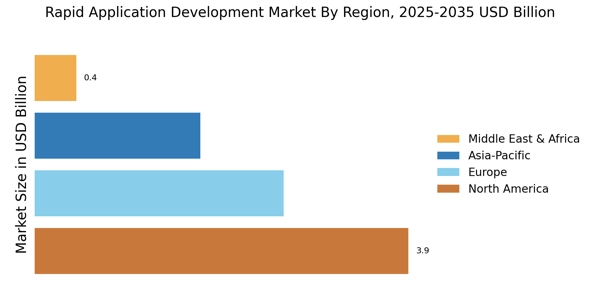
North America is the largest market for Rapid Application Development (RAD), holding approximately 45% of the global market share. The region's growth is driven by the increasing demand for agile development methodologies, cloud computing, and digital transformation initiatives across various sectors. Regulatory support for technology adoption and innovation further catalyzes market expansion, making it a key player in the global landscape. The United States leads the RAD market, with significant contributions from Canada. Major players like Appian, Salesforce, and Microsoft are headquartered here, fostering a competitive environment. The presence of established tech firms and startups alike enhances innovation, while partnerships and collaborations are on the rise, ensuring a robust ecosystem for RAD solutions.

Europe : Emerging Market with Potential

Europe is the second-largest market for Rapid Application Development, accounting for around 30% of the global share. The region is witnessing a surge in demand for digital solutions driven by the need for faster application delivery and improved customer experiences. Regulatory frameworks promoting digital transformation and data protection are also influencing market dynamics, encouraging businesses to adopt RAD methodologies. Leading countries in Europe include Germany, the UK, and France, where companies are increasingly investing in RAD tools. Key players like Mendix and Betty Blocks are making significant strides, while local startups are emerging to meet specific regional needs. The competitive landscape is characterized by innovation and collaboration, with a focus on enhancing user experience and operational efficiency.

Asia-Pacific : Rapid Growth and Adoption

Asia-Pacific is rapidly emerging as a significant player in the Rapid Application Development market, holding approximately 20% of the global share. The region's growth is fueled by increasing smartphone penetration, a burgeoning tech-savvy population, and government initiatives promoting digitalization. Countries like India and China are at the forefront, with a strong push towards adopting agile methodologies in various sectors. India, in particular, is witnessing a boom in RAD adoption, driven by a vibrant startup ecosystem and the presence of key players like Zoho. The competitive landscape is evolving, with both established companies and new entrants vying for market share. The focus on innovation and cost-effective solutions is propelling the region's growth, making it a hotspot for RAD technologies.

Middle East and Africa : Emerging Market with Challenges

The Middle East and Africa (MEA) region is gradually developing its Rapid Application Development market, currently holding about 5% of the global share. The growth is primarily driven by increasing investments in technology and digital transformation initiatives. However, regulatory challenges and varying levels of infrastructure development pose hurdles to rapid adoption, impacting overall market growth. Countries like South Africa and the UAE are leading the charge in RAD adoption, with a focus on enhancing operational efficiency and customer engagement. The competitive landscape is characterized by a mix of local and international players, with companies exploring partnerships to leverage technology. Despite challenges, the region shows promise for future growth as businesses increasingly recognize the value of RAD solutions.

Rapid Application Development Market
 Regional Image

Key Players and Competitive Insights

Major players in Rapid Application Development Market have been focusing on expanding their product portfolios through acquisitions and collaborations. For instance, in October 2022, OutSystems acquired Ionic, a leading mobile app development platform, to expand its low-code development offerings. Leading Rapid Application Development Market players are also investing heavily in research and development to enhance their offerings and gain a competitive edge. Key players in the Rapid Application Development Market industry are focusing on strategic partnerships to expand their reach and enhance their product offerings. 

For example, in March 2022, Mendix, a Siemens business, partnered with AWS to make its low-code platform available on AWS Marketplace. This partnership allows Mendix customers to access AWS services and leverage AWS infrastructure for building and deploying their applications. The competitive landscape of the Rapid Application Development Market is expected to remain highly competitive, with major players focusing on differentiation through innovation, acquisitions, and partnerships.Salesforce is a leading player in the Rapid Application Development Market, offering a comprehensive suite of cloud-based CRM, marketing automation, and low-code development tools.

The company's low-code platform, Salesforce Platform, allows users to build and deploy custom applications without the need for extensive coding knowledge. Salesforce has a strong focus on customer success and provides a wide range of resources and support to help customers maximize their use of the platform. 

With its strong brand recognition, extensive product portfolio, and reach, Salesforce is well-positioned to maintain its leading position in the Rapid Application Development Market.Microsoft is a major competitor in the Rapid Application Development Market, offering a range of low-code and no-code development tools through its Power Platform. Power Platform includes Power Apps, Power BI, Power Automate, and Power Virtual Agents, enabling users to build custom applications, automate processes, analyze data, and create virtual agents without the need for extensive coding skills.

Microsoft has a strong focus on integration with its other products and services, such as Microsoft 365 and Azure, providing users with a comprehensive and seamless experience. With its extensive ecosystem of partners and developers, Microsoft is well-positioned to challenge the dominance of Salesforce in the Rapid Application Development Market.

Key Companies in the Rapid Application Development Market market include

Industry Developments

  • Q2 2024: Retool raises $45M Series C to expand rapid application development platform Retool, a company specializing in rapid application development tools, announced a $45 million Series C funding round to accelerate product development and expand its platform capabilities.
  • Q2 2024: OutSystems Announces New AI-Powered Features for Its Low-Code Application Development Platform OutSystems launched new AI-powered features for its rapid application development platform, aiming to enhance developer productivity and accelerate enterprise software delivery.
  • Q3 2024: Mendix Partners with AWS to Accelerate Enterprise Application Development Mendix announced a strategic partnership with Amazon Web Services (AWS) to integrate its rapid application development platform with AWS services, enabling faster cloud-native application delivery for enterprise customers.
  • Q2 2024: Microsoft launches Power Platform Copilot, bringing generative AI to low-code app development Microsoft introduced Power Platform Copilot, a generative AI feature for its low-code rapid application development suite, designed to help users build business applications more efficiently.
  • Q1 2024: Appian Appoints Christopher Jones as Chief Revenue Officer Appian, a provider of rapid application development software, announced the appointment of Christopher Jones as its new Chief Revenue Officer to drive global sales growth.
  • Q3 2024: Kissflow Launches Unified Work Platform for Rapid Application Development Kissflow unveiled a new unified work platform designed to streamline rapid application development, combining process automation, project management, and app development in a single solution.
  • Q2 2024: Unqork raises $80M Series D to expand no-code enterprise application platform Unqork, a no-code rapid application development platform, secured $80 million in Series D funding to accelerate product innovation and global expansion.
  • Q1 2024: Zoho Launches Creator 7, Next-Gen Low-Code Application Development Platform Zoho introduced Creator 7, the latest version of its low-code rapid application development platform, featuring enhanced automation and integration capabilities.
  • Q2 2024: Salesforce launches Einstein Copilot for Flow, boosting automation in rapid app development Salesforce announced Einstein Copilot for Flow, an AI-powered tool designed to automate workflows and accelerate rapid application development within its platform.
  • Q3 2024: ServiceNow Acquires SkyGiraffe to Enhance Rapid Application Development Capabilities ServiceNow completed the acquisition of SkyGiraffe, a mobile application development platform, to strengthen its rapid application development offerings for enterprise customers.
  • Q2 2024: Betty Blocks Partners with Google Cloud to Accelerate Low-Code Application Development Betty Blocks announced a partnership with Google Cloud to integrate its low-code rapid application development platform with Google Cloud services, aiming to speed up enterprise app delivery.
  • Q1 2024: Quick Base Appoints Deb Gildersleeve as Chief Information Officer Quick Base, a provider of rapid application development solutions, named Deb Gildersleeve as its new Chief Information Officer to lead technology strategy and innovation.

Future Outlook

Rapid Application Development Market Future Outlook

The Rapid Application Development Market is projected to grow at a 21.07% CAGR from 2024 to 2035, driven by increasing demand for agile development and digital transformation.

New opportunities lie in:

  • Integration of AI-driven development tools for enhanced efficiency.
  • Expansion into low-code platforms to attract non-technical users.
  • Development of industry-specific RAD solutions for niche markets.

By 2035, the market is expected to be robust, reflecting substantial growth and innovation.

Market Segmentation

Rapid Application Development Market Application Type Outlook

  • Web Applications
  • Mobile Applications
  • Desktop Applications

Rapid Application Development Market Deployment Model Outlook

  • Cloud-Based
  • On-Premises

Rapid Application Development Market Industry Vertical Outlook

  • Financial Services
  • Healthcare
  • Retail
  • Manufacturing
  • Government

Rapid Application Development Market Organization Size Outlook

  • Small and Medium Businesses (SMBs)
  • Large Enterprises

Rapid Application Development Market Development Approach Outlook

  • Low-Code
  • No-Code

Report Scope

MARKET SIZE 20248.572(USD Billion)
MARKET SIZE 202510.38(USD Billion)
MARKET SIZE 203570.24(USD Billion)
COMPOUND ANNUAL GROWTH RATE (CAGR)21.07% (2024 - 2035)
REPORT COVERAGERevenue Forecast, Competitive Landscape, Growth Factors, and Trends
BASE YEAR2024
Market Forecast Period2025 - 2035
Historical Data2019 - 2024
Market Forecast UnitsUSD Billion
Key Companies ProfiledMarket analysis in progress
Segments CoveredMarket segmentation analysis in progress
Key Market OpportunitiesIntegration of artificial intelligence enhances efficiency in the Rapid Application Development Market.
Key Market DynamicsRising demand for agile development tools drives innovation and competition in the Rapid Application Development Market.
Countries CoveredNorth America, Europe, APAC, South America, MEA

Leave a Comment

FAQs

What is the current valuation of the Rapid Application Development Market?

As of 2024, the market valuation was 8.572 USD Billion.

What is the projected market size for the Rapid Application Development Market by 2035?

The market is projected to reach 70.24 USD Billion by 2035.

What is the expected CAGR for the Rapid Application Development Market during the forecast period 2025 - 2035?

The expected CAGR for the market during this period is 21.07%.

Which deployment model holds the largest market share in the Rapid Application Development Market?

The Cloud-Based deployment model appears to dominate, with a valuation of 49.184 USD Billion.

How do the revenues from mobile applications compare to those from web applications in the market?

Mobile applications are projected to generate 30.0 USD Billion, surpassing web applications at 20.0 USD Billion.

What are the key industry verticals driving growth in the Rapid Application Development Market?

Key industry verticals include Financial Services, Healthcare, and Retail, with valuations of 12.0, 10.0, and 8.0 USD Billion respectively.

Which organization size segment is expected to contribute more to the market?

Large Enterprises are likely to contribute more, with a projected valuation of 42.12 USD Billion.

What development approach is gaining traction in the Rapid Application Development Market?

The Low-Code development approach appears to be gaining traction, with a valuation of 40.192 USD Billion.

Who are the leading players in the Rapid Application Development Market?

Key players include OutSystems, Mendix, Appian, Salesforce, and Microsoft.

What is the valuation of the On-Premises deployment model in the market?

The On-Premises deployment model had a valuation of 21.056 USD Billion.

Download Free Sample

Kindly complete the form below to receive a free sample of this Report

Compare Licence

×
Features License Type
Single User Multiuser License Enterprise User
Price $4,950 $5,950 $7,250
Maximum User Access Limit 1 User Upto 10 Users Unrestricted Access Throughout the Organization
Free Customization
Direct Access to Analyst
Deliverable Format
Platform Access
Discount on Next Purchase 10% 15% 15%
Printable Versions