Remote Asset Management Market (2026 - 2035)

Remote Asset Management Market Research Report: Information by Solutions (Predictive Maintenance, Analytics, Asset Condition Monitoring & Performance Management), by Application (Automation, Healthcare and Wellness, Retail, Utilities, Smart Grids, and Production Monitoring), And By Region (North America, Europe, Asia-Pacific, And Rest Of The World) –Market Forecast Till 2035.
ID: MRFR/ICT/1842-HCR
100 Pages
Apoorva Priyadarshi, Shubham Munde
Last Updated: July 20, 2026
Remote Asset Management Market
Market Size
Forecast Period2026-2035
CAGR (2026-2035)13.50%
2025 Market SizeUSD 32.10 Billion
2035 Market SizeUSD 113.86 Billion
Key Players
IBM Corporation
Cisco Systems
Siemens AG
GE Vernova
Schneider Electric
PTC Inc.
Opportunities
  • Managed-Service and Platform-as-a-Service Models
  • Digital Twin Monetization
  • Emerging-Market Industrialization

Remote Asset Management Market Summary

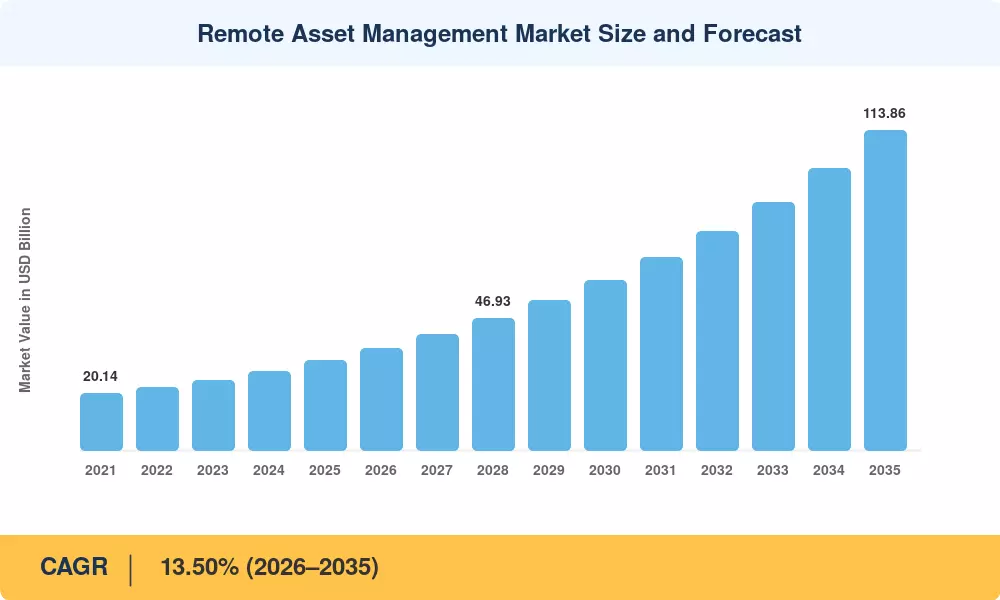
The Remote Asset Management Market was valued at USD 32.10 Billion in 2025 and is projected to grow from USD 36.43 Billion in 2026 to USD 113.86 Billion by 2035, registering a CAGR of 13.50% during the forecast period (2026–2035). This growth trajectory is anchored in two powerful catalysts: the global acceleration of Industry 4.0 capital programs — with manufacturing IoT spending alone crossing USD 450 Billion worldwide by 2024 [1] — and tightening regulatory mandates around asset uptime reporting in critical infrastructure sectors such as energy, transportation, and healthcare.

The technology landscape underpinning the Remote Asset Management Market is shifting rapidly. Legacy SCADA-based monitoring, manual inspection routines, and disconnected spreadsheet tracking are giving way to cloud-native platforms that combine sensor telemetry, edge computing, and AI-driven analytics into unified dashboards. GE Vernova's Predix APM platform and Siemens MindSphere represent this evolution, while the U.S. Department of Energy's USD 3.5 Billion Grid Resilience Innovation Partnerships program [2] is accelerating sensor-dense asset monitoring across power grids and pipeline networks.

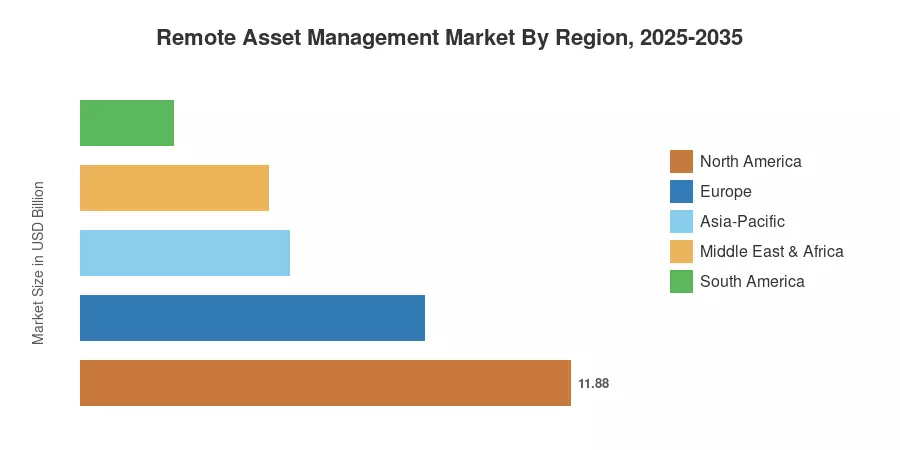
North America dominates the Remote Asset Management Market with an estimated 37% revenue share, driven by mature industrial automation ecosystems in the United States and Canada. Asia-Pacific is the fastest-growing region at a projected CAGR of 15.80%, fueled by China's smart manufacturing subsidies and India's National Infrastructure Pipeline. Europe holds the second-largest share at roughly 26%, supported by EU Digital Single Market mandates and carbon-neutral asset lifecycle targets. As connected device penetration deepens across emerging economies, the Remote Asset Management Market is poised for sustained double-digit expansion through 2035.


Key Report Takeaways

• By Component

  • The Solution segment commands the largest share of the Remote Asset Management Market at approximately 62% of 2025 revenue, reflecting enterprise demand for integrated analytics platforms.
  • Services are the faster-growing component, registering a CAGR of 15.20% as managed-service contracts displace in-house monitoring teams.

• By Type

  • Fixed Asset management accounts for USD 19.90 Billion in 2025, driven by energy and utilities infrastructure.
  • Mobile Asset tracking is expanding at a CAGR of 14.80% as fleet operators and logistics providers digitize rolling stock and container monitoring.

• By Region

  • North America leads the Remote Asset Management Market with a 37% share, underpinned by advanced adoption across oil and gas and manufacturing verticals.
  • Asia-Pacific is projected to reach USD 35.80 Billion by 2035, the highest absolute growth increment among all regions.


Remote Asset Management Market Size and Forecast (2021–2035)

Market Research Future employs a combination of bottom-up revenue modeling — aggregating vendor revenues, contract values, and subscription billings — and top-down cross-validation against macroeconomic indicators such as industrial capital expenditure, telecom M2M connection growth, and enterprise IT spending patterns. Historical figures (2021–2024) are calibrated against publicly reported annual results from leading vendors, while forecast values (2026–2035) apply a compound annual growth rate validated against industry investment trajectories.
Remote Asset Management Market Size and Forecast
Our Impact
Enabled $4.3B Revenue Impact for Fortune 500 and Leading Multinationals
Partnering with 2000+ Global Organizations Each Year
30K+ Citations by Top-Tier Firms in the Industry

Driver Impact Analysis

Driver ~% Impact on CAGR Geographic Relevance Impact Timeline
Predictive maintenance cost savings +2.8% Global Short-term (≤2 yr)
Declining IoT sensor costs +2.4% Global Short-term (≤2 yr)
Cloud-native platform migration +2.1% North America, Europe Medium-term (2–4 yr)
5G and LPWAN network rollouts +1.9% Asia-Pacific, North America Medium-term (2–4 yr)
Regulatory compliance mandates +1.6% Europe, North America Long-term (≥4 yr)
Digital twin and AI convergence +1.5% Global Long-term (≥4 yr)
Sustainability and ESG reporting +1.2% Europe, Asia-Pacific Long-term (≥4 yr)


Predictive Maintenance Cost Savings

According to recent estimates, unplanned downtime costs industrial businesses a substantial amount of money—roughly $600 billion annually for the Global 2000. Because predictive maintenance algorithms, fed by real-time vibration, heat, and pressure sensor data, can cut unexpected outages by 30–50%, the Remote Asset Management (RAM) sector offers crucial tools to limit this risk. In the oil and gas, discrete manufacturing, and utility industries, companies like Honeywell and PTC claim that clients implementing their Asset Performance Management (APM) systems often obtain complete investment payback within 12 to 18 months, creating a potent, self-reinforcing adoption cycle.


Declining IoT Sensor Costs

MEMS technology breakthroughs and mass-market scalability have led to a fundamental drop in the cost of industrial-grade IoT sensors. Large-scale sensor deployments are now financially feasible for mid-tier manufacturers due to the wider commoditization of IoT components, even though the "per-unit" cost varies depending on the degree of ruggedization and processing capability required. With major manufacturers like Bosch and STMicroelectronics continuing to drive production volume, the proliferation of wireless temperature probes and accelerometers is directly expanding the addressable market for RAM solutions, as the global IoT sensors market grows at a CAGR of nearly 19.6% through 2030.


Cloud-Native Platform Migration

Enterprise spending on industrial cloud platforms reached USD 78 Billion in 2024, according to [5]. Cloud-native architectures enable the Remote Asset Management Market to deliver elastic scalability, faster deployment, and lower total cost of ownership compared to on-premise alternatives. AWS IoT SiteWise and Microsoft Azure IoT Hub have emerged as dominant hyperscaler platforms, supporting multi-site asset visibility for global operators managing hundreds of thousands of endpoints.

5G and LPWAN Network Rollouts

The GSMA estimates that 5G industrial connections will surpass 800 million globally by 2028 [8]. For the Remote Asset Management Market, private 5G networks offer the ultra-low latency and deterministic bandwidth needed for real-time control of critical mobile assets — from autonomous mining trucks in Australia's Pilbara region to port cranes at Rotterdam. LoRaWAN and NB-IoT continue to serve cost-sensitive fixed-asset monitoring use cases in agriculture and water utilities.


Restraints Impact Analysis

The restraint estimates below follow the same qualitative methodology outlined in Section 4 and represent directional drag on market expansion rather than precise deductions from CAGR.

Restraint ~% Impact on CAGR Geographic Relevance Impact Timeline
Cybersecurity and data-breach risk –1.8% Global Short-term (≤2 yr)
Legacy system integration complexity –1.5% North America, Europe Medium-term (2–4 yr)
High initial deployment costs for SMEs –1.2% South America, MEA Long-term (≥4 yr)
Skilled workforce shortages –1.0% Global Medium-term (2–4 yr)
Data sovereignty and regulatory fragmentation –0.8% Europe, Asia-Pacific Long-term (≥4 yr)


Cybersecurity and Data-Breach Risk

Each linked asset has the potential to be attacked. Manufacturing was the most targeted industry for the second year in a row, according to the 2023 IBM X-Force Threat Intelligence Index, and ransomware occurrences on operational technology (OT) networks increased by 25% year over year [16]. Because CISOs demand strict security audits on any platform that connects production assets to external networks, this risk profile slows down procurement timelines for the remote asset management market.


Legacy System Integration Complexity

Programmable logic controllers (PLCs) and SCADA systems deployed prior to 2010 are still in use in an estimated 65% of industrial facilities globally [17]. It is expensive, time-consuming, and frequently necessitates proprietary protocol bridges to retrofit these brownfield settings with contemporary sensor gateways and API layers. The market for remote asset management is still severely hampered by this interoperability issue, especially in heavy sectors where equipment replacement cycles last more than 20 years.


High Initial Deployment Costs for SMEs

While per-sensor costs have fallen, the total cost of a Remote Asset Management Market deployment — including connectivity infrastructure, platform licensing, system integration, and employee training — can exceed USD 250,000 for a mid-size facility [18]. Small and medium enterprises in emerging economies lack the capital reserves and technical teams to absorb these upfront investments, limiting market penetration in South America and parts of the Middle East and Africa.


Remote Asset Management Market Opportunities

Managed-Service and Platform-as-a-Service Models

Subscription-based pricing and managed-service delivery can dramatically lower entry barriers for SMEs — the very segment constrained by high upfront costs. Vendors that package hardware, connectivity, and analytics into a single monthly fee can unlock millions of underserved industrial facilities. Cisco's Meraki model in networking demonstrates how consumption-based pricing accelerates adoption in fragmented markets.

Digital Twin Monetization

Digital twin technology is evolving from an engineering simulation tool into a revenue-generating asset. Operators who pair real-time asset telemetry with physics-based digital models can sell performance benchmarking data, predictive failure alerts, and optimization recommendations to OEMs and insurers. The global digital twin market is projected to exceed USD 110 Billion by 2030 [13], and the Remote Asset Management Market is a natural data supplier to this ecosystem.

Emerging-Market Industrialization

India's National Infrastructure Pipeline has earmarked USD 1.4 Trillion across transportation, energy, and water sectors through 2025 [12]. Southeast Asian nations — Vietnam, Indonesia, and Thailand — are building new manufacturing capacity that will be sensor-native from day one. These greenfield deployments represent a high-growth opportunity for the Remote Asset Management Market because they bypass legacy integration hurdles entirely.

ESG Compliance and Carbon Accounting

The EU Corporate Sustainability Reporting Directive (CSRD), effective from 2024, requires large enterprises to disclose energy consumption and emissions data at the asset level [15]. Remote asset monitoring platforms that embed carbon-intensity tracking into their dashboards position themselves as compliance tools, opening a new value proposition beyond traditional uptime management for the Remote Asset Management Market.

Autonomous Operations and Edge AI

Edge inference chipsets from NVIDIA (Jetson) and Intel (Movidius) now enable on-device anomaly detection without round-trips to the cloud. Pairing these with 5G connectivity creates the foundation for lights-out facilities where the Remote Asset Management Market platform serves as the primary operational interface. Early adopters in semiconductor fabrication and pharmaceutical manufacturing report 40% reductions in site-visit labor costs.


Remote Asset Management Market Future Outlook

AI-Driven Autonomous Asset Operations

By 2030, an estimated 60% of large industrial enterprises will operate at least one fully autonomous production line, according to [7]. The Remote Asset Management Market will evolve from a monitoring platform into an autonomous decision-making layer, where AI agents adjust operating parameters, schedule maintenance windows, and re-route workflows without human intervention. Early implementations in pharmaceutical continuous manufacturing and food processing are demonstrating 25% throughput gains.

Platform Economics and Ecosystem Consolidation

The market for remote asset management is about to consolidate around a few major platform ecosystems, such as AWS, Microsoft Azure, Siemens, and PTC. "Orchestration hubs" are replacing "individual bots" as the main competitive unit in the market. Similar to the platform-gravity dynamics seen in cloud infrastructure, vendors that place a high priority on rich integration libraries, scalable API ecosystems, and vibrant developer communities are gaining a disproportionate amount of market share.


Sustainability-Linked Asset Lifecycle Management

Rather than being solely based on economic depreciation schedules, asset lifecycle decisions are increasingly impacted by regulatory reporting requirements. The EU's Carbon Border Adjustment Mechanism (CBAM) and other international frameworks have made asset-level emissions tracking a technical requirement for international trade, even if the U.S. federal climate-disclosure rules (SEC) are currently being repealed. RAM platforms are in a unique position to include these carbon computations into operational dashboards, transforming compliance from a one-time reporting task into an ongoing optimization process.


Convergence of Physical and Digital Infrastructure

Digital twins, augmented reality overlays, and spatial computing will merge with remote asset data streams to create persistent virtual representations of entire facilities. Apple Vision Pro and Meta Quest enterprise editions are already being tested for remote maintenance guidance in aerospace MRO settings. By 2032, the Remote Asset Management Market will incorporate immersive interfaces as standard, enabling remote technicians to inspect assets with full contextual data layered onto live camera feeds.


Remote Asset Management Market Segmentation

By Component

Segment Metric Primary Demand Driver
Solution 62% share (2025) Platform licensing and analytics software
Services CAGR 15.20% Managed services and consulting engagements


The Solution segment captures the majority of the Remote Asset Management Market because enterprise buyers prioritize integrated software platforms that combine data ingestion, analytics, and visualization. Vendors such as IBM Maximo, SAP Intelligent Asset Management, and GE Vernova APM have built comprehensive suites that span asset health, reliability, and strategy modules. Services, while smaller in absolute terms, are growing faster as organizations recognize that deploying and optimizing these platforms requires specialized expertise. Managed service contracts — where the vendor assumes responsibility for monitoring, alerting, and first-level diagnostics — are particularly popular among mid-market manufacturers lacking in-house OT teams.

By Type

Segment Metric Primary Demand Driver
Fixed Asset USD 19.90 Billion (2025) Plant equipment, pipelines, power infrastructure
Mobile Asset CAGR 14.80% Fleet vehicles, containers, rolling stock


Fixed Asset management dominates the Remote Asset Management Market in absolute revenue because stationary industrial equipment — turbines, compressors, transformers, production lines — represents the highest-value asset base requiring continuous monitoring. Mobile Asset tracking is accelerating as GPS-enabled telematics, cellular connectivity, and battery-efficient sensors make it economically feasible to monitor every trailer, railcar, and construction vehicle in real time. The logistics sector's shift toward real-time shipment visibility has been a primary catalyst for mobile asset growth.

By Deployment Mode

Segment Metric Primary Demand Driver
On-Premise 44% share (2025) Data sovereignty, regulated industries
Cloud CAGR 15.60% Scalability, multi-site visibility, lower TCO


Cloud deployment is the fastest-growing mode within the Remote Asset Management Market, driven by hyperscaler investment in industrial IoT services and the operational simplicity of SaaS-based delivery. On-premise installations retain a significant share in defense, nuclear energy, and financial services where data residency requirements and air-gapped network architectures preclude cloud connectivity.

By End-User

Segment Metric Primary Demand Driver
Manufacturing 31% share (2025) OEE optimization, predictive maintenance
Energy and Utilities USD 7.40 Billion (2025) Grid resilience, pipeline monitoring
Transportation and Logistics CAGR 15.40% Fleet telematics, supply chain visibility
Healthcare CAGR 14.10% Medical equipment uptime, cold chain
Retail 8% share (2025) In-store asset monitoring, refrigeration
Other End-Users CAGR 12.80% Agriculture, construction, public sector


Manufacturing is the largest end-user segment in the Remote Asset Management Market, accounting for nearly a third of 2025 revenue. Automotive, electronics, and food and beverage producers rely on remote condition monitoring to maximize overall equipment effectiveness (OEE) across globally distributed production facilities. Energy and Utilities ranks second, with electric utilities deploying thousands of remote monitoring nodes across transmission and distribution networks to comply with NERC reliability standards in North America and similar frameworks in Europe. Transportation and Logistics is the fastest-growing end-user vertical as e-commerce-driven demand for real-time shipment tracking continues to intensify.


Regional Market Share Analysis

Region Metric Primary Investment Themes
North America 37% share (2025) Industrial IoT, oil and gas, predictive maintenance
Europe 26% share (2025) Green Deal compliance, Industry 4.0, carbon accounting
Asia-Pacific CAGR 15.80% Smart manufacturing subsidies, infrastructure build-out
South America USD 2.25 Billion (2025) Mining digitization, agribusiness
Middle East & Africa CAGR 14.20% Oil field automation, smart city programs
Total USD 32.10 Billion

The Remote Asset Management Market exhibits a regionally diverse growth profile, with mature markets driving current revenue concentration and developing regions delivering the highest expansion rates. The following regional summary captures this balance.


North America

Country Metric Key Driver
US 78% of regional share Enterprise cloud adoption, oil and gas digitization
Canada CAGR 13.80% Pipeline monitoring mandates, mining automation
Mexico USD 0.72 Billion (2025) Nearshoring-driven factory buildout


The United States accounts for the vast majority of the North American Remote Asset Management Market, supported by deep enterprise IT spending and a regulatory environment that incentivizes operational technology upgrades through programs such as CISA's Cybersecurity Performance Goals. Canada's pipeline safety regulations under the Canada Energy Regulator have made remote pipeline monitoring a compliance necessity, while Mexico's nearshoring boom is creating demand for greenfield smart factories along the northern border corridor.

Europe

Country Metric Key Driver
Germany 24% of regional share Industrie 4.0 public–private investment
UK CAGR 13.60% Post-Brexit industrial modernization
France USD 1.25 Billion (2025) Nuclear fleet lifecycle management
Italy CAGR 12.90% SME manufacturing digitization
Spain 6% of regional share Renewable energy asset monitoring
Nordic Countries CAGR 14.10% Wind and hydropower remote monitoring
Russia USD 0.38 Billion (2025) Oil extraction automation
Rest of Europe 11% of regional share Mixed industrial adoption


Germany anchors the European Remote Asset Management Market through its Industrie 4.0 framework, which has channeled over EUR 6 Billion in public and private funds into cyber-physical manufacturing systems [6]. France's extensive nuclear fleet — 56 reactors operated by EDF — relies heavily on remote condition monitoring to manage aging infrastructure, while the UK's Catapult High Value Manufacturing centers are accelerating sensor-integrated production across aerospace and automotive supply chains.

Asia-Pacific

Country Metric Key Driver
China 38% of regional share Made in China 2025, state-backed smart factories
India CAGR 17.20% National Infrastructure Pipeline, digital India
Japan USD 1.35 Billion (2025) Aging workforce, robotic automation
South Korea CAGR 14.50% Semiconductor fab monitoring
ASEAN 12% of regional share Greenfield manufacturing capacity
Rest of Asia-Pacific CAGR 13.40% Resource extraction digitization


Asia-Pacific is the fastest-growing region in the Remote Asset Management Market, driven by China's massive smart factory subsidies and India's accelerating industrial digitization. Japan's shrinking labor force — projected to decline by 5 million workers by 2030 [9] — makes remote asset monitoring essential rather than optional for manufacturers. South Korea's semiconductor giants, including Samsung and SK Hynix, deploy thousands of remote monitoring nodes per fabrication facility to achieve the yield targets that underpin their competitive positioning.

South America

Country Metric Key Driver
Brazil 58% of regional share Oil pre-salt fields, agribusiness
Argentina CAGR 13.10% Vaca Muerta shale development
Rest of South America USD 0.52 Billion (2025) Mining and mineral extraction


Brazil dominates the South American Remote Asset Management Market through Petrobras's deep-water pre-salt operations, where remotely monitored subsea equipment operates in environments inaccessible to human inspection. Argentina's Vaca Muerta shale formation is attracting international operators who bring cloud-connected field equipment as standard practice, creating a technology spillover effect across the broader regional supply chain.

Middle East & Africa

Country Metric Key Driver
Saudi Arabia 32% of regional share Saudi Vision 2030, NEOM smart city
UAE CAGR 15.30% Smart infrastructure, logistics hubs
South Africa USD 0.28 Billion (2025) Mining sector digitization
Egypt CAGR 13.70% Energy infrastructure modernization
Rest of MEA 22% of regional share Oil field and utility monitoring


Saudi Arabia's Vision 2030 program and the NEOM megaproject are catalyzing demand within the Remote Asset Management Market as the kingdom builds digitally native industrial cities. The UAE's position as a global logistics hub — with Jebel Ali port and Al Maktoum International Airport as anchor assets — requires continuous remote monitoring across vast supply chain networks. South Africa's mining sector, long reliant on manual inspections, is shifting to sensor-based monitoring as operational safety regulations tighten under the Mine Health and Safety Act.


Remote Asset Management Market By Region, 2025-2035

Competitive Benchmarking

The Remote Asset Management Market exhibits low market concentration, with a Herfindahl-Hirschman Index (HHI) estimated below 600. The top five vendors collectively hold an estimated 28–34% revenue share, while a long tail of regional specialists, niche analytics providers, and system integrators serves the remaining market. Competition centers on platform breadth, AI capabilities, industry-specific domain expertise, and hyperscaler partnership depth.

Company Est. Revenue Share Range Key Offerings for Remote Asset Management Market Strategic Positioning
IBM Corporation ~5–8% Maximo Application Suite, Watson IoT Enterprise APM leader with AI integration
Cisco Systems ~4–7% IoT Control Center, Kinetic Network-centric asset connectivity
Siemens AG ~4–7% MindSphere, Senseye Predictive Maintenance Industrial OT-IT convergence
GE Vernova ~4–6% Predix APM, SmartSignal Deep energy and aviation domain expertise
Schneider Electric ~3–6% EcoStruxure Asset Advisor Sustainability-integrated monitoring
PTC Inc. ~3–5% ThingWorx, Kepware IIoT platform with AR overlay capability
Honeywell International ~3–5% Forge Asset Performance Management Process industries and buildings
SAP SE ~3–5% SAP Intelligent Asset Management ERP-integrated lifecycle management
Rockwell Automation ~2–4% Plex, FactoryTalk Analytics Discrete manufacturing focus
Hitachi Ltd. ~2–4% Lumada Asset Performance Management Data-driven industrial AI


Recent News & Developments


  • Schneider Electric (July 2024): Expanded EcoStruxure Asset Advisor with embedded Scope 1 and 2 emissions tracking, targeting EU CSRD compliance for manufacturing clients [15].
  • In order to assist customers in operational technology (OT) environments, Schneider Electric SE introduced a Managed Security Services (MSS) indicator in August 2023. This new offering offers tested technology as a flexible service for monitoring cyber threats and proactively responding to customer needs, addressing the increased risk of cyber incidents associated with the demand for remote access and connectivity technologies.
  • February 2023: Renault Group's cloud platform, Easy Connect for Fleet fleet management solutions, now gives Wejo Group Limited, a major player in Smart Mobility for Good cloud and software solutions for connected, electric, and autonomous vehicle data, direct access to vehicle data from Renault Group. The next stage of Wejo's entry into the fleet management industry, which is projected to be valued at USD 38 billion by 2024, is the company's expanded partnership and integration with Easy Connect for Fleet Solutions.


Remote Asset Management Market Report Scope

Parameter Detail
Market Scope Remote Asset Management platforms, solutions, and services across all deployment modes and end-user verticals
Study Period 2021–2035
CAGR (Forecast Period) 13.50% (2026–2035)
Market Size (2025) USD 32.10 Billion
Market Size (2035) USD 113.86 Billion
Fastest Growing Segment Cloud Deployment (CAGR 15.60%); Transportation and Logistics end-user (CAGR 15.40%)
Companies Profiled IBM, Cisco, Siemens, GE Vernova, Schneider Electric, PTC, Honeywell, SAP, Rockwell Automation, Hitachi
Valuation Currency USD Billion


FAQs

How does edge computing change procurement decisions for remote asset platforms?
Edge computing shifts evaluation criteria toward on-device inference latency and local data retention. Buyers should prioritize platforms that support containerized analytics at the gateway level, reducing cloud egress costs by up to 40% [11].
What contract structure best mitigates vendor lock-in risk?
Multi-year SaaS agreements with open-API clauses and data portability guarantees protect buyers. Contracts should mandate export of raw telemetry in standard formats such as OPC UA or MQTT [14].
How are insurers leveraging remote asset data for premium underwriting?
Industrial insurers now offer 10–15% premium discounts to facilities with certified continuous monitoring. Asset health telemetry directly feeds actuarial risk models, reducing claims uncertainty [18].
What role does the Remote Asset Management Market play in regulatory audit automation?
Automated compliance dashboards replace manual audit evidence collection. Platforms that generate audit-ready logs for NERC CIP, ISO 55001, and OSHA standards cut audit preparation time by 60% [10].
How do private 5G networks compare to LPWAN for the Remote Asset Management Market?
Private 5G excels for mobile, latency-sensitive assets needing sub-10ms response. LPWAN (LoRa, NB-IoT) remains optimal for low-bandwidth fixed sensors in remote locations where cost-per-node matters most [8].
What cybersecurity framework should buyers require from Remote Asset Management Market vendors?
Mandate IEC 62443 compliance for OT environments and SOC 2 Type II for cloud components. Zero-trust network architecture with certificate-based device authentication is the emerging baseline standard [16].
How will the Remote Asset Management Market adapt to quantum computing threats?
Post-quantum cryptography migration will become a procurement criterion by 2028. NIST's finalized post-quantum standards (CRYSTALS-Kyber, CRYSTALS-Dilithium) will need to be embedded in device firmware and cloud endpoints [20].    
Author
Author
Author Profile
Apoorva Priyadarshi LinkedIn
Research Analyst
With 4+ years of experience in Market Intelligence and Strategic Research, Apoorv specializes in ICT, Semiconductor, and BFSI markets. Combining strong analytical capabilities with a deep understanding of technology-driven industries, he focuses on delivering data-driven insights that support strategic decision-making. With a background in technology and business research, Apoorv has contributed to numerous global market studies, competitive landscape analyses, and opportunity assessments across sectors such as semiconductors, digital banking, cybersecurity, and telecommunications.
Co-Author
Co-Author Profile
Shubham Munde LinkedIn
Team Lead - Research
Shubham brings over 7 years of expertise in Market Intelligence and Strategic Consulting, with a strong focus on the Automotive, Aerospace, and Defense sectors. Backed by a solid foundation in semiconductors, electronics, and software, he has successfully delivered high-impact syndicated and custom research on a global scale. His core strengths include market sizing, forecasting, competitive intelligence, consumer insights, and supply chain mapping. Widely recognized for developing scalable growth strategies, Shubham empowers clients to navigate complex markets and achieve a lasting competitive edge. Trusted by start-ups and Fortune 500 companies alike, he consistently converts challenges into strategic opportunities that drive sustainable growth.

Research Approach


Secondary Research

The secondary research process involved comprehensive analysis of regulatory databases, peer-reviewed engineering journals, industry publications, and authoritative technology organizations. Key sources included the US Department of Energy (DOE) Office of Cybersecurity, Energy Security, and Emergency Response, National Institute of Standards and Technology (NIST) Cybersecurity Framework, European Union Agency for Cybersecurity (ENISA), International Organization for Standardization (ISO) technical committees (ISO/IEC JTC 1/SC 41 for IoT), International Electrotechnical Commission (IEC) standards for industrial communication, National Electrical Manufacturers Association (NEMA), IEEE Standards Association (IEEE-SA), GSM Association (GSMA) for IoT connectivity, Industrial Internet Consortium (IIC), United Nations Industrial Development Organization (UNIDO) Smart Manufacturing reports, OECD Digital Economy Outlook, World Economic Forum (WEF) Industrial IoT reports, European Commission Digital Strategy documents, and national technology ministry reports from key markets.

IoT adoption statistics, cybersecurity compliance requirements, industrial automation standards, regulatory frameworks for smart grids, and market landscape analysis for analytics solutions, asset condition monitoring systems, predictive maintenance platforms, and performance management technologies were all gathered from these sources.


Primary Research

In order to gather both qualitative and quantitative insights, supply-side and demand-side stakeholders were interviewed during the primary research process. Chief technology officers, vice presidents of IoT solutions, heads of industrial automation, directors of regulatory compliance, and business executives from providers of remote asset management platforms, industrial IoT vendors, and system integrators were examples of supply-side sources. Chief information officers, vice presidents of operations, maintenance managers, procurement heads from manufacturing firms, energy businesses, healthcare systems, retail chains, and smart grid operators were examples of demand-side sources. In addition to confirming product roadmap timelines and gathering information on technology adoption patterns, pricing models for SaaS vs. on-premise deployments, and cybersecurity investment priorities, primary research validated market segmentation across solutions (predictive maintenance, analytics, asset condition monitoring & performance management) and applications (automation, healthcare and wellness, retail, utilities, smart grids, production monitoring).

Primary Respondent Breakdown:

By Designation: C-level Primaries (28%), Director Level (32%), Others (40%)

By Region: North America (32%), Europe (30%), Asia-Pacific (28%), Rest of World (10%)


Market Size Estimation

Revenue mapping and deployment volume analysis were used to determine the global market valuation. The methodology comprised:

Finding more than 60 major suppliers of industrial automation and technology in North America, Europe, Asia-Pacific, the Middle East and Africa, and Latin America; mapping solutions for predictive maintenance platforms, advanced analytics engines, asset condition monitoring systems, and performance management suites

Application mapping for smart infrastructure, manufacturing line optimization, power grid monitoring, retail inventory management, healthcare asset tracking, and industrial automation

Examination of stated and projected yearly income for IoT platform services, integrated cybersecurity components, and remote asset management software portfolios

Coverage of technological companies that will account for 75–80% of the worldwide market in 2024

Extrapolation of segment-specific valuations for both solution types and industry verticals utilizing top-down (vendor revenue validation versus total IT/OT spend) and bottom-up (deployment volume × ARPU by country/vertical) methodologies

Download Free Sample

Kindly complete the form below to receive a free sample of this Report

Download PDF ×

We do not share your information with anyone. However, we may send you emails based on your report interest from time to time. You may contact us at any time to opt-out.














