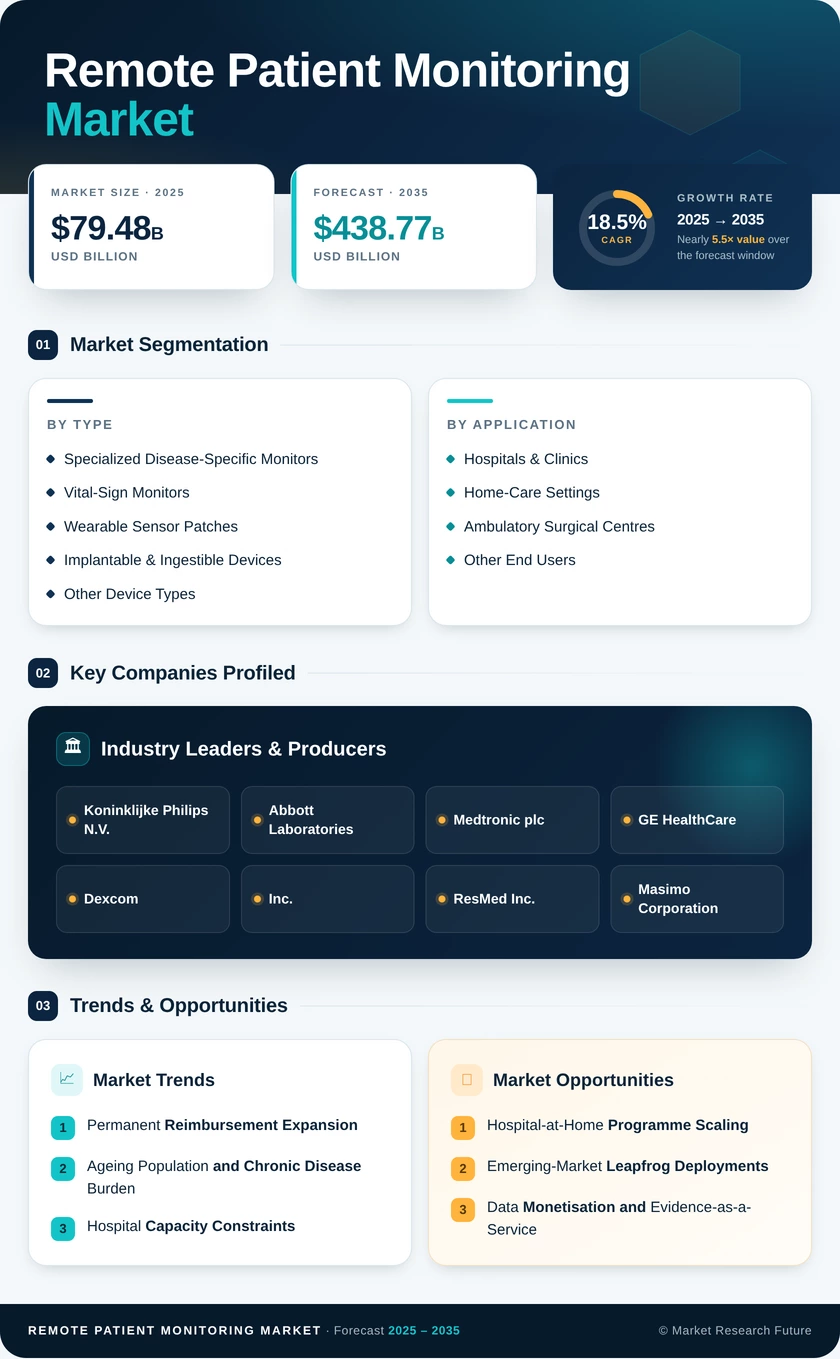
Remote Patient Monitoring Market (2026 - 2035)

Remote Patient Monitoring Market Research Report: Size, Share, Trend Analysis By Types (Devices and Services), By Applications (Cancer, Cardiovascular Diseases, and Diabetes), By End-User (Payers, Providers, and Patients), And By Region (North America, Europe, Asia-Pacific, And Rest Of The World) - Growth Outlook & Industry Forecast 2025 To 2035

Forecast Period
2026-2035
CAGR
18.5%
2025 Market Size
USD 79.48 Billion
2035 Market Size
USD 438.77 Billion
Healthcare ● Updated August 2026 Report ID: MRFR/HC/9421-HCR | Pages: 120 | Author: Rahul Gotadki, Vikita Thakur
  1. 1 Market Summary |
    1. 1.1 Study Assumptions & Market Definition |
    2. 1.2 Scope of the Study |
    3. 1.3 Research Methodology
  2. 2 Key Report Takeaways |
    1. 2.1 By Technology |
    2. 2.2 By Sector |
    3. 2.3 By Geography
  3. 3 Market Size & Forecast (2021–2035) |
    1. 3.1 Historical Market Size (2021–2024) |
    2. 3.2 Base Year Estimate (2025) |
    3. 3.3 Forecast Market Size (2026–2035) |
    4. 3.4 Year-over-Year Growth Analysis
  4. 4 Driver Impact Analysis |
    1. 4.1 Permanent Reimbursement Expansion |
    2. 4.2 Ageing Population and Chronic Disease Burden |
    3. 4.3 Hospital Capacity Constraints |
    4. 4.4 AI-Driven Deterioration Prediction
  5. 5 Restraints Impact Analysis |
    1. 5.1 Cybersecurity and Breach Liability |
    2. 5.2 Clinician Alarm Fatigue |
    3. 5.3 Reimbursement Gaps Outside the United States
  6. 6 Opportunities |
    1. 6.1 Hospital-at-Home Programme Scaling |
    2. 6.2 Emerging-Market Leapfrog Deployments |
    3. 6.3 Data Monetisation and Evidence-as-a-Service |
    4. 6.4 Payer-Embedded Chronic Care Bundles |
    5. 6.5 Interoperability-Native Platform Consolidation
  7. 7 Regional Market Share & Country-Level Analysis |
    1. 7.1 North America | |
      1. 7.1.1 US | |
      2. 7.1.2 Canada | |
      3. 7.1.3 Mexico |
    2. 7.2 Europe | |
      1. 7.2.1 Germany | |
      2. 7.2.2 UK | |
      3. 7.2.3 France | |
      4. 7.2.4 Italy | |
      5. 7.2.5 Spain | |
      6. 7.2.6 Nordic Countries | |
      7. 7.2.7 Russia | |
      8. 7.2.8 Rest of Europe |
    3. 7.3 Asia-Pacific | |
      1. 7.3.1 China | |
      2. 7.3.2 India | |
      3. 7.3.3 Japan | |
      4. 7.3.4 South Korea | |
      5. 7.3.5 ASEAN | |
      6. 7.3.6 Rest of Asia-Pacific |
    4. 7.4 South America | |
      1. 7.4.1 Brazil | |
      2. 7.4.2 Argentina | |
      3. 7.4.3 Rest of South America |
    5. 7.5 Middle East & Africa | |
      1. 7.5.1 Saudi Arabia | |
      2. 7.5.2 UAE | |
      3. 7.5.3 South Africa | |
      4. 7.5.4 Egypt | |
      5. 7.5.5 Rest of Middle East & Africa
  8. 8 Future Outlook (2026–2035) |
    1. 8.1 Autonomous Clinical Triage |
    2. 8.2 Platform Economics and Vendor Consolidation |
    3. 8.3 Diagnostics Convergence |
    4. 8.4 Regulatory Harmonisation and Data Sovereignty
  9. 9 Market Segmentation Analysis |
    1. 9.1 By Device Type | |
      1. 9.1.1 Vital-Sign Monitors | |
      2. 9.1.2 Specialized Disease-Specific Monitors | |
      3. 9.1.3 Wearable Sensor Patches | |
      4. 9.1.4 Implantable & Ingestible Devices | |
      5. 9.1.5 Other Device Types |
    2. 9.2 By Application | |
      1. 9.2.1 Cardiovascular Diseases | |
      2. 9.2.2 Diabetes Management | |
      3. 9.2.3 Respiratory & COPD | |
      4. 9.2.4 Neurological Disorders | |
      5. 9.2.5 Oncology | |
      6. 9.2.6 Other Applications |
    3. 9.3 By End User | |
      1. 9.3.1 Hospitals & Clinics | |
      2. 9.3.2 Home-Care Settings | |
      3. 9.3.3 Ambulatory Surgical Centres | |
      4. 9.3.4 Other End Users
  10. 10 Competitive Landscape |
    1. 10.1 Market Concentration Analysis (2026) |
    2. 10.2 Competitive Benchmarking Matrix |
    3. 10.3 Company Profiles | |
      1. 10.3.1 Koninklijke Philips N.V. | |
      2. 10.3.2 Abbott Laboratories | |
      3. 10.3.3 Medtronic plc | |
      4. 10.3.4 GE HealthCare | |
      5. 10.3.5 Dexcom, Inc. | |
      6. 10.3.6 ResMed Inc. | |
      7. 10.3.7 Masimo Corporation | |
      8. 10.3.8 Baxter International Inc. | |
      9. 10.3.9 Boston Scientific Corporation | |
      10. 10.3.10 OMRON Healthcare | |
      11. 10.3.11 BIOTRONIK SE & Co. KG | |
      12. 10.3.12 Nihon Kohden Corporation
  11. 11 Recent News & Developments
  12. 12 Report Scope & Methodology
  13. 13 Detailed Sources & Citations
  14. 14 Frequently Asked Questions
  15. 15 LIST OF TABLES |
  16. TABLE 1 Global Remote Patient Monitoring Market Size & Forecast, by Revenue (USD Billion), 2021–2035 |
  17. TABLE 2 Global Market — Year-over-Year Growth Analysis, 2021–2035 |
  18. TABLE 3 Driver Impact Analysis Matrix, 2026–2035 |
  19. TABLE 4 Restraint Impact Analysis Matrix, 2026–2035 |
  20. TABLE 5 Global Market Size, by Region, 2021–2035 (USD Billion) |
  21. TABLE 6 North America Market Size, by Country, 2021–2035 (USD Billion) |
  22. TABLE 7 Europe Market Size, by Country, 2021–2035 (USD Billion) |
  23. TABLE 8 Asia-Pacific Market Size, by Country, 2021–2035 (USD Billion) |
  24. TABLE 9 South America Market Size, by Country, 2021–2035 (USD Billion) |
  25. TABLE 10 Middle East & Africa Market Size, by Country, 2021–2035 (USD Billion) |
  26. TABLE 11 Global Market Size, by Device Type, 2021–2035 (USD Billion) |
  27. TABLE 12 Global Market Size, by Application, 2021–2035 (USD Billion) |
  28. TABLE 13 Global Market Size, by End User, 2021–2035 (USD Billion) |
  29. TABLE 14 North America Market Size, by Device Type, 2021–2035 (USD Billion) |
  30. TABLE 15 North America Market Size, by Application, 2021–2035 (USD Billion) |
  31. TABLE 16 Europe Market Size, by Device Type, 2021–2035 (USD Billion) |
  32. TABLE 17 Europe Market Size, by End User, 2021–2035 (USD Billion) |
  33. TABLE 18 Asia-Pacific Market Size, by Device Type, 2021–2035 (USD Billion) |
  34. TABLE 19 Asia-Pacific Market Size, by Application, 2021–2035 (USD Billion) |
  35. TABLE 20 South America Market Size, by End User, 2021–2035 (USD Billion) |
  36. TABLE 21 Middle East & Africa Market Size, by Application, 2021–2035 (USD Billion) |
  37. TABLE 22 Competitive Benchmarking Matrix, 2026 |
  38. TABLE 23 Company Profiles — Key Players |
  39. TABLE 24 Recent Developments & Strategic Announcements, 2023–2025 |
  40. TABLE 25 Report Scope & Methodology Summary |
  41. TABLE 26 Detailed Sources & Citations Index
  42. 16 LIST OF FIGURES |
  43. FIGURE 1 Market Dynamics — Drivers, Restraints, Opportunities and Challenges |
  44. FIGURE 2 Industry Value Chain Analysis |
  45. FIGURE 3 Porter's Five Forces Analysis |
  46. FIGURE 4 Global Market Size Trend & Forecast (USD Billion), 2021–2035 |
  47. FIGURE 5 Year-over-Year Growth Trajectory, 2022–2035 |
  48. FIGURE 6 Market Share by Device Type, 2025 vs 2035 |
  49. FIGURE 7 Market Share by Application, 2025 vs 2035 |
  50. FIGURE 8 Market Share by End User, 2025 vs 2035 |
  51. FIGURE 9 Regional Revenue Share Distribution, 2025 |
  52. FIGURE 10 Regional CAGR Comparison, 2026–2035 |
  53. FIGURE 11 Country-Level Growth Heatmap |
  54. FIGURE 12 Competitive Landscape Positioning Quadrant, 2026 |
  55. FIGURE 13 Top Player Revenue Share Ranges, 2025 |
  56. FIGURE 14 Reimbursement Coverage Maturity by Geography
Share::
Request Free Sample

Segmentation Quick Reference

DimensionSub-SegmentsDominant SegmentFastest Growing Segment
By Device TypeVital-Sign Monitors; Specialized Disease-Specific Monitors; Wearable Sensor Patches; Implantable & Ingestible Devices; Other Device TypesSpecialized Disease-Specific MonitorsWearable Sensor Patches
By ApplicationCardiovascular Diseases; Diabetes Management; Respiratory & COPD; Neurological Disorders; Oncology; Other ApplicationsCardiovascular DiseasesDiabetes Management
By End UserHospitals & Clinics; Home-Care Settings; Ambulatory Surgical Centres; Other End UsersHospitals & ClinicsHome-Care Settings
By GeographyNorth America; Europe; Asia-Pacific; South America; Middle East & AfricaNorth AmericaAsia-Pacific


Market Segmentation Overview

By Device Type

Sub-SegmentKey Trend
Vital-Sign MonitorsMigration from bedside carts to cellular-native home kits
Specialized Disease-Specific MonitorsGuideline endorsement drives reimbursement-linked volume
Wearable Sensor PatchesDisposable economics displacing durable Holter hardware
Implantable & Ingestible DevicesPressure-sensing implants extend heart-failure surveillance
Other Device TypesAccessory and connectivity peripherals grow with fleet size


Device taxonomy is converging on a two-tier structure: cheap disposable sensing at the edge, and expensive implantable or specialized hardware where clinical stakes justify the cost. The middle tier of general-purpose durable monitors faces the sharpest margin pressure.

By Application

Sub-SegmentKey Trend
Cardiovascular DiseasesReadmission penalties sustain the largest revenue pool
Diabetes ManagementType 2 and pre-diabetic coverage expansion accelerates volume
Respiratory & COPDPost-exacerbation surveillance becomes a discharge condition
Neurological DisordersSeizure and movement-disorder tracking gains payer traction
OncologySymptom and toxicity monitoring attaches to episode payments
Other ApplicationsMaternal health and post-surgical recovery scale from pilots


Applications with existing episode-based or penalty-linked payment structures adopt fastest, since procurement does not require creating a new reimbursement category. Oncology and maternal health represent the clearest near-term expansion frontiers.

By End User

Sub-SegmentKey Trend
Hospitals & ClinicsCapacity pressure converts monitoring into an operational necessity
Home-Care SettingsHospital-at-home waivers redirect inpatient budgets outward
Ambulatory Surgical CentresSame-day discharge protocols require post-op surveillance
Other End UsersPayers and long-term care facilities emerge as direct buyers


Purchasing authority is diffusing. Hospitals still hold the largest budgets, but payers buying monitoring as a supplemental benefit represent the structurally faster-growing channel because their savings accrue directly rather than through avoided penalties.




Share::
Request Free Sample
Download PDF ×

We do not share your information with anyone. However, we may send you emails based on your report interest from time to time. You may contact us at any time to opt-out.