Respiratory Care Devices Market (2026 - 2035)

ID: MRFR/MED/5055-HCR
128 Pages
Rahul Gotadki
Last Updated: July 17, 2026
Respiratory Care Devices Market Research Report By Device Type (Therapeutic Devices, Monitoring Devices, Diagnostic Devices, Consumables), By Application (Chronic Obstructive Pulmonary Disease, Asthma, Sleep Apnea, Respiratory Distress Syndrome), By End Use (Hospitals, Homecare, Ambulatory Care Centers, Emergency Medical Services), By Patient Type (Pediatric, Adult, Geriatric) and By Regional (North America, Europe, South America, Asia Pacific, Middle East and Africa) - Industry Forecast to 2035
Respiratory Care Devices Market
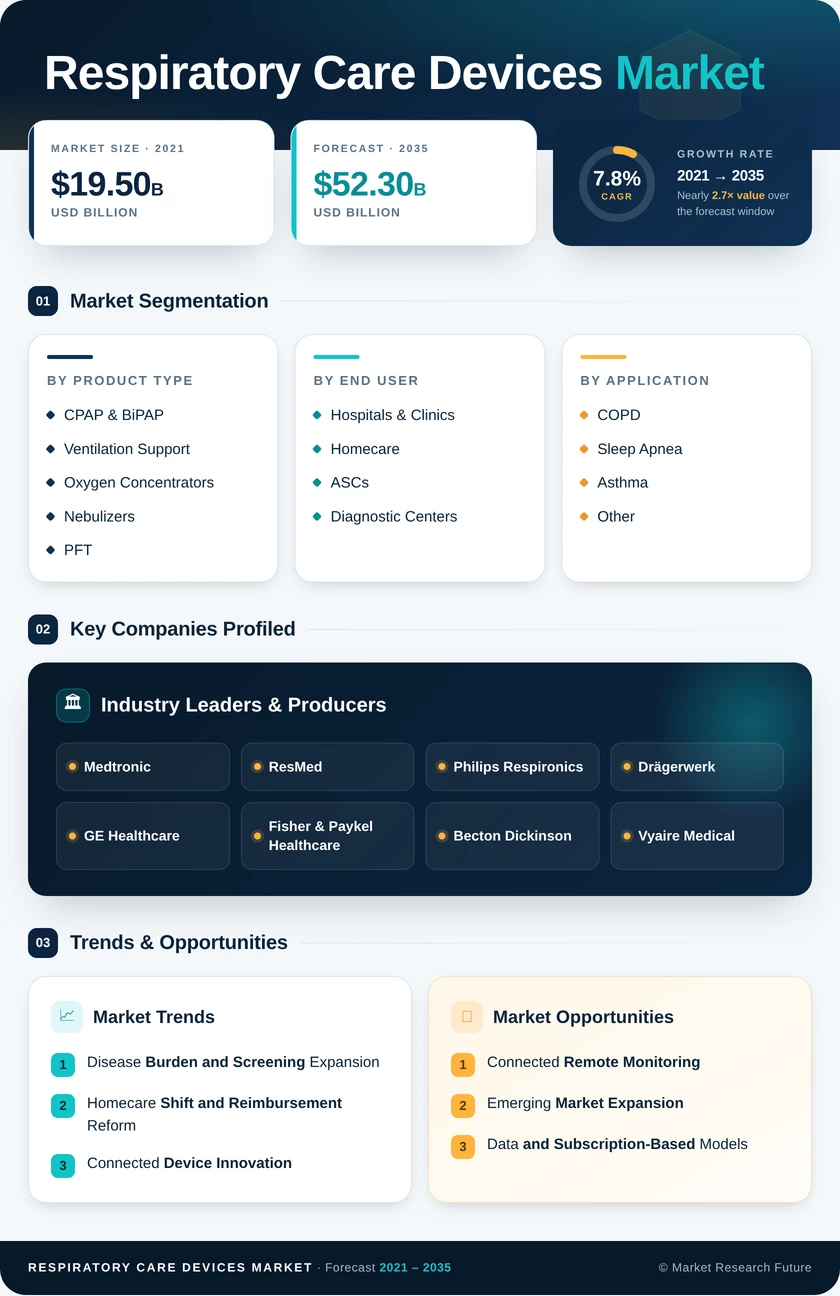
Market Size
Forecast Period2026-2035
CAGR (2026-2035)7.8%
2025 Market SizeUSD 24.8 Billion
2035 Market SizeUSD 52.3 Billion
Key Players
Medtronic
ResMed
Philips Respironics
Drägerwerk
GE Healthcare
Fisher & Paykel Healthcare
Opportunities
  • Connected Remote Monitoring
  • Emerging Market Expansion
  • Data and Subscription-Based Models
  1. 1 Market Overview
    1. 1.1 Study Assumptions & Market Definition
    2. 1.2 Scope of the Study
    3. 1.3 Research Methodology
  2. 2 Market Summary & Key Takeaways
  3. 3 Market Dynamics
    1. 3.1 Market Drivers Analysis
      1. 3.1.1 Disease Burden and Screening Expansion
      2. 3.1.2 Homecare Shift and Reimbursement Reform
      3. 3.1.3 Connected Device Innovation
    2. 3.2 Market Restraints Analysis
      1. 3.2.1 Reimbursement and Affordability Gaps
      2. 3.2.2 Regulatory and Quality Friction
    3. 3.3 Market Opportunity Analysis
      1. 3.3.1 Connected Remote Monitoring
      2. 3.3.2 Emerging Market Expansion
      3. 3.3.3 Data and Subscription-Based Models
      4. 3.3.4 Home Sleep Apnea Testing Growth
      5. 3.3.5 AI-Enabled Diagnostics
    4. 3.4 Industry Value Chain Analysis
    5. 3.5 Porter's Five Forces Analysis
  4. 4 Global Respiratory Care Devices Market Size & Forecast (2021–2035)
    1. 4.1 Historical Market Size (2021–2025)
    2. 4.2 Current & Forecast Market Size (2026–2035)
    3. 4.3 Market Size by Revenue (USD Billion)
    4. 4.4 Year-over-Year Growth Analysis
  5. 5 Segmentation Analysis
    1. 5.1 By Product Type
      1. 5.1.1 CPAP & BiPAP Systems
      2. 5.1.2 Ventilation Support Devices
      3. 5.1.3 Oxygen Concentrators
      4. 5.1.4 Nebulizers
      5. 5.1.5 Pulmonary Function Testing
      6. 5.1.6 Other (Humidifiers, Accessories)
    2. 5.2 By End User
      1. 5.2.1 Hospitals & Clinics
      2. 5.2.2 Homecare Settings
      3. 5.2.3 Ambulatory Surgical Centers
      4. 5.2.4 Diagnostic Centers
    3. 5.3 By Application
      1. 5.3.1 COPD
      2. 5.3.2 Obstructive Sleep Apnea
      3. 5.3.3 Asthma
      4. 5.3.4 Other Respiratory Disorders
  6. 6 Regional Analysis
    1. 6.1 North America
      1. 6.1.1 United States
      2. 6.1.2 Canada
      3. 6.1.3 Mexico
    2. 6.2 Europe
      1. 6.2.1 Germany
      2. 6.2.2 United Kingdom
      3. 6.2.3 France
      4. 6.2.4 Rest of Europe
    3. 6.3 Asia-Pacific
      1. 6.3.1 China
      2. 6.3.2 Japan
      3. 6.3.3 India
      4. 6.3.4 South Korea
      5. 6.3.5 Australia
      6. 6.3.6 Rest of Asia-Pacific
    4. 6.4 South America
      1. 6.4.1 Brazil
      2. 6.4.2 Rest of South America
    5. 6.5 Middle East & Africa
      1. 6.5.1 UAE
      2. 6.5.2 Saudi Arabia
      3. 6.5.3 Rest of Middle East & Africa
  7. 7 Competitive Landscape
    1. 7.1 Market Share Analysis (2026)
    2. 7.2 Competitive Benchmarking Matrix
    3. 7.3 Company Profiles
      1. 7.3.1 Medtronic
      2. 7.3.2 ResMed
      3. 7.3.3 Philips Respironics
      4. 7.3.4 Drägerwerk
      5. 7.3.5 GE Healthcare
      6. 7.3.6 Fisher & Paykel Healthcare
      7. 7.3.7 Becton Dickinson
      8. 7.3.8 Vyaire Medical
      9. 7.3.9 Hamilton Medical
      10. 7.3.10 Invacare
  8. 8 Future Outlook & Strategic Recommendations (2026–2035)
    1. 8.1 Near-Term Outlook (2026–2028)
    2. 8.2 Medium-Term Outlook (2029–2031)
    3. 8.3 Long-Term Outlook (2032–2035)
  9. 9 Recent Developments & News
  10. 10 Frequently Asked Questions (FAQs)
  11. 11 Report Scope & Methodology
    1. 11.1 Study Period & Base Year
    2. 11.2 Data Sources & Citations
    3. 11.3 Abbreviations
  12. 12 LIST OF TABLES |
  13. TABLE 1 Global Respiratory Care Devices Market Size & Forecast, by Revenue (USD Billion), 2021–2035 |
  14. TABLE 2 Global Respiratory Care Devices Market — Year-over-Year Growth Analysis, 2021–2035 |
  15. TABLE 3 Global Respiratory Care Devices Market Size, by Product Type, 2021–2035 (USD Billion) |
  16. TABLE 4 Global Respiratory Care Devices Market Size, by End User, 2021–2035 (USD Billion) |
  17. TABLE 5 Global Respiratory Care Devices Market Size, by Application, 2021–2035 (USD Billion) |
  18. TABLE 6 Global Respiratory Care Devices Market Size, by Region, 2021–2035 (USD Billion) |
  19. TABLE 7 North America Respiratory Care Devices Market Size, by Country, 2021–2035 (USD Billion) |
  20. TABLE 8 Europe Respiratory Care Devices Market Size, by Country, 2021–2035 (USD Billion) |
  21. TABLE 9 Asia-Pacific Respiratory Care Devices Market Size, by Country, 2021–2035 (USD Billion) |
  22. TABLE 10 South America Respiratory Care Devices Market Size, by Country, 2021–2035 (USD Billion) |
  23. TABLE 11 Middle East & Africa Respiratory Care Devices Market Size, by Country, 2021–2035 (USD Billion) |
  24. TABLE 12 Driver Impact Analysis — Global Respiratory Care Devices Market |
  25. TABLE 13 Restraint Impact Analysis — Global Respiratory Care Devices Market |
  26. TABLE 14 Competitive Benchmarking Matrix — Global Respiratory Care Devices Market, 2026 |
  27. TABLE 15 Company Profiles — Key Players, Global Respiratory Care Devices Market |
  28. TABLE 16 Recent Developments & Strategic Announcements, 2023–2025 |
  29. TABLE 17 Report Scope & Methodology Summary |
  30. TABLE 18 Detailed Sources & Citations
  31. 13 LIST OF FIGURES |
  32. FIGURE 1 Global Respiratory Care Devices Market Dynamics (Drivers, Restraints, Opportunities) |
  33. FIGURE 2 Industry Value Chain Analysis |
  34. FIGURE 3 Porter's Five Forces Analysis |
  35. FIGURE 4 Global Market Size Trend, 2021–2035 (USD Billion) |
  36. FIGURE 5 Market Share, by Product Type, 2026 |
  37. FIGURE 6 Market Share, by End User, 2026 |
  38. FIGURE 7 Market Share, by Application, 2026 |
  39. FIGURE 8 Regional Market Share, 2026 |
  40. FIGURE 9 Competitive Landscape Positioning Map

Segmentation Quick Reference

DimensionSub-SegmentsDominant SegmentFastest Growing Segment
By Product TypeCPAP & BiPAP, Ventilation Support, Oxygen Concentrators, Nebulizers, PFT, OtherCPAP & BiPAP SystemsOxygen Concentrators
By End UserHospitals & Clinics, Homecare, ASCs, Diagnostic CentersHospitals & ClinicsHomecare Settings
By ApplicationCOPD, Sleep Apnea, Asthma, OtherCOPDObstructive Sleep Apnea
By RegionNorth America, Europe, Asia-Pacific, South America, MEANorth AmericaAsia-Pacific


Market Segmentation Overview

By Product Type

Sub-SegmentKey Trend
CPAP & BiPAP SystemsConnected adherence-monitoring adoption
Ventilation Support DevicesPortable, transport-ready designs
Oxygen ConcentratorsLightweight, battery-efficient models
NebulizersPediatric-friendly compact formats
Pulmonary Function TestingExpanded early-screening deployment
Other (Humidifiers, Accessories)Steady consumables replacement demand


Product-type segmentation reflects the market's gradual rebalancing toward connected and portable formats as care shifts from hospital to home settings.

By End User

Sub-SegmentKey Trend
Hospitals & ClinicsCritical care capacity expansion
Homecare SettingsReimbursement-driven adoption growth
Ambulatory Surgical CentersOutpatient procedure volume increase
Diagnostic CentersStandalone screening service growth


Home care is steadily narrowing the gap with hospital procurement as payers favor lower-cost, at-home chronic disease management pathways.

By Application

Sub-SegmentKey Trend
COPDAn aging population and pollution-linked growth
Obstructive Sleep ApneaRising diagnostic awareness
AsthmaPediatric and adult prevalence increases
Other Respiratory DisordersBroader screening program expansion


Application-based segmentation underscores COPD's continued leadership position, while sleep apnea diagnosis growth is closing the gap fastest among major disease categories.


Download PDF ×

We do not share your information with anyone. However, we may send you emails based on your report interest from time to time. You may contact us at any time to opt-out.