Author

Snehal Singh

Retail BagsMarket Size, Share, Industry Trend & Analysis Research Report Information By Material (Plastic, Paper, Fabric, Biodegradable), By Product Type (Shopping Bags Tote Bags, Die-Cut Handle Bags, T-Shirt Bags), By End-Use Industry (Grocery Supermarkets, Fashion Apparel, Electronics Appliances, Food & Beverage, Health & Beauty, Luxury Specialty Stores), By Distribution Channel (Online Retail, Offline Retail), By Capacity (Small, Medium, Large), and Region (North America, Europe, Asia-Pacific, Africa, Latin America, Middle East) - Forecast till 2035
As per Market Research Future analysis, the Retail Bags Market Size was estimated at 16.08 USD Billion in 2024. The Retail Bags industry is projected to grow from 17.01 USD Billion in 2025 to 29.9 USD Billion by 2035, exhibiting a compound annual growth rate (CAGR) of 5.8% during the forecast period 2025 - 2035
The Retail Bags Market is experiencing a transformative shift towards sustainability and customization.
| 2024 Market Size | 16.08 (USD Billion) |
| 2035 Market Size | 29.9 (USD Billion) |
| CAGR (2025 - 2035) | 5.8% |
Novolex (US), Mondi Group (GB), Smurfit Kappa (IE), Sealed Air (US), Amcor (AU), International Paper (US), Berry Global (US), DS Smith (GB)
Our Impact
Enabled $4.3B Revenue Impact for Fortune 500 and Leading Multinationals
Partnering with 2000+ Global Organizations Each Year
30K+ Citations by Top-Tier Firms in the Industry
The Retail Bags Market is currently experiencing a dynamic transformation driven by evolving consumer preferences and regulatory changes. Increasing awareness regarding environmental sustainability has led to a notable shift towards eco-friendly materials. Retailers are increasingly adopting reusable and biodegradable options, which not only cater to consumer demand but also align with global sustainability goals. This trend appears to be reshaping the competitive landscape, as brands that prioritize sustainable practices may gain a significant advantage in attracting environmentally conscious consumers. Furthermore, the rise of e-commerce has influenced the Retail Bags Market, as online retailers seek innovative packaging solutions that enhance the unboxing experience while minimizing environmental impact. These evolving retail bags market trends are expected to redefine competitive strategies across regions.
In addition, the Retail Bags Market is witnessing a diversification of product offerings. Retailers are exploring various designs, sizes, and functionalities to meet the diverse needs of consumers. This trend suggests that customization and personalization are becoming increasingly important, as consumers seek bags that reflect their individual styles and preferences. As the market continues to evolve, it is likely that technological advancements will play a crucial role in shaping the future of retail bags, potentially leading to the development of smart bags that integrate technology for enhanced user experience, further shaping emerging retail bags market trends.
The Retail Bags Market is seeing a significant shift towards sustainable materials. Retailers are increasingly opting for biodegradable and reusable options, reflecting a growing consumer preference for environmentally friendly products. This trend indicates a broader commitment to sustainability within the retail sector and supports growth in the retail paper bag market, as paper alternatives gain popularity over single-use plastics.
The rise of e-commerce is reshaping the Retail Bags Market. Online retailers are seeking innovative packaging solutions that not only enhance the customer experience but also address environmental concerns. This shift suggests a need for adaptability in packaging strategies across the retail bags market size spectrum.
There is a noticeable trend towards customization in the Retail Bags Market. Retailers are offering a variety of designs and functionalities to cater to individual consumer preferences. This focus on personalization indicates a shift towards more tailored shopping experiences within the evolving retail bags market trends landscape.
The rapid expansion of e-commerce is significantly influencing the Retail bags Market. As online shopping continues to gain traction, the demand for packaging solutions, including retail bags, is on the rise. Market analysis indicates that the e-commerce sector is expected to grow by over 20% annually, driving the need for efficient and attractive packaging options. Retailers are increasingly focusing on providing a seamless unboxing experience, which includes the use of high-quality retail bags. This trend not only enhances customer satisfaction but also encourages repeat purchases, thereby propelling the Retail Bags Market forward. The interplay between e-commerce and retail bags is likely to shape future market dynamics.
Regulatory changes are emerging as a critical driver in the Retail Bags Market. Governments worldwide are implementing stricter regulations on plastic bag usage, prompting retailers to seek alternative solutions. These regulations often include bans on single-use plastics and mandates for recyclable materials, which are reshaping the market landscape. Market Research Future suggest that compliance with these regulations could lead to a shift in consumer behavior, as shoppers become more inclined to choose sustainable options. This regulatory environment not only influences product development but also encourages innovation within the Retail Bags Market, as companies strive to meet new standards while maintaining profitability.
The increasing emphasis on sustainability is a pivotal driver in the Retail Bags Market. Consumers are becoming more environmentally conscious, leading to a surge in demand for eco-friendly bags made from biodegradable or recyclable materials. This shift is reflected in market data, indicating that the sustainable retail bags segment is projected to grow at a compound annual growth rate of approximately 8% over the next five years. Retailers are responding by adopting sustainable practices, which not only meet consumer expectations but also enhance brand loyalty. As regulations around plastic usage tighten, businesses are compelled to innovate and offer sustainable alternatives, thereby shaping the Retail Bags Market towards a greener future.
Technological advancements play a crucial role in the evolution of the Retail Bags Market. Innovations in manufacturing processes, such as the use of advanced polymers and smart materials, are enhancing the durability and functionality of retail bags. Additionally, the integration of technology in design processes allows for greater customization, catering to diverse consumer preferences. Market data suggests that the adoption of technology in bag production could lead to a reduction in costs by up to 15%, making it more feasible for retailers to offer high-quality products. This trend not only improves operational efficiency but also positions the Retail Bags Market for sustained growth as it adapts to changing consumer demands.
Consumer preferences for convenience are reshaping the Retail Bags Market. As lifestyles become increasingly fast-paced, shoppers are seeking bags that offer ease of use and portability. This trend is evident in the rising popularity of reusable and foldable bags, which cater to the on-the-go consumer. Market data indicates that the convenience segment of retail bags is projected to account for a significant share of the market, with an expected growth rate of around 6% annually. Retailers are responding by diversifying their product offerings to include bags that align with these preferences, thereby enhancing their competitive edge in the Retail Bags Market.
In the Retail Bags Market, the material segment demonstrates diverse options, with plastic bags standing out as the largest segment. Plastic bags continue to hold a significant share of the market, favored for their durability and cost-effectiveness, resulting in their widespread usage across retail sectors. On the other hand, biodegradable bags have gained traction, reflecting an increasing consumer preference for sustainable options. This shift in preference is primarily driven by rising environmental concerns and regulatory measures pushing for reduced plastic consumption, positively impacting the retail paper bag market.
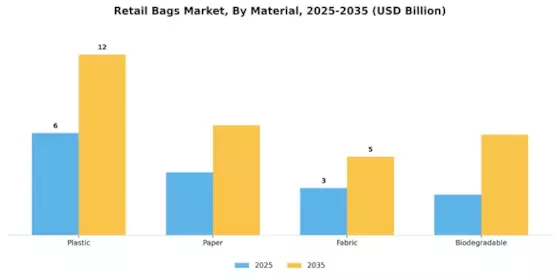
Plastic (Dominant) vs. Biodegradable (Emerging)
Plastic bags dominate the retail bags market due to their versatility, ease of production, and affordability. Conversely, biodegradable and paper-based alternatives are emerging strongly, strengthening the retail paper bag market as governments promote eco-friendly solutions. Plastic bags have become a staple for retailers seeking practical solutions for everyday use, contributing to their classification as the dominant material. Conversely, biodegradable bags are emerging as a key player, appealing to eco-conscious consumers and businesses aiming to reduce their environmental footprint. These bags are typically made from natural materials that decompose over time, making them an attractive alternative. The growth of biodegradable bags is guided by the increasing legislation against single-use plastics and heightened consumer awareness, signaling a positive trajectory for the segment.
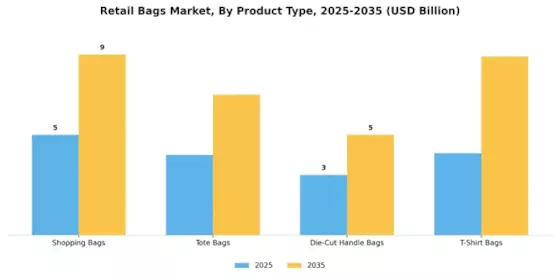
In the Retail Bags Market, Shopping Bags hold the largest share as they are a staple choice for consumers due to their convenience and versatility. With increasing awareness towards sustainability, reusable shopping bags have gained a substantial foothold, influencing the dynamics in this category. Conversely, Tote Bags are the fastest-growing segment, appealing particularly to eco-conscious consumers and urban dwellers looking for stylish and functional options. Their lightweight nature, coupled with trendy designs, makes them increasingly popular in the retail landscape. The growth in the Shopping Bags segment is spurred by factors such as e-commerce expansion and the increasing demand for convenient and eco-friendly shopping solutions. In contrast, the surge in Tote Bags can be attributed to rising fashion trends, as they are often seen as both practical and fashionable. Retailers are continuously innovating these bags to cater to evolving consumer preferences, further accelerating the growth of this segment.
Shopping Bags (Dominant) vs. Tote Bags (Emerging)
Shopping Bags are recognized as the dominant force in the Retail Bags Market due to their established presence and extensive usage in various retail outlets, often designed for durability and maximum utility. These bags are typically available in multiple materials, including plastic and biodegradable options, catering to diverse consumer preferences. On the other hand, Tote Bags have emerged as a fashionable alternative, gaining traction among younger demographics and those inclined towards sustainability. Their versatility allows them not only for shopping but also for everyday use, making them a valuable addition to consumers' wardrobes. Retailers are increasingly focusing on Tote Bags, enhancing their appeal through unique designs and sustainable materials, thus positioning them as a favorable option for fashion-forward shoppers.
The Retail Bags Market is significantly influenced by various end-use industries, with grocery supermarkets commanding the largest market share. This dominance stems from the continuous demand for retail bags in grocery stores, where consumers frequently purchase multiple items. Following closely are fashion apparel and food & beverage sectors, which also contribute notably to the market, although with smaller shares compared to grocery supermarkets. Health & beauty and electronics appliances segments are also active participants, reinforcing the diverse applications of retail bags across different sectors. Analyzing growth trends, the fashion apparel segment is emerging as the fastest-growing category, driven by the increasing importance of sustainability and eco-friendly packaging options. As consumers become more environmentally conscious, brands are increasingly opting for retail bags that align with these values. The food & beverage sector continues to innovate with new packaging solutions, further boosting demand. Innovation and eco-friendliness are at the forefront of industry shifts, making the retail bags market dynamic and forward-looking.
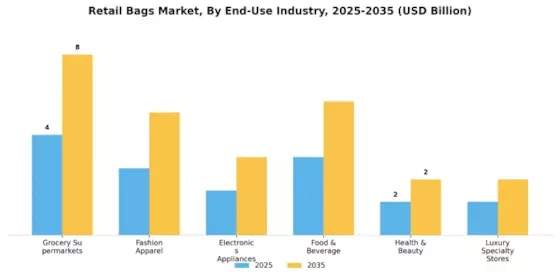
Grocery Supermarkets: Dominant vs. Fashion Apparel: Emerging
Grocery supermarkets represent the dominant force in the Retail Bags Market, benefiting from high consumer turnover and a consistent need for packaging solutions. These establishments utilize various types of retail bags to accommodate different products, emphasizing practicality and functionality in their offerings. On the other hand, the fashion apparel sector is classified as an emerging segment that is rapidly gaining momentum. Driven by trends such as consumer sustainability and an increased focus on branding, fashion retailers are innovating their packaging strategies. They are transitioning towards the use of more sustainable materials, appealing to eco-conscious consumers while enhancing the unboxing experience. This shift towards sustainability positions fashion apparel as a key player with significant growth potential in the retail bags market.
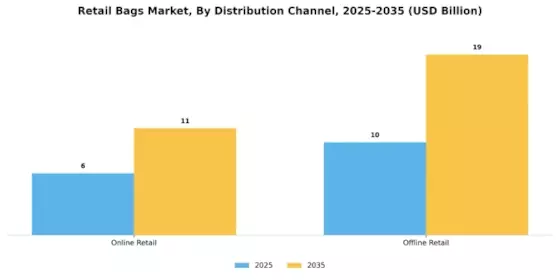
In the Retail Bags Market, Online Retail accounts for a significant portion of market share, driven by the growing preference for e-commerce shopping and convenience. As consumers increasingly migrate towards digital platforms for their shopping needs, the demand for retail bags in this channel continues to rise, showcasing its dominance within the market. Conversely, Offline Retail remains a vital channel, particularly in areas where consumers prefer in-person shopping experiences, contributing to the overall market dynamics.
Distribution Channels: Online Retail (Dominant) vs. Offline Retail (Emerging)
Online Retail in the Retail Bags Market holds a dominant position, characterized by an expansive reach and accessibility that caters to a broad demographic. Consumers benefit from the convenience of ordering bags online, often leading to higher sales volumes. On the other hand, Offline Retail is emerging rapidly, especially with the resurgence of brick-and-mortar stores post-pandemic, as customers seek tactile interactions with products. This channel is increasingly adapting to consumer preferences by enhancing in-store experiences and integrating digital solutions, ensuring its growth trajectory remains robust.
In the Retail Bags Market, the capacity segment exhibits a distinct distribution among small, medium, and large bags. Medium capacity bags occupy the largest share, serving as the most popular choice among consumers due to their versatility and convenience. Meanwhile, large capacity bags, while currently less prevalent, show increasing adoption as environmentally conscious consumers seek sustainable options for carrying goods. The preference for time-saving and efficient packing further supports the rise of these larger bags in retail settings.
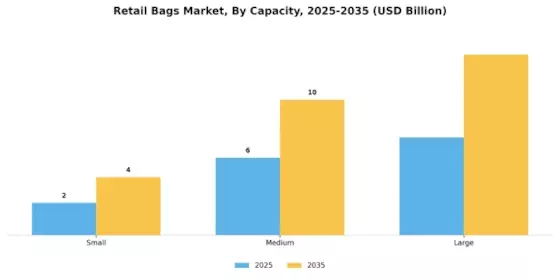
Medium Capacity (Dominant) vs. Large Capacity (Emerging)
Medium capacity retail bags are recognized for their dominance in the market, bridging the gap between usability and convenience. These bags cater to a diverse range of consumer needs, from daily shopping to special occasions. They are often the preferred choice due to their optimal size that accommodates various products without being cumbersome. On the other hand, large capacity bags are emerging as a popular choice among eco-friendly shoppers. Their growing acceptance is fueled by trends towards sustainability, with consumers increasingly favoring bags that minimize environmental impact. This segment appeals particularly to bulk purchasers and those looking for reusable options, reflecting a broader shift towards environmental responsibility.
Get more detailed insights about Retail Bags Market Request Free Sample
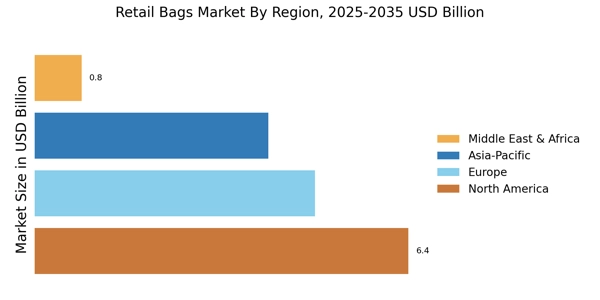
North America is the largest market for retail bags, holding approximately 40% of the global share, making it a critical region within the north america retail bags market landscape. The region's growth is driven by increasing consumer demand for sustainable packaging solutions and stringent regulations aimed at reducing plastic waste. The U.S. and Canada are the primary contributors, with strong expansion in the us retail bags market supported by regulatory initiatives and sustainability programs. Regulatory initiatives, such as bans on single-use plastics in several states, further catalyze market expansion. The competitive landscape in North America is robust, featuring key players like Novolex, Sealed Air, and International Paper. These companies are investing heavily in sustainable practices and product innovation to meet consumer preferences. The presence of advanced manufacturing facilities and a strong distribution network enhances market accessibility. As retailers increasingly adopt sustainable practices, the demand for eco-friendly retail bags is expected to rise significantly, solidifying North America's market position.
Europe is the second-largest market for retail bags, accounting for approximately 30% of the global market share. The region's growth is significantly influenced by stringent environmental regulations and a strong consumer preference for sustainable products. Countries like Germany and France lead the market, driven by initiatives aimed at reducing plastic usage and promoting biodegradable alternatives. The European Union's directives on single-use plastics are pivotal in shaping market dynamics and encouraging innovation in sustainable packaging solutions. Leading countries in Europe include Germany, France, and the UK, where major players like Mondi Group and DS Smith are actively engaged in developing eco-friendly products. The competitive landscape is characterized by a mix of established companies and innovative startups focusing on sustainable materials. As consumer awareness regarding environmental issues grows, the demand for retail bags that comply with regulatory standards is expected to surge, further enhancing market growth.
Asia-Pacific is an emerging powerhouse in the retail bags market, holding approximately 25% of the global share. The region's growth is fueled by rising disposable incomes, urbanization, and a shift towards modern retail formats. Countries like China and India are at the forefront, with increasing consumer awareness regarding environmental sustainability driving demand for eco-friendly bags. Government initiatives aimed at reducing plastic waste are also contributing to market expansion, creating a favorable environment for growth. The competitive landscape in Asia-Pacific is diverse, with key players such as Amcor and Berry Global leading the charge. The presence of a large manufacturing base and a growing retail sector enhances market dynamics. As consumers increasingly prefer sustainable options, companies are innovating to meet these demands, resulting in a dynamic market environment. The region's potential for growth is significant, with ongoing investments in sustainable practices expected to shape the future of the retail bags market.
The Middle East and Africa represent a resource-rich frontier for the retail bags market, holding approximately 5% of the global share. The region's growth is driven by increasing urbanization, a burgeoning retail sector, and rising consumer awareness regarding environmental issues. Countries like South Africa and the UAE are leading the market, with initiatives aimed at reducing plastic waste and promoting sustainable alternatives. Government regulations are gradually evolving to support eco-friendly practices, creating opportunities for market expansion. The competitive landscape in the Middle East and Africa is still developing, with a mix of local and international players. Companies are beginning to invest in sustainable packaging solutions to cater to the growing demand for eco-friendly products. As the retail sector continues to expand, the demand for innovative retail bags is expected to rise, presenting significant growth opportunities for businesses in the region. The focus on sustainability is likely to shape the future of the retail bags market in this region.
Many global, regional, and local vendors characterize the Retail Bags Market. The market is highly competitive, with all the players competing to gain market share. Intense competition, rapid advances in technology, frequent changes in government policies, and environmental regulations are key factors that confront market growth. The vendors compete based on cost, product quality, reliability, and government regulations. Vendors must provide cost-efficient, high-quality products to survive and succeed in an intensely competitive market.The major competitors in the market are Berry Global Inc, COSMOPLAST UAE, Action Packaging, The Clorox Company, International Plastics Inc, NOVOLEX (US), NOVPLASTA, S.R.O, INTEPLAST Group, Poly-America, L.P, Reynolds Consumer Products LLC, PLASTA Group, Biobag International As, POLYKAR Industries Inc, Universal Plastic & Metal Manufacturing Limited, Alpha Omega Pack Factory L.L.C are among others. The Retail Bags Market is a consolidated market due to increasing competition, acquisitions, mergers and other strategic market developments and decisions to improve operational effectiveness.


November 2023: Reynolds Consumer Products, the creator of Hefty® Ultra Strong™ trash bags, today announced that Hefty® Ultra Strong™ Fabuloso®* Scented tall kitchen trash bags have been recognized as one of the 2022 New Product Pacesetters™ of 2022.
September 2022: Novolex invested USD 10 million to expand its plastic bag and polyethylene film recycling capacity at its facility in North Vernon, Indiana. This strategic move demonstrates Novolex's commitment to promoting recycling and furthering its capabilities in the sustainable management of plastic materials.
March 2022: Action Bags has successfully acquired Four Star Plastics, a strategic move that will enhance their capabilities and expand product offerings. This acquisition marks a significant milestone for both companies, bringing together Action Bags’ extensive experience in packaging solutions with Four Star Plastics’ expertise in plastic manufacturing.
January 2020: The Clorox Company Glad® business announced that it has introduced recyclable food bags as part of its integration with TerraCycle's Loop pilot program in the U.S. Through this program, consumers will be able to order the products online and then receive and recycle their favorite food bags through a reusable steel container and return pouch.
Retail Bags Market Segmentation
Retail Bags Market by Material Outlook
Retail Bags Market by Product Type Outlook
Retail Bags Market by End-Use Industry Outlook
Retail Bags Market by Distribution Channel Outlook
Retail Bags Market by Capacity Outlook
Retail Bags Market Regional Outlook
The Retail Bags Market is projected to grow at a 5.8% CAGR from 2025 to 2035, driven by sustainability trends, e-commerce expansion, and consumer preferences for convenience.
New opportunities lie in:
By 2035, the Retail Bags Market is expected to achieve robust growth, reflecting evolving consumer demands and innovative solutions.
| MARKET SIZE 2024 | 16.08(USD Billion) |
| MARKET SIZE 2025 | 17.01(USD Billion) |
| MARKET SIZE 2035 | 29.9(USD Billion) |
| COMPOUND ANNUAL GROWTH RATE (CAGR) | 5.8% (2025 - 2035) |
| REPORT COVERAGE | Revenue Forecast, Competitive Landscape, Growth Factors, and Trends |
| BASE YEAR | 2024 |
| Market Forecast Period | 2025 - 2035 |
| Historical Data | 2019 - 2024 |
| Market Forecast Units | USD Billion |
| Key Companies Profiled | Novolex (US), Mondi Group (GB), Smurfit Kappa (IE), Sealed Air (US), Amcor (AU), International Paper (US), Berry Global (US), DS Smith (GB) |
| Segments Covered | Material, Product Type, End-Use Industry, Distribution Channel, Capacity |
| Key Market Opportunities | Growing demand for sustainable materials in the Retail Bags Market presents significant innovation opportunities. |
| Key Market Dynamics | Shifting consumer preferences towards sustainable materials drive innovation and competition in the retail bags market. |
| Countries Covered | North America, Europe, APAC, South America, MEA |
The Retail Bags Market is projected to reach a valuation of 29.9 USD Billion by 2035.


The secondary research process involved comprehensive analysis of regulatory databases, industry publications, packaging associations, and authoritative government sources. Key sources included the United States Environmental Protection Agency (EPA), European Environment Agency (EEA), Food and Drug Administration (FDA) Center for Food Safety and Applied Nutrition, European Commission Directorate-General for Environment, American Forest & Paper Association (AF&PA), Flexible Packaging Association (FPA), Plastics Industry Association (PLASTICS), National Retail Federation (NRF), Eurostat Packaging Waste Database, Statistics Canada Manufacturing and Retail Trade Divisions, China National Bureau of Statistics, Ministry of Environment, Forest and Climate Change (India), Central Pollution Control Board (CPCB) India, Australian Bureau of Statistics, United Nations Environment Programme (UNEP) Global Plastics Outlook, World Economic Forum (WEF) Circular Economy Reports, Organization for Economic Co-operation and Development (OECD) Environment Statistics, International Trade Centre (ITC) Trade Map, and national commerce ministry reports from key retail markets. These sources were used to collect packaging waste regulations, retail trade statistics, material consumption trends, single-use plastic ban implementations, sustainability mandates, and market landscape analysis for polyethylene (PE), polypropylene (PP), paper bags, biodegradable plastics, and reusable bag technologies.
Qualitative and quantitative insights were obtained by interviewing supply-side and demand-side stakeholders during the primary research process. CEOs, VPs of Sustainability, manufacturing leaders, and commercial directors from retail bag manufacturers, flexible packaging converters, and material suppliers comprised the supply-side sources. Procurement directors, sustainability officers, and supply chain managers from grocery retailers, quick-service restaurant chains, e-commerce platforms, and food service operators comprised demand-side sources. The primary research validated material segmentation, confirmed the timelines for sustainable packaging transition, and collected insights on procurement patterns, price volatility impacts, and regulatory compliance strategies.
Primary Respondent Breakdown:
By Designation: C-level Primaries (28%), Director Level (35%), Others (37%)
By Region: North America (32%), Europe (30%), Asia-Pacific (35%), Rest of World (3%)
Global market valuation was derived through production volume analysis and revenue mapping across the packaging value chain. The methodology included:
Identification of 55+ key manufacturers and converters across North America, Europe, Asia-Pacific, and Latin America
Product mapping across plastic (PE, PP, biodegradable),
Kindly complete the form below to receive a free sample of this Report

“This is really good guys. Excellent work on a tight deadline. I will continue to use you going forward and recommend you to others. Nice job”


“Thanks. It’s been a pleasure working with you, please use me as reference with any other Intel employees.”


“Thanks for sending the report it gives us a good global view of the Betaïne market.”


“Thank you, this will be very helpful for OQS.”


“We found the report very insightful! we found your research firm very helpful. I'm sending this email to secure our future business.”


“I am very pleased with how market segments have been defined in a relevant way for my purposes (such as "Portable Freezers & refrigerators" and "last-mile"). In general the report is well structured. Thanks very much for your efforts.”


“I have been reading the first document or the study, ,the Global HVAC and FP market report 2021 till 2026. Must say, good info! I have not gone in depth at all parts, but got a good indication of the data inside!”


“We got the report in time, we really thank you for your support in this process. I also thank to all of your team as they did a great job.”


“The Automotive 48V ECU Components Procurement Intelligence Study” was a complex project, but the Market Research Future (MRFR) team handled it with quality, agility, and customer-centricity. They delivered all requested data on time and within the agreed scope. The team, including Shubhendra Anand and Rahul Gotadki, was always readily available to clarify questions and swiftly implement necessary adjustments, driving the project to a successful conclusion within a very demanding timeframe.
I would also like to specifically commend Akshay Agarwal for his responsiveness and support at every stage—from our initial inquiry on May 6th through to final delivery on June 18th. His dedication made the entire process seamless.”



