×
Request Free Sample ×

Kindly complete the form below to receive a free sample of this Report

* Please use a valid business email

Leading companies partner with us for data-driven Insights

clients tt-cursor
Hero Background

Returnable Transport Packaging Market

ID: MRFR/PCM/22394-HCR
111 Pages
Snehal Singh
October 2025

Returnable Transport Packaging Rtp Market Research Report: By Material Type (Plastic, Metal, Wood, Corrugated Cardboard), By Application (Food and Beverage, Automotive, Healthcare, Industrial, Retail), By Design Type (Foldable, Collapsible, Stackable, Reusable) and By Regional (North America, Europe, South America, Asia Pacific, Middle East and Africa) - Forecast to 2035.

Share:
Download PDF ×

We do not share your information with anyone. However, we may send you emails based on your report interest from time to time. You may contact us at any time to opt-out.

Returnable Transport Packaging Market Infographic
Purchase Options

Returnable Transport Packaging Market Summary

As per MRFR analysis, the Returnable Transport Packaging Market Size was estimated at 12.35 USD Billion in 2024. The Returnable Transport Packaging industry is projected to grow from 12.91 USD Billion in 2025 to 20.01 USD Billion by 2035, exhibiting a compound annual growth rate (CAGR) of 4.48 during the forecast period 2025 - 2035.

Key Market Trends & Highlights

The Returnable Transport Packaging Market is experiencing a robust shift towards sustainability and technological innovation.

  • The market is increasingly driven by a focus on sustainability, with companies prioritizing eco-friendly packaging solutions.
  • Technological advancements are enhancing the efficiency and functionality of returnable transport packaging systems.
  • Customization and flexibility are becoming essential as businesses seek tailored solutions to meet diverse operational needs.
  • Key market drivers include sustainability initiatives and cost efficiency, particularly in the Food and Beverage and Pharmaceuticals segments across North America and Asia-Pacific.

Market Size & Forecast

2024 Market Size 12.35 (USD Billion)
2035 Market Size 20.01 (USD Billion)
CAGR (2025 - 2035) 4.48%

Major Players

CHEP (AU), IFCO SYSTEMS (DE), Palletways (GB), Rehrig Pacific Company (US), Schoeller Allibert (NL), Tosca Services (US), Averitt Express (US), Kuehne + Nagel (CH)

Returnable Transport Packaging Market Trends

The Returnable Transport Packaging Market is currently experiencing a notable transformation, driven by a growing emphasis on sustainability and cost efficiency. Companies are increasingly recognizing the environmental benefits associated with reusable packaging solutions, which not only reduce waste but also lower overall transportation costs. This shift appears to be influenced by heightened consumer awareness regarding ecological issues, prompting businesses to adopt practices that align with sustainable development goals. Furthermore, advancements in materials technology are enabling the production of more durable and lightweight packaging options, which may enhance the appeal of returnable transport solutions across various industries. In addition to sustainability, the Returnable Transport Packaging Market is witnessing a surge in innovation, with companies exploring new designs and functionalities to meet diverse logistical needs. The integration of smart technologies, such as RFID tracking and IoT capabilities, is becoming increasingly prevalent, allowing for improved inventory management and enhanced supply chain visibility. This trend suggests that the market is not only evolving in terms of materials but also in terms of operational efficiency. As businesses continue to prioritize sustainability and efficiency, the Returnable Transport Packaging Market is poised for further growth, potentially reshaping the landscape of logistics and supply chain management in the coming years.

Sustainability Focus

The Returnable Transport Packaging Market is increasingly influenced by a strong commitment to sustainability. Companies are adopting reusable packaging solutions to minimize waste and reduce their carbon footprint, reflecting a broader trend towards environmentally responsible practices.

Technological Advancements

Innovations in materials and technology are reshaping the Returnable Transport Packaging Market. The introduction of lightweight, durable materials and smart technologies, such as RFID and IoT, enhances operational efficiency and inventory management.

Customization and Flexibility

There is a growing demand for customized returnable transport packaging solutions tailored to specific industry needs. This trend indicates a shift towards more flexible packaging options that can accommodate various products and logistical requirements.

Returnable Transport Packaging Market Drivers

Sustainability Initiatives

The increasing emphasis on sustainability within the Global Returnable Transport Packaging Market Rtp Market Industry is a primary driver. Companies are increasingly adopting returnable transport packaging solutions to reduce waste and minimize their carbon footprint. For instance, major retailers are transitioning to reusable containers, which not only lowers landfill contributions but also enhances brand reputation. The market is projected to reach 12.3 USD Billion in 2024, reflecting a growing commitment to environmentally friendly practices. This trend is likely to continue as consumers demand more sustainable options, pushing businesses to innovate and invest in returnable transport packaging solutions.

Market Segment Insights

By Application: Food and Beverage (Largest) vs. Pharmaceuticals (Fastest-Growing)

In the Returnable Transport Packaging Market, the application segment has a diverse distribution, with Food and Beverage leading the way. This segment dominates due to the rising demand for sustainable packaging solutions and efficient logistics processes, which are essential for maintaining freshness and reducing waste. Pharmaceuticals follow closely, emerging as a significant player in the market, driven by the need for secure and compliant transportation of sensitive products. The growth trends within the application segment reveal robust expansion across sectors, particularly in Pharmaceuticals, which is becoming the fastest-growing segment. The increasing focus on environmentally friendly packaging, coupled with stringent regulations in the pharmaceutical sector, is propelling its demand. Additionally, advancements in packaging technology and logistical innovations are enhancing the efficiency of returnable transport packaging, thereby attracting more industries to adopt these solutions.

Food and Beverage: Dominant vs. Pharmaceuticals: Emerging

The Food and Beverage application of returnable transport packaging holds a dominant position, characterized by its need for efficient and sustainable solutions to meet high-volume transportation demands. This segment thrives on the principles of reducing costs and minimizing environmental impact, leading to a continued preference for reusable packaging options. Its strong market presence is bolstered by consumer trends favoring fresh and high-quality products, which require secure and reliable transport systems. On the other hand, the Pharmaceuticals segment is emerging, driven by stringent regulatory requirements for the safe transportation of sensitive medical products. This segment prioritizes security, traceability, and compliance, making innovative packaging solutions extremely relevant. As pharmaceuticals become increasingly complex, the demand for specialized, returnable packaging systems that ensure product integrity during transit is expected to rise, thereby positioning this segment for rapid growth in the coming years.

By Material Type: Plastic (Largest) vs. Metal (Fastest-Growing)

In the Returnable Transport Packaging Market, the material type segment showcases a diverse distribution among various materials such as plastic, metal, wood, glass, and textile. Plastic dominates this market, benefitting from its lightweight properties and recyclability, appealing to businesses looking for cost-effective and sustainable solutions. Metal, while not the largest segment, is rapidly gaining attention due to its durability and strength, making it a preferred choice for transporting heavier goods.

Plastic (Dominant) vs. Metal (Emerging)

Plastic remains the dominant material in the Returnable Transport Packaging Market due to its versatility, lightweight nature, and resistance to various chemicals. It is widely favored in various industries like food, pharmaceuticals, and retail, where hygiene and reuse are crucial. Conversely, metal packaging is emerging as a strong player, particularly in sectors requiring strong, protective packaging. Its recyclability and ability to protect contents from external factors have led to an uplift in its popularity, especially among environmentally conscious companies. As sustainability concerns grow, both materials are likely to evolve, with more innovations expected in metal as it transitions from traditional uses to more versatile applications.

By End Use: Retail (Largest) vs. E-commerce (Fastest-Growing)

The Returnable Transport Packaging Market exhibits a varied landscape across its end use segments. The retail segment currently holds a significant share, driven by the increasing demand for sustainable packaging solutions that enhance customer satisfaction. Retailers are adopting returnable transport packaging to streamline their supply chains and reduce waste, which reinforces this segment's dominant position. In contrast, the logistics and manufacturing segments also contribute to the market, reflecting robust demands for reusable packaging in operations and product handling.

Retail (Dominant) vs. E-commerce (Emerging)

The retail end use segment is characterized by its high usage of returnable transport packaging, supporting efficient distribution and enhancing customer experience through quality assurance. Retailers leverage this packaging to minimize costs and improve sustainability, leading to increased operational efficiencies. On the other hand, the e-commerce segment is emerging rapidly, driven by the boom in online shopping and the need for secure, sustainable packaging solutions. E-commerce platforms utilize returnable transport packaging to enhance product protection during shipping while also minimizing environmental impact. This segment's growth is fueled by changing consumer preferences toward eco-friendly practices and innovations in packaging technology.

By Design Type: Reusable Containers (Largest) vs. Pallets (Fastest-Growing)

In the Returnable Transport Packaging Market, the market share is significantly led by reusable containers, which are extensively used due to their versatility and environmental benefits. Pallets follow closely, representing a substantial portion of the market share, while crates, bags, and dunnage also contribute to the overall segment, albeit at a smaller scale. Each design type meets different logistical needs, catering to varied industries in transportation and storage.

Pallets (Dominant) vs. Crates (Emerging)

Pallets are recognized as the dominant design type in the Returnable Transport Packaging Market due to their efficiency in handling and transporting goods. Their ability to support heavy loads and ease of stacking makes them ideal for a wide range of industries. Crates, on the other hand, represent an emerging segment, gaining traction due to their ability to securely hold products and provide protection during transit. While pallets offer widespread usage, crates are carving out a niche, particularly in sectors where product integrity is critical. The ongoing shift towards sustainability is further pushing the development and adoption of both pallets and crates.

By Size and Capacity: Large (Largest) vs. Small (Fastest-Growing)

In the Returnable Transport Packaging Market, the size and capacity segment displays a diverse distribution among various sizes. Large-sized packaging dominates the market due to its ability to accommodate bulk goods efficiently, appealing to large-scale manufacturers. Meanwhile, small-sized options have gained traction, often favored by e-commerce businesses and retailers that prioritize space-saving solutions for shipment and storage. Growth trends reveal an increasing preference for small and custom-sized packaging as consumer behavior shifts towards more sustainable and flexible solutions. As businesses adapt to changing logistics demands, the custom size segment is poised for growth, driven by innovation aimed at minimizing waste and enhancing operational efficiency. The stackable options are also witnessing a rise, reinforcing the need for optimized storage and transportation solutions.

Large (Dominant) vs. Small (Emerging)

The large segment of the Returnable Transport Packaging Market is characterized by robust durability and capacity, making it the preferred choice for industries requiring the transport of heavier, bulk items. Large transport packaging solutions maximize space during shipping and distribution, significantly reducing logistical costs for manufacturers. On the other hand, the small segment is emerging as a significant player, primarily driven by the rise of e-commerce, where compact packaging is essential for cost-effective and efficient shipping. Small-sized solutions are often lightweight and designed for quick handling, appealing to businesses that require quick deliveries and flexible inventory management. The growing trend towards environmentally friendly packaging solutions has further propelled demand in both segments, with innovations catering to sustainability needs.

Get more detailed insights about Returnable Transport Packaging Market

Regional Insights

North America : Market Leader in Packaging Solutions

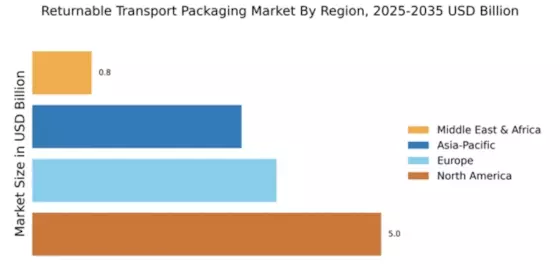
North America is poised to maintain its leadership in the Returnable Transport Packaging Market, holding a significant market share of 5.0 in 2024. The region's growth is driven by increasing demand for sustainable packaging solutions, stringent regulations promoting recycling, and a robust logistics infrastructure. Companies are increasingly adopting returnable packaging to reduce waste and enhance supply chain efficiency, aligning with environmental goals. The competitive landscape in North America is characterized by the presence of key players such as CHEP, Rehrig Pacific Company, and Tosca Services. These companies are leveraging advanced technologies and innovative designs to meet the evolving needs of various industries, including food and beverage, automotive, and retail. The focus on sustainability and cost-effectiveness is expected to further propel market growth in this region.

Europe : Sustainable Packaging Initiatives

Europe is witnessing a significant shift towards sustainable packaging solutions, with a market size of 3.5 in 2024. The region's growth is fueled by stringent environmental regulations and a strong consumer preference for eco-friendly products. Governments are actively promoting the use of returnable transport packaging to minimize waste and enhance recycling efforts, creating a favorable regulatory environment for market expansion. Leading countries such as Germany, France, and the UK are at the forefront of this trend, with major players like IFCO SYSTEMS and Schoeller Allibert driving innovation. The competitive landscape is marked by collaborations and partnerships aimed at developing advanced packaging solutions that meet both regulatory requirements and consumer expectations. This focus on sustainability is expected to continue shaping the market dynamics in Europe.

Asia-Pacific : Emerging Market Potential

Asia-Pacific is emerging as a significant player in the Returnable Transport Packaging Market, with a market size of 3.0 in 2024. The region's growth is driven by rapid industrialization, increasing urbanization, and a growing emphasis on sustainable practices. Countries like China and India are witnessing a surge in demand for returnable packaging solutions as businesses seek to optimize supply chains and reduce environmental impact. The competitive landscape in Asia-Pacific is evolving, with both local and international players vying for market share. Companies such as Kuehne + Nagel and Palletways are expanding their operations to cater to the increasing demand. The focus on innovation and sustainability is expected to drive further growth, making this region a key area of interest for investors and stakeholders in the packaging industry.

Middle East and Africa : Developing Market Landscape

The Middle East and Africa region is gradually developing its Returnable Transport Packaging Market, with a market size of 0.85 in 2024. The growth is primarily driven by increasing investments in infrastructure and logistics, alongside a rising awareness of sustainable packaging solutions. Governments are beginning to implement regulations that encourage the use of returnable packaging, which is expected to boost market growth in the coming years. Countries like South Africa and the UAE are leading the charge, with local and international companies exploring opportunities in this emerging market. The presence of key players is still limited, but as demand grows, more companies are likely to enter the market, enhancing competition and innovation. This region presents unique opportunities for growth, particularly in sectors such as food and beverage and retail.

Key Players and Competitive Insights

The Returnable Transport Packaging Market is currently characterized by a dynamic competitive landscape, driven by increasing demand for sustainable packaging solutions and the need for efficient supply chain management. Key players such as CHEP (AU), IFCO SYSTEMS (DE), and Schoeller Allibert (NL) are strategically positioned to leverage these trends. CHEP (AU) focuses on innovation in pallet and container solutions, while IFCO SYSTEMS (DE) emphasizes its commitment to sustainability through reusable plastic containers. Schoeller Allibert (NL) is enhancing its product offerings with advanced materials and designs, collectively shaping a competitive environment that prioritizes efficiency and environmental responsibility.

In terms of business tactics, companies are increasingly localizing manufacturing to reduce lead times and optimize supply chains. The market appears moderately fragmented, with several key players exerting considerable influence. This structure allows for a diverse range of offerings, catering to various industries, including food and beverage, automotive, and consumer goods. The collective strategies of these companies suggest a trend towards collaboration and shared resources, enhancing overall market efficiency.

In November 2025, CHEP (AU) announced a partnership with a leading logistics provider to enhance its service offerings in the Asia-Pacific region. This strategic move is likely to bolster CHEP's market presence and improve its operational efficiency, aligning with the growing demand for integrated supply chain solutions. The partnership may also facilitate the introduction of innovative packaging solutions tailored to regional needs, thereby reinforcing CHEP's competitive edge.

In October 2025, IFCO SYSTEMS (DE) launched a new line of eco-friendly reusable containers designed specifically for the fresh produce sector. This initiative underscores IFCO's commitment to sustainability and positions the company as a leader in environmentally responsible packaging. The introduction of these containers is expected to attract environmentally conscious clients, potentially increasing market share and enhancing brand loyalty.

In September 2025, Schoeller Allibert (NL) expanded its product range by introducing a new series of collapsible containers aimed at the automotive industry. This strategic expansion not only diversifies Schoeller Allibert's offerings but also addresses the specific needs of the automotive sector for space-efficient and durable packaging solutions. Such innovations are likely to enhance customer satisfaction and drive sales growth in a competitive market.

As of December 2025, the Returnable Transport Packaging Market is witnessing trends such as digitalization, sustainability, and AI integration, which are redefining competitive dynamics. Strategic alliances among key players are becoming increasingly common, fostering innovation and enhancing supply chain reliability. The shift from price-based competition to a focus on technological advancements and sustainable practices is evident, suggesting that future competitive differentiation will hinge on the ability to innovate and adapt to evolving market demands.

Key Companies in the Returnable Transport Packaging Market market include

Industry Developments

  • Q2 2024: ORBIS Corporation Expands Manufacturing Capabilities with New Facility in Urbana, Ohio ORBIS Corporation, a leader in reusable packaging, announced the opening of a new manufacturing facility in Urbana, Ohio, to increase production capacity for its returnable transport packaging solutions.
  • Q2 2024: Schoeller Allibert Launches New Range of Returnable Plastic Pallets for Automotive Sector Schoeller Allibert introduced a new line of returnable plastic pallets designed specifically for the automotive industry, aiming to enhance supply chain sustainability and efficiency.
  • Q1 2024: Brambles Appoints New CEO to Lead Global Reusable Packaging Business Brambles Limited, parent company of CHEP, announced the appointment of a new Chief Executive Officer to drive growth and innovation in its global returnable transport packaging operations.
  • Q2 2024: Mauser Packaging Solutions Announces Strategic Partnership with European Logistics Provider Mauser Packaging Solutions entered into a strategic partnership with a major European logistics company to expand the use of returnable intermediate bulk containers across the continent.
  • Q1 2024: DS Smith Opens New Innovation Hub Focused on Reusable Transport Packaging DS Smith inaugurated a new innovation hub dedicated to developing advanced reusable transport packaging solutions for the food and beverage sector.
  • Q2 2024: Myers Industries Acquires Reusable Packaging Firm Scepter Myers Industries completed the acquisition of Scepter, a manufacturer of reusable transport packaging products, to strengthen its position in the North American market.
  • Q1 2024: Greif Launches EcoBalance Returnable IBCs for Chemical Industry Greif introduced its new EcoBalance line of returnable intermediate bulk containers (IBCs), targeting chemical manufacturers seeking sustainable transport solutions.
  • Q2 2024: Berry Global Announces $70 Million Investment in Returnable Packaging Production Berry Global revealed a $70 million investment to expand its manufacturing capacity for returnable transport packaging products in North America.
  • Q1 2024: Brambles’ CHEP Division Wins Major Contract with European Retailer for Reusable Pallet Pooling CHEP, a division of Brambles, secured a significant contract to provide reusable pallet pooling services to a leading European retail chain.
  • Q2 2024: Schoeller Allibert and IFCO Announce Collaboration on Smart Returnable Crate Solutions Schoeller Allibert and IFCO entered a collaboration to develop smart returnable crate solutions featuring IoT tracking for the fresh produce supply chain.
  • Q1 2024: Schuetz Expands Returnable Packaging Production with New Facility in Mexico Schuetz opened a new manufacturing facility in Mexico to increase production of returnable transport packaging for the Latin American market.
  • Q2 2024: ORBIS Corporation Partners with Major US Grocery Chain for Reusable Tote Rollout ORBIS Corporation announced a partnership with a leading US grocery retailer to supply reusable totes for the company’s distribution network.

Future Outlook

Returnable Transport Packaging Market Future Outlook

The Returnable Transport Packaging Market is projected to grow at a 4.48% CAGR from 2024 to 2035, driven by sustainability initiatives, cost reduction strategies, and increased demand for efficient logistics.

New opportunities lie in:

  • Development of smart packaging solutions with IoT integration
  • Expansion into emerging markets with tailored packaging solutions
  • Partnerships with logistics firms for optimized returnable systems

By 2035, the market is expected to be robust, driven by innovation and strategic partnerships.

Market Segmentation

Returnable Transport Packaging Market End Use Outlook

  • Retail
  • Logistics
  • Manufacturing
  • Distribution
  • E-commerce

Returnable Transport Packaging Market Application Outlook

  • Food and Beverage
  • Pharmaceutical
  • Automotive
  • Consumer Goods
  • Electronics

Returnable Transport Packaging Market Design Type Outlook

  • Reusable Containers
  • Pallets
  • Crates
  • Bags
  • Dunnage

Returnable Transport Packaging Market Material Type Outlook

  • Plastic
  • Metal
  • Wood
  • Glass
  • Textile

Returnable Transport Packaging Market Size and Capacity Outlook

  • Small
  • Medium
  • Large
  • Custom Size
  • Stackable

Report Scope

MARKET SIZE 202412.35(USD Billion)
MARKET SIZE 202512.91(USD Billion)
MARKET SIZE 203520.01(USD Billion)
COMPOUND ANNUAL GROWTH RATE (CAGR)4.48% (2024 - 2035)
REPORT COVERAGERevenue Forecast, Competitive Landscape, Growth Factors, and Trends
BASE YEAR2024
Market Forecast Period2025 - 2035
Historical Data2019 - 2024
Market Forecast UnitsUSD Billion
Key Companies ProfiledCHEP (AU), IFCO SYSTEMS (DE), Palletways (GB), Rehrig Pacific Company (US), Schoeller Allibert (NL), Tosca Services (US), Averitt Express (US), Kuehne + Nagel (CH)
Segments CoveredApplication, Material Type, End Use, Design Type, Size and Capacity
Key Market OpportunitiesGrowing demand for sustainable packaging solutions drives innovation in the Returnable Transport Packaging Market.
Key Market DynamicsRising environmental concerns drive demand for sustainable returnable transport packaging solutions across various industries.
Countries CoveredNorth America, Europe, APAC, South America, MEA

Leave a Comment

FAQs

What is the expected market size of the Returnable Transport Packaging (RTP) Market in 2024?

The Returnable Transport Packaging (RTP) Market is expected to reach a valuation of USD 12.35 billion in 2024.

What is the projected CAGR of the Returnable Transport Packaging (RTP) Market from 2024 to 2035?

Returnable Transport Packaging Market is projected to grow at a CAGR of 4.48% during the forecast period, 2025-2035

Which region is expected to hold the largest market share in the Returnable Transport Packaging (RTP) Market in 2024?

Returnable Transport Packaging Market was valued at USD 12.35 Billion in 2024

What are the key applications of Returnable Transport Packaging (RTP) in various industries?

Returnable Transport Packaging (RTP) finds applications in various industries, including food and beverage, automotive, electronics, and healthcare, for the transportation and storage of goods.

Who are some of the leading competitors in the Returnable Transport Packaging (RTP) Market?

Some of the leading competitors in the Returnable Transport Packaging (RTP) Market include Schoeller Allibert, ORBIS Corporation, Nefab Group, and Tosca.

What are the key factors driving the growth of the Returnable Transport Packaging (RTP) Market?

The growth of the Returnable Transport Packaging (RTP) Market is primarily driven by the increasing demand for sustainable packaging solutions, rising e-commerce activities, and growing emphasis on supply chain efficiency.

What are the challenges faced by the Returnable Transport Packaging (RTP) Market?

The Returnable Transport Packaging (RTP) Market faces challenges such as fluctuating raw material prices, intense competition, and the need for proper waste management systems.

What are the opportunities for growth in the Returnable Transport Packaging (RTP) Market?

The Returnable Transport Packaging (RTP) Market presents opportunities for growth through innovation in sustainable materials, technological advancements, and expanding applications in emerging markets.

What are the key trends shaping the Returnable Transport Packaging (RTP) Market?

Key trends shaping the Returnable Transport Packaging (RTP) Market include the adoption of automation, digitalization, and the integration of Internet of Things (IoT) solutions.

What is the expected market valuation of the Returnable Transport Packaging (RTP) Market in 2035?

The Returnable Transport Packaging (RTP) Market is expected to reach a valuation of USD 12.91 billion by 2034.

Download Free Sample

Kindly complete the form below to receive a free sample of this Report

Compare Licence

×
Features License Type
Single User Multiuser License Enterprise User
Price $4,950 $ $7,250
Maximum User Access Limit 1 User Upto 10 Users Unrestricted Access Throughout the Organization
Free Customization
Direct Access to Analyst
Deliverable Format
Platform Access
Discount on Next Purchase 10% 15% 15%
Printable Versions