SEGMENTATION QUICK REFERENCE
| Dimension | Sub-Segments | Dominant Segment | Fastest Growing Segment |
| Type | Partially Reusable, Fully Reusable | Partially Reusable | Fully Reusable |
| Configuration | Two-Stage-to-Orbit (TSTO), Single-Stage-to-Orbit (SSTO) | TSTO | TSTO |
| Payload Class | Small, Medium, Heavy | Medium | Heavy |
| End User | Commercial, Defense & Government | Commercial | Defense & Government |
| Mission | Satellite Deployment, Human Spaceflight, Cargo Resupply & Other | Satellite Deployment | Human Spaceflight |
| Geography | North America, Europe, Asia-Pacific, South America, Middle East & Africa | North America | Asia-Pacific |
MARKET SEGMENTATION OVERVIEW
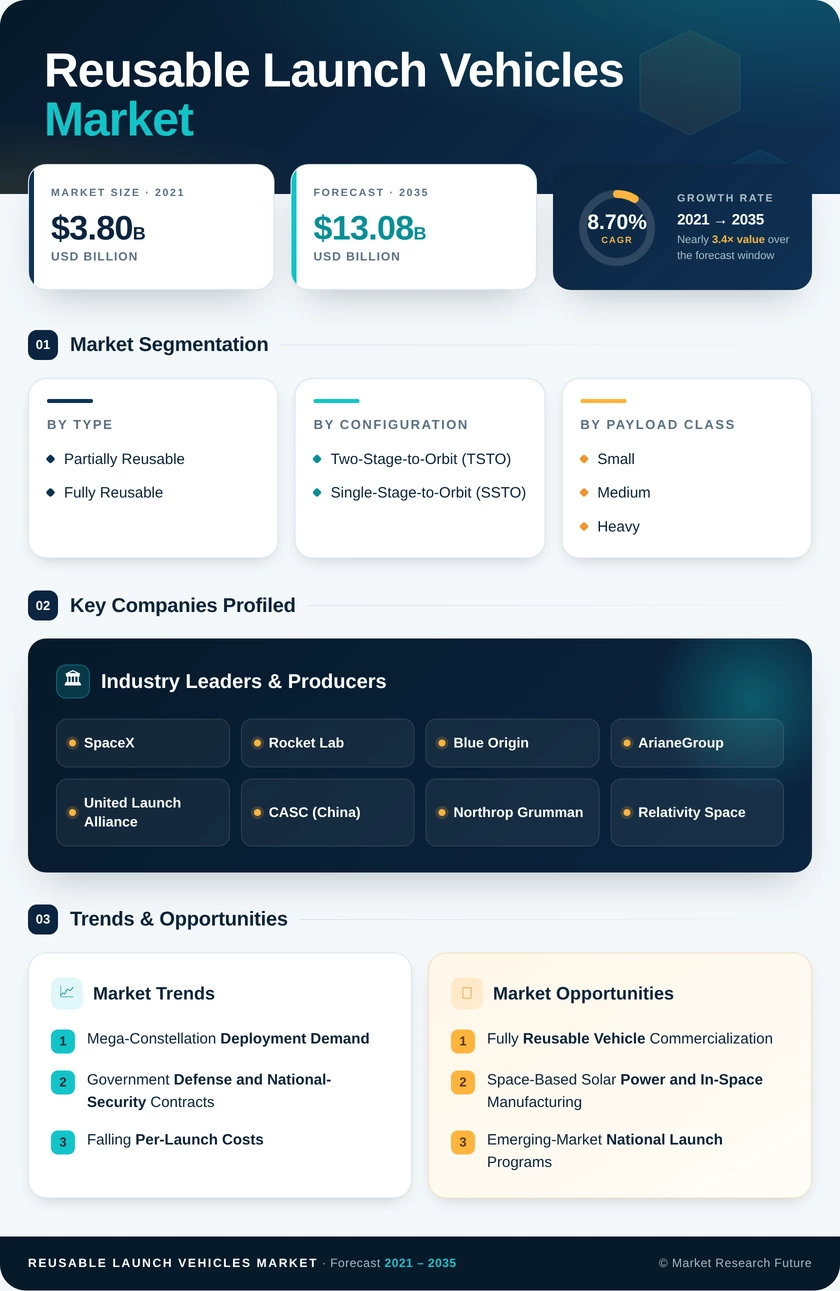
By Type
| Sub-Segment | Key Trend |
| Partially Reusable | Operational mainstay; first-stage booster recovery standard for 90%+ of missions |
| Fully Reusable | Emerging class: Starship and Long March 9 variants targeting full-stack return |
Partially reusable systems represent the commercial backbone of the global launch market, with flight-proven first stages now routinely completing 20–40 missions before retirement. Fully reusable architectures remain in active development, targeting per-launch costs an order of magnitude lower than current partially reusable benchmarks.
By Configuration
| Sub-Segment | Key Trend |
| Two-Stage-to-Orbit (TSTO) | Dominant architecture; optimized staging enables diverse mission profiles |
| Single-Stage-to-Orbit (SSTO) | Research phase, constrained by mass-fraction and thermal challenges |
TSTO designs allow separate optimization of each stage's propulsion, thermal protection, and recovery hardware, which explains their commercial dominance. SSTO remains a long-horizon concept, with government research programs exploring advanced propulsion cycles that could eventually close the engineering gap.
By Payload Class
| Sub-Segment | Key Trend |
| Small (<2,000 kg) | Dedicated and rideshare missions for small-satellite operators |
| Medium (2,000–20,000 kg) | Core class for constellation replenishment and ISS logistics |
| Heavy (>20,000 kg) | Fastest growth; driven by lunar cargo, station modules, and space-based solar |
Medium payloads remain the workhorse category, aligning with the mass requirements of most commercial and government LEO missions. The heavy class is experiencing the steepest demand growth as deep-space exploration programs and in-space construction initiatives scale up.
By End User
| Sub-Segment | Key Trend |
| Commercial | Constellation mega-programs, space tourism, and rideshare services |
| Defense & Government | NSSL contracts, responsive launch doctrine and intelligence satellite refresh |
Commercial end users generate the majority of launch revenue, with mega-constellation programs alone requiring dozens of dedicated missions annually. Government and defense users are expanding procurement of reusable vehicles as rapid-response launch capability becomes a core element of national-security space strategy.
By Mission
| Sub-Segment | Key Trend |
| Satellite Deployment | Largest segment; driven by LEO, MEO, and GEO constellation needs |
| Human Spaceflight | Fastest growth: commercial crew, orbital tourism, and Artemis missions |
| Cargo Resupply & Other | ISS logistics, in-space servicing, and technology demonstration |
Satellite deployment sustains the bulk of launch demand globally, while human spaceflight is emerging as a high-value growth vector as commercial crew and tourism missions multiply. Cargo resupply missions provide a steady baseline demand, particularly for ISS and future commercial space-station operators.