×
Request Free Sample ×

Kindly complete the form below to receive a free sample of this Report

* Please use a valid business email

Leading companies partner with us for data-driven Insights

clients tt-cursor
Hero Background

Rf For Fixed Wireless Acces Market

ID: MRFR/SEM/41053-HCR
200 Pages
Aarti Dhapte
October 2025

RF for Fixed Wireless Access Market Research Report By Technology (Millimeter Wave, Sub-6 GHz, Microwave), By Deployment Type (Outdoor, Indoor, Hybrid), By End Use (Residential, Commercial, Industrial), By Frequency Band (Low Band, Mid Band, High Band) and By Regional (North America, Europe, South America, Asia-Pacific, Middle East and Africa) - Forecast to 2035

Share:
Download PDF ×

We do not share your information with anyone. However, we may send you emails based on your report interest from time to time. You may contact us at any time to opt-out.

Rf For Fixed Wireless Acces Market Infographic
Purchase Options

Rf For Fixed Wireless Acces Market Summary

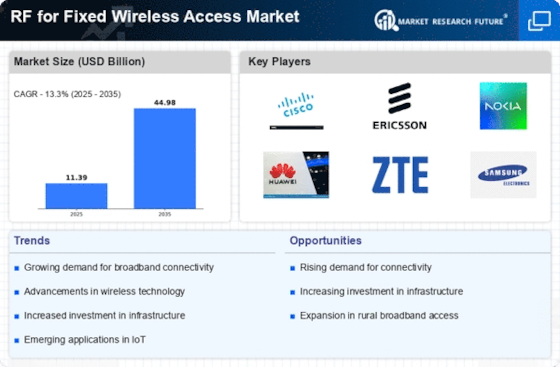
As per MRFR analysis, the RF for Fixed Wireless Access Market was estimated at 11.39 USD Billion in 2024. The RF for Fixed Wireless Access industry is projected to grow from 12.9 USD Billion in 2025 to 44.98 USD Billion by 2035, exhibiting a compound annual growth rate (CAGR) of 13.3 during the forecast period 2025 - 2035.

Key Market Trends & Highlights

The RF for Fixed Wireless Access Market is poised for substantial growth driven by technological advancements and increasing connectivity demands.

  • North America remains the largest market for RF solutions, driven by robust infrastructure and high-speed internet demand.
  • Asia-Pacific is emerging as the fastest-growing region, fueled by rapid urbanization and increasing investments in broadband technologies.
  • Millimeter Wave technology dominates the market, while Sub-6 GHz is experiencing the fastest growth due to its versatility in various applications.
  • Key market drivers include the rising demand for high-speed internet and government initiatives aimed at broadband expansion.

Market Size & Forecast

2024 Market Size 11.39 (USD Billion)
2035 Market Size 44.98 (USD Billion)
CAGR (2025 - 2035) 13.3%

Major Players

Cisco Systems (US), Ericsson (SE), Nokia (FI), Huawei Technologies (CN), ZTE Corporation (CN), Samsung Electronics (KR), CommScope Holding Company (US), MikroTik (LV)

Rf For Fixed Wireless Acces Market Trends

The RF for Fixed Wireless Access Market is currently experiencing a transformative phase, driven by the increasing demand for high-speed internet connectivity in both urban and rural areas. This market appears to be evolving as service providers seek to enhance their offerings through advanced technologies. The proliferation of smart devices and the growing reliance on cloud-based applications further contribute to the necessity for robust wireless solutions. As a result, stakeholders are likely to invest in innovative RF technologies to meet the diverse needs of consumers and businesses alike. Moreover, the competitive landscape of the RF for Fixed Wireless Access Market is becoming increasingly dynamic. Companies are exploring partnerships and collaborations to leverage complementary strengths and expand their market reach. The emphasis on cost-effective solutions, coupled with the need for reliable connectivity, suggests that the market will continue to attract new entrants. This ongoing evolution indicates a promising future for RF technologies, as they play a crucial role in bridging the digital divide and enhancing overall connectivity across various regions.

Emergence of Advanced Technologies

The RF for Fixed Wireless Access Market is witnessing the integration of advanced technologies such as beamforming and massive MIMO. These innovations enhance signal quality and increase capacity, allowing service providers to deliver superior performance. As competition intensifies, the adoption of these technologies appears to be a strategic move to attract and retain customers.

Growing Demand for Rural Connectivity

There is a noticeable trend towards addressing the connectivity needs of rural areas within the RF for Fixed Wireless Access Market. As more individuals and businesses in remote locations seek reliable internet access, service providers are likely to focus on developing solutions tailored to these underserved markets. This shift may lead to increased investment in infrastructure and technology.

Sustainability Initiatives

Sustainability is becoming a focal point in the RF for Fixed Wireless Access Market. Companies are increasingly prioritizing eco-friendly practices and energy-efficient technologies. This trend suggests a growing awareness of environmental impacts and a commitment to reducing carbon footprints, which may resonate well with environmentally conscious consumers.

Rf For Fixed Wireless Acces Market Drivers

Expansion of Smart Cities

The development of smart cities is a pivotal driver for the RF for Fixed Wireless Access Market. As urban areas evolve, the integration of advanced technologies such as IoT and smart infrastructure necessitates reliable and high-speed connectivity. The implementation of smart city initiatives often requires extensive wireless networks to support various applications, including traffic management and public safety. Consequently, municipalities are increasingly turning to fixed wireless access solutions, which are perceived as cost-effective and efficient. This trend indicates a growing market potential for RF technologies tailored to smart city applications.

Rising Adoption of Remote Work

The shift towards remote work has significantly influenced the RF for Fixed Wireless Access Market. As organizations adapt to flexible work arrangements, the demand for reliable internet connectivity in residential areas has intensified. Data shows that a substantial percentage of the workforce continues to work remotely, necessitating enhanced internet solutions. This trend compels service providers to explore fixed wireless access technologies to meet the connectivity needs of remote workers. The ongoing evolution of work environments suggests that the RF for Fixed Wireless Access Market will continue to expand as remote work becomes a permanent fixture.

Increasing Demand for High-Speed Internet

The RF for Fixed Wireless Access Market is experiencing a surge in demand for high-speed internet connectivity. As more consumers and businesses rely on robust internet services for daily operations, the need for reliable fixed wireless access solutions becomes paramount. Recent data indicates that the number of broadband subscriptions has increased significantly, with a notable rise in demand for wireless solutions in underserved areas. This trend suggests that service providers are likely to invest in RF technologies to enhance their offerings, thereby driving growth in the RF for Fixed Wireless Access Market.

Technological Advancements in RF Solutions

Technological advancements in RF solutions are propelling the RF for Fixed Wireless Access Market forward. Innovations such as advanced modulation techniques and improved antenna designs enhance the performance and reliability of fixed wireless access systems. These developments enable service providers to offer higher data rates and better coverage, addressing the growing consumer demand for seamless connectivity. As technology continues to evolve, the RF for Fixed Wireless Access Market is expected to witness increased competition and investment, further driving the adoption of cutting-edge wireless solutions.

Government Initiatives for Broadband Expansion

Government initiatives aimed at expanding broadband access are crucial drivers for the RF for Fixed Wireless Access Market. Various countries have launched programs to improve internet connectivity in rural and underserved regions, recognizing the importance of digital inclusion. These initiatives often include funding for infrastructure development, which can facilitate the deployment of fixed wireless access solutions. As governments prioritize broadband expansion, the RF for Fixed Wireless Access Market is likely to benefit from increased investments and partnerships between public and private sectors, fostering growth in this domain.


Market Segment Insights

By Technology: Millimeter Wave (Largest) vs. Sub-6 GHz (Fastest-Growing)

In the RF for Fixed Wireless Access Market, the technology segment is primarily dominated by Millimeter Wave solutions, which hold a significant market share due to their high bandwidth capacity and performance. Sub-6 GHz technology closely follows, contributing to the overall market with a balance of coverage and capacity, making them a vital choice for many deployments. Meanwhile, Microwave technology serves as a reliable option, particularly in areas where higher frequency solutions may face limitations, occupying a smaller, yet crucial portion of the total market. As demand for high-speed internet access increases, growth trends in the RF for Fixed Wireless Access Market are markedly influenced by advancements in Millimeter Wave and Sub-6 GHz technologies. The rapid penetration of 5G services emphasizes the need for faster, more efficient solutions, with Sub-6 GHz emerging as the fastest-growing segment due to its combination of extensive range and ability to penetrate obstacles. Conversely, Millimeter Wave continues to be favored for its high data rates in urban environments, while Microwave remains relevant for its effectiveness in rural and challenging terrains.

Technology: Millimeter Wave (Dominant) vs. Sub-6 GHz (Emerging)

Millimeter Wave technology is characterized by its ability to deliver ultra-high speed and capacity, making it the dominant player in the RF for Fixed Wireless Access Market. This segment is especially effective in densely populated urban areas, where the demand for data-intensive applications is highest. On the other hand, Sub-6 GHz technology is emerging rapidly, known for its balanced approach offering good performance and coverage. It effectively addresses the needs of both urban and suburban areas, facilitating broader access to wireless connectivity. While Millimeter Wave represents the pinnacle of capacity and speed, Sub-6 GHz is becoming increasingly important as it bridges the gap in coverage and accessibility, thus enhancing overall network performance.

By Deployment Type: Outdoor (Largest) vs. Indoor (Fastest-Growing)

In the RF for Fixed Wireless Access Market, the deployment type segment is primarily divided into outdoor, indoor, and hybrid categories. Currently, outdoor deployment holds the largest market share, as it caters to extensive coverage and high bandwidth demands in various environments. In contrast, indoor deployment is rapidly gaining traction, particularly in urban areas where density and demand for high-speed wireless connectivity are increasing. Hybrid deployment combines both outdoor and indoor systems, allowing for flexibility and adaptability in different scenarios, although it occupies a smaller share compared to the predominant outdoor option. As the demand for reliable high-speed internet continues to escalate, the outdoor deployment remains essential due to its capability to cover larger areas, especially in underserved regions. Meanwhile, the indoor deployment is projected to grow the fastest, driven by increasing smart home technologies and IoT applications. The shift towards remote work and online services during the pandemic also contributed to the surge in indoor connectivity needs, prompting providers to innovate and enhance their offerings. Hybrid solutions are becoming more relevant as businesses look to integrate diverse deployment strategies to optimize performance and user experience across various environments.

Outdoor (Dominant) vs. Indoor (Emerging)

The outdoor deployment of RF for Fixed Wireless Access offers significant advantages, including extensive range and high-capacity coverage, making it the dominant choice for service providers aiming to deliver connectivity across large geographical areas. Its robust infrastructure supports a variety of applications, including broadband services in rural regions and connectivity for public transportation systems. The technology remains the backbone for many fixed wireless initiatives, due to its established capabilities in handling high traffic loads and delivering reliable service. Conversely, indoor deployment is emerging rapidly as users demand consistent and high-speed internet access within residential and commercial spaces. This segment is marked by innovations in technology focused on enhancing signal penetration and reliability, addressing the growing trends of smart devices and an increasing reliance on seamless internet connectivity for daily activities.

By End-Use: Residential (Largest) vs. Commercial (Fastest-Growing)

The RF for Fixed Wireless Access Market is segmented into Residential, Commercial, and Industrial end-users. The Residential segment holds the largest market share, driven by increasing demands for high-speed internet in homes. The growth of smart home technologies and remote work trends significantly contribute to this demand. In contrast, the Commercial segment, while smaller in outright share, is experiencing rapid growth due to the increasing adoption of fixed wireless solutions by businesses aiming to reduce operational costs and enhance connectivity.

Residential (Dominant) vs. Commercial (Emerging)

The Residential segment of the RF for Fixed Wireless Access Market is characterized by its dominance due to the widespread need for reliable and high-speed internet access in homes. The proliferation of smart devices and the shift towards remote work have further fueled this demand, making it a primary focus for service providers. In contrast, the Commercial segment is emerging as a vital area of growth, as businesses increasingly seek to leverage fixed wireless access to improve connectivity, streamline operations, and eliminate the constraints of traditional wired connections. This segment is rapidly evolving, driven by advancements in technology and the need for flexible and scalable internet solutions.

By Frequency Band: Mid Band (Largest) vs. High Band (Fastest-Growing)

In the RF for Fixed Wireless Access Market, the frequency band segment is meticulously categorized into Low Band, Mid Band, and High Band. The Mid Band segment holds the largest share, appealing due to its balanced performance characteristics that facilitate wide coverage and relatively high data rates. Low Band follows, well-suited for extensive geographical reach but limited in capacity. High Band, while trailing in terms of share, is witnessing rapid growth due to increasing demand for high-speed fiber-like connectivity, particularly in urban areas. Growth trends within this segment are largely influenced by technological advancements and the escalating need for high-capacity data transmission. The push for 5G deployment is a significant driver for the Mid Band and High Band segments, which are crucial in meeting the soaring bandwidth demands. Emerging applications in smart cities and IoT are further fueling interest in High Band frequencies, marking it as a vital player in shaping the future landscape of wireless access solutions.

Mid Band (Dominant) vs. High Band (Emerging)

The Mid Band segment of the RF for Fixed Wireless Access Market is characterized by its ability to strike an ideal balance between coverage and capacity, making it dominant in the marketplace. This segment supports robust connectivity with adequate speeds for both residential and business applications, hence facilitating its widespread adoption. Conversely, the High Band segment is rapidly emerging as a key player due to its capability to deliver ultra-fast data rates, particularly in denser urban environments. As consumer demand for high-speed internet grows, particularly for video streaming and gaming, High Band frequencies are gaining momentum. This segment is poised for significant expansion, driven by technological innovations and advancements in antenna technologies, enabling greater efficiency in data transmission.

Get more detailed insights about Rf For Fixed Wireless Acces Market

Regional Insights

North America : Innovation and Expansion Hub

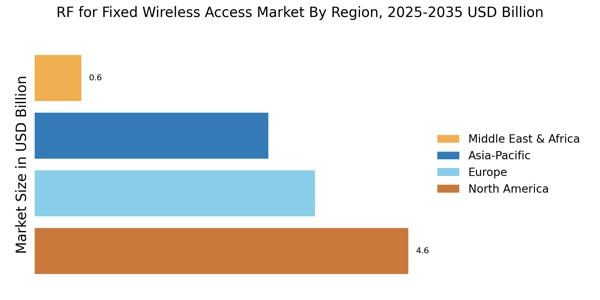
North America is the largest market for RF in Fixed Wireless Access, holding approximately 40% of the global market share. The region's growth is driven by increasing demand for high-speed internet, especially in rural areas, and supportive regulatory frameworks that encourage investment in broadband infrastructure. The Federal Communications Commission (FCC) has implemented initiatives to expand broadband access, further fueling market growth. The United States and Canada are the leading countries in this region, with major players like Cisco Systems and CommScope leading the charge. The competitive landscape is characterized by rapid technological advancements and partnerships among key players. Companies are focusing on enhancing their product offerings to meet the growing demand for reliable and high-speed wireless solutions.

Europe : Emerging Market with Strong Demand

Europe is witnessing significant growth in the RF for Fixed Wireless Access market, holding around 30% of the global share. The demand is driven by the need for enhanced connectivity and the European Union's commitment to digital transformation. Regulatory bodies are promoting investments in wireless infrastructure, which is expected to further accelerate market growth. The European Commission has set ambitious targets for broadband coverage, which is a key catalyst for this sector. Leading countries in this region include Germany, the UK, and France, where companies like Ericsson and Nokia are prominent. The competitive landscape is marked by innovation and collaboration among telecom operators and technology providers. The presence of established players and new entrants is fostering a dynamic environment, ensuring that the market remains competitive and responsive to consumer needs.

Asia-Pacific : Rapidly Growing Market Potential

Asia-Pacific is rapidly emerging as a significant player in the RF for Fixed Wireless Access market, accounting for approximately 25% of the global market share. The region's growth is fueled by increasing urbanization, rising internet penetration, and government initiatives aimed at enhancing digital infrastructure. Countries like India and China are leading the charge, with substantial investments in telecommunications and broadband services. China and India are the largest markets in this region, with key players such as Huawei Technologies and ZTE Corporation driving innovation. The competitive landscape is characterized by aggressive pricing strategies and technological advancements. As demand for high-speed internet continues to rise, companies are focusing on expanding their service offerings to capture a larger market share, making the region a hotspot for investment and development.

Middle East and Africa : Untapped Market with Growth Potential

The Middle East and Africa region is an emerging market for RF in Fixed Wireless Access, holding about 5% of the global market share. The growth is driven by increasing mobile broadband penetration and government initiatives aimed at improving connectivity in underserved areas. Regulatory bodies are encouraging investments in telecommunications infrastructure, which is expected to boost market growth significantly in the coming years. Leading countries in this region include South Africa and Nigeria, where companies like Samsung Electronics are making significant inroads. The competitive landscape is evolving, with both local and international players vying for market share. As the demand for reliable internet access grows, the region presents numerous opportunities for investment and innovation, making it a focal point for future developments in fixed wireless access.

Rf For Fixed Wireless Acces Market Regional Image

Key Players and Competitive Insights

The RF for Fixed Wireless Access Market represents a rapidly evolving sector that is fundamental to the connectivity and digital infrastructure landscape worldwide. This market is characterized by intense competition, driven by the increasing demand for high-speed internet services particularly in underserved areas where traditional broadband methods may not suffice. Key players in this industry are constantly innovating and enhancing their offerings to stay ahead of the competition, focusing on providing reliable and cost-effective fixed wireless access solutions.

Factors influencing competitive dynamics include technological advancements, regulatory environments, changing consumer preferences, and the strategic partnerships that organizations establish to expand their reach and capabilities. With the ongoing push for digital inclusion, understanding the competitive landscape is vital for stakeholders looking to navigate this space effectively.Verizon Communications has made a significant mark in the RF for Fixed Wireless Access Market, leveraging its extensive infrastructure and technological capabilities to deliver robust connectivity solutions. The company benefits from a strong national presence, characterized by a well-established network that enables it to offer reliable services to both urban and rural customers.

Verizon’s investment in advanced wireless technologies not only enhances service quality but also allows it to cater to a diverse customer base, from residential users to large enterprises. The company's commitment to innovation, particularly in the development of next-generation RF technologies, positions it as a formidable player in this competitive landscape.

Additionally, strategic initiatives, including collaborations and partnerships, further enhance its market position, allowing it to respond effectively to the dynamic needs of consumers and businesses alike.TMobile US operates as a formidable competitor within the Global RF for Fixed Wireless Access Market, distinguished by its innovative approaches and robust digital offerings. The company has fortified its market presence through strategic investments in high-capacity wireless networks and advanced RF solutions designed to meet the growing demand for high-speed internet access.

TMobile US has excelled at leveraging its existing infrastructure to provide competitive pricing and flexible plans, appealing to a broad spectrum of customers, including residential and business segments. Through aggressive marketing strategies and customer-centric initiatives, TMobile US effectively enhances its visibility and fosters customer loyalty. A focus on expanding coverage into previously underserved areas complements its strong service capabilities, contributing to its competitive edge in driving wireless technology adoption in the market.

Key Companies in the Rf For Fixed Wireless Acces Market market include

Industry Developments

The RF for Fixed Wireless Access Market is witnessing notable developments with companies like Verizon Communications and T-Mobile US expanding their fixed wireless offerings to enhance broadband access in underserved areas. Recent advancements in technology by Qualcomm and Samsung Electronics are driving growth, as improved chipsets allow for higher bandwidth and better efficiency. CommScope and ZTE are collaborating on innovative solutions designed to support next-generation wireless connectivity. The ongoing competition among industry giants like AT&T, Dish Network, Mavenir, and Ericsson is also contributing to market dynamism, particularly in terms of infrastructure investments and service improvements.

Additionally, Cisco Systems and Nokia are focusing on network enhancements to cater to increasing demand. Recent merger and acquisition activities include strategic partnerships and acquisitions aimed at consolidating resources and capabilities; for instance, companies are exploring synergies that bolster their offerings in fixed wireless technologies. These moves indicate a robust shift towards growing market valuations, with significant implications on service delivery and consumer access to broadband services globally, ultimately shaping the competitive landscape and driving innovation within the RF for Fixed Wireless Access segment.

Future Outlook

Rf For Fixed Wireless Acces Market Future Outlook

The RF for Fixed Wireless Access Market is projected to grow at a 13.3% CAGR from 2024 to 2035, driven by increasing demand for high-speed internet and advancements in wireless technology.

New opportunities lie in:

  • Development of integrated RF solutions for urban environments
  • Expansion of rural broadband initiatives leveraging fixed wireless technology
  • Partnerships with IoT providers to enhance connectivity solutions

By 2035, the market is expected to achieve substantial growth, positioning itself as a leader in wireless communication.

Market Segmentation

Rf For Fixed Wireless Acces Market End-Use Outlook

  • Residential
  • Commercial
  • Industrial

Rf For Fixed Wireless Acces Market Technology Outlook

  • Millimeter Wave
  • Sub-6 GHz
  • Microwave

Rf For Fixed Wireless Acces Market Frequency Band Outlook

  • Low Band
  • Mid Band
  • High Band

Rf For Fixed Wireless Acces Market Deployment Type Outlook

  • Outdoor
  • Indoor
  • Hybrid

Report Scope

MARKET SIZE 2024 11.39(USD Billion)
MARKET SIZE 2025 12.9(USD Billion)
MARKET SIZE 2035 44.98(USD Billion)
COMPOUND ANNUAL GROWTH RATE (CAGR) 13.3% (2024 - 2035)
REPORT COVERAGE Revenue Forecast, Competitive Landscape, Growth Factors, and Trends
BASE YEAR 2024
Market Forecast Period 2025 - 2035
Historical Data 2019 - 2024
Market Forecast Units USD Billion
Key Companies Profiled Market analysis in progress
Segments Covered Market segmentation analysis in progress
Key Market Opportunities Advancements in millimeter-wave technology enhance capacity and coverage in the RF for Fixed Wireless Access Market.
Key Market Dynamics Technological advancements in radio frequency are driving competitive dynamics in the Fixed Wireless Access market.
Countries Covered North America, Europe, APAC, South America, MEA

Leave a Comment

FAQs

What is the projected market valuation for the RF for Fixed Wireless Access Market in 2035?

The projected market valuation for the RF for Fixed Wireless Access Market in 2035 is 44.98 USD Billion.

What was the market valuation for the RF for Fixed Wireless Access Market in 2024?

The overall market valuation for the RF for Fixed Wireless Access Market was 11.39 USD Billion in 2024.

What is the expected CAGR for the RF for Fixed Wireless Access Market during the forecast period 2025 - 2035?

The expected CAGR for the RF for Fixed Wireless Access Market during the forecast period 2025 - 2035 is 13.3%.

Which companies are considered key players in the RF for Fixed Wireless Access Market?

Key players in the RF for Fixed Wireless Access Market include Cisco Systems, Ericsson, Nokia, Huawei Technologies, ZTE Corporation, Samsung Electronics, CommScope Holding Company, and MikroTik.

What are the projected valuations for the Millimeter Wave technology segment by 2035?

The projected valuation for the Millimeter Wave technology segment is expected to reach between 2.5 and 10.0 USD Billion by 2035.

How does the Indoor deployment type segment perform in terms of market valuation?

The Indoor deployment type segment is projected to achieve a valuation between 3.42 and 13.5 USD Billion by 2035.

What is the expected market performance for the Residential end-use segment by 2035?

The Residential end-use segment is anticipated to reach a valuation between 4.55 and 18.0 USD Billion by 2035.

What are the projected valuations for the Mid Band frequency segment by 2035?

The Mid Band frequency segment is expected to achieve a valuation between 4.56 and 17.99 USD Billion by 2035.

What is the market outlook for the Outdoor deployment type segment in 2035?

The Outdoor deployment type segment is projected to reach a valuation between 4.55 and 18.0 USD Billion by 2035.

How do the key players influence the RF for Fixed Wireless Access Market?

Key players like Cisco Systems and Ericsson likely influence the RF for Fixed Wireless Access Market through innovation and competitive strategies.

Download Free Sample

Kindly complete the form below to receive a free sample of this Report

Compare Licence

×
Features License Type
Single User Multiuser License Enterprise User
Price $4,950 $5,950 $7,250
Maximum User Access Limit 1 User Upto 10 Users Unrestricted Access Throughout the Organization
Free Customization
Direct Access to Analyst
Deliverable Format
Platform Access
Discount on Next Purchase 10% 15% 15%
Printable Versions