RF Test Equipment Market

Key Players: Keysight Technologies, Rohde & Schwarz, Anritsu Corporation, National Instruments (Emerson), Viavi Solutions, Fortive (Tektronix), Teledyne Technologies, Spirent Communications

RF Test Equipment Market

RF Test Equipment Market Size, Share and Research Report By Type (Traditional GP Instrumentation, Modular GP Instrumentation, Specialized Test Instruments), By Form Factor (Benchtop, Portable, Modular), By Frequency Range (Below 1 GHz, 1–6 GHz, Above 6 GHz), By Component (RF Analyzers, RF Amplifiers, RF Oscillators, Other Components), By End-User Industry (Telecommunications, Automotive, Consumer Electronics, Aerospace & Defense, Other End Users) - Industry Forecast to 2035
ID: MRFR/SEM/4279-CR
118 Pages
Nirmit Biswas, Aarti Dhapte
Last Updated: June 17, 2026

RF Test Equipment Market Summary

The RF Test Equipment Market reached an estimated USD 4.30 billion in 2025 and is projected to grow from USD 4.59 billion in 2026 to USD 8.28 billion by 2035, registering a CAGR of 6.78% across the forecast window. Two structural catalysts underpin this trajectory: the global push toward millimeter-wave 5G infrastructure—where over 4.7 million commercial base stations in China alone demand continuous RF signal measurement devices for massive-MIMO validation [1]—and the rapid proliferation of automotive radar operating in the 77–81 GHz band, which requires precise spectrum analyzer instruments for type-approval testing [8].

A generational technology transition is changing the nature of procurement cycles. Legacy analog benchtop analyzers are being replaced by software-defined modular platforms that combine several radio frequency test equipment in a single chassis. The 3GPP Release 19 requirements for Europe, approved in late 2025, reduced benchtop renewal cycles to less than twelve months, accelerating platform obsolescence and forcing capital expenditure towards reconfigurable microwave RF tests [1][5]. Wi-Fi 7, satellite-direct-to-device, and O-RAN disaggregated architectures are generating incremental revenue streams that didn’t exist five years ago for wireless protocol test equipment.


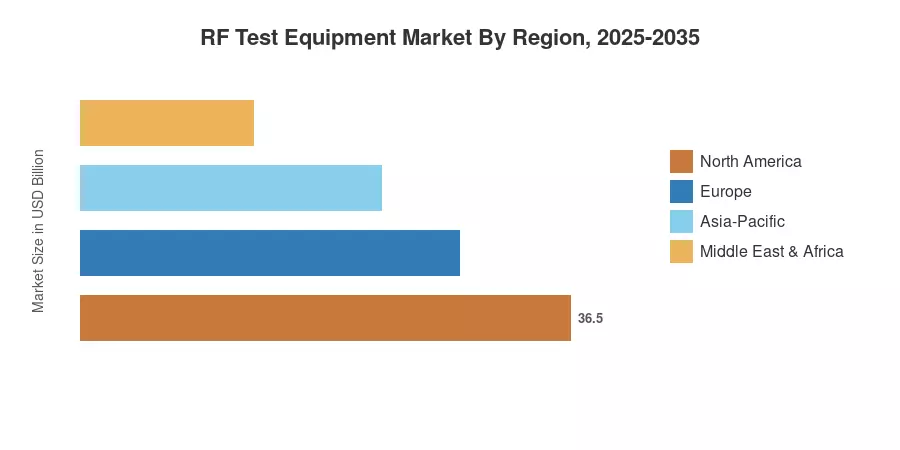
North America has the largest share of 38.3% of 2025 revenue, driven by FCC C-band interference requirements and DoD electromagnetic-spectrum upgrade spending [2][19]. Asia-Pacific is the fastest expanding market with an 8.3% CAGR driven by China’s FR2 deployment ambitions and India’s 5G densification push. The second greatest proportion is in Europe, with 24.2 % backed by the EU’s Digital Decade Program and the implementation of V-band standards [6][18]. Double-digit growth is anticipated for the RF Test Equipment Market across regional pockets through the 2030s.


Key Report Takeaways

• By Type

  • Traditional GP instrumentation held a 34.8% revenue share in 2025, anchored by recurring calibration and compliance workflows across telecom labs.
  • Modular GP instrumentation is expanding at an 8.4% CAGR through 2035, driven by demand for reconfigurable microwave RF testers.

• By Form Factor

  • Benchtop instruments captured 37.6% of the RF Test Equipment Market in 2025, reflecting installed-base dominance in calibration centers.
  • Modular platforms are projected to expand at a significant CAGR through 2031. 

• By Geography

  • North America led the RF Test Equipment Market with 38.3% share, supported by C-band spectrum compliance testing requirements.
  • Asia-Pacific is on track for the fastest 8.3% CAGR, spurred by private 5G network rollouts and Ka-band satellite terminal validation.


Market Size and Forecast (2021–2035)

Market Research Future (MRFR) has designed a market-sizing model that combines top-down revenue analysis of publicly traded instrument vendors with bottom-up demand forecasts across verticals such as telecom, automotive, and aerospace. Historical data (2021-2024) are based on audited financial disclosures. Forecast figures (2026-2035) are based on calibrated growth assumptions confirmed against capital-expenditure pipelines, spectrum-auction schedules and standards-body release timetables.
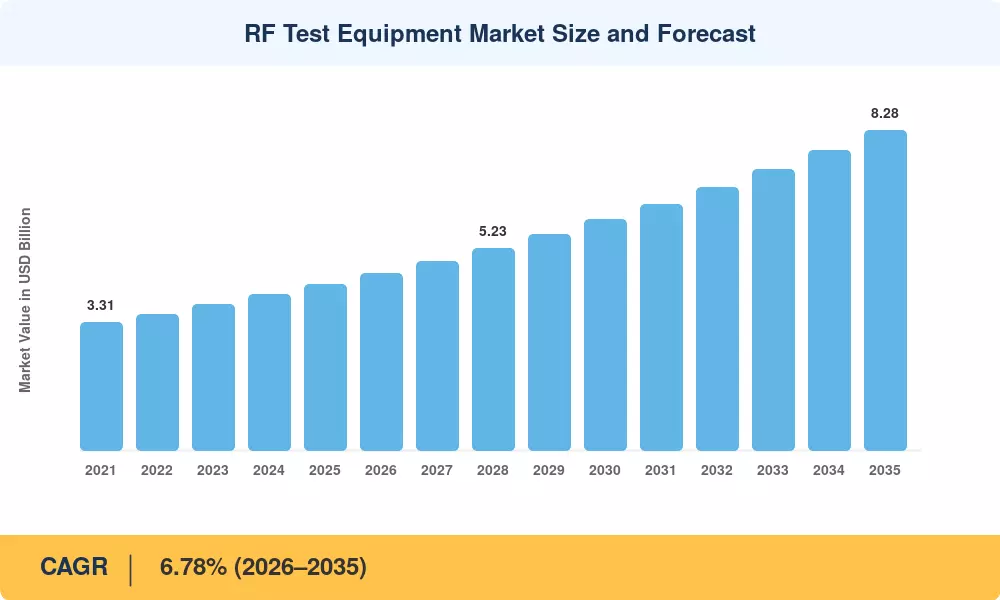
RF Test Equipment Market Size and Forecast
Our Impact
Enabled $4.3B Revenue Impact for Fortune 500 and Leading Multinationals
Partnering with 2000+ Global Organizations Each Year
30K+ Citations by Top-Tier Firms in the Industry

Driver Impact Analysis

Driver ~% Impact on CAGR Geographic Relevance Impact Timeline
Millimeter-wave 5G deployment (FR2) ~1.8% Global Short-term (≤2 yr)
Automotive radar (77–81 GHz) growth ~1.2% North America, Europe, Asia-Pacific Medium-term (2–4 yr)
LEO satellite Ka-band terminal production ~0.9% North America, Asia-Pacific Medium-term (2–4 yr)
O-RAN disaggregation and open test ~0.7% Europe, Asia-Pacific Short-term (≤2 yr)
Wi-Fi 7 / Wi-Fi 8 certification cycles ~0.5% Global Medium-term (2–4 yr)
6G pre-commercial R&D instrumentation ~0.4% North America, Europe, Asia-Pacific Long-term (≥4 yr)
Defense EW spectrum modernization ~0.6% North America, Europe Long-term (≥4 yr)


Millimeter-Wave 5G Rollouts

The transition from sub-6 GHz to FR2 bands above 24 GHz has fundamentally reshaped purchasing priorities for radio frequency testing tools. China's MIIT reported over 4.7 million commercial 5G base stations by mid-2025, with roughly 40% employing massive-MIMO arrays that require over-the-air chamber validation [1]. Each chamber installation demands dedicated spectrum analyzer instruments and channel emulators, creating an equipment multiplier effect that extends well beyond traditional benchtop unit counts.

Automotive Radar Expansion

Global demand for 77–81 GHz automotive radar modules is experiencing sustained growth, driven by the increasing integration of Advanced Driver Assistance Systems (ADAS). Every radar module must pass electromagnetic-compatibility and range-resolution tests using specialized microwave RF testers before vehicle integration. The EU's Intelligent Speed Assistance mandate and the US National Highway Traffic Safety Administration's (NHTSA) rulemaking for automatic emergency braking are tightening type-approval requirements, ensuring long-term demand for high-frequency RF signal measurement devices.


LEO Satellite Terminal Production

SpaceX's Starlink, Amazon's Project Kuiper, and OneWeb collectively plan to manufacture over 15 million Ka-band user terminals between 2025 and 2030 [20]. Each terminal undergoes antenna-pattern and EVM measurements using wireless protocol test equipment calibrated for 26.5–40 GHz operation. This volume production pipeline introduces factory-floor test throughput as a critical bottleneck, favoring automated modular platforms over traditional benchtop setups.

Defense Electromagnetic-Spectrum Operations

The US Department of Defense continues to prioritize electromagnetic-spectrum superiority as a core component of its modernization strategy, as outlined in recent fiscal budget requests for Research, Development, Test, and Evaluation (RDT&E). NATO allies have initiated parallel procurement cycles, expanding demand for wideband radio frequency testing tools capable of characterizing signals from 2 GHz to 110 GHz to support electronic-warfare test ranges and cognitive-EW simulation platforms in increasingly contested environments.


Restraints Impact Analysis

Restraint estimates below are directional CAGR headwinds; they do not net directly against driver contributions.

Restraint ~% Drag on CAGR Geographic Relevance Impact Timeline
High instrument unit costs and long ROI cycles ~–0.6% Global Persistent
Semiconductor supply-chain volatility ~–0.5% Global Short-term (≤2 yr)
Fragmented calibration and standards landscape ~–0.3% Emerging markets Medium-term (2–4 yr)
Skilled RF-engineering talent shortage ~–0.4% North America, Europe Medium-term (2–4 yr)
Software-licensing complexity in modular platforms ~–0.2% Global Persistent


High Capital Cost and Extended ROI Cycles

Deploying mmWave Over-the-Air (OTA) test environments requires significant capital investment, with high-end anechoic chambers representing multi-million-dollar commitments. For mid-tier operators and smaller contract test houses, these costs—compounded by the need for advanced automation and high-frequency instrumentation—often result in extended return-on-investment (ROI) cycles. This creates a stratified adoption landscape where Tier-1 entities lead investment in cutting-edge validation capabilities. At the same time, budget-constrained organizations must often rely on shared or modular test facilities to manage financial exposure.


Semiconductor Supply Constraints

The radio frequency (RF) test equipment market remains sensitive to the broader semiconductor supply chain, which in 2026 is grappling with high-stakes demand driven by the AI infrastructure boom. While manufacturers have largely normalized supply chains following the crises of the early 2020s, the "zero-sum" competition for wafer and packaging capacity—particularly for high-precision components like precision ADCs, DACs, and FPGAs—can lead to localized volatility. This competitive environment necessitates that test equipment providers prioritize high-margin, specialized platforms, occasionally resulting in extended lead times for specific high-frequency measurement modules.


RF-Engineering Talent Gap

The wireless infrastructure sector is currently facing a pronounced engineering talent gap. While specific "unfilled position" counts fluctuate, the 2026 industry labor analysis indicates a persistent shortage of personnel with specialized expertise in high-frequency RF systems, AI-enabled workflows, and regulatory compliance. The "aging out" of senior engineers, combined with a mismatch between traditional academic curricula and the highly specialized needs of modern microwave and mmWave engineering, has constrained equipment utilization rates. Firms are increasingly shifting toward skill-based hiring and proactive upskilling programs to secure the talent necessary to operate advanced protocol test equipment.


RF Test Equipment Market Opportunities

Private 5G and CBRS Enterprise Networks

Enterprise private 5G deployments in manufacturing, mining, and logistics are projected to exceed 45,000 networks globally by 2030 [3]. Each deployment requires site-specific RF planning and commissioning using portable radio frequency testing tools, opening a recurring-revenue service channel for equipment vendors.

Test-as-a-Service and Cloud-Enabled Remote Labs

Cloud-connected microwave RF testers allow OEMs to rent capacity rather than own assets, lowering entry barriers in price-sensitive markets. Keysight's PathWave and Rohde & Schwarz's Cloud4Testing platforms already offer remote-access spectrum analyzer instruments, shifting revenue models toward subscriptions. This model particularly benefits emerging-market laboratories that lack capital for outright purchase.

6G Sub-Terahertz Research Instrumentation

Early-stage 6G research at frequencies between 100 GHz and 300 GHz demands entirely new generations of RF signal measurement devices. National laboratories in the US, South Korea, and Finland are budgeting USD 500 million collectively for sub-THz testbed infrastructure through 2030 [4]. Equipment vendors that establish reference architectures now will lock in design wins for production-grade wireless protocol test equipment when 6G standards crystallize.

Emerging-Market 5G Densification

India's BharatNet extension and Southeast Asia's 700 MHz refarming campaigns are creating greenfield demand for affordable radio frequency testing tools [3]. Vendors offering compact, cost-optimized spectrum analyzer instruments stand to capture market share in regions where legacy instrumentation penetration remains below 30%.

Data Monetization Through Digital Twins

Test-data analytics platforms that create digital twins of RF environments can monetize measurement data beyond the initial instrument sale. By integrating machine-learning-driven anomaly detection, microwave RF testers evolve into predictive-maintenance sensors for network operators, generating recurring software-license revenue.


RF Test Equipment Market Future Outlook

AI-Driven Autonomous Test Workflows

Machine-learning algorithms are transforming RF test execution from manual script-based routines to self-optimizing measurement campaigns. By 2030, autonomous test sequencing could reduce characterization time for radio frequency testing tools by up to 40%, according to industry roadmaps [9]. Vendors embedding neural-network inference engines directly into spectrum analyzer instruments will differentiate on throughput rather than raw specification alone.

Platform Economics and Subscription Models

The RF Test Equipment Market is transitioning from capital-expenditure ownership toward operating-expenditure subscription licensing. Modular platforms that separate hardware from software unlock annual recurring revenue for OEMs. At the same time, customers gain flexibility to activate new wireless protocol test equipment capabilities via feature keys as standards evolve [10][12].

6G and Sub-Terahertz Measurement Science

The ITU's IMT-2030 framework for 6G targets frequency bands extending up to 300 GHz, necessitating a new generation of transceiver architectures and measurement science. National metrology institutes, including NIST (US), PTB (Germany), and NICT (Japan), are prioritizing significant, sustained funding for sub-THz calibration standards. While there is no centralized international budget, these independent and collaborative investments are establishing the essential metrological foundation required for the next cycle of commercial instrumentation development, which is expected to accelerate significantly after 2032.


Sustainability and Circular-Economy Instrumentation

Sustainability is becoming a core design metric as laboratories focus on reducing their energy footprints to meet corporate Scope 3 emission targets. Vendors are responding by engineering higher-efficiency microwave RF testers and committing to company-wide energy reduction goals; for example, Keysight Technologies has committed to a 10% reduction in energy usage by 2030 (relative to a 2019 baseline). Furthermore, the rise of certified pre-owned and refurbishment programs is creating a viable circular-economy revenue layer, allowing operators to meet high-performance requirements while extending the lifecycle of precision measurement assets.


RF Test Equipment Market Segmentation

By Type

Segment Key Metric Primary Demand Driver
Traditional GP Instrumentation 34.8% share (2025) Compliance labs and recurring calibration
Modular GP Instrumentation 8.4% CAGR Reconfigurable multi-standard test needs
Specialized Test Instruments USD 0.87 Billion (2025) Millimeter-wave and satellite-specific testing


Traditional GP instrumentation retains the largest share of the RF Test Equipment Market because compliance and calibration laboratories still depend on standalone benchtop units with traceable accuracy specifications. Modular GP instrumentation is gaining ground as OEMs seek radio frequency testing tools that can be reconfigured across 5G, Wi-Fi 7, and V2X standards without purchasing entirely new chassis.

By Form Factor

Segment Key Metric Primary Demand Driver
Benchtop 37.6% share (2025) R&D and calibration-grade accuracy
Portable USD 0.92 Billion (2025) Field deployment and site commissioning
Modular 8.7% CAGR High-throughput manufacturing test


Benchtop instruments dominate the RF Test Equipment Market for laboratory applications where measurement uncertainty budgets demand the highest dynamic range. Portable RF signal measurement devices are increasingly critical for field technicians commissioning private 5G networks and validating small-cell installations in urban environments.

By Frequency Range

Segment Key Metric Primary Demand Driver
1–6 GHz 59.0% share (2025) Sub-6 GHz 5G and Wi-Fi band coverage
Above 6 GHz 9.2% CAGR mmWave 5G, automotive radar, satellite
Below 1 GHz USD 0.61 Billion (2025) IoT, broadcast, and legacy cellular


The 1–6 GHz band commands the largest share because it spans the sub-6 GHz 5G NR, LTE, and Wi-Fi frequency allocations that account for the bulk of global wireless traffic. Above-6 GHz spectrum analyzer instruments are the fastest-growing segment as millimeter-wave deployments and automotive radar volumes scale.

By Component

Segment Key Metric Primary Demand Driver
RF Analysers 29.5% share (2025) Signal integrity and spectral-mask compliance
RF Amplifiers 7.9% CAGR Power-amplifier linearization testing
RF Oscillators USD 0.38 Billion (2025) Phase-noise and frequency-stability measurement


RF Analyzers—including spectrum analyzers, signal analyzers, and network analyzers—form the backbone of any RF test bench. RF Amplifiers are the fastest-growing component class as GaN and SiGe power-amplifier adoption in 5G base stations increases the need for advanced microwave RF testers.

By End-User Industry

Segment Key Metric Primary Demand Driver
Telecommunications 40.6% share (2025) Network build-out and device certification
Automotive 8.6% CAGR 77–81 GHz radar and V2X module testing
Consumer Electronics USD 0.52 Billion (2025) Wi-Fi 7, UWB, and Bluetooth LE audio
Aerospace & Defense 6.9% CAGR EW, satellite payload, and avionics


Telecommunications remains the dominant vertical in the RF Test Equipment Market, consuming wireless protocol test equipment for base-station manufacturing, device-conformance testing, and network-optimization field surveys. Automotive is the fastest-growing end user, as every new vehicle radar module and V2X transceiver requires dedicated radio frequency testing tools for regulatory approval.


Regional Market Share Analysis

Region Key Metric Primary Investment Themes
North America 38.3% share (2025) C-band compliance, defense EW modernization
Europe USD 1.04 Billion (2025) Release 19 certification, automotive V2X
Asia-Pacific 8.3% CAGR (2026–2035) Private 5G, LEO terminal manufacturing
South America USD 0.25 Billion (2025) 5G auction preparation, broadcast transition
Middle East & Africa 6.1% CAGR (2026–2035) Satellite backhaul, smart-city pilot programs
Total USD 4.30 Billion (2025)

The RF Test Equipment Market spans five major regions, each shaped by distinct spectrum-policy regimes, infrastructure investment timelines, and end-user industry mixes. North America's dominance reflects mature defense and telecom R&D ecosystems, while Asia-Pacific's rapid growth stems from high-volume manufacturing test demands and aggressive 5G deployment targets.


North America

Country Key Metric Key Driver
United States 78.4% of regional revenue FCC spectrum mandates, DoD EW budgets
Canada 5.5% CAGR 3500 MHz 5G build-out
Mexico USD 0.04 Billion Broadcast-to-5G spectrum transition


The United States accounts for the vast majority of North American spending on radio frequency testing tools, driven by FCC C-band interference compliance and a USD 2.4 billion DoD electromagnetic-spectrum program [2][19]. Canada's ISED spectrum auctions and Mexico's IFT 5G roadmap are scaling regional demand for portable RF signal measurement devices.

Europe

Country Key Metric Key Driver
Germany 23.1% of regional revenue Automotive radar OEM test labs
United Kingdom 6.4% CAGR Open-RAN diversification policy
France USD 0.11 Billion Defense modernization (LPM 2024–2030)
Italy 5.8% CAGR 26 GHz private 5G spectrum awards
Spain USD 0.06 Billion Rural 5G coverage mandates
Nordic Countries 6.7% CAGR Ericsson & Nokia R&D headquarters
Russia USD 0.04 Billion Domestic import-substitution programs
Rest of Europe 5.2% CAGR EU Chips Act co-investment


Germany's automotive OEMs anchor European demand for microwave RF testers, while the UK's 5G Diversification Strategy channels funding into open-RAN interoperability labs that rely heavily on wireless protocol test equipment [6][16].

Asia-Pacific

Country Key Metric Key Driver
China 42.8% of regional revenue Massive-MIMO base-station validation
India 9.4% CAGR BharatNet 5G extension
Japan USD 0.18 Billion NTT IOWN photonic-wireless convergence
South Korea 8.7% CAGR Samsung 6G research testbeds
ASEAN USD 0.09 Billion 700 MHz refarming and 5G trials
Rest of Asia-Pacific 7.5% CAGR Satellite-ground terminal assembly hubs


China's 4.7 million 5G base stations generate the greatest single-country demand for spectrum analyzer instruments in the RF Test Equipment Market, while India's accelerating densification campaign is scaling procurement of cost-effective radio frequency testing tools [1][3].

South America

Country Key Metric Key Driver
Brazil 62.5% of regional revenue Anatel 3.5 GHz auction compliance
Argentina 5.3% CAGR Rural broadband wireless backhaul
Rest of South America USD 0.04 Billion Broadcast digital switchover testing


Brazil dominates South American demand for RF signal measurement devices following its 2021 5G auction, with Anatel compliance requirements for the 3.5 GHz band sustaining instrument procurement through 2028 [3].

Middle East & Africa

Country Key Metric Key Driver
Saudi Arabia 34.6% of regional revenue NEOM and Vision 2030 smart-city networks
UAE 6.5% CAGR Etisalat mmWave private-network pilots
South Africa USD 0.02 Billion ICASA spectrum auction compliance
Egypt 5.9% CAGR 4G/5G network modernization
Rest of MEA USD 0.03 Billion Satellite-backhaul deployment in rural zones


Saudi Arabia's NEOM project and the UAE's private 5G initiatives are the primary demand engines for microwave RF testers in the Middle East, complemented by satellite-backhaul testing needs across sub-Saharan Africa [3].


RF Test Equipment Market By Region, 2025-2035

Competitive Benchmarking

The RF test equipment market is moderately consolidated, and the top five players are expected to hold 48-56% of the global revenue. The Herfindahl-Hirschman Index is in the intermediate range (~1,200–1,500), indicating a few full-portfolio incumbents and several specialty experts serving the automobile, satellite and defense sub-segments.

Company Est. Revenue Share Range Key Offerings for RF Test Equipment Market Strategic Positioning
Keysight Technologies ~14–18% UXA/PXA signal analyzers, PathWave software Broadest mmWave portfolio; cloud-enabled test
Rohde & Schwarz ~12–16% R&S FSW analyzer, CMX500 5G tester Vertically integrated; strong automotive & defense
Anritsu Corporation ~7–10% ShockLine VNAs, MT8000A 5G platform Compact field instruments; O-RAN certification
National Instruments (Emerson) ~5–8% PXIe modular platforms, LabVIEW ecosystem Modular architecture leader; semiconductor focus
Viavi Solutions ~4–6% CellAdvisor, OneAdvisor field tools Network-lifecycle focus; fiber-to-RF convergence
Fortive (Tektronix) ~3–5% RSA spectrum analyzers, signal generators Mid-range benchtop; education & general-purpose
Teledyne Technologies ~3–5% LeCroy oscilloscopes, RF subsystems High-bandwidth oscilloscope integration
Spirent Communications ~2–4% 5G location & protocol conformance Protocol-layer and GNSS simulation specialist
EXFO Inc. ~2–3% FTBx platforms, optical-to-RF test Fiber-RF convergence for fronthaul testing
Yokogawa Electric ~1–3% Optical spectrum analyzers, signal generators Precision measurement; photonic-network crossover


Recent News & Developments


  • 3GPP (December 2025): Finalized Release 19 specifications, adding NR-NTN, NR sidelink enhancements, and AI/ML-based network energy savings. The release accelerated procurement of upgraded spectrum analyzer instruments by certification laboratories worldwide. [5]
  • FCC (January 2022): Concluded the 3.45–3.55 GHz auction, generating USD 22.5 billion in spectrum revenues and mandating interference-mitigation tests that require calibrated radio frequency testing tools across the C-band. [2]


  • National Instruments / Emerson (October 2023): Completed integration of NI's PXIe product line under Emerson's Test & Measurement division, consolidating modular radio frequency testing tools with Emerson's industrial-automation portfolio. [12]


RF Test Equipment Market Report Scope

Parameter Detail
Market Scope Global RF Test Equipment Market covering instruments for RF/microwave signal generation, analysis, and protocol conformance
Study Period 2021–2035
CAGR 6.78% (2026–2035)
Market Size (2025) USD 4.30 Billion
Market Size (2035) USD 8.28 Billion
Fastest Growing Segments Modular platforms (form factor); Above 6 GHz (frequency); Automotive (end user)
Companies Profiled Keysight, Rohde & Schwarz, Anritsu, NI/Emerson, Viavi, Fortive, Teledyne, Spirent, EXFO, Yokogawa
Valuation Currency USD Billion


FAQs

What calibration interval should buyers specify for mmWave spectrum analyzer instruments?

Most OEMs recommend annual calibration for spectrum analyzer instruments operating above 24 GHz, though high-reliability defense contracts often mandate six-month intervals. Confirm interval requirements with your accredited metrology partner. [21]

How does O-RAN disaggregation change RF Test Equipment Market procurement strategies?

O-RAN splits radio and baseband, requiring separate wireless protocol test equipment for fronthaul interface conformance. Buyers should budget for additional interoperability test licenses alongside traditional RF signal measurement devices. [16]

Which RF Test Equipment Market segment offers the best near-term ROI for contract test labs?

Above-6 GHz modular platforms deliver the fastest payback because automotive and 5G FR2 device volumes are surging. Modular microwave RF testers let labs reconfigure quickly across multiple customer standards. [8]

Are refurbished radio frequency testing tools a viable option for emerging-market labs?

Certified pre-owned instruments from Keysight and Rohde & Schwarz carry full warranty and calibration traceability. They typically cost 40–60% less than new units, making them practical for budget-constrained labs. [9][10]

How will 6G research affect the RF Test Equipment Market demand before standards are finalized?

Pre-standard 6G research requires wideband RF signal measurement devices covering 100–300 GHz. National labs are already funding sub-THz testbeds, seeding early instrument demand ahead of formal ITU standardization. [4]

What cybersecurity risks should buyers consider with cloud-connected microwave RF testers?

Cloud-enabled instruments expose measurement data to network threats, so buyers need encrypted data pipelines and role-based access controls. Vendor SOC 2 Type II certification is a baseline requirement. [9]

Can a single modular platform replace multiple benchtop spectrum analyzer instruments in the RF Test Equipment Market?

Modern PXIe chassis covers DC to 50 GHz and consolidates signal generation, analysis, and protocol testing. One platform can replace three to four standalone benchtop units for most production-test applications. [12]


Author
Author
Author Profile
Nirmit Biswas LinkedIn
Senior Research Analyst
With 5+ years of expertise in Market Intelligence and Strategic Research, Nirmit Biswas specializes in ICT, Semiconductors, and BFSI. Backed by an MBA in Financial Services and a Computer Science foundation, Nirmit blends technical depth with business acumen. He has successfully led 100+ projects for global enterprises and startups, including Amazon, Cisco, L&T and Huawei, delivering market estimations, competitive benchmarking, and GTM strategies. His focus lies in transforming complex data into clear, actionable insights that drive growth, innovation, and investment decisions. Recognized for bridging engineering innovation with executive strategy, Nirmit helps businesses navigate dynamic markets with confidence.
Co-Author
Co-Author Profile
Aarti Dhapte LinkedIn
AVP - Research
A consulting professional focused on helping businesses navigate complex markets through structured research and strategic insights. I partner with clients to solve high-impact business problems across market entry strategy, competitive intelligence, and opportunity assessment. Over the course of my experience, I have led and contributed to 100+ market research and consulting engagements, delivering insights across multiple industries and geographies, and supporting strategic decisions linked to $500M+ market opportunities. My core expertise lies in building robust market sizing, forecasting, and commercial models (top-down and bottom-up), alongside deep-dive competitive and industry analysis. I have played a key role in shaping go-to-market strategies, investment cases, and growth roadmaps, enabling clients to make confident, data-backed decisions in dynamic markets.

Research Approach


Secondary Research

The secondary research process involved comprehensive analysis of regulatory databases, technical standards repositories, peer-reviewed engineering journals, and authoritative telecommunications & electronics industry organizations. Key sources included the Federal Communications Commission (FCC) Equipment Authorization Database, European Telecommunications Standards Institute (ETSI), Institute of Electrical and Electronics Engineers (IEEE) Xplore Digital Library, International Telecommunication Union (ITU) Radiocommunication Sector, American National Standards Institute (ANSI), National Institute of Standards and Technology (NIST), US Department of Defense (DoD) Test Resource Management Center, NASA Technical Reports Server (NTRS), European Space Agency (ESA) Publications, Organisation for Economic Co-operation and Development (OECD) Digital Economy Outlook, World Bank ICT Statistics, International Monetary Fund (IMF) Technology Sector Reports, Eurostat Digital Economy and Society Statistics, Organisation of Asia-Pacific News Agencies (OANA) Technology Reports, and national spectrum regulatory authorities (Ofcom UK, Anatel Brazil, SRMC Japan, MIIT China). These sources were utilized to collect spectrum allocation data, equipment certification metrics, wireless infrastructure deployment statistics, frequency band utilization trends, and regulatory compliance requirements for spectrum analyzers, signal generators, network analyzers, oscilloscopes, and modular test systems across IT & telecommunications, aerospace & defense, automotive, consumer electronics, and industrial verticals.


Primary Research

In order to gather both qualitative and quantitative insights, supply-side and demand-side stakeholders were interviewed during the primary research process. CEOs, CTOs, VPs of Product Engineering, heads of R&D, regulatory compliance officers, and business unit directors from manufacturers of RF test equipment, suppliers of semiconductor instruments, and T&M solution integrators were examples of supply-side sources. Chief engineers, RF test managers, spectrum managers, procurement directors from telecom companies, defense contractors, automakers, aerospace manufacturers, consumer electronics brands, and directors of research labs at universities and government research facilities were examples of demand-side sources. In addition to confirming product development roadmaps and gathering information on 5G/6G testing adoption, O-RAN validation trends, electromagnetic compatibility (EMC) testing requirements, pricing strategies, and procurement cycles, primary research validated market segmentation across connectivity types (oscilloscopes, spectrum analyzers, signal generators, network analyzers), form factors (bench-top, portable, modular), frequency ranges (<1 GHz, 1-6 GHz, and end-user verticals.

Primary Respondent Breakdown:

By Designation: C-level Executives (28%), Director Level (32%), Managers & Technical Leads (25%), Others (15%)

By Region: North America (32%), Europe (29%), Asia-Pacific (33%), Rest of World (6%)


Market Size Estimation

Global market valuation was derived through revenue triangulation and test equipment deployment analysis. The methodology included:

Identification of 40+ key manufacturers across North America, Europe, Asia-Pacific, and Rest of World, including specialized T&M instrument providers and diversified electronic test solution conglomerates

Product mapping across spectrum analyzers, signal generators, network analyzers, oscilloscopes, and other RF connectivity instruments across bench-top, portable, and modular form factors

Analysis of reported and modeled annual revenues specific to RF test equipment product lines and service portfolios

Coverage of manufacturers representing 75-80% of global market share in 2024

Extrapolation using bottom-up (equipment unit shipments × ASP by product category and geography) and top-down (manufacturer revenue validation and industry spend analysis) approaches to derive segment-specific valuations for IT & telecommunications, aerospace & defense, automotive, consumer electronics, industrial, medical, and academic & research institution end-user segments

Frequency band analysis correlating 5G mmWave deployment, sub-6GHz infrastructure rollout, and IoT/wireless connectivity expansion to RF test equipment demand forecasting

Download Free Sample

Kindly complete the form below to receive a free sample of this Report

Download PDF ×

We do not share your information with anyone. However, we may send you emails based on your report interest from time to time. You may contact us at any time to opt-out.